Tajikistan Nuclear Power Plant and Equipment Market Size, Share & Growth Rate
The Tajikistan Nuclear Power Plant and Equipment Market was estimated at USD 384 Million in 2025 and is projected to reach USD 508 Million by 2032, growing at a CAGR of 4.1% from 2026 to 2032. This growth is primarily driven by the country's urgent need to expand its energy infrastructure and the government's commitment to diversifying its energy mix. As Tajikistan grapples with rising electricity demand and the imperative to reduce its reliance on imported fossil fuels, the nuclear power sector is being positioned as a viable and sustainable solution.
Tajikistan Nuclear Power Plant and Equipment Market Year-wise Growth Rate and Key Drivers
This graph highlights how the Tajikistan Nuclear Power Plant and Equipment Market has steadily grown over the years, supported by major growth factors.
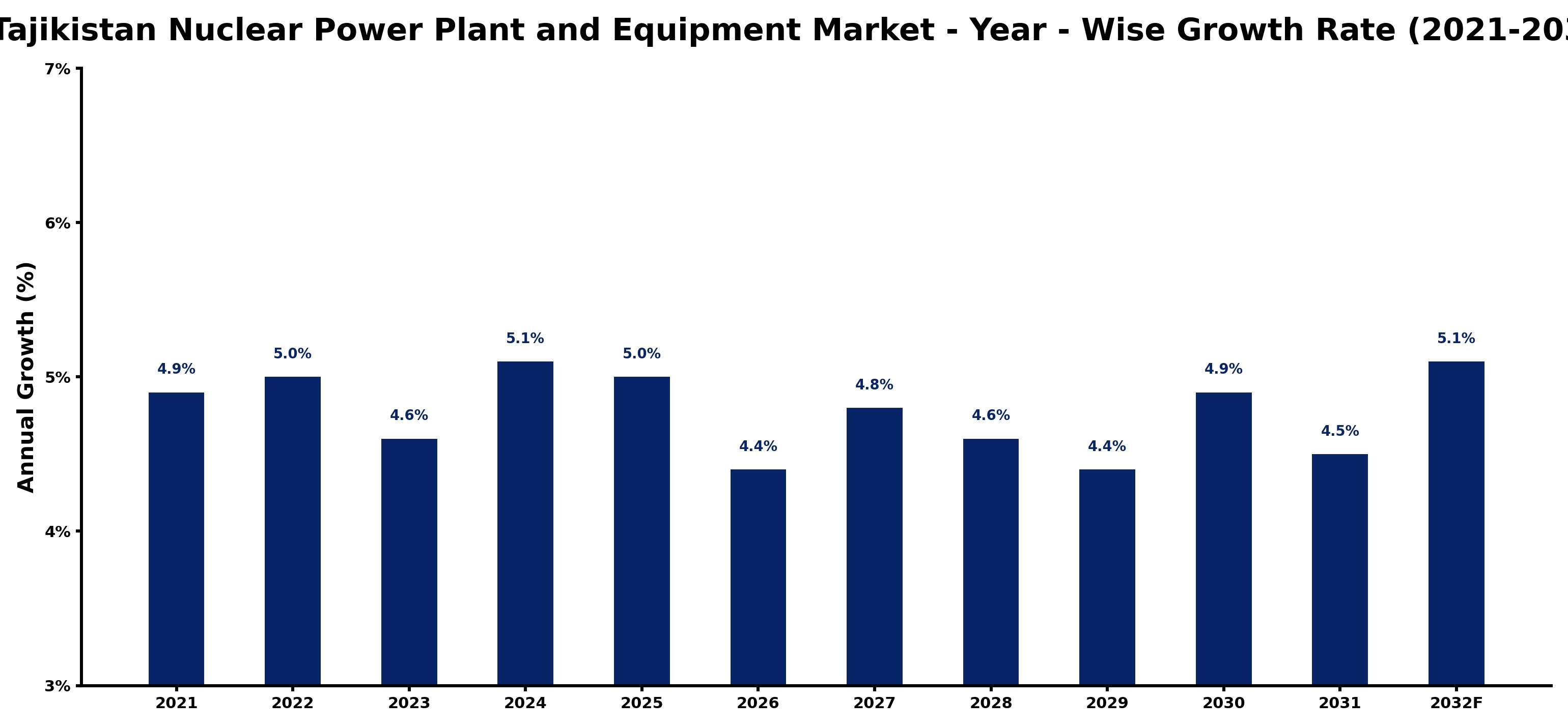
The table below presents the year‑wise growth rates along with the key drivers influencing the market
| Year | Growth Rate | Major Drivers |
| 2021 | 4.9% | Increased investment in infrastructure |
| 2022 | 5.0% | Government support for energy projects |
| 2023 | 4.6% | Rising energy demand from industry |
| 2024 | 5.1% | Technological advancements in nuclear |
| 2025 | 5.0% | International partnerships for development |
| 2026 | 4.4% | Growing focus on clean energy |
| 2027 | 4.8% | Enhanced regulatory frameworks established |
| 2028 | 4.6% | Public awareness of nuclear benefits |
| 2029 | 4.4% | Research initiatives promoting innovation |
| 2030 | 4.9% | Expansion of skilled workforce availability |
| 2031 | 4.5% | Regional cooperation on energy security |
| 2032 | 5.1% | Long-term energy planning initiatives |
Note - Market size estimations and growth projections presented in this report are based on 6Wresearch's advanced forecasting approach, validated with industry datasets as of June 2026.
Tajikistan Nuclear Power Plant and Equipment Market Synopsis
Tajikistan's energy landscape is characterized by significant dependence on hydroelectric power, which, while abundant, can be unpredictable. The government's exploration of nuclear energy signifies a strategic shift towards ensuring a more stable and diversified energy supply. As a result, discussions around potential sites for nuclear plant construction are becoming increasingly prominent.
The market is witnessing a surge in interest from international suppliers eager to collaborate on the necessary infrastructure. This influx is critical for building the local capacity needed to support the emerging nuclear energy sector, reflecting a global trend of increasing investments in advanced nuclear technologies.
Tajikistan Nuclear Power Plant and Equipment Market Key Takeaways
- The market is at a pivotal stage, driven by government initiatives to establish a nuclear power framework.
- Investment opportunities are growing as foreign entities recognize the potential in Tajikistan's energy diversification goals.
- The focus on adopting cutting-edge technologies is reshaping the landscape of nuclear energy delivery.
- Regional geopolitical dynamics are influencing partnerships and strategic planning in the nuclear sector.
- Challenges such as funding and safety remain pivotal in shaping the market's development trajectory.
Evaluation of Restraints in Tajikistan Nuclear Power Plant and Equipment Market
Several factors currently impede the rapid advancement of the Tajikistan Nuclear Power Plant and Equipment Market. Chief among these are financial constraints that limit the capacity for investment in necessary infrastructure, compounded by a lack of skilled professionals in the nuclear energy sector. Additionally, regulatory frameworks are still being established, which creates uncertainty around project timelines and investment returns. The mountainous geography and seismic activity pose unique challenges for the safe operation of nuclear facilities, necessitating rigorous safety protocols and engineering solutions. Addressing these restraints will be crucial for realizing the full potential of nuclear energy in Tajikistan.
Tajikistan Nuclear Power Plant and Equipment Market Trends
Current trends indicate a robust interest in modern nuclear technologies, particularly those focused on safety and efficiency. There is an increasing demand for equipment that adheres to international standards, ensuring compliance with safety regulations. Furthermore, the government is keen on engaging with global experts to adopt best practices in nuclear plant management, which is contributing to a burgeoning market for training and consultancy services.
Tajikistan Nuclear Power Plant and Equipment Market Opportunities
The potential for growth in the Tajikistan Nuclear Power Plant and Equipment Market is substantial, with several avenues for investment. Opportunities lie in the construction of new nuclear facilities, the modernization of existing infrastructure, and the procurement of advanced nuclear technologies. The government's push for international partnerships also opens doors for collaborative projects, offering investors the chance to influence the energy landscape while contributing to sustainable practices in the region.
Government Initiatives in the Tajikistan Nuclear Power Plant and Equipment Market
The Tajikistan government is actively promoting the development of nuclear energy as part of its long-term energy strategy, which includes legislative measures that prioritize safety and environmental sustainability. Engagement with international bodies for technology transfer and expertise sharing is underway, focusing on building a regulatory framework that meets global standards. These initiatives demonstrate the government's commitment to fostering a nuclear energy sector while ensuring public safety and environmental responsibility.
Future Insights of the Tajikistan Nuclear Power Plant and Equipment Market
Looking ahead to the 2026-2032 period, the Tajikistan Nuclear Power Plant and Equipment Market is expected to gain momentum as the government prioritizes energy security and diversification strategies. Increased collaboration with international stakeholders is likely to enhance knowledge transfer and technical capabilities, ultimately leading to the development of efficient and sustainable nuclear facilities. However, the successful navigation of financing and public acceptance will be crucial to realizing these future advancements.
Tajikistan Nuclear Power Plant and Equipment Market Latest Developments (May 2025 - June 2026)
Recent developments in the Tajikistan Nuclear Power Plant and Equipment Market indicate a growing momentum towards establishing a nuclear energy framework. The government is in discussions with international partners to explore feasibility studies for potential nuclear plant sites. Additionally, initiatives are being launched to train local personnel in nuclear technologies, ensuring that the country builds its domestic capacity alongside developing its nuclear infrastructure.
Tajikistan Nuclear Power Plant and Equipment Market - Key Attractiveness of the Report
- 10 Years of Market Numbers
- Historical Data Starting from 2022 to 2025
- Base Year: 2025
- Forecast Data until 2032
- Key Performance Indicators Impacting the Market
- Major Upcoming Developments and Projects
Key Highlights of the Report:
- Tajikistan Nuclear Power Plant and Equipment Market Outlook
- Market Size of Tajikistan Nuclear Power Plant and Equipment Market, 2025
- Forecast of Tajikistan Nuclear Power Plant and Equipment Market, 2032
- Historical Data and Forecast of Tajikistan Nuclear Power Plant and Equipment Revenues & Volume for the Period 2022-2032F
- Tajikistan Nuclear Power Plant and Equipment Market Trend Evolution
- Tajikistan Nuclear Power Plant and Equipment Market Drivers and Challenges
- Tajikistan Nuclear Power Plant and Equipment Price Trends
- Tajikistan Nuclear Power Plant and Equipment Porter's Five Forces
- Tajikistan Nuclear Power Plant and Equipment Industry Life Cycle
- Historical Data and Forecast of Tajikistan Nuclear Power Plant and Equipment Market Revenues & Volume By Reactor Type for the Period 2022-2032F
- Historical Data and Forecast of Tajikistan Nuclear Power Plant and Equipment Market Revenues & Volume By PWR for the Period 2022-2032F
- Historical Data and Forecast of Tajikistan Nuclear Power Plant and Equipment Market Revenues & Volume By PHWR for the Period 2022-2032F
- Historical Data and Forecast of Tajikistan Nuclear Power Plant and Equipment Market Revenues & Volume By Boiling water reactor for the Period 2022-2032F
- Historical Data and Forecast of Tajikistan Nuclear Power Plant and Equipment Market Revenues & Volume By High temperature gas cooled reactor for the Period 2022-2032F
- Historical Data and Forecast of Tajikistan Nuclear Power Plant and Equipment Market Revenues & Volume By Fast Breeder Reactor for the Period 2022-2032F
- Historical Data and Forecast of Tajikistan Nuclear Power Plant and Equipment Market Revenues & Volume By Others for the Period 2022-2032F
- Historical Data and Forecast of Tajikistan Nuclear Power Plant and Equipment Market Revenues & Volume By Equipment for the Period 2022-2032F
- Historical Data and Forecast of Tajikistan Nuclear Power Plant and Equipment Market Revenues & Volume By Island Equipment for the Period 2022-2032F
- Historical Data and Forecast of Tajikistan Nuclear Power Plant and Equipment Market Revenues & Volume By Auxiliary Equipment for the Period 2022-2032F
- Tajikistan Nuclear Power Plant and Equipment Import Export Trade Statistics
- Market Opportunity Assessment By Reactor Type
- Market Opportunity Assessment By Equipment
- Tajikistan Nuclear Power Plant and Equipment Top Companies Market Share
- Tajikistan Nuclear Power Plant and Equipment Competitive Benchmarking By Technical and Operational Parameters
- Tajikistan Nuclear Power Plant and Equipment Company Profiles
- Tajikistan Nuclear Power Plant and Equipment Key Strategic Recommendations






































