Singapore Nuclear Power Plant and Equipment Market Size, Share & Growth Rate
The Singapore Nuclear Power Plant and Equipment Market was estimated at USD 798 Million in 2025 and is projected to reach USD 1149 Million by 2032, growing at a CAGR of 5.3% from 2026 to 2032. This growth is primarily fueled by Singapore's strategic commitment to diversify its energy sources while prioritizing sustainability and environmental responsibility. As the nation seeks to enhance its energy security, the exploration of nuclear technologies stands at the forefront of discussions, reflecting a shift towards a more resilient energy framework.
Singapore Nuclear Power Plant and Equipment Market Growth Rate Analysis (2021-2032)
The Singapore Nuclear Power Plant and Equipment Market has exhibited steady growth, with a notable increase of 6.2% in 2021 followed by 6.4% in 2022. This upward trend, attributed to heightened investments in energy infrastructure and a pressing need for sustainability, reflects a growing consumer demand for cleaner energy solutions. Although growth slightly dipped to 6.1% in 2023, it rebounded to 6.3% in 2025 and projected 6.6% in 2026, driven by advancements in nuclear technology and supportive governmental policies aimed at energy transition. As the country continues to prioritize digitalization in energy management, trends indicate a stable growth rate around 6% through 2032, underscoring the market's resilience amid global energy shifts.
Singapore Nuclear Power Plant and Equipment Market Year-wise Growth Rate and Key Drivers
This graph highlights how the Singapore Nuclear Power Plant and Equipment Market has steadily grown over the past five years, supported by major growth factors.
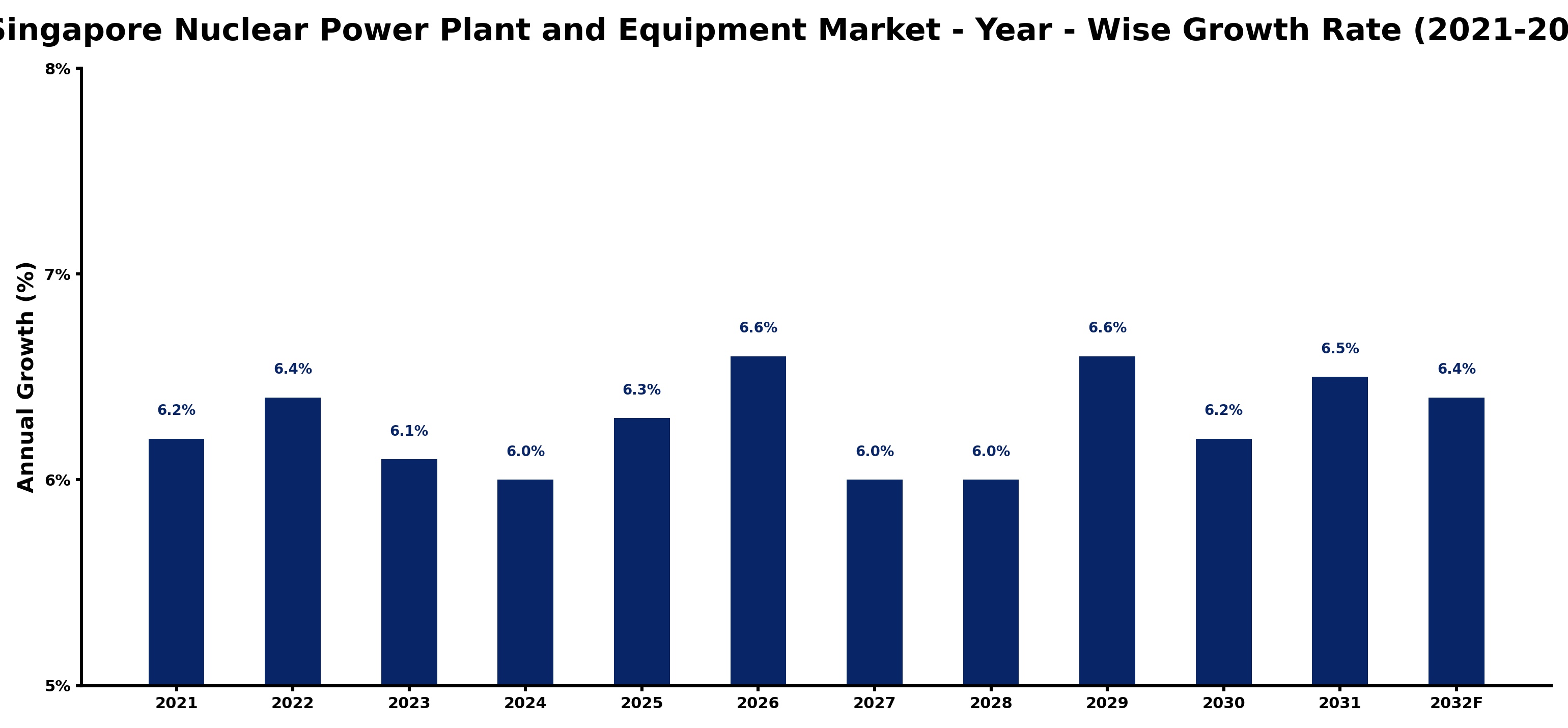
The table below presents the year‑wise growth rates along with the key drivers influencing the market
| Year | Growth Rate | Major Drivers |
| 2021 | 6.2% | Expansion of commercial construction activities |
| 2022 | 6.4% | Expansion of commercial construction activities |
| 2023 | 6.1% | Increasing industrial infrastructure investments |
| 2024 | 6.0% | Growing urbanization and commercial development |
| 2025 | 6.3% | Increasing adoption of advanced technologies |
| 2026 | 6.6% | Rapid growth in telecom and data center sectors |
| 2027 | 6.0% | Increasing industrial infrastructure investments |
| 2028 | 6.0% | Increasing industrial infrastructure investments |
| 2029 | 6.6% | Rapid growth in telecom and data center sectors |
| 2030 | 6.2% | Expansion of transportation and logistics networks |
| 2031 | 6.5% | Growing urbanization and commercial development |
| 2032 | 6.4% | Expansion of commercial construction activities |
Note - Market size estimations and growth projections presented in this report are based on 6Wresearch's advanced forecasting approach, validated with industry datasets as of June 2026.
Singapore Nuclear Power Plant and Equipment Market Synopsis
The most significant force shaping the Singapore Nuclear Power Plant and Equipment Market today is the government's pursuit of a diversified energy mix. While Singapore has yet to establish nuclear power plants, the interest in nuclear technologies for research and potential future applications is steadily growing, influencing market dynamics.
As Singapore navigates through environmental challenges and energy reliability issues, the allure of nuclear power as a clean energy alternative becomes more pronounced. This evolving landscape is characterized by increased international collaboration, stringent safety standards, and innovative research, shaping the foundation for future nuclear infrastructure.
Singapore Nuclear Power Plant and Equipment Market Key Takeaways
- The market is expected to grow significantly, reaching USD 1149 Million by 2032, driven by sustainable energy initiatives.
- Public and governmental interest in nuclear energy is rising, despite the absence of operational nuclear power plants in the country.
- International collaborations and advancements in nuclear technology are pivotal to Singapore's exploratory efforts in this sector.
- Regulatory frameworks and safety standards will continue to influence the market's development trajectory.
- Environmental concerns and the demand for reliable energy sources remain primary drivers for market evolution.
Evaluation of Restraints in Singapore Nuclear Power Plant and Equipment Market
Despite its potential, the Singapore Nuclear Power Plant and Equipment Market grapples with several constraints. The country's limited domestic energy landscape restricts demand for nuclear power equipment, creating a challenging environment for market expansion. Additionally, public apprehension about nuclear safety, bolstered by global incidents, hampers the push towards nuclear adoption. The intricate regulatory frameworks and substantial financial investments needed for nuclear projects further complicate the landscape, requiring careful navigation to foster growth.
Singapore Nuclear Power Plant and Equipment Market Trends
Current trends in the Singapore Nuclear Power Plant and Equipment Market showcase a growing inclination towards the integration of advanced technologies. Innovations in nuclear safety and sustainability are being emphasized as potential pathways for adoption. The drive towards environmental sustainability is leading to increased investments in research initiatives focused on nuclear applications, which could enhance the country's energy resilience. Furthermore, international partnerships are paving the way for knowledge transfer and technology sharing, accelerating market developments.
Singapore Nuclear Power Plant and Equipment Market Opportunities
Opportunities within the Singapore Nuclear Power Plant and Equipment Market predominantly lie in research and development partnerships. As the nation explores nuclear as a viable energy source, initiatives that focus on safety protocols, waste management, and technological advancements present avenues for investment and growth. Additionally, the proactive engagement of government bodies in facilitating discussions around nuclear energy could create a conducive environment for future infrastructure projects.
Government Initiatives in the Singapore Nuclear Power Plant and Equipment Market
The Singapore government is actively exploring various initiatives to enhance its energy landscape, which includes considerations for nuclear energy. Policies aimed at promoting renewable energy sources and reducing carbon emissions are being prioritized. Furthermore, public spending on research initiatives and educational programs centered around nuclear technology is becoming increasingly common, signifying a commitment to exploring its potential. These government efforts are crucial in shaping a progressive regulatory environment that could support future nuclear projects.
Future Insights of the Singapore Nuclear Power Plant and Equipment Market
Looking ahead to the 2026-2032 period, the Singapore Nuclear Power Plant and Equipment Market is expected to evolve significantly. The growing recognition of nuclear energy's role in achieving sustainability goals will likely drive increased interest and investment. As the regulatory landscape matures, and with the support of international collaborations, Singapore is poised to lay the groundwork for future nuclear infrastructure. The emphasis on safety and technological innovation will remain central, propelling the market into a new era of energy production.
Singapore Nuclear Power Plant and Equipment Market Latest Developments (May 2025 - June 2026)
Recent developments in the Singapore Nuclear Power Plant and Equipment Market indicate a continuing dialogue among stakeholders about nuclear energy's viability. As international energy strategies shift, Singapore is keeping a close watch on global advancements in nuclear technology and safety protocols. Increased research funding and collaborative projects signal a strategic alignment with global nuclear trends, fostering a conducive environment for future explorations in nuclear power.
Singapore Nuclear Power Plant and Equipment Market - Key Attractiveness of the Report
- 10 Years of Market Numbers
- Historical Data Starting from 2022 to 2025
- Base Year: 2025
- Forecast Data until 2032
- Key Performance Indicators Impacting the Market
- Major Upcoming Developments and Projects
Key Highlights of the Report:
- Singapore Nuclear Power Plant and Equipment Market Outlook
- Market Size of Singapore Nuclear Power Plant and Equipment Market, 2025
- Forecast of Singapore Nuclear Power Plant and Equipment Market, 2032F
- Historical Data and Forecast of Singapore Nuclear Power Plant and Equipment Revenues & Volume for the Period 2022-2032F
- Singapore Nuclear Power Plant and Equipment Market Trend Evolution
- Singapore Nuclear Power Plant and Equipment Market Drivers and Challenges
- Singapore Nuclear Power Plant and Equipment Price Trends
- Singapore Nuclear Power Plant and Equipment Porter's Five Forces
- Singapore Nuclear Power Plant and Equipment Industry Life Cycle
- Historical Data and Forecast of Singapore Nuclear Power Plant and Equipment Market Revenues & Volume By Reactor Type for the Period 2022-2032F
- Historical Data and Forecast of Singapore Nuclear Power Plant and Equipment Market Revenues & Volume By PWR for the Period 2022-2032F
- Historical Data and Forecast of Singapore Nuclear Power Plant and Equipment Market Revenues & Volume By PHWR for the Period 2022-2032F
- Historical Data and Forecast of Singapore Nuclear Power Plant and Equipment Market Revenues & Volume By Boiling water reactor for the Period 2022-2032F
- Historical Data and Forecast of Singapore Nuclear Power Plant and Equipment Market Revenues & Volume By High temperature gas cooled reactor for the Period 2022-2032F
- Historical Data and Forecast of Singapore Nuclear Power Plant and Equipment Market Revenues & Volume By Fast Breeder Reactor for the Period 2022-2032F
- Historical Data and Forecast of Singapore Nuclear Power Plant and Equipment Market Revenues & Volume By Others for the Period 2022-2032F
- Historical Data and Forecast of Singapore Nuclear Power Plant and Equipment Market Revenues & Volume By Equipment for the Period 2022-2032F
- Historical Data and Forecast of Singapore Nuclear Power Plant and Equipment Market Revenues & Volume By Island Equipment for the Period 2022-2032F
- Historical Data and Forecast of Singapore Nuclear Power Plant and Equipment Market Revenues & Volume By Auxiliary Equipment for the Period 2022-2032F
- Singapore Nuclear Power Plant and Equipment Import Export Trade Statistics
- Market Opportunity Assessment By Reactor Type
- Market Opportunity Assessment By Equipment
- Singapore Nuclear Power Plant and Equipment Top Companies Market Share
- Singapore Nuclear Power Plant and Equipment Competitive Benchmarking By Technical and Operational Parameters
- Singapore Nuclear Power Plant and Equipment Company Profiles
- Singapore Nuclear Power Plant and Equipment Key Strategic Recommendations






































