Kazakhstan Nuclear Power Plant and Equipment Market Size, Share & Growth Rate
The Kazakhstan Nuclear Power Plant and Equipment Market was estimated at USD 327 Million in 2025 and is projected to reach USD 461 Million by 2032, growing at a CAGR of 5.0% from 2026 to 2032. This robust growth trajectory is driven by the government's strategic push to diversify the energy portfolio and significantly reduce reliance on fossil fuels. Moreover, technological advancements and international collaborations further catalyze the market, opening doors for modern equipment and infrastructure development.
Kazakhstan Nuclear Power Plant and Equipment Market Year-wise Growth Rate and Key Drivers
This graph highlights how the Kazakhstan Nuclear Power Plant and Equipment Market has steadily grown over the years, supported by major growth factors.
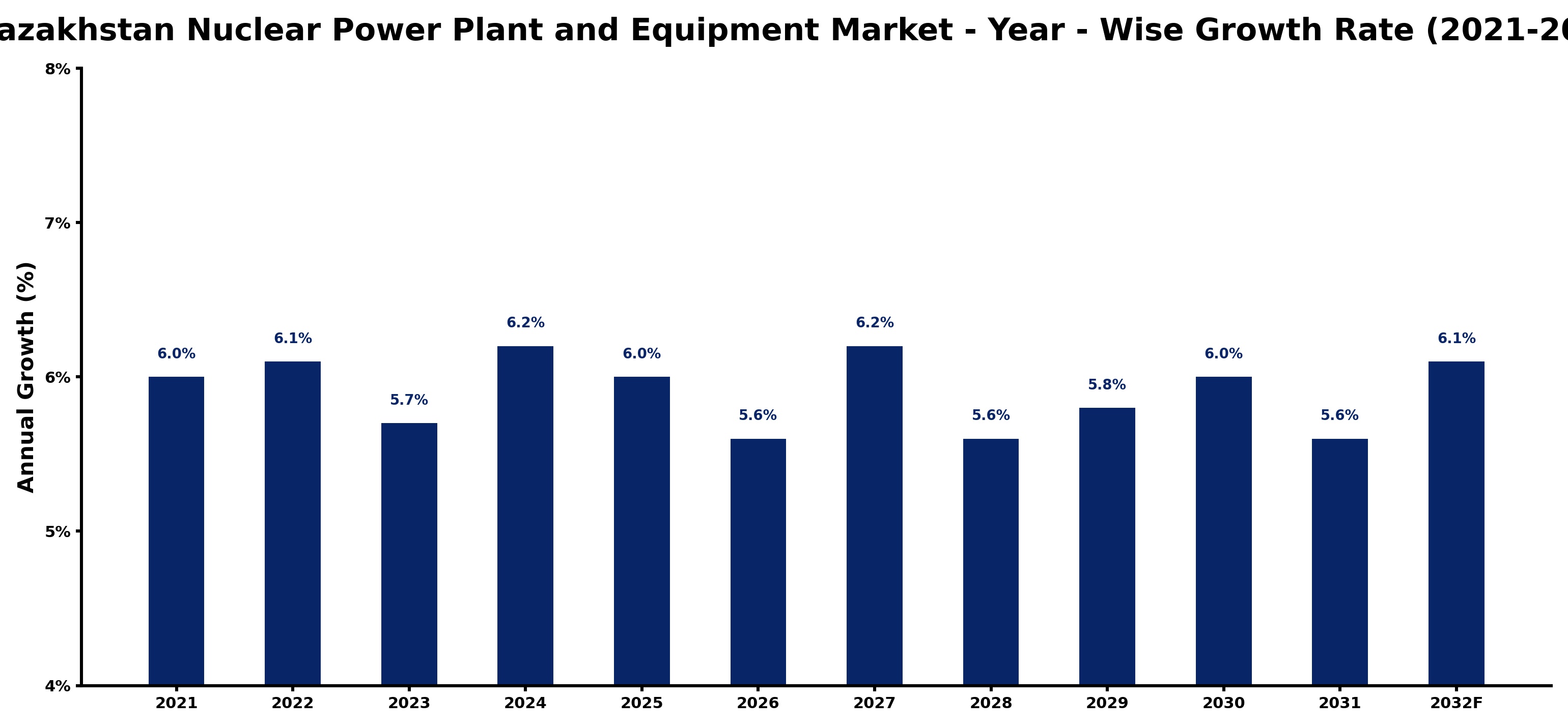
The table below presents the year‑wise growth rates along with the key drivers influencing the market
| Year | Growth Rate | Major Drivers |
| 2021 | 6.0% | Increased energy demand drives investment |
| 2022 | 6.1% | New nuclear projects initiated nationwide |
| 2023 | 5.7% | Technological advancements enhance efficiency |
| 2024 | 6.2% | Government incentives promote nuclear energy |
| 2025 | 6.0% | Public awareness of nuclear benefits |
| 2026 | 5.6% | International partnerships expand capabilities |
| 2027 | 6.2% | Research funding boosts innovation efforts |
| 2028 | 5.6% | Regulatory support encourages market growth |
| 2029 | 5.8% | Sustainability initiatives drive nuclear adoption |
| 2030 | 6.0% | Infrastructure upgrades enhance operational capacity |
| 2031 | 5.6% | Skilled workforce development strengthens industry |
| 2032 | 6.1% | Industrial activity supported growth |
Note - Market size estimations and growth projections presented in this report are based on 6Wresearch's advanced forecasting approach, validated with industry datasets as of June 2026.
Kazakhstan Nuclear Power Plant and Equipment Market Synopsis
Kazakhstan's commitment to nuclear energy is becoming increasingly evident as it seeks to balance its energy mix and meet rising electricity demands. With significant investments in nuclear infrastructure on the horizon, the market is poised for dynamic growth, attracting both domestic and international stakeholders.
In recent years, the government has prioritized nuclear energy, recognizing its potential to provide a reliable and clean power source. This shift is coupled with the necessity to comply with international safety standards, further solidifying the market's potential.
Kazakhstan Nuclear Power Plant and Equipment Market Key Takeaways
- The market is projected to experience steady growth, driven by government initiatives aimed at expanding nuclear energy capacity.
- Increased investments are expected in modern nuclear technology and safety systems, responding to the demand for enhanced operational efficiency.
- Strategic international partnerships are paving the way for advanced equipment supply and knowledge transfer.
- Regulatory frameworks are evolving to facilitate the growth and sustainability of the nuclear energy sector.
- There is a growing emphasis on clean energy solutions, positioning nuclear power as a crucial component of Kazakhstan's energy strategy.
Evaluation of Restraints in Kazakhstan Nuclear Power Plant and Equipment Market
The market faces several restraints that may impact growth trajectories. Chief among these are the regulatory hurdles that can delay project timelines, as well as political uncertainties that affect investor confidence. The evolving regulatory environment, influenced by geopolitical factors and international norms, adds complexity to project execution. Furthermore, securing adequate financing for large-scale nuclear projects remains a challenge, requiring long-term commitments from stakeholders. Compliance with rigorous safety and environmental standards also poses additional demands on suppliers and project developers, impacting the overall market dynamics.
Kazakhstan Nuclear Power Plant and Equipment Market Trends
Several trends are emerging in the Kazakhstan Nuclear Power Plant and Equipment Market, reflecting the shift towards sustainable energy solutions. A notable increase in demand for advanced nuclear technology is seen, with a focus on enhancing efficiency and safety. Moreover, international collaborations are becoming commonplace, facilitating the transfer of knowledge and technology required to modernize existing facilities and build new power plants. The integration of digital technologies into nuclear operations is also gaining traction, aiming to improve monitoring and operational management.
Kazakhstan Nuclear Power Plant and Equipment Market Opportunities
The Kazakhstan Nuclear Power Plant and Equipment Market presents significant investment opportunities as the nation prioritizes nuclear energy. Potential areas for investment include the supply of sophisticated equipment and advanced technology tailored for nuclear power generation. Investors can also explore opportunities in the construction and operational support of new plants as the country ramps up its nuclear capacity. Engaging in joint ventures with local entities can further enhance market entry and expansion prospects, capitalizing on the increasing governmental emphasis on nuclear power.
Government Initiatives in the Kazakhstan Nuclear Power Plant and Equipment Market
The government of Kazakhstan is actively fostering the development of the nuclear power sector through strategic policies and initiatives. This includes regulatory oversight from the Atomic Energy Committee, which is responsible for ensuring safety compliance and international standards adherence. Furthermore, partnerships with nations possessing advanced nuclear technology are being established to bolster local capabilities and infrastructure. The government is implementing a comprehensive nuclear power development program aimed at increasing capacity and ensuring a stable energy future.
Future Insights of the Kazakhstan Nuclear Power Plant and Equipment Market
Looking ahead to 2026-2032, the Kazakhstan Nuclear Power Plant and Equipment Market is expected to thrive as the government reinforces its commitment to nuclear energy. Anticipated enhancements in regulatory frameworks and increased public awareness about the benefits of nuclear power will play critical roles in market expansion. With a proactive approach to clean energy, Kazakhstan stands to leverage its geographical advantages and strategic alliances to position itself as a leader in the nuclear sector, aligning with global energy transitions.
Kazakhstan Nuclear Power Plant and Equipment Market Latest Developments (May 2025 - June 2026)
Recent developments in the Kazakhstan Nuclear Power Plant and Equipment Market indicate a positive momentum towards strengthening the nuclear infrastructure. There has been an uptick in government-backed initiatives aimed at accelerating project timelines, alongside increased dialogue with international partners for technology sharing. Enhanced public relations efforts are underway to build a favorable perception of nuclear energy, ensuring community support for upcoming projects.
Kazakhstan Nuclear Power Plant and Equipment Market - Key Attractiveness of the Report
- 10 Years of Market Numbers
- Historical Data Starting from 2022 to 2025
- Base Year: 2025
- Forecast Data until 2032
- Key Performance Indicators Impacting the Market
- Major Upcoming Developments and Projects
Key Highlights of the Report:
- Kazakhstan Nuclear Power Plant and Equipment Market Outlook
- Market Size of Kazakhstan Nuclear Power Plant and Equipment Market, 2025
- Forecast of Kazakhstan Nuclear Power Plant and Equipment Market, 2032
- Historical Data and Forecast of Kazakhstan Nuclear Power Plant and Equipment Revenues & Volume for the Period 2022-2032F
- Kazakhstan Nuclear Power Plant and Equipment Market Trend Evolution
- Kazakhstan Nuclear Power Plant and Equipment Market Drivers and Challenges
- Kazakhstan Nuclear Power Plant and Equipment Price Trends
- Kazakhstan Nuclear Power Plant and Equipment Porter's Five Forces
- Kazakhstan Nuclear Power Plant and Equipment Industry Life Cycle
- Historical Data and Forecast of Kazakhstan Nuclear Power Plant and Equipment Market Revenues & Volume By Reactor Type for the Period 2022-2032F
- Historical Data and Forecast of Kazakhstan Nuclear Power Plant and Equipment Market Revenues & Volume By PWR for the Period 2022-2032F
- Historical Data and Forecast of Kazakhstan Nuclear Power Plant and Equipment Market Revenues & Volume By PHWR for the Period 2022-2032F
- Historical Data and Forecast of Kazakhstan Nuclear Power Plant and Equipment Market Revenues & Volume By Boiling water reactor for the Period 2022-2032F
- Historical Data and Forecast of Kazakhstan Nuclear Power Plant and Equipment Market Revenues & Volume By High temperature gas cooled reactor for the Period 2022-2032F
- Historical Data and Forecast of Kazakhstan Nuclear Power Plant and Equipment Market Revenues & Volume By Fast Breeder Reactor for the Period 2022-2032F
- Historical Data and Forecast of Kazakhstan Nuclear Power Plant and Equipment Market Revenues & Volume By Others for the Period 2022-2032F
- Historical Data and Forecast of Kazakhstan Nuclear Power Plant and Equipment Market Revenues & Volume By Equipment for the Period 2022-2032F
- Historical Data and Forecast of Kazakhstan Nuclear Power Plant and Equipment Market Revenues & Volume By Island Equipment for the Period 2022-2032F
- Historical Data and Forecast of Kazakhstan Nuclear Power Plant and Equipment Market Revenues & Volume By Auxiliary Equipment for the Period 2022-2032F
- Kazakhstan Nuclear Power Plant and Equipment Import Export Trade Statistics
- Market Opportunity Assessment By Reactor Type
- Market Opportunity Assessment By Equipment
- Kazakhstan Nuclear Power Plant and Equipment Top Companies Market Share
- Kazakhstan Nuclear Power Plant and Equipment Competitive Benchmarking By Technical and Operational Parameters
- Kazakhstan Nuclear Power Plant and Equipment Company Profiles
- Kazakhstan Nuclear Power Plant and Equipment Key Strategic Recommendations






































