Thailand Nuclear Power Plant and Equipment Market Size, Share & Growth Rate
The Thailand Nuclear Power Plant and Equipment Market was estimated at USD 192 Million in 2025 and is projected to reach USD 220 Million by 2032, growing at a CAGR of 2.0% from 2026 to 2032. This growth trajectory is largely driven by Thailand's urgent need to diversify its energy portfolio amid rising electricity demands. With urbanization and industrial expansion accelerating, the government's strategic embrace of nuclear energy as a sustainable option positions the sector for significant advancements over the forecast period.
Thailand Nuclear Power Plant and Equipment Market Growth Rate Analysis (2021-2032)
The Thailand Nuclear Power Plant and Equipment Market has seen a gradual recovery following -3.4% growth in 2021, driven by renewed investments and a strategic push towards energy diversification. This growth picked up to 2.6% in 2022 and continued to improve, reaching 3.4% in 2023, fueled by government policies supporting nuclear energy as a viable alternative to fossil fuels. As Thailand aims to enhance energy security and reduce carbon emissions, the market is expected to maintain a steady upward trend, with growth rates projected at 3.1% in 2024 and 3.3% in 2030. Despite minor fluctuations, ongoing digitalization and a growing consumer demand for sustainable energy sources are bolstering long-term prospects.
Thailand Nuclear Power Plant and Equipment Market Year-wise Growth Rate and Key Drivers
This graph highlights how the Thailand Nuclear Power Plant and Equipment Market has steadily grown over the past five years, supported by major growth factors.
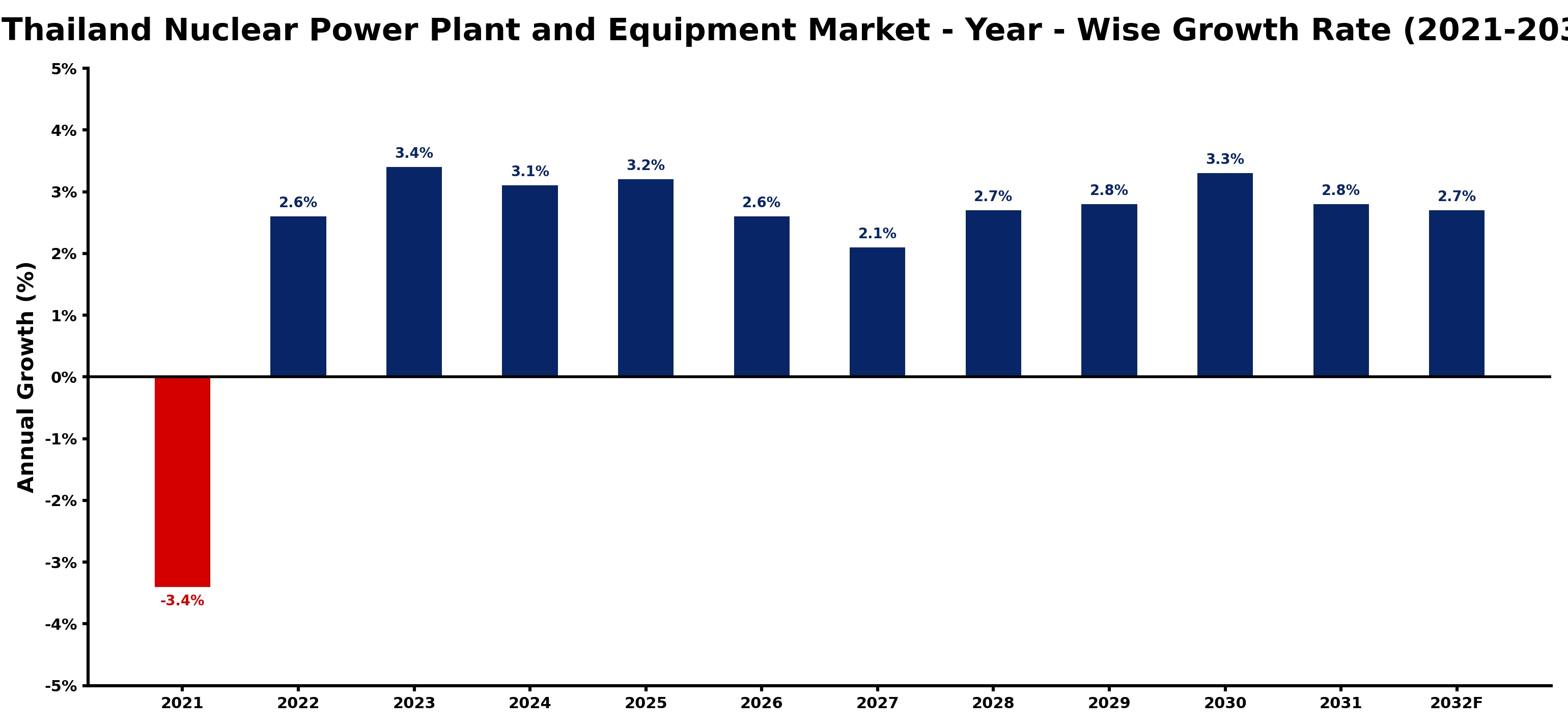
The table below presents the year‑wise growth rates along with the key drivers influencing the market
| Year | Growth Rate | Major Drivers |
| 2021 | -3.4% | Increasing smart city development projects |
| 2022 | 2.6% | Expansion of manufacturing activities |
| 2023 | 3.4% | Growing renewable energy integration projects |
| 2024 | 3.1% | Increasing industrial infrastructure investments |
| 2025 | 3.2% | Increasing smart city development projects |
| 2026 | 2.6% | Government infrastructure modernization initiatives |
| 2027 | 2.1% | Government infrastructure modernization initiatives |
| 2028 | 2.7% | Expansion of manufacturing activities |
| 2029 | 2.8% | Increasing industrial infrastructure investments |
| 2030 | 3.3% | Expansion of transportation and logistics networks |
| 2031 | 2.8% | Increasing industrial automation investments |
| 2032 | 2.7% | Increasing industrial automation investments |
Note - Market size estimations and growth projections presented in this report are based on 6Wresearch's advanced forecasting approach, validated with industry datasets as of June 2026.
Thailand Nuclear Power Plant and Equipment Market Synopsis
As Thailand aims to meet increasing electricity demands, the nuclear power sector is emerging as a pivotal component of the nation's energy strategy. Notably, the government has outlined a comprehensive Power Development Plan that emphasizes the role of nuclear energy in achieving energy security and environmental sustainability.
The market is shaped by substantial governmental initiatives focused on enhancing energy infrastructure and reducing greenhouse gas emissions. By prioritizing nuclear power, Thailand seeks to leverage cost-effective solutions and uphold its commitments to international environmental standards, reinforcing the growing acceptance of nuclear energy.
Thailand Nuclear Power Plant and Equipment Market Key Takeaways
- Projected growth driven by increasing electricity demand and urbanization.
- Government initiatives promote nuclear energy as a sustainable alternative.
- Focus on safety advancements enhances public confidence in nuclear technology.
- Challenges such as public perception of nuclear safety require strategic management.
- Significant international partnerships are poised to bolster technological capabilities.
Evaluation of Restraints in Thailand Nuclear Power Plant and Equipment Market
Despite the promising growth prospects, the Thailand Nuclear Power Plant and Equipment Market faces significant restraints primarily stemming from public perception of nuclear safety. Community concerns about potential accidents and waste management often lead to resistance against new nuclear projects. The delicate balance between regulatory compliance and public acceptance is essential for the sector's development. Thus, it is crucial for stakeholders to implement transparent communication strategies and robust safety protocols to alleviate fears and ensure community trust.
Thailand Nuclear Power Plant and Equipment Market Trends
Current trends indicate a shift towards advanced nuclear technologies that enhance safety and efficiency, reflecting global innovations in the sector. Thailand's focus on small modular reactors (SMRs) may open new avenues for power generation, aligning with the need for less intrusive, safer energy solutions. Moreover, the integration of digital technologies for monitoring and maintenance is gaining traction, promising improvements in operational efficiency.
Thailand Nuclear Power Plant and Equipment Market Opportunities
Emerging opportunities within the Thailand Nuclear Power Plant and Equipment Market primarily revolve around investments in technology modernization and infrastructure development. The government's commitment to increasing the share of nuclear energy in the energy mix presents substantial openings for collaboration with international partners in technology transfer and expertise. Furthermore, the continued emphasis on sustainability may fuel investments in advanced waste management solutions, ensuring the long-term viability of nuclear power.
Government Initiatives in the Thailand Nuclear Power Plant and Equipment Market
The Thai government is actively pursuing initiatives designed to bolster its nuclear power capabilities. These initiatives include strategic investment in research and development, regulatory frameworks to streamline the approval process for new projects, and collaborations with international nuclear agencies. Public spending is directed towards enhancing the existing energy infrastructure and ensuring compliance with stringent safety standards, demonstrating a proactive approach to integrating nuclear energy into the national energy landscape.
Future Insights of the Thailand Nuclear Power Plant and Equipment Market
Looking ahead to the 2026-2032 period, the Thailand Nuclear Power Plant and Equipment Market is expected to witness notable advancements driven by technological innovations and a supportive policy environment. The government's commitment to expanding nuclear energy's role in the energy mix will likely enhance the stability and reliability of power supply. Furthermore, ongoing public engagement and education efforts aimed at addressing safety concerns will be critical to fostering community acceptance and support for future projects.
Thailand Nuclear Power Plant and Equipment Market Latest Developments (May 2025 - June 2026)
The industry has observed a shift towards enhancing safety protocols and the integration of modern technology within existing nuclear infrastructure. Recent announcements signal increased government focus on innovative energy solutions, promoting collaborations with global technology leaders to ensure the adoption of state-of-the-art practices. Additionally, community engagement strategies are being refined to address public concerns, thus fostering a more favorable perception of nuclear power within the nation.
Thailand Nuclear Power Plant and Equipment Market - Key Attractiveness of the Report
- 10 Years of Market Numbers
- Historical Data Starting from 2022 to 2025
- Base Year: 2025
- Forecast Data until 2032
- Key Performance Indicators Impacting the Market
- Major Upcoming Developments and Projects
Key Highlights of the Report:
- Thailand Nuclear Power Plant and Equipment Market Outlook
- Market Size of Thailand Nuclear Power Plant and Equipment Market, 2025
- Forecast of Thailand Nuclear Power Plant and Equipment Market, 2032F
- Historical Data and Forecast of Thailand Nuclear Power Plant and Equipment Revenues & Volume for the Period 2022-2032F
- Thailand Nuclear Power Plant and Equipment Market Trend Evolution
- Thailand Nuclear Power Plant and Equipment Market Drivers and Challenges
- Thailand Nuclear Power Plant and Equipment Price Trends
- Thailand Nuclear Power Plant and Equipment Porter's Five Forces
- Thailand Nuclear Power Plant and Equipment Industry Life Cycle
- Historical Data and Forecast of Thailand Nuclear Power Plant and Equipment Market Revenues & Volume By Reactor Type for the Period 2022-2032F
- Historical Data and Forecast of Thailand Nuclear Power Plant and Equipment Market Revenues & Volume By PWR for the Period 2022-2032F
- Historical Data and Forecast of Thailand Nuclear Power Plant and Equipment Market Revenues & Volume By PHWR for the Period 2022-2032F
- Historical Data and Forecast of Thailand Nuclear Power Plant and Equipment Market Revenues & Volume By Boiling water reactor for the Period 2022-2032F
- Historical Data and Forecast of Thailand Nuclear Power Plant and Equipment Market Revenues & Volume By High temperature gas cooled reactor for the Period 2022-2032F
- Historical Data and Forecast of Thailand Nuclear Power Plant and Equipment Market Revenues & Volume By Fast Breeder Reactor for the Period 2022-2032F
- Historical Data and Forecast of Thailand Nuclear Power Plant and Equipment Market Revenues & Volume By Others for the Period 2022-2032F
- Historical Data and Forecast of Thailand Nuclear Power Plant and Equipment Market Revenues & Volume By Equipment for the Period 2022-2032F
- Historical Data and Forecast of Thailand Nuclear Power Plant and Equipment Market Revenues & Volume By Island Equipment for the Period 2022-2032F
- Historical Data and Forecast of Thailand Nuclear Power Plant and Equipment Market Revenues & Volume By Auxiliary Equipment for the Period 2022-2032F
- Thailand Nuclear Power Plant and Equipment Import Export Trade Statistics
- Market Opportunity Assessment By Reactor Type
- Market Opportunity Assessment By Equipment
- Thailand Nuclear Power Plant and Equipment Top Companies Market Share
- Thailand Nuclear Power Plant and Equipment Competitive Benchmarking By Technical and Operational Parameters
- Thailand Nuclear Power Plant and Equipment Company Profiles
- Thailand Nuclear Power Plant and Equipment Key Strategic Recommendations






































