Ghana Nuclear Power Plant and Equipment Market Size, Share & Growth Rate
The Ghana Nuclear Power Plant and Equipment Market was estimated at USD 450 Million in 2025 and is projected to reach USD 597 Million by 2032, growing at a CAGR of 4.1% from 2026 to 2032. This growth trajectory is primarily fueled by Ghana's increasing electricity demand, which necessitates a transition towards more sustainable and reliable energy sources. As the government actively seeks to diversify its energy portfolio, investments in nuclear technology are becoming increasingly critical to meeting the nation's long-term energy goals.
Ghana Nuclear Power Plant and Equipment Market Year-wise Growth Rate and Key Drivers
This graph highlights how the Ghana Nuclear Power Plant and Equipment Market has steadily grown over the years, supported by major growth factors.
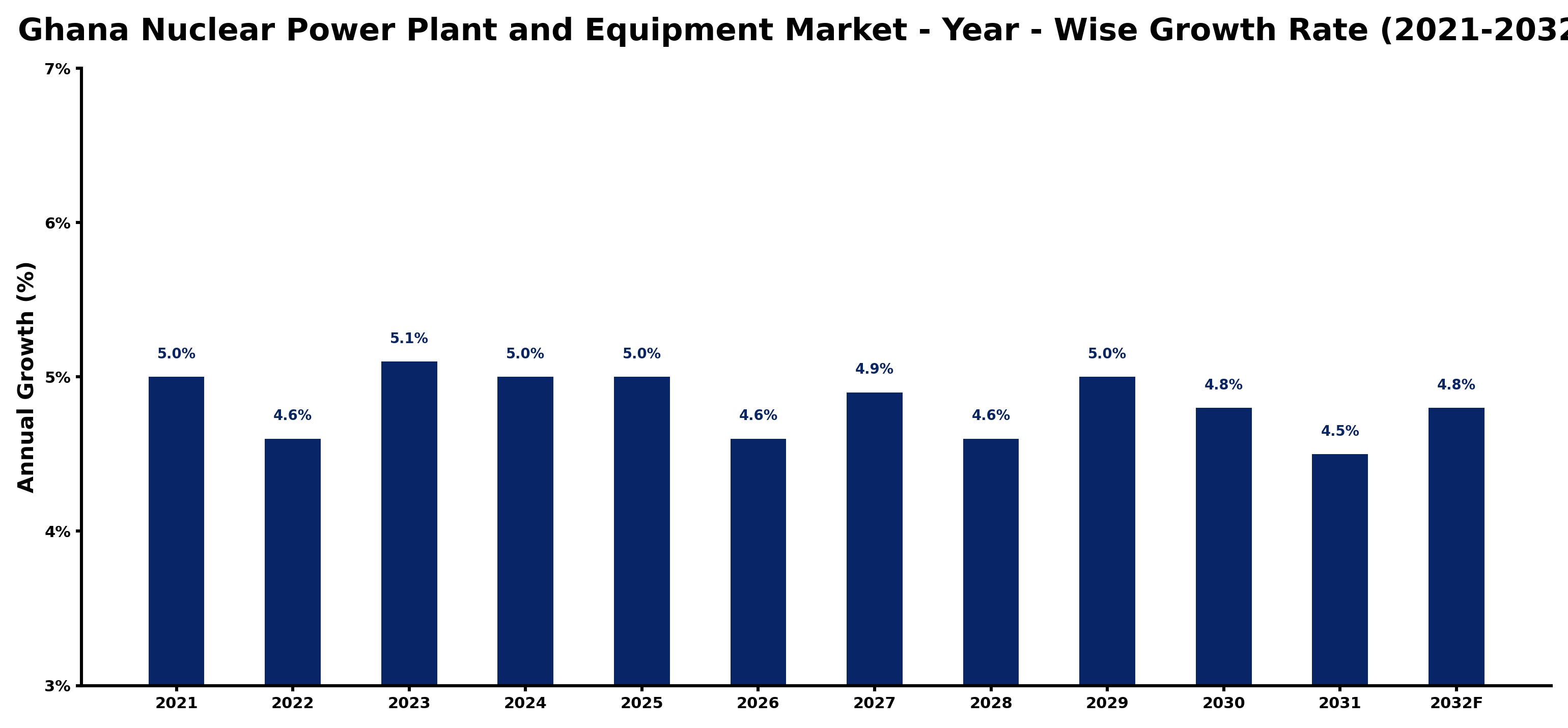
The table below presents the year‑wise growth rates along with the key drivers influencing the market
| Year | Growth Rate | Major Drivers |
| 2021 | 5.0% | Government investment in infrastructure |
| 2022 | 4.6% | Increased public awareness initiatives |
| 2023 | 5.1% | International partnerships enhanced technology |
| 2024 | 5.0% | Regulatory support for nuclear projects |
| 2025 | 5.0% | Rising energy demand drives investment |
| 2026 | 4.6% | Local workforce training programs expanded |
| 2027 | 4.9% | Research and development funding increased |
| 2028 | 4.6% | Sustainability initiatives gained traction |
| 2029 | 5.0% | Public-private partnerships foster growth |
| 2030 | 4.8% | Technological advancements improved efficiency |
| 2031 | 4.5% | Energy diversification strategies implemented |
| 2032 | 4.8% | Community engagement programs strengthened support |
Note - Market size estimations and growth projections presented in this report are based on 6Wresearch's advanced forecasting approach, validated with industry datasets as of June 2026.
Ghana Nuclear Power Plant and Equipment Market Synopsis
The most significant force shaping the Ghana Nuclear Power Plant and Equipment Market is the government's strategic focus on nuclear energy as a sustainable solution to the energy crisis. This initiative is aimed not only at meeting current power demands but also at ensuring energy security and economic growth over the coming decades.
Moreover, public and private sector collaboration is fostering an environment ripe for investment in nuclear infrastructure and technology. This partnership model is crucial for overcoming the existing challenges and ensuring that nuclear energy is perceived as a viable, safe, and efficient energy source for Ghana.
Ghana Nuclear Power Plant and Equipment Market Key Takeaways
- The Ghanaian government is committed to establishing a nuclear power plant by 2030.
- Investment opportunities are emerging in equipment supply, construction, and training services.
- Safety and public perception are pivotal issues requiring strategic communication and education.
- International collaboration is essential to facilitate technology transfer and expertise.
- The market is anticipated to grow steadily due to increasing energy demands and government policies.
Evaluation of Restraints in Ghana Nuclear Power Plant and Equipment Market
Despite the promising outlook, several critical restraints hinder the market's full potential. Regulatory challenges remain a significant concern, as the development of comprehensive legal frameworks and safety protocols can delay project initiation. Public apprehension about nuclear safety adds another layer of complexity, often requiring extensive outreach and education initiatives to mitigate fears and promote understanding of nuclear energy's benefits. Furthermore, securing financial backing for high-cost nuclear projects poses a significant barrier, which necessitates innovative funding solutions and partnerships.
Ghana Nuclear Power Plant and Equipment Market Trends
Current trends highlight a growing interest in advanced nuclear technologies that enhance safety and efficiency. Innovations in small modular reactors (SMRs) are particularly gaining traction, as they offer a potentially more manageable and flexible approach to nuclear power generation. Additionally, there is an increasing emphasis on sustainability, encouraging investments in technologies that minimize environmental impacts and ensure compliance with international standards.
Ghana Nuclear Power Plant and Equipment Market Opportunities
Opportunities for investment abound in the Ghana Nuclear Power Plant and Equipment Market. Key areas include the supply and maintenance of advanced nuclear equipment, engineering services for new construction, and consulting services that facilitate knowledge transfer and strategic planning. Furthermore, as the demand for skilled professionals in the sector grows, there is a pressing need for training and development programs tailored to local talent, presenting yet another avenue for investment.
Government Initiatives in the Ghana Nuclear Power Plant and Equipment Market
The Ghanaian government is proactively positioning nuclear energy as a cornerstone of its energy diversification strategy. Policies have been enacted to govern the development, operation, and safety of nuclear facilities, including the establishment of the Nuclear Regulatory Authority. Additionally, international agreements have been signed to ensure cooperation and compliance with global standards, further supporting the safe development of the nuclear sector.
Future Insights of the Ghana Nuclear Power Plant and Equipment Market
Looking ahead to 2026-2032, the Ghana Nuclear Power Plant and Equipment Market is expected to flourish as the government remains steadfast in its commitment to expanding the energy mix. The increasing demand for electricity, coupled with the global transition towards sustainable energy sources, will drive the development of nuclear infrastructure. As public acceptance grows and financing challenges are addressed, the market will likely experience significant advancements, paving the way for a robust nuclear energy sector.
Ghana Nuclear Power Plant and Equipment Market Latest Developments (May 2025 - June 2026)
Recent developments indicate a heightened engagement between the Ghanaian government and international stakeholders to accelerate the nuclear power initiative. Efforts are underway to refine safety regulations and foster community engagement, addressing public concerns about nuclear energy. Furthermore, discussions are taking place around establishing partnerships for technology transfer and the promotion of nuclear education programs to build local expertise in the sector.
Ghana Nuclear Power Plant and Equipment Market - Key Attractiveness of the Report
- 10 Years of Market Numbers
- Historical Data Starting from 2022 to 2025
- Base Year: 2025
- Forecast Data until 2032
- Key Performance Indicators Impacting the Market
- Major Upcoming Developments and Projects
Key Highlights of the Report:
- Ghana Nuclear Power Plant and Equipment Market Outlook
- Market Size of Ghana Nuclear Power Plant and Equipment Market, 2025
- Forecast of Ghana Nuclear Power Plant and Equipment Market, 2032
- Historical Data and Forecast of Ghana Nuclear Power Plant and Equipment Revenues & Volume for the Period 2022-2032F
- Ghana Nuclear Power Plant and Equipment Market Trend Evolution
- Ghana Nuclear Power Plant and Equipment Market Drivers and Challenges
- Ghana Nuclear Power Plant and Equipment Price Trends
- Ghana Nuclear Power Plant and Equipment Porter's Five Forces
- Ghana Nuclear Power Plant and Equipment Industry Life Cycle
- Historical Data and Forecast of Ghana Nuclear Power Plant and Equipment Market Revenues & Volume By Reactor Type for the Period 2022-2032F
- Historical Data and Forecast of Ghana Nuclear Power Plant and Equipment Market Revenues & Volume By PWR for the Period 2022-2032F
- Historical Data and Forecast of Ghana Nuclear Power Plant and Equipment Market Revenues & Volume By PHWR for the Period 2022-2032F
- Historical Data and Forecast of Ghana Nuclear Power Plant and Equipment Market Revenues & Volume By Boiling water reactor for the Period 2022-2032F
- Historical Data and Forecast of Ghana Nuclear Power Plant and Equipment Market Revenues & Volume By High temperature gas cooled reactor for the Period 2022-2032F
- Historical Data and Forecast of Ghana Nuclear Power Plant and Equipment Market Revenues & Volume By Fast Breeder Reactor for the Period 2022-2032F
- Historical Data and Forecast of Ghana Nuclear Power Plant and Equipment Market Revenues & Volume By Others for the Period 2022-2032F
- Historical Data and Forecast of Ghana Nuclear Power Plant and Equipment Market Revenues & Volume By Equipment for the Period 2022-2032F
- Historical Data and Forecast of Ghana Nuclear Power Plant and Equipment Market Revenues & Volume By Island Equipment for the Period 2022-2032F
- Historical Data and Forecast of Ghana Nuclear Power Plant and Equipment Market Revenues & Volume By Auxiliary Equipment for the Period 2022-2032F
- Ghana Nuclear Power Plant and Equipment Import Export Trade Statistics
- Market Opportunity Assessment By Reactor Type
- Market Opportunity Assessment By Equipment
- Ghana Nuclear Power Plant and Equipment Top Companies Market Share
- Ghana Nuclear Power Plant and Equipment Competitive Benchmarking By Technical and Operational Parameters
- Ghana Nuclear Power Plant and Equipment Company Profiles
- Ghana Nuclear Power Plant and Equipment Key Strategic Recommendations






































