Russia Nuclear Power Plant and Equipment Market Size, Share & Growth Rate
The Russia Nuclear Power Plant and Equipment Market was estimated at USD 92 Million in 2025 and is projected to reach USD 100 Million by 2032, growing at a CAGR of 1.2% from 2026 to 2032. This growth trajectory is propelled by the nation's commitment to expanding its nuclear power capacity in response to escalating energy demands and the imperative to reduce reliance on fossil fuels. Additionally, modernization efforts and advancements in nuclear technology are further stimulating demand within the sector.
Russia Nuclear Power Plant and Equipment Market Year-wise Growth Rate and Key Drivers
This graph highlights how the Russia Nuclear Power Plant and Equipment Market has steadily grown over the years, supported by major growth factors.
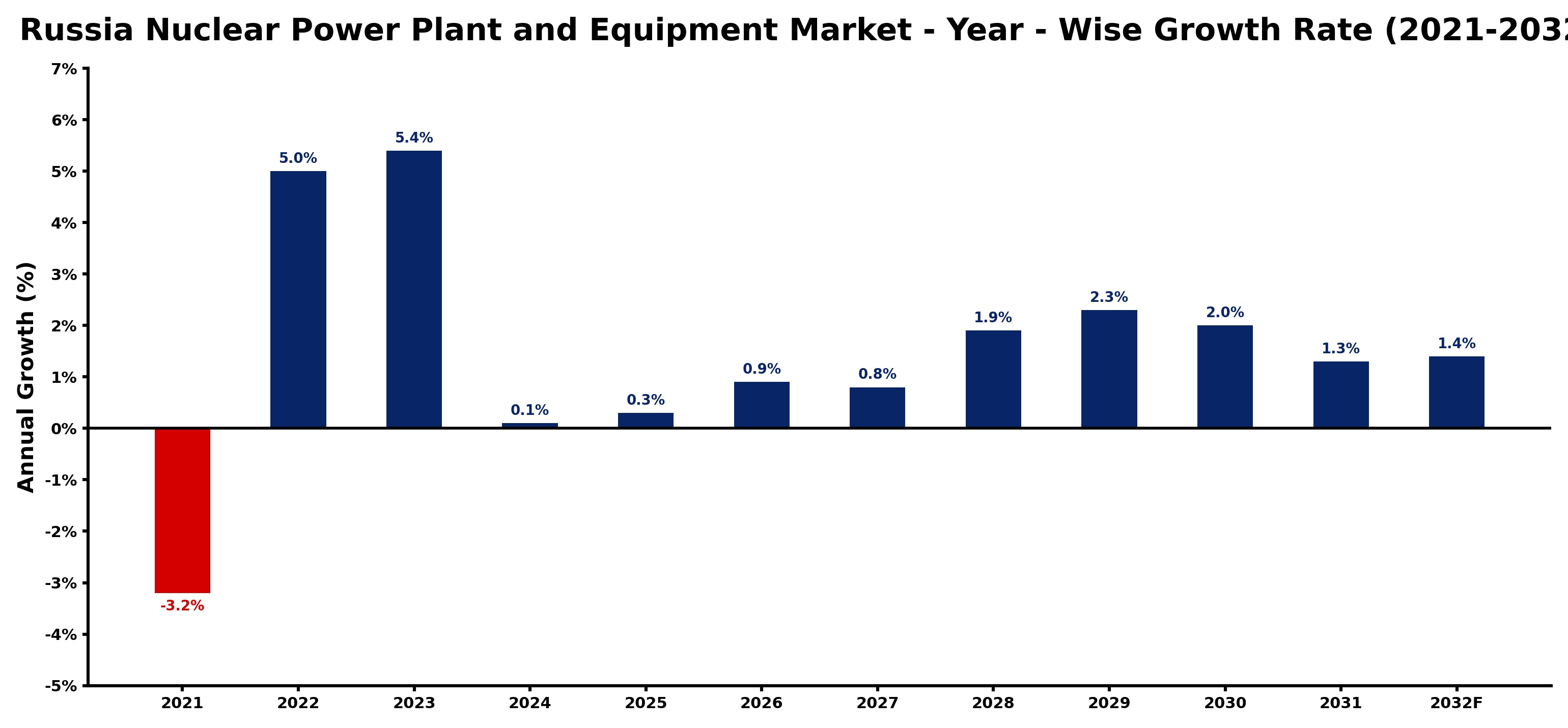
The table below presents the year‑wise growth rates along with the key drivers influencing the market
| Year | Growth Rate | Major Drivers |
| 2021 | -3.2% | Expansion of commercial construction activities |
| 2022 | 5.0% | Increasing industrial infrastructure investments |
| 2023 | 5.4% | Increasing adoption of advanced technologies |
| 2024 | 0.1% | Rapid growth in telecom and data center sectors |
| 2025 | 0.3% | Expansion of commercial construction activities |
| 2026 | 0.9% | Rapid growth in telecom and data center sectors |
| 2027 | 0.8% | Increasing industrial infrastructure investments |
| 2028 | 1.9% | Rapid growth in telecom and data center sectors |
| 2029 | 2.3% | Increasing industrial infrastructure investments |
| 2030 | 2.0% | Expansion of transportation and logistics networks |
| 2031 | 1.3% | Growing urbanization and commercial development |
| 2032 | 1.4% | Government infrastructure modernization initiatives |
Note - Market size estimations and growth projections presented in this report are based on 6Wresearch's advanced forecasting approach, validated with industry datasets as of June 2026.
Russia Nuclear Power Plant and Equipment Market Synopsis
In recent years, the Russia Nuclear Power Plant and Equipment Market has experienced a surge driven by modernization projects and new plant constructions. However, the market is also facing a transformative period as Russia seeks to solidify its standing in the global nuclear landscape and enhance its technological capabilities.
Looking ahead, the focus will shift towards advanced technologies, including Generation IV reactors, which promise to revolutionize safety and efficiency in the sector. The interplay between domestic developments and international collaborations will be crucial in shaping the market's future.
Russia Nuclear Power Plant and Equipment Market Key Takeaways
- The market is primed for steady growth, with significant investments in nuclear infrastructure.
- Ongoing modernization and technology upgrades are essential for maintaining competitive advantages.
- Collaboration with international partners is becoming increasingly prevalent, boosting technology transfer.
- Government initiatives are focused on ensuring safety and regulatory compliance in nuclear operations.
- Investment opportunities abound in advanced technologies and maintenance projects.
Evaluation of Restraints in Russia Nuclear Power Plant and Equipment Market
Despite the promising landscape, the Russia Nuclear Power Plant and Equipment Market encounters notable restraints that could hinder growth. Stringent regulatory frameworks and potential political shifts pose challenges to project timelines and investment certainty. Additionally, the complexities associated with advanced nuclear technologies require significant resources and expertise for effective implementation. Safety concerns related to nuclear operations further amplify the need for stringent adherence to protocols, which can complicate operational processes.
Russia Nuclear Power Plant and Equipment Market Trends
A definitive trend in the Russia Nuclear Power Plant and Equipment Market is the increasing investment in advanced nuclear technologies, particularly Generation IV reactors. These next-generation systems aim to improve safety and operational efficiency while addressing concerns about radioactive waste. Moreover, the emphasis on nuclear security and enhanced regulatory frameworks underscores the market's commitment to safe operations. Collaboration with international entities for joint projects is also a growing trend, leading to shared expertise and improved technological capabilities.
Russia Nuclear Power Plant and Equipment Market Opportunities
The Russia Nuclear Power Plant and Equipment Market offers a wealth of investment opportunities, particularly in partnerships with domestic firms for construction and maintenance projects. As the nation modernizes its existing infrastructure and expands its nuclear capacity, demand for innovative solutions in plant upgrades and safety enhancements will grow. Additionally, research and development collaborations with Russian nuclear organizations present fertile ground for technological advancements, driving operational efficiency across the industry.
Government Initiatives in the Russia Nuclear Power Plant and Equipment Market
Government policies in Russia are aimed at fostering the nuclear energy sector, emphasizing the importance of safety, sustainability, and technological advancement. A comprehensive regulatory framework has been established, encompassing rigorous safety standards and regular inspections to ensure the secure operation of nuclear facilities. Financial incentives and support for domestic nuclear operators further enhance the competitiveness of the market, promoting innovation and collaborative efforts with global partners.
Future Insights of the Russia Nuclear Power Plant and Equipment Market
The outlook for the Russia Nuclear Power Plant and Equipment Market between 2026 and 2032 is optimistic, with continued growth driven by state initiatives to expand nuclear capacity. As Russia leverages its historical expertise and technological advancements, it positions itself as a leader in global nuclear technology. Innovations within the sector are anticipated to not only elevate domestic operations but also enhance export capabilities, further solidifying Russia's role in the international nuclear market.
Russia Nuclear Power Plant and Equipment Market Latest Developments (May 2025 - June 2026)
Recent developments in the Russia Nuclear Power Plant and Equipment Market indicate a robust commitment to enhancing infrastructure and operational capabilities. Initiatives focusing on the research and development of advanced nuclear technologies are gaining momentum, along with increased public and private sector partnerships aimed at modernizing facilities. The ongoing collaboration with international entities underscores a strategic direction towards integrating best practices and innovative solutions, ensuring the market remains competitive on a global scale.
Russia Nuclear Power Plant and Equipment Market - Key Attractiveness of the Report
- 10 Years of Market Numbers
- Historical Data Starting from 2022 to 2025
- Base Year: 2025
- Forecast Data until 2032
- Key Performance Indicators Impacting the Market
- Major Upcoming Developments and Projects
Key Highlights of the Report:
- Russia Nuclear Power Plant and Equipment Market Outlook
- Market Size of Russia Nuclear Power Plant and Equipment Market, 2025
- Forecast of Russia Nuclear Power Plant and Equipment Market, 2032
- Historical Data and Forecast of Russia Nuclear Power Plant and Equipment Revenues & Volume for the Period 2022-2032F
- Russia Nuclear Power Plant and Equipment Market Trend Evolution
- Russia Nuclear Power Plant and Equipment Market Drivers and Challenges
- Russia Nuclear Power Plant and Equipment Price Trends
- Russia Nuclear Power Plant and Equipment Porter's Five Forces
- Russia Nuclear Power Plant and Equipment Industry Life Cycle
- Historical Data and Forecast of Russia Nuclear Power Plant and Equipment Market Revenues & Volume By Reactor Type for the Period 2022-2032F
- Historical Data and Forecast of Russia Nuclear Power Plant and Equipment Market Revenues & Volume By PWR for the Period 2022-2032F
- Historical Data and Forecast of Russia Nuclear Power Plant and Equipment Market Revenues & Volume By PHWR for the Period 2022-2032F
- Historical Data and Forecast of Russia Nuclear Power Plant and Equipment Market Revenues & Volume By Boiling water reactor for the Period 2022-2032F
- Historical Data and Forecast of Russia Nuclear Power Plant and Equipment Market Revenues & Volume By High temperature gas cooled reactor for the Period 2022-2032F
- Historical Data and Forecast of Russia Nuclear Power Plant and Equipment Market Revenues & Volume By Fast Breeder Reactor for the Period 2022-2032F
- Historical Data and Forecast of Russia Nuclear Power Plant and Equipment Market Revenues & Volume By Others for the Period 2022-2032F
- Historical Data and Forecast of Russia Nuclear Power Plant and Equipment Market Revenues & Volume By Equipment for the Period 2022-2032F
- Historical Data and Forecast of Russia Nuclear Power Plant and Equipment Market Revenues & Volume By Island Equipment for the Period 2022-2032F
- Historical Data and Forecast of Russia Nuclear Power Plant and Equipment Market Revenues & Volume By Auxiliary Equipment for the Period 2022-2032F
- Russia Nuclear Power Plant and Equipment Import Export Trade Statistics
- Market Opportunity Assessment By Reactor Type
- Market Opportunity Assessment By Equipment
- Russia Nuclear Power Plant and Equipment Top Companies Market Share
- Russia Nuclear Power Plant and Equipment Competitive Benchmarking By Technical and Operational Parameters
- Russia Nuclear Power Plant and Equipment Company Profiles
- Russia Nuclear Power Plant and Equipment Key Strategic Recommendations






































