Poland Nuclear Power Plant and Equipment Market Size, Share & Growth Rate
The Poland Nuclear Power Plant and Equipment Market was estimated at USD 159 Million in 2025 and is projected to reach USD 216 Million by 2032, growing at a CAGR of 4.5% from 2026 to 2032. This growth is primarily fueled by Poland's strategic initiatives to reduce its heavy dependence on coal while ensuring energy security. Additionally, increasing demand for cleaner energy solutions amid rising electricity consumption is propelling significant investments into nuclear infrastructure and advanced technologies.
Poland Nuclear Power Plant and Equipment Market Year-wise Growth Rate and Key Drivers
This graph highlights how the Poland Nuclear Power Plant and Equipment Market has steadily grown over the years, supported by major growth factors.
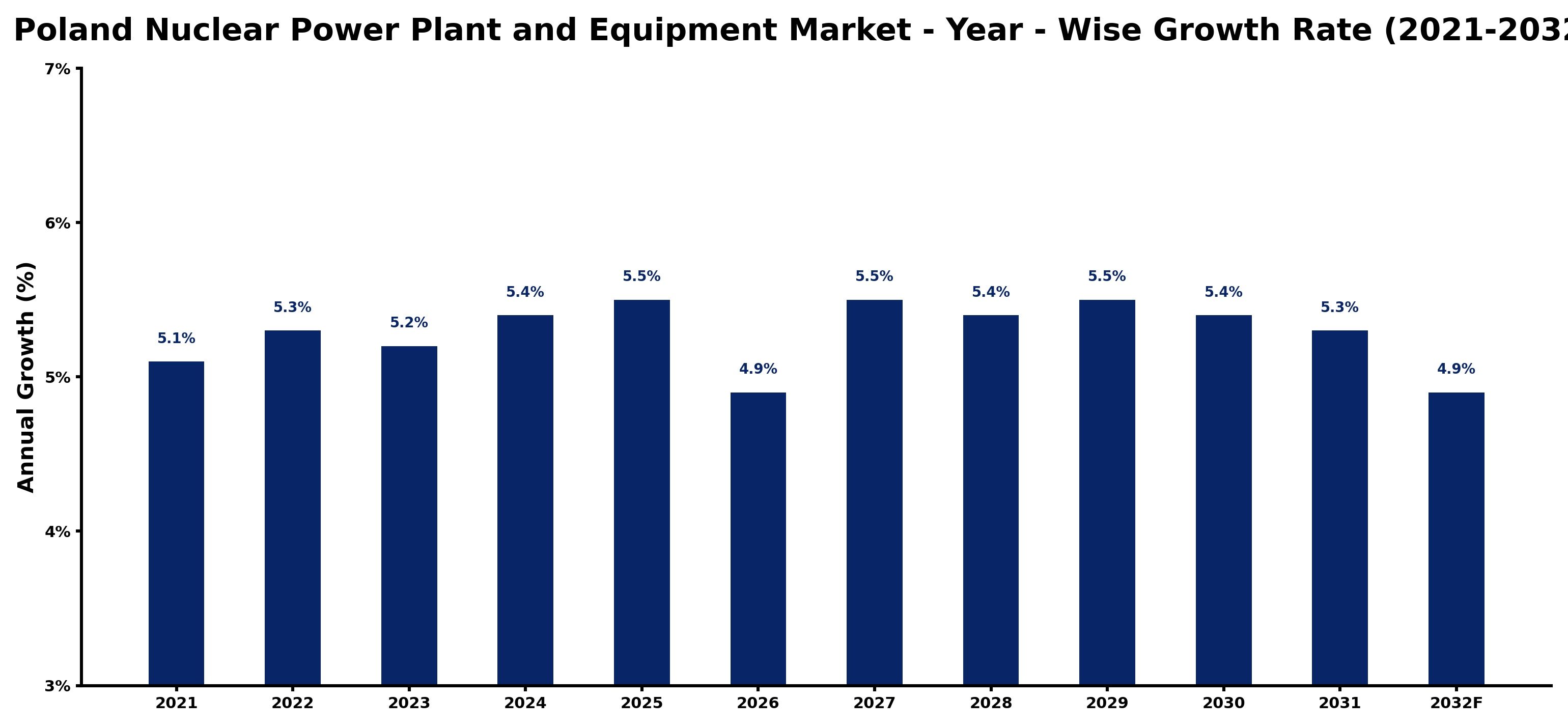
The table below presents the year‑wise growth rates along with the key drivers influencing the market
| Year | Growth Rate | Major Drivers |
| 2021 | 5.1% | Increasing smart city development projects |
| 2022 | 5.3% | Government infrastructure modernization initiatives |
| 2023 | 5.2% | Increasing industrial automation investments |
| 2024 | 5.4% | Government infrastructure modernization initiatives |
| 2025 | 5.5% | Rapid growth in telecom and data center sectors |
| 2026 | 4.9% | Rapid growth in telecom and data center sectors |
| 2027 | 5.5% | Government infrastructure modernization initiatives |
| 2028 | 5.4% | Increasing industrial automation investments |
| 2029 | 5.5% | Expansion of manufacturing activities |
| 2030 | 5.4% | Growing renewable energy integration projects |
| 2031 | 5.3% | Increasing industrial infrastructure investments |
| 2032 | 4.9% | Government infrastructure modernization initiatives |
Note - Market size estimations and growth projections presented in this report are based on 6Wresearch's advanced forecasting approach, validated with industry datasets as of June 2026.
Poland Nuclear Power Plant and Equipment Market Synopsis
Recently, Poland has made substantial progress toward integrating nuclear power into its energy mix, signaling a shift from coal. However, the journey ahead includes overcoming various challenges such as public perception and regulatory complexities. The evolving landscape is characterized by a push for innovation and partnerships that will define the future of nuclear energy in Poland.
As the market anticipates the construction of its first nuclear power plant, the potential for growth is being closely monitored. The emphasis on sustainability and the government's supportive policies are key drivers that promise to enhance the market's trajectory in the coming years. Together, these elements are positioning Poland's nuclear sector for a transformative phase.
Poland Nuclear Power Plant and Equipment Market Key Takeaways
- Significant growth is projected for the nuclear power sector, driven by government initiatives to diversify energy sources.
- The market is witnessing increased investments in advanced nuclear technologies aimed at improving safety and efficiency.
- There is a rising focus on small modular reactors (SMRs) to cater to local energy needs and enhance grid reliability.
- Partnerships with international technology providers are crucial for knowledge transfer and market development.
- Public perception and regulatory frameworks remain key factors influencing investment dynamics in the sector.
Evaluation of Restraints in Poland Nuclear Power Plant and Equipment Market
Despite the optimistic outlook, the Poland Nuclear Power Plant and Equipment Market faces several constraints. One of the significant challenges is the entrenched reliance on coal, which complicates efforts to transition towards nuclear energy. Public opposition stemming from safety concerns adds a layer of complexity, often affecting policy decisions. Moreover, the substantial initial capital investments required for constructing nuclear facilities and the lengthy timelines associated with development pose financial barriers. The regulatory landscape is also evolving, with potential uncertainties that may impact investor confidence and strategic planning.
Poland Nuclear Power Plant and Equipment Market Trends
The demand for advanced nuclear technologies is on the rise, with a growing emphasis on safety and operational efficiency. Digitalization and automation are becoming integral to enhancing maintenance procedures and overall performance. Additionally, the increasing interest in small modular reactors (SMRs) showcases a shift toward more adaptable solutions to meet specific energy demands, especially in remote areas. Collectively, these trends indicate a progressive move toward integrating innovative practices into Poland's nuclear landscape.
Poland Nuclear Power Plant and Equipment Market Opportunities
The nuclear sector in Poland is ripe with investment opportunities, particularly as the country commits to diversifying its energy portfolio. The ongoing projects for building nuclear plants and enhancing existing infrastructures present lucrative avenues for stakeholders. Furthermore, collaboration with global nuclear technology firms may facilitate technological advancements and create long-term partnerships, thus amplifying growth potential. Investors should focus on developing state-of-the-art equipment and services to capitalize on the emerging market dynamics.
Government Initiatives in the Poland Nuclear Power Plant and Equipment Market
The Polish government has firmly established its commitment to expanding nuclear power as part of a comprehensive energy diversification strategy. The introduction of the Nuclear Power Act in 2020 has laid the groundwork for regulatory frameworks governing the construction and operation of nuclear facilities. By setting a target to generate 10% of its electricity from nuclear sources by 2040, Poland is working towards securing international partnerships to bolster its nuclear capabilities, thereby creating a conducive environment for market growth.
Future Insights of the Poland Nuclear Power Plant and Equipment Market
Looking ahead to 2026-2032, the Poland Nuclear Power Plant and Equipment Market is set to undergo significant transformation. As the country progresses with its nuclear ambitions, the expected development of new plants is likely to catalyze further investments in the sector. The integration of innovative technologies and a focus on sustainability will drive demand for nuclear equipment and services. Overall, the market appears positioned for robust expansion, contingent upon effectively navigating existing challenges and capitalizing on emerging opportunities.
Poland Nuclear Power Plant and Equipment Market Latest Developments (May 2025 - June 2026)
In the past year, the Polish nuclear sector has seen a flurry of activities aimed at advancing its nuclear capabilities. Key developments include ongoing negotiations with international firms for technology sharing and investment, as well as public forums to discuss the nuclear energy transition. The emphasis on safety and modernization is evident, with initiatives aimed at improving public perception and regulatory compliance. As projects move from planning to execution, the landscape of Poland's nuclear market is evolving rapidly.
Poland Nuclear Power Plant and Equipment Market - Key Attractiveness of the Report
- 10 Years of Market Numbers
- Historical Data Starting from 2022 to 2025
- Base Year: 2025
- Forecast Data until 2032
- Key Performance Indicators Impacting the Market
- Major Upcoming Developments and Projects
Key Highlights of the Report:
- Poland Nuclear Power Plant and Equipment Market Outlook
- Market Size of Poland Nuclear Power Plant and Equipment Market, 2025
- Forecast of Poland Nuclear Power Plant and Equipment Market, 2032
- Historical Data and Forecast of Poland Nuclear Power Plant and Equipment Revenues & Volume for the Period 2022-2032F
- Poland Nuclear Power Plant and Equipment Market Trend Evolution
- Poland Nuclear Power Plant and Equipment Market Drivers and Challenges
- Poland Nuclear Power Plant and Equipment Price Trends
- Poland Nuclear Power Plant and Equipment Porter's Five Forces
- Poland Nuclear Power Plant and Equipment Industry Life Cycle
- Historical Data and Forecast of Poland Nuclear Power Plant and Equipment Market Revenues & Volume By Reactor Type for the Period 2022-2032F
- Historical Data and Forecast of Poland Nuclear Power Plant and Equipment Market Revenues & Volume By PWR for the Period 2022-2032F
- Historical Data and Forecast of Poland Nuclear Power Plant and Equipment Market Revenues & Volume By PHWR for the Period 2022-2032F
- Historical Data and Forecast of Poland Nuclear Power Plant and Equipment Market Revenues & Volume By Boiling water reactor for the Period 2022-2032F
- Historical Data and Forecast of Poland Nuclear Power Plant and Equipment Market Revenues & Volume By High temperature gas cooled reactor for the Period 2022-2032F
- Historical Data and Forecast of Poland Nuclear Power Plant and Equipment Market Revenues & Volume By Fast Breeder Reactor for the Period 2022-2032F
- Historical Data and Forecast of Poland Nuclear Power Plant and Equipment Market Revenues & Volume By Others for the Period 2022-2032F
- Historical Data and Forecast of Poland Nuclear Power Plant and Equipment Market Revenues & Volume By Equipment for the Period 2022-2032F
- Historical Data and Forecast of Poland Nuclear Power Plant and Equipment Market Revenues & Volume By Island Equipment for the Period 2022-2032F
- Historical Data and Forecast of Poland Nuclear Power Plant and Equipment Market Revenues & Volume By Auxiliary Equipment for the Period 2022-2032F
- Poland Nuclear Power Plant and Equipment Import Export Trade Statistics
- Market Opportunity Assessment By Reactor Type
- Market Opportunity Assessment By Equipment
- Poland Nuclear Power Plant and Equipment Top Companies Market Share
- Poland Nuclear Power Plant and Equipment Competitive Benchmarking By Technical and Operational Parameters
- Poland Nuclear Power Plant and Equipment Company Profiles
- Poland Nuclear Power Plant and Equipment Key Strategic Recommendations






































