Tajikistan Power Generation Market Size, Share & Growth Rate
The Tajikistan Power Generation Market was estimated at USD 472 Million in 2025 and is projected to reach USD 648 Million by 2032, growing at a CAGR of 4.6% from 2026 to 2032. This growth trajectory is primarily driven by the increasing investment in hydropower projects, which capitalize on the country's rich water resources, as well as a concerted effort by the government to modernize the energy infrastructure. Additionally, the rising demand for sustainable energy solutions, particularly in rural areas, is propelling developments in renewable energy sectors.
Tajikistan Power Generation Market Year-wise Growth Rate and Key Drivers
This graph highlights how the Tajikistan Power Generation Market has steadily grown over the years, supported by major growth factors.
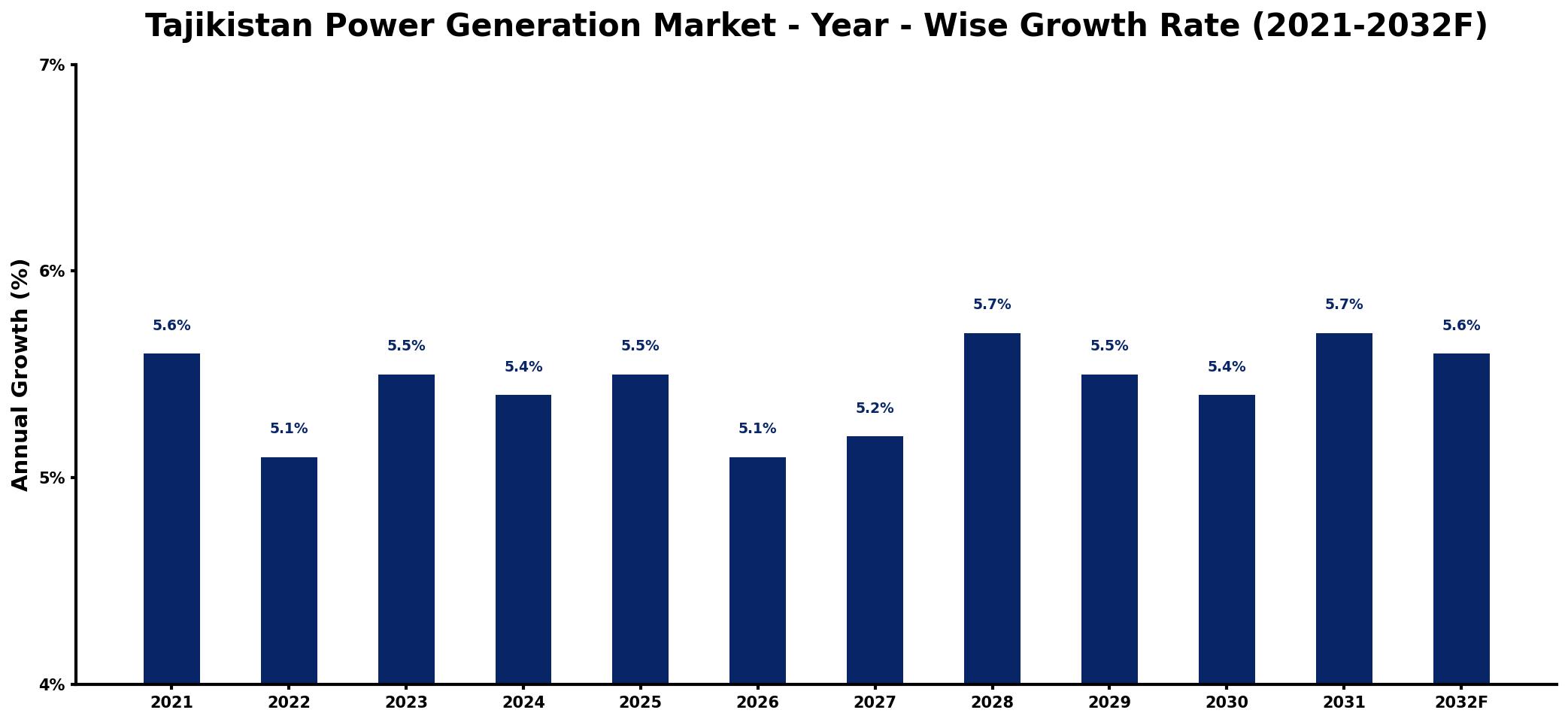
The table below presents the year‑wise growth rates along with the key drivers influencing the market
| Year | Growth Rate | Major Drivers |
| 2021 | 5.6% | improved raw material availability |
| 2022 | 5.1% | growing industrial electricity needs |
| 2023 | 5.5% | rising residential energy consumption |
| 2024 | 5.4% | expanding renewable energy projects |
| 2025 | 5.5% | enhanced regional energy cooperation |
| 2026 | 5.1% | increased foreign direct investments |
| 2027 | 5.2% | growing urban population demand |
| 2028 | 5.7% | advancements in energy technologies |
| 2029 | 5.5% | increased government energy initiatives |
| 2030 | 5.4% | rising energy efficiency programs |
| 2031 | 5.7% | growing electric vehicle adoption |
| 2032 | 5.6% | enhanced energy security policies |
Note: Market size estimations and growth projections presented in this report are based on 6Wresearch's proprietary forecasting methodology, utilizing the latest available industry data, government publications, and primary research inputs.
Tajikistan Power Generation Market Synopsis
Tajikistans heavy reliance on hydropower has positioned it as a leader in the region for sustainable energy generation. With hydropower facilities accounting for over 90% of the electricity produced, there is significant potential for expansion and modernization, especially with ongoing infrastructural investments aimed at reducing transmission losses.
The market is at a pivotal moment, where the government's focus on renewable energy diversification is crucial. Initiatives to attract foreign investments are gaining momentum, setting the stage for increased efficiency and greater energy security to meet the growing demands of both urban and rural populations.
Tajikistan Power Generation Market Key Takeaways
- Tajikistan's power generation is predominantly hydropower, significantly influenced by the countrys geographic advantages.
- Government policies are increasingly fostering a competitive market to attract private investments in energy infrastructure.
- Investment in renewable energy technologies such as solar and wind is on the rise, contributing to market diversification.
- Infrastructure modernization efforts aim to enhance the reliability and efficiency of electricity supply across the nation.
- Challenges related to aging infrastructure and investment limitations continue to impact market growth.
Evaluation of Restraints in Tajikistan Power Generation Market
Despite its potential, the Tajikistan Power Generation Market is constrained by several key factors. Aging infrastructure hampers the efficiency of existing power generation and distribution systems, leading to significant transmission losses. Furthermore, the sectors over-dependence on hydropower exposes it to vulnerabilities, particularly with shifting climate patterns affecting water availability. Financing for new projects remains limited, coupled with high costs for infrastructure upgrades, making it challenging to attract the necessary capital. Political instability and regulatory uncertainties also pose risks that could impede the markets growth trajectory, necessitating comprehensive reforms and strategic investments.
Tajikistan Power Generation Market Trends
The landscape of the Tajikistan Power Generation Market is evolving, with a clear trend towards renewable energy adoption and infrastructure enhancements. Hydropower continues to dominate, but increasing awareness around sustainability has sparked interest in alternative sources such as solar and wind energy. Additionally, the government is implementing reforms aimed at improving market efficiency and reducing dependency on imported electricity. Public-private partnerships are gaining traction, offering collaborative opportunities to modernize energy facilities and enhance grid stability.
Tajikistan Power Generation Market Opportunities
There is a myriad of investment opportunities emerging within the Tajikistan Power Generation Market. The development of new hydropower projects presents a significant chance for boosting electricity production and export capacity. Additionally, the increasing demand for modernized infrastructure creates avenues for investors to participate in upgrading existing systems. The government's commitment to increasing the share of renewable energies further opens the door for solar and wind projects, offering promising returns on investment. Public-private partnerships are also being encouraged, with incentives available for investors willing to engage in the sector.
Government Initiatives in the Tajikistan Power Generation Market
The government of Tajikistan is actively pursuing policies to enhance energy security and sustainability within the power generation sector. Initiatives are in place to attract foreign investments through tax incentives and subsidies, which aim to support the development of both hydropower and renewable energy projects. Regulatory frameworks are being refined to promote competition and efficiency in the energy market, while efforts to electrify rural areas highlight the commitment to improving access to electricity for all citizens. Such government initiatives are foundational to modernizing the energy landscape in Tajikistan.
Future Insights of the Tajikistan Power Generation Market
Looking ahead, the Tajikistan Power Generation Market is set for notable expansion between 2026 and 2032. Factors driving this growth include increased investments in renewable energy and ongoing government initiatives targeting infrastructure improvements. The countrys extensive hydropower potential remains a cornerstone, supplemented by a broader commitment to diversifying the energy mix. However, challenges such as financing and geopolitical tensions could affect this trajectory. As stakeholders navigate these dynamics, the market is poised to contribute significantly to Tajikistans energy sustainability goals.
Tajikistan Power Generation Market Latest Developments (2025 - 2026)
In recent months, there have been significant developments within the Tajikistan Power Generation Market. The government has launched several initiatives aimed at attracting foreign direct investment into both hydropower and renewable energy sectors, signaling a robust commitment to modernizing the energy framework. Discussions around public-private partnerships are intensifying as stakeholders seek collaboration to enhance energy infrastructure. Additionally, efforts to implement innovative technologies and improve operational efficiencies are becoming priorities, positioning the market for greater reliability and sustainability.
Tajikistan Power Generation Market - Key Attractiveness of the Report
- 10 Years of Market Numbers
- Historical Data Starting from 2022 to 2025
- Base Year: 2025
- Forecast Data until 2032
- Key Performance Indicators Impacting the Market
- Major Upcoming Developments and Projects
Key Highlights of the Report:
- Tajikistan Power Generation Market Outlook
- Market Size of Tajikistan Power Generation Market, 2025
- Forecast of Tajikistan Power Generation Market, 2032
- Historical Data and Forecast of Tajikistan Power Generation Revenues & Volume for the Period 2022-2032F
- Tajikistan Power Generation Market Trend Evolution
- Tajikistan Power Generation Market Drivers and Challenges
- Tajikistan Power Generation Price Trends
- Tajikistan Power Generation Porter's Five Forces
- Tajikistan Power Generation Industry Life Cycle
- Historical Data and Forecast of Tajikistan Power Generation Market Revenues & Volume By Application for the Period 2022-2032F
- Historical Data and Forecast of Tajikistan Power Generation Market Revenues & Volume By Commercial for the Period 2022-2032F
- Historical Data and Forecast of Tajikistan Power Generation Market Revenues & Volume By Industrial for the Period 2022-2032F
- Historical Data and Forecast of Tajikistan Power Generation Market Revenues & Volume By Residential for the Period 2022-2032F
- Historical Data and Forecast of Tajikistan Power Generation Market Revenues & Volume By Source for the Period 2022-2032F
- Historical Data and Forecast of Tajikistan Power Generation Market Revenues & Volume By Non-Renewable for the Period 2022-2032F
- Historical Data and Forecast of Tajikistan Power Generation Market Revenues & Volume By Renewable for the Period 2022-2032F
- Tajikistan Power Generation Import Export Trade Statistics
- Market Opportunity Assessment By Application
- Market Opportunity Assessment By Source
- Tajikistan Power Generation Top Companies Market Share
- Tajikistan Power Generation Competitive Benchmarking By Technical and Operational Parameters
- Tajikistan Power Generation Company Profiles
- Tajikistan Power Generation Key Strategic Recommendations






































