Tajikistan Real Estate Market Size, Share & Growth Rate
The Tajikistan Real Estate Market was estimated at USD 230 Million in 2025 and is projected to reach USD 300 Million by 2032, growing at a CAGR of 3.9% from 2026 to 2032. This growth trajectory is primarily driven by ongoing urbanization and population growth in key cities like Dushanbe, which continues to attract foreign investment. Increased demand for both residential and commercial properties is expected to create a competitive landscape, further fueling market dynamics.
Tajikistan Real Estate Market Year-wise Growth Rate and Key Drivers
This graph highlights how the Tajikistan Real Estate Market has steadily grown over the years, supported by major growth factors.
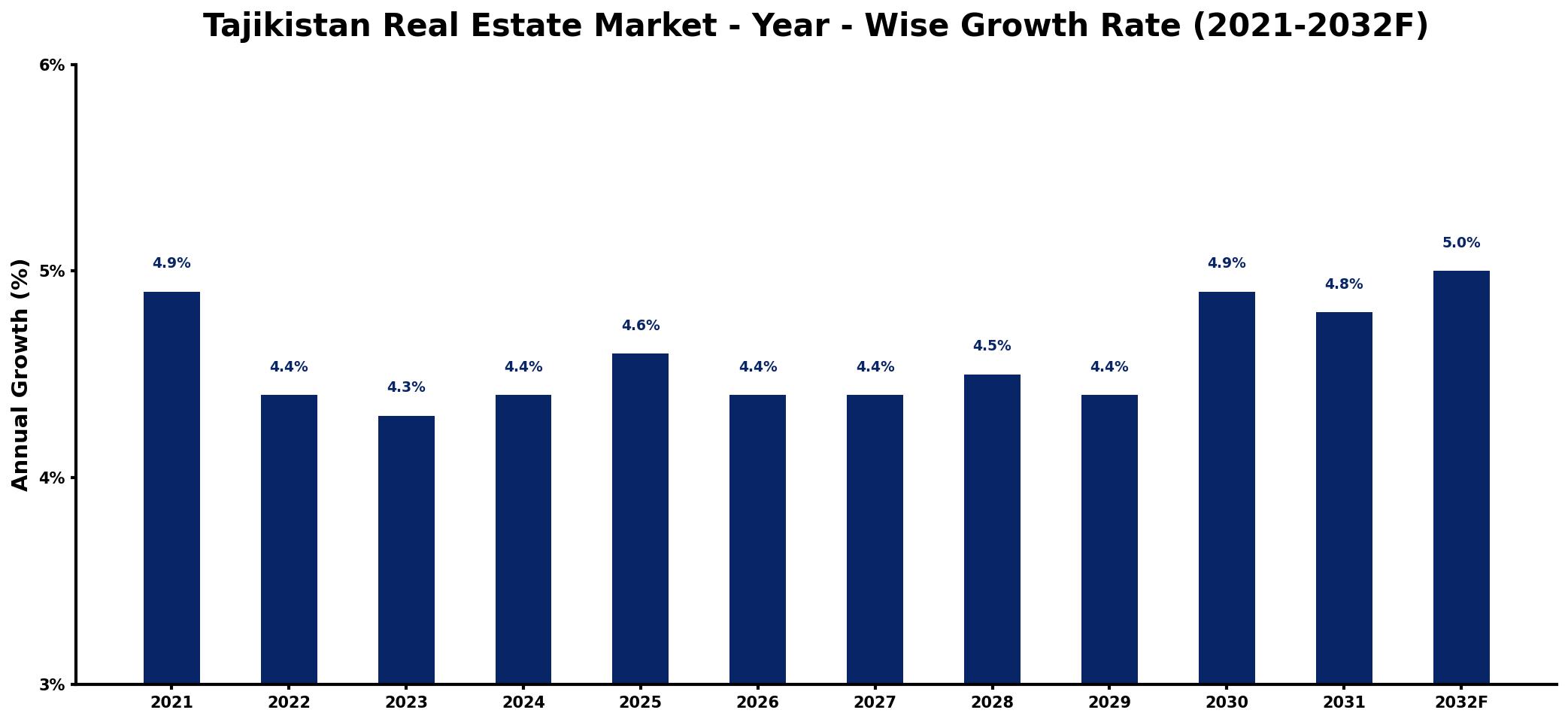
The table below presents the year‑wise growth rates along with the key drivers influencing the market
| Year | Growth Rate | Major Drivers |
| 2021 | 4.9% | Increased foreign investment activity |
| 2022 | 4.4% | Growing urban population demand |
| 2023 | 4.3% | Expansion of infrastructure projects |
| 2024 | 4.4% | Rise in disposable income levels |
| 2025 | 4.6% | Development of new housing projects |
| 2026 | 4.4% | Enhanced government support initiatives |
| 2027 | 4.4% | Improved access to financing options |
| 2028 | 4.5% | Surge in tourism-related developments |
| 2029 | 4.4% | Growth in expatriate community presence |
| 2030 | 4.9% | Strengthened local construction capabilities |
| 2031 | 4.8% | Increased interest in sustainable living |
| 2032 | 5.0% | strengthening international trade flows |
Note: Market size estimations and growth projections presented in this report are based on 6Wresearch's proprietary forecasting methodology, utilizing the latest available industry data, government publications, and primary research inputs.
Tajikistan Real Estate Market Synopsis
In recent years, the Tajikistan real estate market has shown notable momentum, largely attributed to increasing urbanization and government initiatives aimed at enhancing foreign investment. However, as we look to the future, there are indications that while growth will continue, it may be tempered by challenges such as bureaucratic processes and financing limitations that could inhibit the overall market potential.
The outlook suggests a promising environment for investors, particularly with rising middle-class incomes and an expanding tourism sector. As the market evolves, demand for innovative and diverse property offerings will likely shape the strategic approaches of both local and international stakeholders.
Tajikistan Real Estate Market Key Takeaways
- The market is experiencing robust growth with a projected size of USD 300 Million by 2032.
- Urbanization and a growing population are significant drivers of property demand in key urban centers.
- Government policies are increasingly supportive of foreign investment, promoting a more favorable climate.
- Infrastructure improvements are underway, enhancing accessibility and market viability.
- Despite challenges, the Tajikistan real estate sector presents attractive investment opportunities, particularly in hospitality and residential developments.
Evaluation of Restraints in Tajikistan Real Estate Market
The Tajikistan real estate market grapples with several significant constraints that inhibit its growth potential. Limited access to financing poses a formidable challenge for property developers and buyers alike. This is exacerbated by a lack of transparency in property transactions, which can deter foreign investors wary of bureaucratic entanglements. Additionally, inconsistent enforcement of property rights creates uncertainties that can undermine market confidence. Political instability and economic fluctuations further amplify these risks, making it imperative for stakeholders to navigate these complexities judiciously.
Tajikistan Real Estate Market Trends
One of the prevailing trends in the Tajikistan real estate market is the increasing urbanization, especially in Dushanbe, which has led to heightened demand for both residential and commercial properties in central locations. There is also a growing interest in luxury developments as the tourism sector expands, creating opportunities for hospitality projects that cater to affluent travelers. Moreover, the market is witnessing the integration of technology in real estate transactions, improving transparency and efficiency, which is critical for attracting foreign investors.
Tajikistan Real Estate Market Opportunities
The Tajikistan real estate market offers compelling investment opportunities, particularly for those looking to capitalize on the ongoing economic growth and urbanization. With a relatively low cost of entry compared to neighboring markets, investors can leverage favorable pricing and potential capital appreciation. The hospitality sector, in particular, is ripe for investment due to the increasing influx of tourists and the government's commitment to enhancing tourism infrastructure. Additionally, the rising middle class presents opportunities in residential properties, which are in high demand.
Government Initiatives in the Tajikistan Real Estate Market
The Tajik government has implemented several initiatives aimed at bolstering the real estate market. Key among these is the Law on Real Estate, which regulates ownership and transactions, contributing to a more structured market environment. Furthermore, tax incentives and simplified procedures for foreign investors have been introduced to attract greater foreign participation in the sector. Additionally, the State Committee on Investments and State Property Management plays a crucial role in promoting transparency and improving regulatory frameworks to foster investor confidence.
Future Insights of the Tajikistan Real Estate Market
Looking ahead to 2026-2032, the Tajikistan real estate market is set to benefit from a combination of sustained economic growth and urbanization trends. As infrastructure improvements continue and foreign investment increases, the market is likely to see expanded opportunities in various segments, including residential, commercial, and hospitality. However, addressing existing challenges, such as transparency and financing, will be crucial to unlocking the market's full potential. Overall, optimism prevails about the market's trajectory and the prospects for robust growth.
Tajikistan Real Estate Market Latest Developments (2025 - 2026)
In the recent months leading into mid-2026, the Tajikistan real estate market has experienced a series of developments reflecting its evolving landscape. There have been significant strides in infrastructure projects aimed at enhancing connectivity in urban areas, which are expected to boost property values. Additionally, ongoing foreign investments in luxury developments and hospitality are beginning to reshape the market, pointing towards a more diversified property landscape. Furthermore, increased government efforts to streamline property registration processes are anticipated to improve market transparency.
Tajikistan Real Estate Market - Key Attractiveness of the Report
- 10 Years of Market Numbers
- Historical Data Starting from 2022 to 2025
- Base Year: 2025
- Forecast Data until 2032
- Key Performance Indicators Impacting the Market
- Major Upcoming Developments and Projects
Key Highlights of the Report:
- Tajikistan Real Estate Market Outlook
- Market Size of Tajikistan Real Estate Market, 2025
- Forecast of Tajikistan Real Estate Market, 2032
- Historical Data and Forecast of Tajikistan Real Estate Revenues & Volume for the Period 2022-2032F
- Tajikistan Real Estate Market Trend Evolution
- Tajikistan Real Estate Market Drivers and Challenges
- Tajikistan Real Estate Price Trends
- Tajikistan Real Estate Porter's Five Forces
- Tajikistan Real Estate Industry Life Cycle
- Historical Data and Forecast of Tajikistan Real Estate Market Revenues & Volume By Property for the Period 2022-2032F
- Historical Data and Forecast of Tajikistan Real Estate Market Revenues & Volume By Residential for the Period 2022-2032F
- Historical Data and Forecast of Tajikistan Real Estate Market Revenues & Volume By Commercial for the Period 2022-2032F
- Historical Data and Forecast of Tajikistan Real Estate Market Revenues & Volume By Industrial for the Period 2022-2032F
- Historical Data and Forecast of Tajikistan Real Estate Market Revenues & Volume By Land for the Period 2022-2032F
- Historical Data and Forecast of Tajikistan Real Estate Market Revenues & Volume By Others for the Period 2022-2032F
- Historical Data and Forecast of Tajikistan Real Estate Market Revenues & Volume By Type for the Period 2022-2032F
- Historical Data and Forecast of Tajikistan Real Estate Market Revenues & Volume By Sales for the Period 2022-2032F
- Historical Data and Forecast of Tajikistan Real Estate Market Revenues & Volume By Rental for the Period 2022-2032F
- Historical Data and Forecast of Tajikistan Real Estate Market Revenues & Volume By Lease for the Period 2022-2032F
- Tajikistan Real Estate Import Export Trade Statistics
- Market Opportunity Assessment By Property
- Market Opportunity Assessment By Type
- Tajikistan Real Estate Top Companies Market Share
- Tajikistan Real Estate Competitive Benchmarking By Technical and Operational Parameters
- Tajikistan Real Estate Company Profiles
- Tajikistan Real Estate Key Strategic Recommendations






































