Tanzania Oats Market Size, Share & Growth Rate
The Tanzania Oats Market was estimated at USD 503 Million in 2025 and is projected to reach USD 726 Million by 2032, growing at a CAGR of 5.4% from 2026 to 2032. This robust growth trajectory is largely driven by a shift in consumer behavior toward healthier eating habits, combined with an increasing recognition of the nutritional benefits associated with oats. The integration of oats into various food products, such as granola bars and cereals, further contributes to this expanding market landscape.
Tanzania Oats Market Year-wise Growth Rate and Key Drivers
This graph highlights how the Tanzania Oats Market has steadily grown over the years, supported by major growth factors.
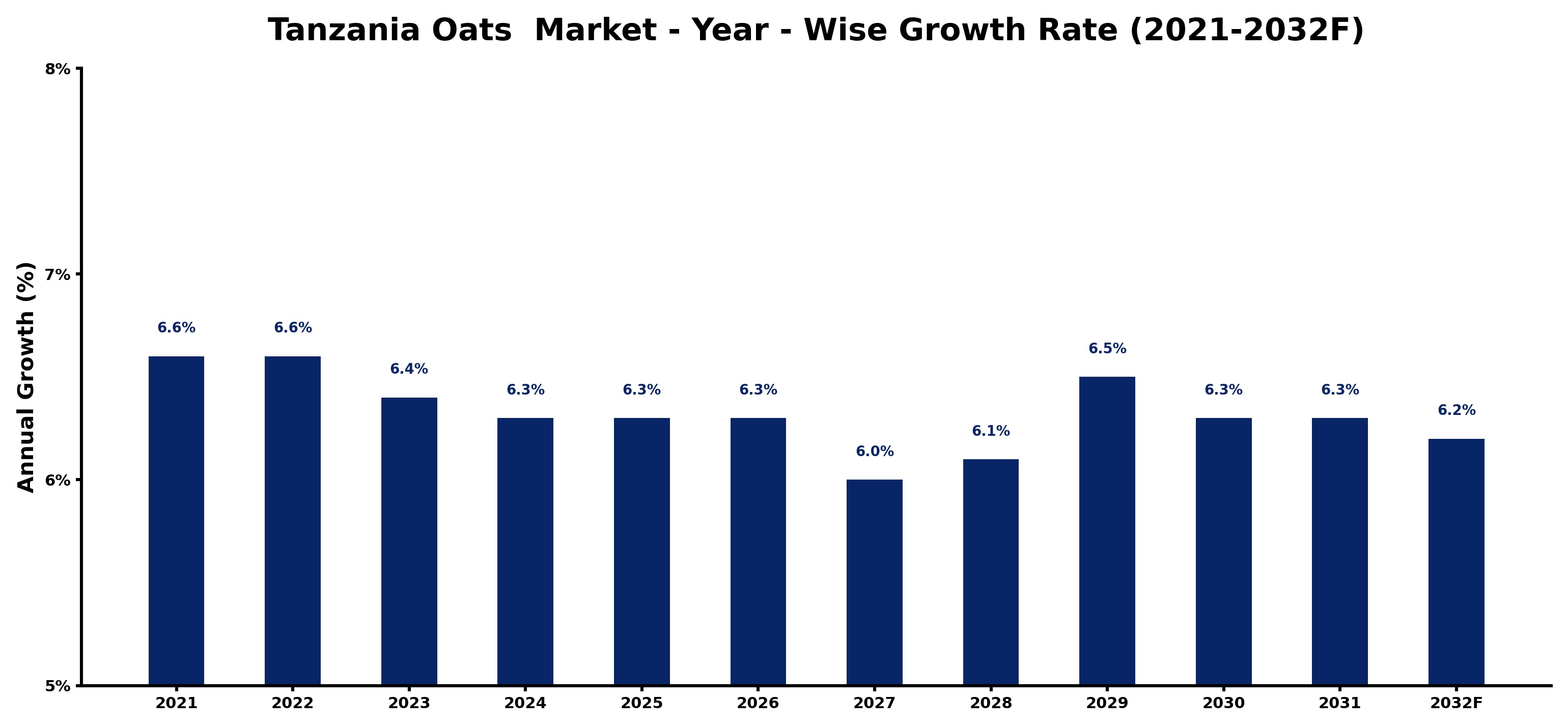
The table below presents the year‑wise growth rates along with the key drivers influencing the market
| Year | Growth Rate | Major Drivers |
| 2021 | 6.6% | Health consciousness drove consumption |
| 2022 | 6.6% | Increased urbanization boosted demand |
| 2023 | 6.4% | Product innovation attracted consumers |
| 2024 | 6.3% | Rising disposable incomes encouraged purchases |
| 2025 | 6.3% | Nutritional awareness expanded market reach |
| 2026 | 6.3% | E-commerce growth enhanced accessibility |
| 2027 | 6.0% | Breakfast trends favored oats consumption |
| 2028 | 6.1% | Sustainability initiatives attracted new buyers |
| 2029 | 6.5% | Local sourcing improved supply chains |
| 2030 | 6.3% | Fitness trends supported product popularity |
| 2031 | 6.3% | Culinary trends embraced oat products |
| 2032 | 6.2% | Consumer education increased product usage |
Note - Market size estimations and growth projections presented in this report are based on 6Wresearch’s advanced forecasting approach, validated with industry datasets as of June 2026.
Tanzania Oats Market Synopsis
The strongest force shaping the Tanzania oats market today is the escalating health consciousness among consumers. With an increasing awareness of dietary choices, more Tanzanians are incorporating oats into their meals, favoring them for their high fiber content and versatility.
Additionally, the growing urban middle class is seeking convenient yet nutritious options, propelling oats to the forefront of breakfast and snack choices. This trend is complemented by the introduction of innovative oat-based products that cater to diverse culinary preferences, enhancing the overall market appeal.
Tanzania Oats Market Key Takeaways
- The Tanzania oats market is experiencing significant growth due to rising health awareness among consumers.
- There is an increasing demand for oat-based products across various food categories.
- Urbanization and a growing middle class are driving the shift toward nutritious eating habits.
- Domestic production and sustainable practices are essential for reducing import dependency.
- Investment opportunities in production and value-added oat products are on the rise.
Evaluation of Restraints in Tanzania Oats Market
Despite the positive growth indicators, the Tanzania oats market faces several limitations. A significant challenge is the historical reliance on traditional staples like maize and rice, which hinders the widespread acceptance of oats among the population. This limited consumer awareness is exacerbated by a heavy dependence on imported oats, often resulting in higher retail prices. Additionally, infrastructural challenges related to storage and transportation continue to impede the efficient distribution of oat products, constraining market expansion.
Tanzania Oats Market Trends
The trend toward healthy eating is undeniably reshaping the demand landscape for oats in Tanzania. As consumers increasingly gravitate towards nutrient-dense food options, oats are being embraced not just for breakfast but also as a versatile ingredient in smoothies, snacks, and baked goods. Furthermore, the environmental sustainability associated with oats cultivation, which requires less water and fertilizers compared to other grains, is gaining traction among eco-conscious consumers.
Tanzania Oats Market Opportunities
The market is ripe with investment opportunities, particularly in the production and processing sectors. With the rising demand for oat-based items, there is substantial potential for new entrants to capitalize on developing local processing facilities. Value-added products like oat snacks, flour, and oat milk could significantly expand market offerings and appeal to a wider consumer base. Collaborations with local farmers to cultivate oats can also enhance sustainability and promote inclusive growth within the agricultural sector.
Government Initiatives in the Tanzania Oats Market
The Tanzanian government is actively promoting the oats market through various supportive policies aimed at bolstering agricultural productivity. Incentives and subsidies are being offered to farmers to encourage the cultivation of oats, while regulations ensure that food safety standards are maintained. These initiatives are designed to strengthen domestic production capabilities, thereby reducing reliance on imports and enhancing food security across the nation.
Future Insights of the Tanzania Oats Market
Looking forward to 2026-2032, the Tanzania oats market is positioned for promising growth. The increasing urbanization and the expanding middle-class population are expected to amplify the demand for nutritious and convenient food options. Moreover, as health trends continue to evolve, oats will likely become a staple ingredient in various dietary regimes. We foresee an environment ripe for product innovation and collaborative partnerships that align with consumer preferences for both health and sustainability.
Tanzania Oats Market Latest Developments (May 2025 - June 2026)
Recent developments in the Tanzania oats market indicate a marked shift toward product diversification, with several food manufacturers launching new oat-based snacks and breakfast options. There is a growing emphasis on local sourcing and partnerships with farmers to boost domestic production capabilities. Additionally, marketing campaigns are increasingly focusing on educating consumers about the health benefits of oats, aiming to increase acceptance and consumption rates within the general population.
Tanzania Oats Market - Key Attractiveness of the Report
- 10 Years of Market Numbers
- Historical Data Starting from 2022 to 2025
- Base Year: 2025
- Forecast Data until 2032
- Key Performance Indicators Impacting the Market
- Major Upcoming Developments and Projects
Key Highlights of the Report:
- Tanzania Oats Market Outlook
- Market Size of Tanzania Oats Market, 2025
- Forecast of Tanzania Oats Market, 2032
- Historical Data and Forecast of Tanzania Oats Revenues & Volume for the Period 2022-2032F
- Tanzania Oats Market Trend Evolution
- Tanzania Oats Market Drivers and Challenges
- Tanzania Oats Price Trends
- Tanzania Oats Porter's Five Forces
- Tanzania Oats Industry Life Cycle
- Historical Data and Forecast of Tanzania Oats Market Revenues & Volume By Form for the Period 2022-2032F
- Historical Data and Forecast of Tanzania Oats Market Revenues & Volume By Flavoured Oats for the Period 2022-2032F
- Historical Data and Forecast of Tanzania Oats Market Revenues & Volume By Base Oats for the Period 2022-2032F
- Historical Data and Forecast of Tanzania Oats Market Revenues & Volume By Distribution Channel for the Period 2022-2032F
- Historical Data and Forecast of Tanzania Oats Market Revenues & Volume By Supermarket/Hypermarket for the Period 2022-2032F
- Historical Data and Forecast of Tanzania Oats Market Revenues & Volume By Convenience Stores for the Period 2022-2032F
- Historical Data and Forecast of Tanzania Oats Market Revenues & Volume By Online Channels for the Period 2022-2032F
- Historical Data and Forecast of Tanzania Oats Market Revenues & Volume By Others for the Period 2022-2032F
- Tanzania Oats Import Export Trade Statistics
- Market Opportunity Assessment By Form
- Market Opportunity Assessment By Distribution Channel
- Tanzania Oats Top Companies Market Share
- Tanzania Oats Competitive Benchmarking By Technical and Operational Parameters
- Tanzania Oats Company Profiles
- Tanzania Oats Key Strategic Recommendations






































