Tanzania Unified Communications as a Service Market Size, Share & Growth Rate
The Tanzania Unified Communications as a Service Market was estimated at USD 481 Million in 2025 and is projected to reach USD 666 Million by 2032, growing at a CAGR of 4.8% from 2026 to 2032. This growth trajectory is primarily propelled by a surge in the demand for remote work solutions and the increasing emphasis on efficient communication tools among businesses. As Tanzanian enterprises continue to embrace digital transformation, the adoption of UCaaS solutions is expected to be a critical component in enhancing operational efficiencies and fostering collaboration.
Tanzania Unified Communications as a Service Market Year-wise Growth Rate and Key Drivers
This graph highlights how the Tanzania Unified Communications as a Service Market has steadily grown over the years, supported by major growth factors.
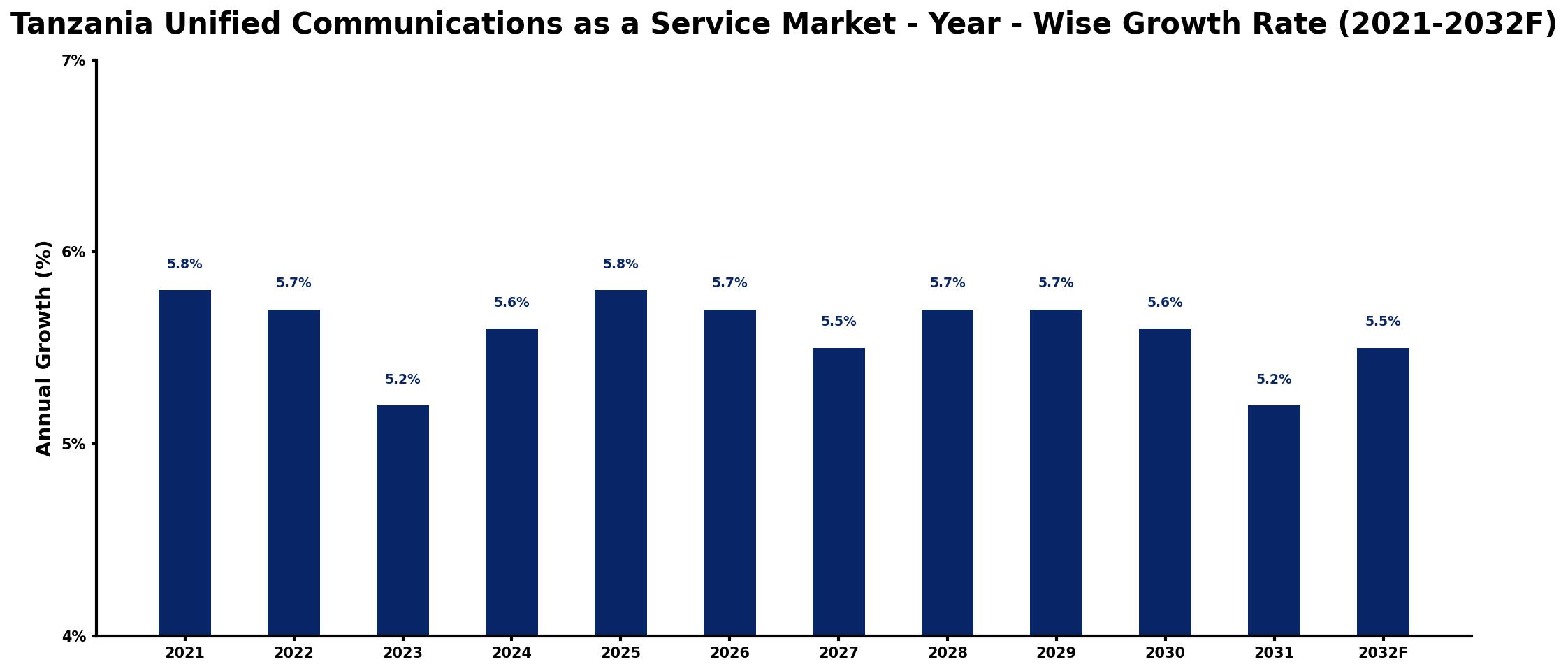
The table below presents the year‑wise growth rates along with the key drivers influencing the market
| Year | Growth Rate | Major Drivers |
| 2021 | 5.8% | increased remote work adoption |
| 2022 | 5.7% | growing cloud infrastructure investments |
| 2023 | 5.2% | rising demand for collaboration tools |
| 2024 | 5.6% | expansion of digital transformation initiatives |
| 2025 | 5.8% | enhanced mobile workforce solutions |
| 2026 | 5.7% | increased focus on cybersecurity measures |
| 2027 | 5.5% | growth in video conferencing usage |
| 2028 | 5.7% | rising end-use demand growth |
| 2029 | 5.7% | increased integration of AI technologies |
| 2030 | 5.6% | growing interest in hybrid solutions |
| 2031 | 5.2% | rising need for scalability options |
| 2032 | 5.5% | increased investment in user experience |
Note: Market size estimations and growth projections presented in this report are based on 6Wresearch's proprietary forecasting methodology, utilizing the latest available industry data, government publications, and primary research inputs.
Tanzania Unified Communications as a Service Market Synopsis
The most significant force shaping the Tanzania Unified Communications as a Service market is the rapid shift toward cloud-based communication solutions, driven by the need for cost-effective and agile business operations. Companies are increasingly recognizing the value of UCaaS in facilitating seamless collaboration among distributed teams.
Additionally, the integration of features such as voice and video conferencing, instant messaging, and file sharing has further propelled market adoption. As organizations in Tanzania pursue more flexible communication methodologies, the UCaaS market is poised for sustained growth, tailored to meet the specific needs of local businesses.
Tanzania Unified Communications as a Service Market Key Takeaways
- The market is witnessing robust growth due to the increasing demand for remote work capabilities.
- Businesses are adopting UCaaS solutions to improve collaboration and reduce operational costs.
- Integration of advanced features is becoming essential for enhancing user experience.
- Security measures are a key focus area for vendors as data privacy concerns grow.
- Government policies are fostering a supportive environment for UCaaS adoption in Tanzania.
Evaluation of Restraints in Tanzania Unified Communications as a Service Market
Despite the promising outlook, the Tanzania Unified Communications as a Service market is confronted with significant restraints. A key issue is the limited internet infrastructure in various regions, which hampers the reliable delivery of UCaaS solutions. Furthermore, the costs associated with the implementation and maintenance of these services can be prohibitive for small to medium-sized enterprises. There is also a considerable gap in awareness regarding the benefits of UCaaS, which can hinder broader adoption. To address these challenges effectively, collaboration between service providers, regulatory bodies, and businesses will be vital.
Tanzania Unified Communications as a Service Market Trends
Key trends shaping the Tanzania Unified Communications as a Service market include a pronounced shift toward remote work arrangements and the increasing integration of mobile applications. As businesses adapt to the realities of a more distributed workforce, the demand for reliable and comprehensive UCaaS solutions continues to rise. Additionally, the ongoing digital transformation across industries is leading to an increased focus on scalable and flexible communication tools, which are crucial for enhancing productivity and efficiency in the workplace.
Tanzania Unified Communications as a Service Market Opportunities
The potential for growth in the Tanzania Unified Communications as a Service market is vast. Investors have ample opportunities to engage with local service providers who are developing UCaaS solutions tailored to the unique needs of Tanzanian businesses. Moreover, partnerships with global UCaaS providers seeking to penetrate the regional market can yield significant benefits. There is also a pressing need for infrastructure development and improvements in network connectivity, which would facilitate broader access to UCaaS offerings and enhance the overall market landscape.
Government Initiatives in the Tanzania Unified Communications as a Service Market
The Tanzanian government plays a pivotal role in shaping the Unified Communications as a Service market through various initiatives aimed at bolstering ICT infrastructure and encouraging digital transformation. Policies have been introduced to attract foreign investment, including incentives such as tax breaks and streamlined regulatory processes. Furthermore, the government emphasizes the importance of data privacy and security, which fosters trust and promotes the adoption of UCaaS solutions across various sectors.
Future Insights of the Tanzania Unified Communications as a Service Market
Looking ahead to the 2026-2032 period, the Tanzania Unified Communications as a Service market is set to witness substantial expansion. The ongoing rise of remote work, coupled with an increasing focus on cost-effective communication solutions, will fuel demand for UCaaS offerings. Improved internet infrastructure and the proliferation of mobile devices are expected to enhance market accessibility and enable a wider range of organizations to harness the benefits of UCaaS. As businesses seek innovative solutions to foster collaboration, this market will continue to evolve, providing numerous opportunities for both local and international players.
Tanzania Unified Communications as a Service Market Latest Developments (2025 - 2026)
In recent months, the Tanzania UCaaS market has seen a notable increase in activity, with several local providers enhancing their service offerings to incorporate advanced features tailored for remote work. The emphasis on integrating enhanced security protocols has gained traction, as businesses become increasingly concerned about data protection. Furthermore, collaborations between technology firms and telecommunications companies have emerged, aimed at improving network reliability and expanding UCaaS access throughout the country.
Tanzania Unified Communications as a Service Market - Key Attractiveness of the Report
- 10 Years of Market Numbers
- Historical Data Starting from 2022 to 2025
- Base Year: 2025
- Forecast Data until 2032
- Key Performance Indicators Impacting the Market
- Major Upcoming Developments and Projects
Key Highlights of the Report:
- Tanzania Unified Communications as a Service Market Outlook
- Market Size of Tanzania Unified Communications as a Service Market, 2025
- Forecast of Tanzania Unified Communications as a Service Market, 2032
- Historical Data and Forecast of Tanzania Unified Communications as a Service Revenues & Volume for the Period 2022-2032F
- Tanzania Unified Communications as a Service Market Trend Evolution
- Tanzania Unified Communications as a Service Market Drivers and Challenges
- Tanzania Unified Communications as a Service Price Trends
- Tanzania Unified Communications as a Service Porter's Five Forces
- Tanzania Unified Communications as a Service Industry Life Cycle
- Historical Data and Forecast of Tanzania Unified Communications as a Service Market Revenues & Volume By Component for the Period 2022-2032F
- Historical Data and Forecast of Tanzania Unified Communications as a Service Market Revenues & Volume By Telephony for the Period 2022-2032F
- Historical Data and Forecast of Tanzania Unified Communications as a Service Market Revenues & Volume By Unified Messaging for the Period 2022-2032F
- Historical Data and Forecast of Tanzania Unified Communications as a Service Market Revenues & Volume By Conferencing for the Period 2022-2032F
- Historical Data and Forecast of Tanzania Unified Communications as a Service Market Revenues & Volume By Collaboration Platforms And Applications for the Period 2022-2032F
- Historical Data and Forecast of Tanzania Unified Communications as a Service Market Revenues & Volume By Organization Size for the Period 2022-2032F
- Historical Data and Forecast of Tanzania Unified Communications as a Service Market Revenues & Volume By SMEs for the Period 2022-2032F
- Historical Data and Forecast of Tanzania Unified Communications as a Service Market Revenues & Volume By Large Enterprises for the Period 2022-2032F
- Historical Data and Forecast of Tanzania Unified Communications as a Service Market Revenues & Volume By Vertical for the Period 2022-2032F
- Historical Data and Forecast of Tanzania Unified Communications as a Service Market Revenues & Volume By BFSI for the Period 2022-2032F
- Historical Data and Forecast of Tanzania Unified Communications as a Service Market Revenues & Volume By Telecom and IT for the Period 2022-2032F
- Historical Data and Forecast of Tanzania Unified Communications as a Service Market Revenues & Volume By Consumer Goods and Retail for the Period 2022-2032F
- Historical Data and Forecast of Tanzania Unified Communications as a Service Market Revenues & Volume By Healthcare for the Period 2022-2032F
- Historical Data and Forecast of Tanzania Unified Communications as a Service Market Revenues & Volume By Public Sector and Utilities for the Period 2022-2032F
- Historical Data and Forecast of Tanzania Unified Communications as a Service Market Revenues & Volume By Logistics and Transportation for the Period 2022-2032F
- Historical Data and Forecast of Tanzania Unified Communications as a Service Market Revenues & Volume By Travel and Hospitality for the Period 2022-2032F
- Historical Data and Forecast of Tanzania Unified Communications as a Service Market Revenues & Volume By Others (Education, Media and Entertainment, and Manufacturing) for the Period 2022-2032F
- Tanzania Unified Communications as a Service Import Export Trade Statistics
- Market Opportunity Assessment By Component
- Market Opportunity Assessment By Organization Size
- Market Opportunity Assessment By Vertical
- Tanzania Unified Communications as a Service Top Companies Market Share
- Tanzania Unified Communications as a Service Competitive Benchmarking By Technical and Operational Parameters
- Tanzania Unified Communications as a Service Company Profiles
- Tanzania Unified Communications as a Service Key Strategic Recommendations






































