Thailand 5G Radio Access Network Market Growth Rate
According to 6Wresearch internal database and industry insights, the Thailand 5G Radio Access Network Market is projected to grow at a substantial compound annual growth rate (CAGR) of 17.2% during the forecast period of 2026–2032.
Thailand 5G Radio Access Network Market Year-wise Growth Rate and Key Drivers
This graph illustrates the annual growth rates of the Thailand 5G Radio Access Network Market from 2021 to 2032, highlighting a steady upward trajectory and projected market expansion over the forecast period.
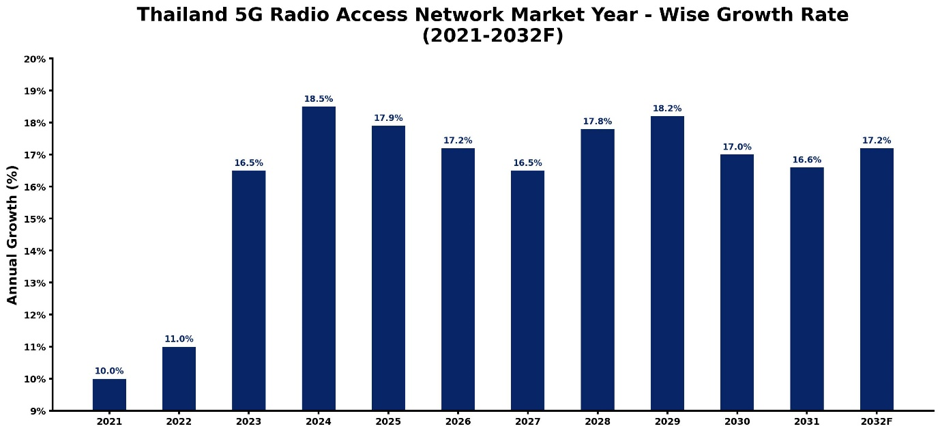
The following table summarizes the historical and forecasted growth rates of the Thailand 5G Radio Access Network Market, along with with the rationale behind each year’s performance.
| Year | Estimated Growth (%) | Market Rationale |
| 2021 | 10% | Initial 5G rollout phase with limited RAN deployments and pilot testing in major cities |
| 2022 | 11% | Early infrastructure expansion as telecom operators begin nationwide 5G coverage planning |
| 2023 | 16.5% | Strong growth driven by rising mobile data usage and densification of urban networks |
| 2024 | 18.5% | Rapid deployment of Massive MIMO and small cells to improve network capacity and speed |
| 2025 | 17.9% | Slight stabilization as initial rollout phase matures and expansion becomes more structured |
| 2026 | 17.2% | Steady growth supported by mainstream 5G adoption and continued infrastructure investment |
| 2027 | 16.5% | Mild slowdown due to high CAPEX requirements and integration complexity of advanced RAN systems |
| 2028 | 17.8% | Growth rebound driven by Open RAN adoption and increasing vendor ecosystem diversification |
| 2029 | 18.2% | Strong expansion supported by private 5G networks, smart city projects, and enterprise demand |
| 2030 | 17% | Moderate growth as market transitions from expansion to optimization phase |
| 2031 | 16.6% | Slight decline due to early saturation in urban RAN deployments and infrastructure maturity |
| 2032 | 17.2% | Stabilized growth driven by network upgrades, edge computing integration, and AI-enabled RAN optimization |
Topics Covered in the Thailand 5G Radio Access Network Market Report
The Thailand 5G Radio Access Network Industry report covers the market by RAN type, frequency, and deployment type. The report provides a detailed analysis of ongoing market trends, opportunities/high-growth areas, and market drivers that will help stakeholders align strategies based on current and future market dynamics.
Thailand 5G Radio Access Network Market Highlights
| Report Name | Thailand 5G Radio Access Network Market |
| Forecast period | 2026-2032 |
| CAGR | 17.2% |
| Growing Sector | Information and Communication Technology (ICT) |
Thailand 5G Radio Access Network Market Synopsis
There is fast growth in the Thailand 5G Radio Access Network (RAN) market owing to rapid rollout of 5G and the rising need for high-capacity wireless infrastructure. RAN technology helps facilitate smooth radio connection between the user devices and core networks, thus offering improved performance for mobile broadband and industrial automation. Growing focus on virtualization and cloud-native technologies is revolutionizing network efficiency. This market is anticipated to see strong adoption by telecom companies, enterprises, and smart connectivity initiatives backed by governments in.
Evaluation of Growth Drivers in Thailand 5G Radio Access Network Market (2026–2032)
Below are some major drivers and their influence on the market dynamics:
| Drivers | Primary Segment Affected | Why It Matters (Evidence) |
| Nationwide 5G rollout acceleration | Sub-6 GHz RAN | Expands coverage across urban and rural areas, enabling mass connectivity adoption |
| Rising demand for ultra-low latency applications | Open RAN / Virtualized RAN | Supports smart manufacturing, autonomous systems, and real-time IoT communication |
| Telecom network virtualization | Cloud-based RAN | Enhances scalability, flexibility, and reduces operational costs for operators |
| Growth of smart cities and IoT ecosystems | Distributed RAN | Requires dense, high-capacity network infrastructure for seamless connectivity |
| Enterprise private 5G adoption | Software-defined RAN | Drives demand for secure, dedicated, and customizable network architectures |
The Thailand 5G Radio Access Network Market is projected to grow strongly at a CAGR of 17.2% during 2026–2032, owing to rapid digital transformation and rising need for high capacity wireless infrastructure. Development of smart cities, industrial automation, and Internet of Things (IoT)-based ecosystems has been driving the deployment of RAN in the country. Telecom operators have been making moves towards cloud-native, virtualized, and Open RAN architecture to enhance efficiency and scalability, while government initiatives are boosting 5G adoption rate in the country.
Evaluation of Restraints in Thailand 5G Radio Access Network Market
Below are some major restraints and their influence on the market dynamics:
| Restraints | Primary Segment Affected | What This Means (Evidence) |
| High infrastructure deployment cost | mmWave / Above 39 GHz | Limits large-scale rollout due to expensive dense network requirements |
| Complex multi-vendor integration | Open RAN | Creates interoperability issues and delays in deployment timelines |
| Spectrum availability constraints | Sub-6 GHz & mmWave | Restricts optimal network performance and expansion speed |
| Cybersecurity risks in cloud RAN | Cloud-based RAN | Raises concerns over data privacy and network reliability |
| Shortage of skilled telecom engineers | Virtualized RAN | Slows down adoption of advanced software-defined network technologies |
Thailand 5G Radio Access Network Market Challenges
Thailand 5G Radio Access Network Market is witnessing certain structural and operational issues such as heavy capital investment required for large-scale infrastructure rollout and reliance on imported telecommunications equipment. Complex integration challenges for existing systems and advanced Open RAN architectures have led to slower rollouts deployment. Lack of experienced workforce for virtualization technology and cloud-native networks results in operational issues. Besides, security threats for cloud-based networks and rural network expansion disparities are posing obstacles to consistent market growth, which requires close cooperation between telecom operators, vendors, and government organizations.
Thailand 5G Radio Access Network (RAN) Market Trends
Below mentioned are the major trends responsible for Thailand 5G Radio Access Network Market Growth:
- Rapid 5G Network Rollouts: The country's telecom operators are rolling out 5G coverage throughout urban and rural areas to increase digital inclusion.
- Move to Virtualized and O-RAN: Operators are increasingly moving towards open RAN architecture to improve network flexibility, as well as reduce dependency on traditional vendors.
- Densified 5G RAN Infrastructure: Growing demand for high-quality video streaming, gaming, and Fixed Wireless Access (FWA) services is driving the spending on densified 5G RAN infrastructure.
Investment Opportunities in Thailand 5G Radio Access Network Market
Below mentioned are the investment opportunities available in Thailand 5G Radio Access Network Market:
- 5G RAN Infrastructure Deployment: Investments in macrocells, small cells, and Massive MIMO solutions may be made to support 5G coverage expansion and densification throughout the country.
- Open RAN Ecosystem Development: Opportunities exist in Software defined RAN solutions, interoperability test platform development, and multi-vendor integrations related to Open RAN adoption.
- Telecom Networks and Optimization Services: RAN optimization software, managed services and AI based network optimization solutions are recurring revenues for investors.
Top 4 Leading Players in Thailand 5G Radio Access Network Market
Stated below are some of the leading companies holding majority of Thailand 5G Radio Access Network Market Share:
1. Nokia Corporation
| Company Name | Nokia Corporation |
| Established Year | 1865 |
| Headquarters | Espoo, Finland |
| Official Website | Click Here |
Nokia provides advanced 5G RAN, Open RAN, and cloud-native telecom solutions widely deployed across Asia-Pacific operators, including Thailand.
2. Telefonaktiebolaget LM Ericsson
| Company Name | Telefonaktiebolaget LM Ericsson |
| Established Year | 1876 |
| Headquarters | Stockholm, Sweden |
| Official Website | Click Here |
Ericsson is a leading provider of end-to-end 5G RAN infrastructure, supporting large-scale deployments and network modernization in Thailand.
3. Huawei Technologies
| Company Name | Huawei Technologies |
| Established Year | 1987 |
| Headquarters | Shenzhen, China |
| Official Website | Click Here |
Huawei supplies high-performance 5G RAN equipment, enabling ultra-dense network coverage and advanced spectrum utilization.
4. ZTE Corporation
| Company Name | ZTE Corporation |
| Established Year | 1985 |
| Headquarters | Shenzhen, China |
| Official Website | Click Here |
ZTE provides integrated 5G RAN systems and end-to-end telecom solutions supporting cost-efficient deployment across emerging markets.
Government Initiatives in Thailand 5G Radio Access Network Market
According to Thai government data, these authorities are actively promoting 5G deployment through national digital economy policies and smart city initiatives. The National Broadcasting and Telecommunications Commission is speeding up the process of spectrum allocation for 5G services, while public-private partnerships support infrastructure expansion. Program such as Thailand 4.0 which pushes the adoption of advanced connectivity in industries such as manufacturing and logistics. Rural broadband investments are contributing to the deployment of RAN infrastructure, which improve nationwide connectivity as well as supporting economic modernization through high-speed networks.
Future Insights of the Thailand 5G Radio Access Network Market
Thailand 5G Radio Access Network Market is forecasted to see robust growth due to the growing deployment of Open RAN, cloud-based infrastructures, and enterprise private networks. Future growth will be influenced by the growing requirement for ultra-low latency applications like autonomous solutions and smart manufacturing. The emphasis will be placed on network virtualization and energy-efficient architecture by telecom companies. Government initiatives along with foreign investments will contribute to making the infrastructure scalable, enabling Thailand to emerge as the regional 5G leader.
Market Segmentation Analysis
The report offers a comprehensive study of the following market segments and their leading categories in market:
By RAN Type – Market Dominated by Distributed RAN, Set for Rapid Expansion
According to Sachin, Senior Research Analyst, 6Wresearch. Distributed RAN dominated the Thailand 5G Radio Access Network Market till 2025 with nearly 40% share, driven by its cost efficiency and widespread deployment across urban and suburban networks. It is expected to maintain leadership during 2026–2032, growing at around 17.5% CAGR due to rising demand for flexible and scalable network architectures.
By Frequency – Market Dominated by Sub-6 GHz, Set for Rapid Expansion
The Sub-6 GHz segment held around 55% market share till 2025 due to its wide coverage and cost-effective deployment advantages. It is projected to remain dominant through 2026–2032, expanding at a CAGR of nearly 17.8%, supported by nationwide 5G rollout strategies.
Note: Market size estimations and growth projections presented in this report are based on 6Wresearch’s advanced forecasting approach, validated with industry datasets as of June 2026.
Key Attractiveness of the Report:
- 10 Years of Market Numbers
- Historical Data Starting from 2022 to 2025
- Base Year: 2025
- Forecast Data until 2032
- Key Performance Indicators Impacting the Market
- Major Upcoming Developments and Projects
Key Highlights of the Report:
- Thailand 5G Radio Access Network Market Outlook
- Market Size of Thailand 5G Radio Access Network Market, 2025
- Forecast of Thailand 5G Radio Access Network Market, 2032
- Historical Data and Forecast of Thailand 5G Radio Access Network Revenues & Volume for the Period 2022- 2032
- Thailand 5G Radio Access Network Market Trend Evolution
- Thailand 5G Radio Access Network Market Drivers and Challenges
- Thailand 5G Radio Access Network Price Trends
- Thailand 5G Radio Access Network Porter's Five Forces
- Thailand 5G Radio Access Network Industry Life Cycle
- Historical Data and Forecast of Thailand 5G Radio Access Network Market Revenues & Volume By RAN Type for the Period 2022- 2032
- Historical Data and Forecast of Thailand 5G Radio Access Network Market Revenues & Volume By Centralized RAN for the Period 2022- 2032
- Historical Data and Forecast of Thailand 5G Radio Access Network Market Revenues & Volume By Open RAN for the Period 2022- 2032
- Historical Data and Forecast of Thailand 5G Radio Access Network Market Revenues & Volume By Virtualized RAN for the Period 2022- 2032
- Historical Data and Forecast of Thailand 5G Radio Access Network Market Revenues & Volume By Distributed RAN for the Period 2022- 2032
- Historical Data and Forecast of Thailand 5G Radio Access Network Market Revenues & Volume By Frequency for the Period 2022- 2032
- Historical Data and Forecast of Thailand 5G Radio Access Network Market Revenues & Volume By Sub-6 GHz for the Period 2022- 2032
- Historical Data and Forecast of Thailand 5G Radio Access Network Market Revenues & Volume By mmWave for the Period 2022- 2032
- Historical Data and Forecast of Thailand 5G Radio Access Network Market Revenues & Volume By 26-39 GHz for the Period 2022- 2032
- Historical Data and Forecast of Thailand 5G Radio Access Network Market Revenues & Volume By Above 39 GHz for the Period 2022- 2032
- Historical Data and Forecast of Thailand 5G Radio Access Network Market Revenues & Volume By Deployment Type for the Period 2022- 2032
- Historical Data and Forecast of Thailand 5G Radio Access Network Market Revenues & Volume By Cloud-based for the Period 2022- 2032
- Historical Data and Forecast of Thailand 5G Radio Access Network Market Revenues & Volume By Hybrid for the Period 2022- 2032
- Historical Data and Forecast of Thailand 5G Radio Access Network Market Revenues & Volume By Software-defined for the Period 2022- 2032
- Historical Data and Forecast of Thailand 5G Radio Access Network Market Revenues & Volume By On-Premise for the Period 2022- 2032
- Thailand 5G Radio Access Network Import Export Trade Statistics
- Market Opportunity Assessment By RAN Type
- Market Opportunity Assessment By Frequency
- Market Opportunity Assessment By Deployment Type
- Thailand 5G Radio Access Network Top Companies Market Share
- Thailand 5G Radio Access Network Competitive Benchmarking By Technical and Operational Parameters
- Thailand 5G Radio Access Network Company Profiles
- Thailand 5G Radio Access Network Key Strategic Recommendations
Market Covered
The report offers an extensive study of the following market segments:
By RAN Type
- Centralized RAN (C-RAN)
- Open RAN (O-RAN)
- Virtualized RAN (vRAN)
- Distributed RAN (D-RAN)
By Frequency
- Sub-6 GHz
- mmWave
- 26–39 GHz
- Above 39 GHz
By Deployment Type
- Cloud-based
- Hybrid
- Software-defined
- On-Premise






































