Thailand Artificial Intelligence (AI) Market Size & Growth Rate (2026-2032)
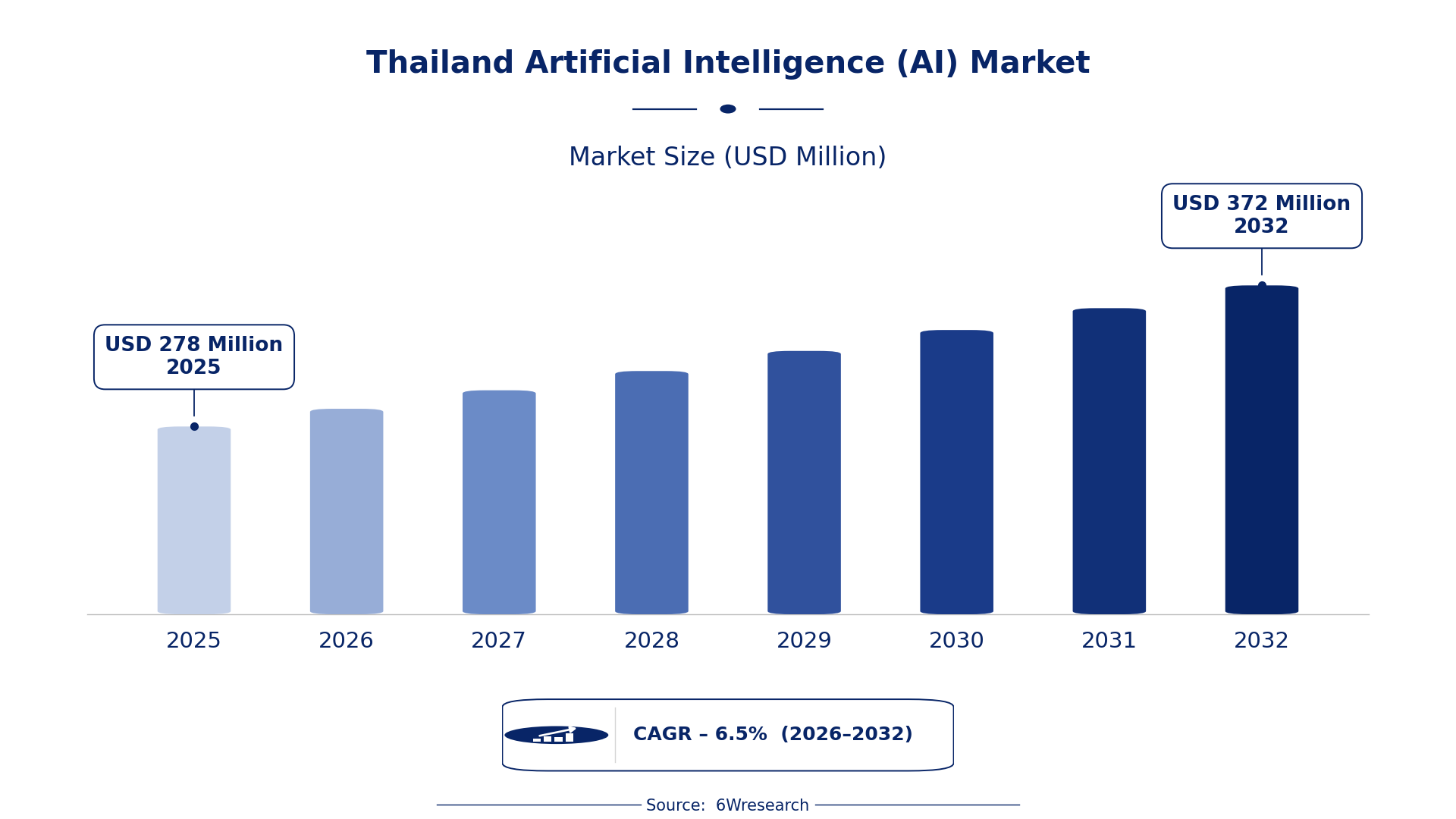
The Thailand Artificial Intelligence (AI) Market was estimated at USD 278 Million in 2025 and is projected to reach USD 372 Million by 2032, growing at a CAGR of 6.5% from 2026 to 2032.
Thailand Artificial Intelligence (AI) Market Synopsis
The increasing adoption of AI technologies is the primary force shaping the Thailand Artificial Intelligence (AI) Market. Businesses across various sectors are realizing the transformative potential of AI, integrating machine learning, natural language processing, and computer vision to enhance operational efficiency and innovate products and services.
As organizations strive to remain competitive, the AI market is expanding rapidly. With applications ranging from healthcare to finance, the focus is on developing intelligent solutions that can drive data-driven decision-making, streamline processes, and ultimately contribute to economic growth in Thailand.
Thailand Artificial Intelligence (AI) Market Year-wise Growth Rate and Key Drivers
This graph illustrates the annual growth rates of the Thailand Artificial Intelligence (AI) Market from 2021 to 2032, highlighting a steady upward trajectory and projected expansion over the forecast period.
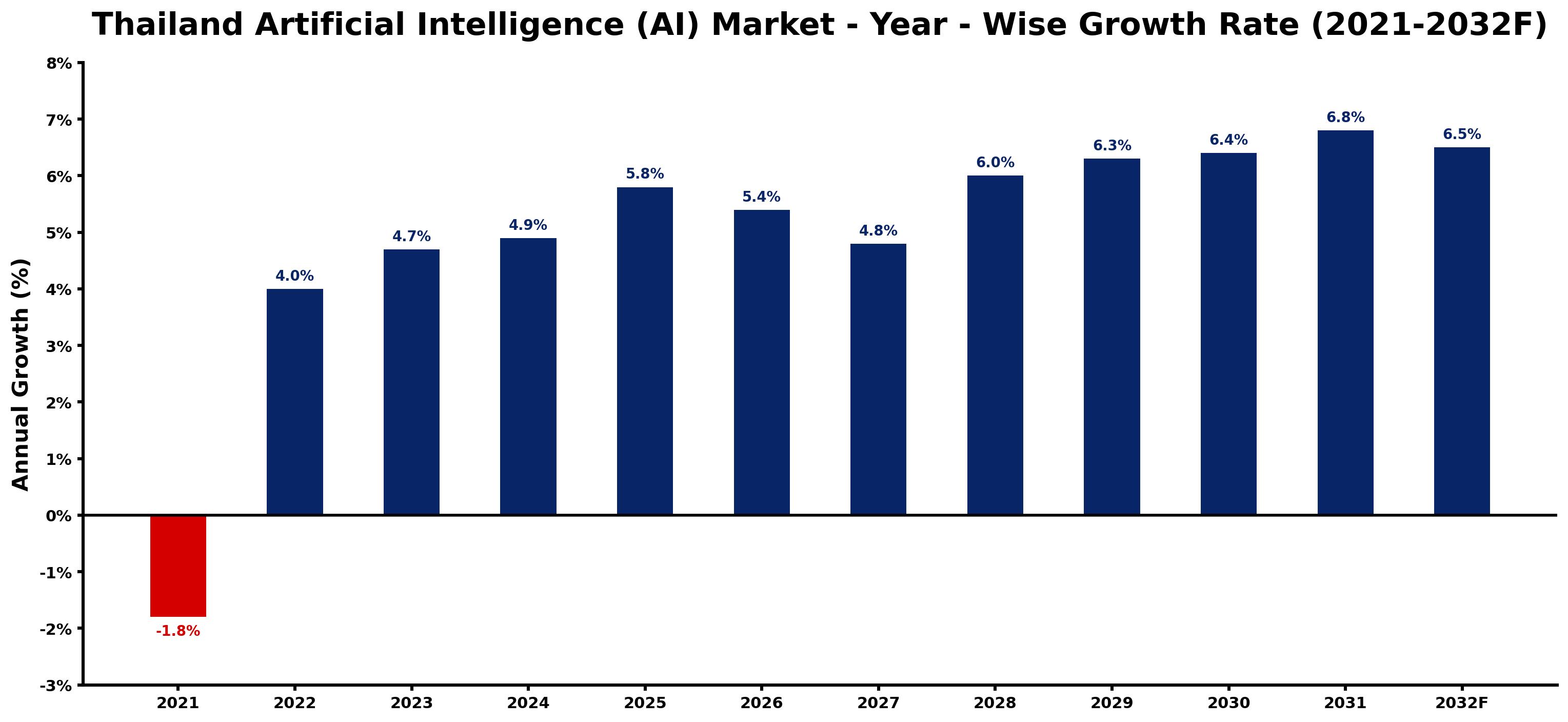
The table below presents the year‑wise growth rates along with the key drivers influencing the market
| Year | Growth Rate | Major Drivers |
| 2021 | -1.8% | Delay in government AI policy implementation from NTPC. |
| 2022 | 4.0% | Thailand's National Artificial Intelligence Strategy support initiatives. |
| 2023 | 4.7% | Increased government funding for AI research and development. |
| 2024 | 4.9% | Growing adoption of AI in fintech for efficiency. |
| 2025 | 5.8% | Burgeoning local startups innovating AI for retail sector. |
| 2026 | 5.4% | Emergence of AI-powered language processing for tourism. |
| 2027 | 4.8% | Growth of AI educational programs at Thai universities. |
| 2028 | 6.0% | Strong demand for AI in supply chain optimization. |
| 2029 | 6.3% | Increased collaboration between tech firms and universities. |
| 2030 | 6.4% | Thailand 4.0 policies driving technology adoption across sectors. |
| 2031 | 6.8% | Rise of AI solutions for public health management. |
| 2032 | 6.5% | Growing integration of AI in Thai SMEs operational processes. |
Note: Market size estimations and growth projections presented in this report are based on 6Wresearch's proprietary forecasting methodology, utilizing the latest available industry data, government publications, and primary research inputs.
Thailand Artificial Intelligence (AI) Market Key Takeaways
Below are some of the specific key takeaways from the market, including:
- The Thailand AI market is projected to grow significantly, reaching USD 372 Million by 2032.
- Machine learning and natural language processing are among the most sought-after AI applications.
- Businesses are increasingly recognizing AI as a key driver of innovation and efficiency.
- Ethical deployment of AI technologies remains a critical challenge for market participants.
- Government initiatives are actively shaping the regulatory environment for AI applications.
Evaluation of Restraints in Thailand Artificial Intelligence (AI) Market
The Thailand Artificial Intelligence (AI) Market faces notable restraints that could hinder its growth trajectory. Concerns about the ethical deployment of AI technologies pose significant challenges. Companies must navigate issues related to transparency, fairness, and accountability, particularly in sensitive areas such as finance and healthcare. The public's skepticism towards AI applications, fueled by fears of job displacement and privacy violations, further complicates the landscape. As a result, businesses need to prioritize ethical considerations to build trust and foster acceptance of AI solutions.
Thailand Artificial Intelligence (AI) Market Trends
A clear trend emerging in the Thailand AI market is the shift towards automation, with businesses increasingly adopting AI-driven solutions to optimize their operations. The demand for AI applications in healthcare is also on the rise, particularly in telemedicine and diagnostics. Additionally, organizations are focusing on integrating AI with Internet of Things (IoT) technologies, enhancing data analysis capabilities and operational efficiency. As AI becomes more accessible, small and medium enterprises are beginning to explore its potential, driving further growth in this sector.
Thailand Artificial Intelligence (AI) Market Opportunities
The Thailand AI market presents numerous growth and investment opportunities. Companies that invest in AI research and development can capitalize on emerging technologies and applications. The healthcare sector, in particular, offers significant prospects, with AI solutions for patient care and administrative efficiencies gaining traction. on top of that, businesses willing to adopt AI for enhancing customer experiences through personalized services will likely find a competitive edge. As public and private sectors collaborate to advance AI initiatives, the potential for innovation continues to expand.
Government Initiatives in the Thailand Artificial Intelligence (AI) Market
Government policy plays a crucial role in shaping the Thailand Artificial Intelligence (AI) Market. The Thai government is focused on developing a regulatory framework that supports AI innovation while ensuring ethical deployment. With various initiatives underway, the government aims to create an environment conducive to technological advancements, fostering collaboration between public and private sectors.
- A national digital infrastructure upgrade programme launched in late 2022 aims to enhance connectivity and support AI initiatives.
- A regulatory framework introduced in 2025 mandates transparency in AI algorithms used in public sector applications.
- Currently ongoing is a public-private partnership initiative that seeks to expand AI research funding and promote local start-ups.
- Upcoming initiatives include a planned AI skill development programme set to begin in 2026, targeting workforce readiness.
Future Insights of the Thailand Artificial Intelligence (AI) Market
Looking ahead to 2026-2032, the Thailand Artificial Intelligence (AI) Market is expected to experience sustained growth driven by technological advancements and increased adoption across various sectors. As businesses continue to integrate AI into their operations, the focus will shift towards developing more sophisticated algorithms and applications. The collaboration between government and industry stakeholders will play a pivotal role in addressing ethical concerns while fostering innovation, ensuring that the market remains competitive and responsive to the needs of the economy.
Thailand Artificial Intelligence (AI) Market Latest Developments
In the past year, the Thailand Artificial Intelligence (AI) Market has seen a surge in activity as companies ramp up their AI capabilities. A notable trend is the increasing collaboration between tech firms and educational institutions to foster AI talent, highlighting the growing importance of workforce development in this field.
- A major technology vendor launched an AI-driven customer service platform in early 2023, successfully enhancing client interactions.
- A partnership between a leading regional operator and a local university began in Q1 2023 to advance AI research and development.
- An initiative that started in mid-2023 is underway to implement AI solutions in smart city projects across urban areas.
- Plans are in place for a comprehensive AI training programme targeting small businesses, expected to roll out by late 2024.
Thailand Artificial Intelligence (AI) Market - Key Attractiveness of the Report
- 10 Years of Market Numbers
- Historical Data Starting from 2022 to 2025
- Base Year: 2025
- Forecast Data until 2032
- Key Performance Indicators Impacting the Market
- Major Upcoming Developments and Projects
Key Highlights of the Report:
- Thailand Artificial Intelligence (AI) Market Outlook
- Market Size of Thailand Artificial Intelligence (AI) Market, 2025
- Forecast of Thailand Artificial Intelligence (AI) Market, 2032
- Historical Data and Forecast of Thailand Artificial Intelligence (AI) Revenues & Volume for the Period 2022-2032F
- Thailand Artificial Intelligence (AI) Market Trend Evolution
- Thailand Artificial Intelligence (AI) Market Drivers and Challenges
- Thailand Artificial Intelligence (AI) Price Trends
- Thailand Artificial Intelligence (AI) Porter's Five Forces
- Thailand Artificial Intelligence (AI) Industry Life Cycle
- Historical Data and Forecast of Thailand Artificial Intelligence (AI) Market Revenues & Volume By Offering for the Period 2022-2032F
- Historical Data and Forecast of Thailand Artificial Intelligence (AI) Market Revenues & Volume By Hardware for the Period 2022-2032F
- Historical Data and Forecast of Thailand Artificial Intelligence (AI) Market Revenues & Volume By Software for the Period 2022-2032F
- Historical Data and Forecast of Thailand Artificial Intelligence (AI) Market Revenues & Volume By Services for the Period 2022-2032F
- Historical Data and Forecast of Thailand Artificial Intelligence (AI) Market Revenues & Volume By Technology for the Period 2022-2032F
- Historical Data and Forecast of Thailand Artificial Intelligence (AI) Market Revenues & Volume By Machine Learning for the Period 2022-2032F
- Historical Data and Forecast of Thailand Artificial Intelligence (AI) Market Revenues & Volume By Natural Language Processing for the Period 2022-2032F
- Historical Data and Forecast of Thailand Artificial Intelligence (AI) Market Revenues & Volume By Context-Aware Computing for the Period 2022-2032F
- Historical Data and Forecast of Thailand Artificial Intelligence (AI) Market Revenues & Volume By Computer Vision for the Period 2022-2032F
- Historical Data and Forecast of Thailand Artificial Intelligence (AI) Market Revenues & Volume By Business Function for the Period 2022-2032F
- Historical Data and Forecast of Thailand Artificial Intelligence (AI) Market Revenues & Volume By Finance for the Period 2022-2032F
- Historical Data and Forecast of Thailand Artificial Intelligence (AI) Market Revenues & Volume By Security for the Period 2022-2032F
- Historical Data and Forecast of Thailand Artificial Intelligence (AI) Market Revenues & Volume By Human Resources for the Period 2022-2032F
- Historical Data and Forecast of Thailand Artificial Intelligence (AI) Market Revenues & Volume By Law for the Period 2022-2032F
- Historical Data and Forecast of Thailand Artificial Intelligence (AI) Market Revenues & Volume By Marketing and Sales for the Period 2022-2032F
- Historical Data and Forecast of Thailand Artificial Intelligence (AI) Market Revenues & Volume By Other Business Function (IT operations) for the Period 2022-2032F
- Historical Data and Forecast of Thailand Artificial Intelligence (AI) Market Revenues & Volume By Deployment Mode for the Period 2022-2032F
- Historical Data and Forecast of Thailand Artificial Intelligence (AI) Market Revenues & Volume By On-premises for the Period 2022-2032F
- Historical Data and Forecast of Thailand Artificial Intelligence (AI) Market Revenues & Volume By Cloud for the Period 2022-2032F
- Historical Data and Forecast of Thailand Artificial Intelligence (AI) Market Revenues & Volume By Organization Size for the Period 2022-2032F
- Historical Data and Forecast of Thailand Artificial Intelligence (AI) Market Revenues & Volume By Large Enterprises for the Period 2022-2032F
- Historical Data and Forecast of Thailand Artificial Intelligence (AI) Market Revenues & Volume By SMEs for the Period 2022-2032F
- Historical Data and Forecast of Thailand Artificial Intelligence (AI) Market Revenues & Volume By Verticals for the Period 2022-2032F
- Historical Data and Forecast of Thailand Artificial Intelligence (AI) Market Revenues & Volume By BFSI for the Period 2022-2032F
- Historical Data and Forecast of Thailand Artificial Intelligence (AI) Market Revenues & Volume By IT/ ITES for the Period 2022-2032F
- Historical Data and Forecast of Thailand Artificial Intelligence (AI) Market Revenues & Volume By Telecommunication for the Period 2022-2032F
- Historical Data and Forecast of Thailand Artificial Intelligence (AI) Market Revenues & Volume By Government and Defense for the Period 2022-2032F
- Historical Data and Forecast of Thailand Artificial Intelligence (AI) Market Revenues & Volume By Manufacturing for the Period 2022-2032F
- Historical Data and Forecast of Thailand Artificial Intelligence (AI) Market Revenues & Volume By Healthcare and Lifesciences for the Period 2022-2032F
- Historical Data and Forecast of Thailand Artificial Intelligence (AI) Market Revenues & Volume By Retail and Ecommerce for the Period 2022-2032F
- Historical Data and Forecast of Thailand Artificial Intelligence (AI) Market Revenues & Volume By Automotive, Transportation & Logistics for the Period 2022-2032F
- Thailand Artificial Intelligence (AI) Import Export Trade Statistics
- Market Opportunity Assessment By Offering
- Market Opportunity Assessment By Technology
- Market Opportunity Assessment By Business Function
- Market Opportunity Assessment By Deployment Mode
- Market Opportunity Assessment By Organization Size
- Market Opportunity Assessment By Verticals
- Thailand Artificial Intelligence (AI) Top Companies Market Share
- Thailand Artificial Intelligence (AI) Competitive Benchmarking By Technical and Operational Parameters
- Thailand Artificial Intelligence (AI) Company Profiles
- Thailand Artificial Intelligence (AI) Key Strategic Recommendations






































