Thailand Automobile Components Market Summary
The thailand automobile components market was estimated at USD 140 Million in 2025 and is projected to reach USD 161 Million by 2032, growing at a CAGR of 2.8% from 2026 to 2032.
Thailand Automobile Components Market Year-wise Growth Rate and Key Drivers
This graph highlights how the Thailand Automobile Components Market has steadily grown over the past five years, supported by major growth factors.
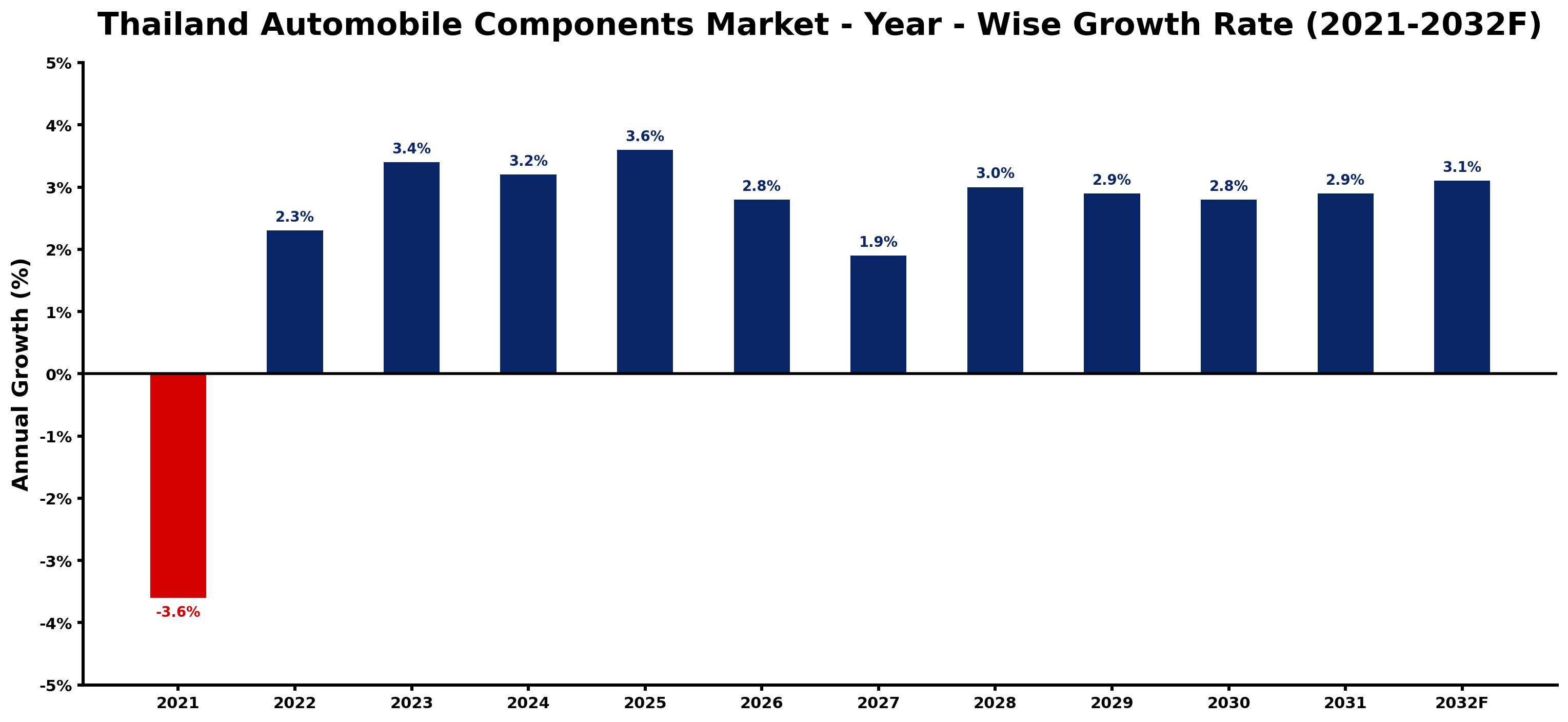
The table below presents the year wise growth rates along with the key drivers influencing the market
| Year | Growth Rate | Major Drivers |
| 2021 | -3.6% | Pandemicrelated supply chain disruptions hampered production efficiency, leading to decreased automotive component availability. |
| 2022 | 2.3% | Manufacturers began investing heavily in automation to improve production efficiency. |
| 2023 | 3.4% | Emerging electric vehicle demand prompted innovation in battery component production. |
| 2024 | 3.2% | Collaborations between automakers and tech firms accelerated development of smart components. |
| 2025 | 3.6% | Consumer preferences shifted towards fuel-efficient vehicles, influencing component design choices. |
| 2026 | 2.8% | Sustainability trends encouraged the use of eco-friendly materials in manufacturing processes. |
| 2027 | 1.9% | Thailand's automotive exports expanded, attracting foreign investment in component production. |
| 2028 | 3.0% | Increased vehicle ownership rates stimulated demand for aftermarket parts and accessories. |
| 2029 | 2.9% | Technological advancements in vehicle safety features created new component opportunities. |
| 2030 | 2.8% | Shift towards autonomous driving technologies required advanced sensors and electronic components. |
| 2031 | 2.9% | Changing demographics led to a growing market for compact and hybrid vehicles. |
| 2032 | 3.1% | Emerging market trends emphasized connectivity, enhancing the need for digital components. |
Note - Market size estimations and growth projections presented in this report are based on 6Wresearch's advanced forecasting approach, validated with industry datasets as of June 2026.
Thailand Automobile Components Market Synopsis
The Thailand Automobile Components Market is projected to reach 2.8% and witness significant growth during the forecast period (2026-2032). The automotive components sector plays a pivotal role in the broader economic landscape of Thailand, contributing approximately 11% to its gross domestic product (GDP) and providing jobs for over 2 million individuals. The market not only supports local employment but also significantly adds to the nation's export revenues, particularly with shipments directed towards major markets such as Japan, Europe, and North America.
Thailand Automobile Components Market Growth Drivers
The growth trajectory of the Thailand Automobile Components Market can be primarily attributed to a range of dynamic factors. Among these, the increasing consumer income levels have led to a higher demand for vehicles, which in turn drives the need for vehicle components. Additionally, government incentives aimed at fostering research and development among local manufacturers bolster innovation and competitiveness.
- Rising consumer income levels enhance purchasing power, leading to increased demand for personal and commercial vehicles.
- Government support through various initiatives encourages local manufacturers to invest in R&D, enhancing product quality and innovation.
- Robust infrastructure development, fueled by public and private investment, significantly improves logistics and supply chain efficiency for the automotive sector.
- Favorable trade agreements within the ASEAN region facilitate smoother export operations and bolster the competitiveness of Thai manufacturers in international markets.
- Technological advancements in manufacturing processes enable improved production efficiency, reducing costs and increasing output capabilities.
Thailand Automobile Components Market Challenges and Restraints
Despite the favorable market conditions, certain challenges could hinder the growth of the Thailand Automobile Components Market. Stringent environmental regulations, especially concerning emissions standards, are becoming a significant compliance burden for manufacturers.
- Compliance with increasingly stringent environmental regulations leads to higher operational costs for manufacturers, potentially impacting profitability.
- Currency exchange rate fluctuations present risks for exporters, making product pricing less predictable and reducing competitive edge in foreign markets.
- The potential for economic fluctuations can lead to reduced consumer confidence, adversely affecting vehicle sales and subsequently the components market.
- Supply chain disruptions, particularly in the wake of global events such as the COVID-19 pandemic, reveal vulnerabilities that can impact production continuity.
- Technological disruptions, while offering opportunities, also demand continuous investment in upskilling the workforce and updating manufacturing capabilities.
Thailand Automobile Components Market Government Investment and Initiatives
The Thai government has been actively implementing policies to enhance the automobile components sector's competitiveness in the ASEAN region and globally. Public spending directed towards infrastructure development specifically benefits the automotive supply chain, improving access to raw materials and markets.
- Investment in transportation infrastructure, including road and rail networks, is prioritized to facilitate smoother logistics for manufacturers.
- Incentives for automakers that invest in sustainable practices are being promoted, aligning the industry with global sustainability trends.
- Support for vocational training programs aims to develop a skilled workforce tailored to the needs of the automotive industry.
- Government-backed initiatives focus on innovation, with grants and funding available for R&D projects that enhance product offerings in the automobile components sector.
- Partnerships between public and private sectors are encouraged to foster collaboration, driving growth and creating a more dynamic business environment for automobile component manufacturers.
Thailand Automobile Components Market Latest Developments (May 2025 - June 2026)
Recent developments within the Thailand Automobile Components Market indicate a strategic focus on sustainability and technological innovation. Efforts to adopt electric and hybrid vehicle components have gained momentum, reflecting a global shift towards green technology. Furthermore, several local manufacturers are investing in advanced manufacturing technologies, including automation and artificial intelligence, to enhance production efficiency and minimize costs.
- Industry players are increasingly exploring collaborations with technology firms to innovate connected vehicle components, ensuring compatibility with evolving automotive technologies.
- Increased participation in regional automotive trade shows has led to greater exposure to international markets, allowing Thai manufacturers to showcase their capabilities.
- The government's revised automotive policy, aimed at enhancing local production and reducing dependency on imports, has further stimulated interest and investment in the sector.
- Emerging trends in lightweight materials for vehicle manufacturing are being researched and developed, aligning with global demands for improved fuel efficiency.
- Ongoing assessments of trade agreements are paving the way for more favorable export conditions, enhancing the competitive standing of Thai automobile components in global markets.
Thailand Automobile Components Market - Key Attractiveness of the Report
- 10 Years of Market Numbers
- Historical Data Starting from 2022 to 2025
- Base Year: 2025
- Forecast Data until 2032
- Key Performance Indicators Impacting the Market
- Major Upcoming Developments and Projects
Key Highlights of the Report:
- Thailand Automobile Components Market Outlook
- Market Size of Thailand Automobile Components Market, 2025
- Forecast of Thailand Automobile Components Market, 2032
- Historical Data and Forecast of Thailand Automobile Components Revenues & Volume for the Period 2022-2032F
- Thailand Automobile Components Market Trend Evolution
- Thailand Automobile Components Market Drivers and Challenges
- Thailand Automobile Components Price Trends
- Thailand Automobile Components Porter's Five Forces
- Thailand Automobile Components Industry Life Cycle
- Historical Data and Forecast of Thailand Automobile Components Market Revenues & Volume By Product Type for the Period 2022-2032F
- Historical Data and Forecast of Thailand Automobile Components Market Revenues & Volume By Flywheel for the Period 2022-2032F
- Historical Data and Forecast of Thailand Automobile Components Market Revenues & Volume By Pressure Plate for the Period 2022-2032F
- Historical Data and Forecast of Thailand Automobile Components Market Revenues & Volume By Clutch for the Period 2022-2032F
- Historical Data and Forecast of Thailand Automobile Components Market Revenues & Volume By Other for the Period 2022-2032F
- Historical Data and Forecast of Thailand Automobile Components Market Revenues & Volume By Applications for the Period 2022-2032F
- Historical Data and Forecast of Thailand Automobile Components Market Revenues & Volume By Passenger Cars (PC) for the Period 2022-2032F
- Historical Data and Forecast of Thailand Automobile Components Market Revenues & Volume By Light Commercial Vehicles (LCV) for the Period 2022-2032F
- Historical Data and Forecast of Thailand Automobile Components Market Revenues & Volume By Heavy Commercial Vehicles (HCV) for the Period 2022-2032F
- Thailand Automobile Components Import Export Trade Statistics
- Market Opportunity Assessment By Product Type
- Market Opportunity Assessment By Applications
- Thailand Automobile Components Top Companies Market Share
- Thailand Automobile Components Competitive Benchmarking By Technical and Operational Parameters
- Thailand Automobile Components Company Profiles
- Thailand Automobile Components Key Strategic Recommendations






































