Thailand Automotive Drive Shaft Market Size, Share & Growth Rate
The Thailand Automotive Drive Shaft Market was estimated at USD 236 Million in 2025 and is projected to reach USD 270 Million by 2032, growing at a CAGR of 1.9% from 2026 to 2032. This growth trajectory is fueled by the resilience of Thailands automotive manufacturing sector, which remains robust despite economic fluctuations. The increasing consumer inclination towards SUVs and the accelerating adoption of electric and hybrid vehicles are further propelling demand for advanced drive shaft technologies in the region.
Thailand Automotive Drive Shaft Market Year-wise Growth Rate and Key Drivers
This graph highlights how the Thailand Automotive Drive Shaft Market has steadily grown over the years, supported by major growth factors.
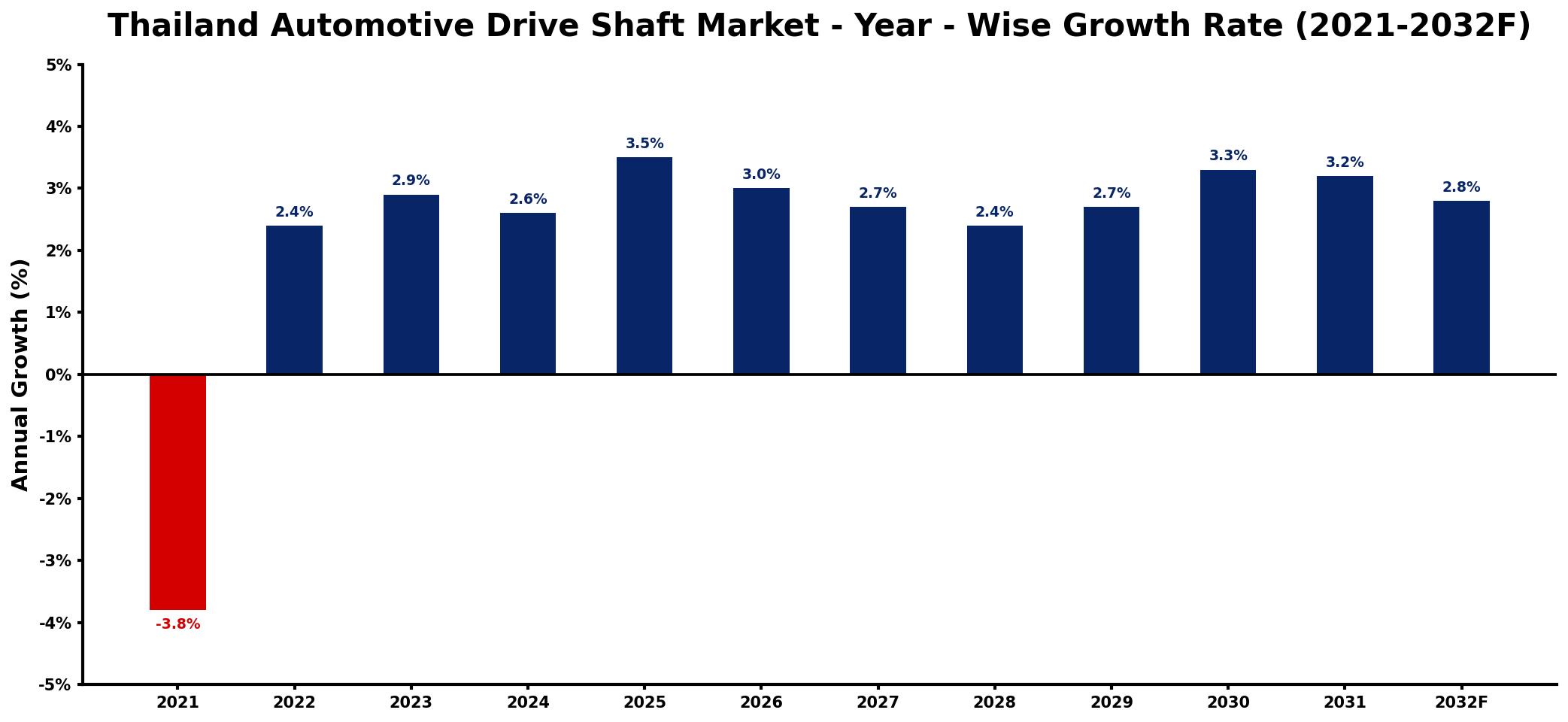
The table below presents the year‑wise growth rates along with the key drivers influencing the market
| Year | Growth Rate | Major Drivers |
| 2021 | -3.8% | decrease in vehicle production rates |
| 2022 | 2.4% | rising demand for electric vehicles |
| 2023 | 2.9% | increased investments in manufacturing |
| 2024 | 2.6% | expansion of local suppliers network |
| 2025 | 3.5% | growing preference for fuel efficiency |
| 2026 | 3.0% | innovation in vehicle technology applications |
| 2027 | 2.7% | increased focus on sustainability practices |
| 2028 | 2.4% | development of new market segments |
| 2029 | 2.7% | rising consumer spending on mobility |
| 2030 | 3.3% | enhancements in manufacturing capabilities |
| 2031 | 3.2% | growing popularity of hybrid vehicles |
| 2032 | 2.8% | increased production capacity utilization |
Note: Market size estimations and growth projections presented in this report are based on 6Wresearch's proprietary forecasting methodology, utilizing the latest available industry data, government publications, and primary research inputs.
Thailand Automotive Drive Shaft Market Synopsis
A pivotal force currently shaping the Thailand Automotive Drive Shaft Market is the rapid evolution towards electric and hybrid vehicles. As the automotive sector pivots to meet global sustainability goals, manufacturers are compelled to innovate their drive shaft solutions, aligning with the demands of this changing landscape.
Additionally, the growth of Thailand as a prominent automobile manufacturing hub continues to drive significant demand for drive shafts. With a strong emphasis on quality and compliance with international standards, local manufacturers are positioned to capitalize on both domestic and export opportunities.
Thailand Automotive Drive Shaft Market Key Takeaways
- Robust growth is anticipated in the automotive drive shaft sector due to rising vehicle production.
- The market is witnessing a notable shift towards electric and hybrid vehicle components.
- Quality assurance and adherence to global automotive standards are crucial for manufacturers.
- Investment in R&D is becoming increasingly important to keep pace with technological advancements.
- The export-oriented nature of Thailand's automotive industry fosters continuous innovation.
Evaluation of Restraints in Thailand Automotive Drive Shaft Market
Despite the promising growth, the Thailand Automotive Drive Shaft Market faces tangible restraints. The need to adapt to shifting automotive technologies, particularly the rise of electric and hybrid vehicles, necessitates significant investment in R&D, which can strain resources for many manufacturers. Furthermore, ensuring compliance with rigorous safety standards demands both time and financial commitment. Navigating global supply chain issues, such as sourcing materials and managing disruptions, adds another layer of complexity for players in this market.
Thailand Automotive Drive Shaft Market Trends
Current trends within the Thailand Automotive Drive Shaft Market reflect a strong shift towards lightweight materials that enhance fuel efficiency and performance. Moreover, an increasing focus on drive shafts designed for electric and hybrid vehicles is evident, with manufacturers working on innovations to reduce weight while maintaining strength and durability. Additionally, the trend towards customization is gaining traction, as automotive manufacturers seek to differentiate their products in a competitive landscape.
Thailand Automotive Drive Shaft Market Opportunities
The transition to electric vehicles presents significant growth opportunities for the automotive drive shaft market. Manufacturers capable of developing specialized components for EVs can tap into a burgeoning segment driven by global sustainability trends. Furthermore, investment in advanced manufacturing techniques such as automation and AI can lead to improved efficiency and productivity, ultimately enhancing market competitiveness.
Government Initiatives in the Thailand Automotive Drive Shaft Market
The Thai government has implemented several initiatives aimed at boosting the automotive sector, focusing on promoting electric vehicle adoption and enhancing the overall manufacturing ecosystem. Policies encouraging investment in green technologies and offering incentives for R&D are integral to this framework. Furthermore, public spending on infrastructure improvements facilitates better logistics for manufacturers, supporting the automotive supply chain.
Future Insights of the Thailand Automotive Drive Shaft Market
Looking ahead to 2026-2032, the Thailand Automotive Drive Shaft Market is poised for transformative changes. As the automotive sector increasingly embraces electrification, manufacturers will need to prioritize innovation in drive shaft technologies. The anticipated rise in domestic and global demand for EVs, coupled with Thailand's strategic position as an automotive hub, will underpin market expansion. Overall, the future of the market appears promising, driven by adaptation and responsiveness to evolving consumer preferences.
Thailand Automotive Drive Shaft Market Latest Developments (2025 - 2026)
In recent months, the Thailand Automotive Drive Shaft Market has witnessed a heightened focus on developing drive shaft solutions compatible with electric vehicles. Manufacturers are increasingly investing in research collaborations aimed at improving material strength and weight reduction. Additionally, several industry stakeholders have initiated partnerships to address supply chain challenges and enhance production efficiency, ensuring they remain competitive in a rapidly evolving marketplace.
Thailand Automotive Drive Shaft Market - Key Attractiveness of the Report
- 10 Years of Market Numbers
- Historical Data Starting from 2022 to 2025
- Base Year: 2025
- Forecast Data until 2032
- Key Performance Indicators Impacting the Market
- Major Upcoming Developments and Projects
Key Highlights of the Report:
- Thailand Automotive Drive Shaft Market Outlook
- Market Size of Thailand Automotive Drive Shaft Market, 2025
- Forecast of Thailand Automotive Drive Shaft Market, 2032
- Historical Data and Forecast of Thailand Automotive Drive Shaft Revenues & Volume for the Period 2022-2032F
- Thailand Automotive Drive Shaft Market Trend Evolution
- Thailand Automotive Drive Shaft Market Drivers and Challenges
- Thailand Automotive Drive Shaft Price Trends
- Thailand Automotive Drive Shaft Porter's Five Forces
- Thailand Automotive Drive Shaft Industry Life Cycle
- Historical Data and Forecast of Thailand Automotive Drive Shaft Market Revenues & Volume By Design Type for the Period 2022-2032F
- Historical Data and Forecast of Thailand Automotive Drive Shaft Market Revenues & Volume By Hollow Shaft for the Period 2022-2032F
- Historical Data and Forecast of Thailand Automotive Drive Shaft Market Revenues & Volume By Solid Shaft for the Period 2022-2032F
- Historical Data and Forecast of Thailand Automotive Drive Shaft Market Revenues & Volume By Position Type for the Period 2022-2032F
- Historical Data and Forecast of Thailand Automotive Drive Shaft Market Revenues & Volume By Rear Axle for the Period 2022-2032F
- Historical Data and Forecast of Thailand Automotive Drive Shaft Market Revenues & Volume By Front Axle for the Period 2022-2032F
- Historical Data and Forecast of Thailand Automotive Drive Shaft Market Revenues & Volume By Vehicle Type for the Period 2022-2032F
- Historical Data and Forecast of Thailand Automotive Drive Shaft Market Revenues & Volume By Passenger Cars for the Period 2022-2032F
- Historical Data and Forecast of Thailand Automotive Drive Shaft Market Revenues & Volume By Commercial Vehicles for the Period 2022-2032F
- Thailand Automotive Drive Shaft Import Export Trade Statistics
- Market Opportunity Assessment By Design Type
- Market Opportunity Assessment By Position Type
- Market Opportunity Assessment By Vehicle Type
- Thailand Automotive Drive Shaft Top Companies Market Share
- Thailand Automotive Drive Shaft Competitive Benchmarking By Technical and Operational Parameters
- Thailand Automotive Drive Shaft Company Profiles
- Thailand Automotive Drive Shaft Key Strategic Recommendations






































