Thailand Automotive Wheel Rims Market Size, Share & Growth Rate
The Thailand Automotive Wheel Rims Market was estimated at USD 95 Million in 2025 and is projected to reach USD 109 Million by 2032, growing at a CAGR of 2.0% from 2026 to 2032. This trajectory reflects a growing automotive sector driven by rising consumer purchasing power and a significant demand for personalized vehicle aesthetics. As vehicle owners increasingly seek enhanced performance and style, the demand for premium wheel rims will likely continue to escalate.
Thailand Automotive Wheel Rims Market Growth Rate Analysis (2021-2032)
The Thailand Automotive Wheel Rims Market has shown a pronounced recovery after experiencing a decline of 3.2% in 2021. With a growth of 2.6% in 2022, this upward trend continued into 2023, where it reached 3.0%. Factors contributing to this resurgence include a rebound in consumer demand driven by increased vehicle sales and a push towards more sustainable manufacturing practices. Additionally, investments in advanced technologies and infrastructure enhancements have bolstered production efficiency. Projections for the coming years suggest stable growth rates, with 3.5% anticipated in 2025, reflecting ongoing adaptations within the automotive sector. The momentum is expected to foster a favorable business environment, enhancing the market's resilience through 2032.
Thailand Automotive Wheel Rims Market Year-wise Growth Rate and Key Drivers
This graph highlights how the Thailand Automotive Wheel Rims Market has steadily grown over the past five years, supported by major growth factors.
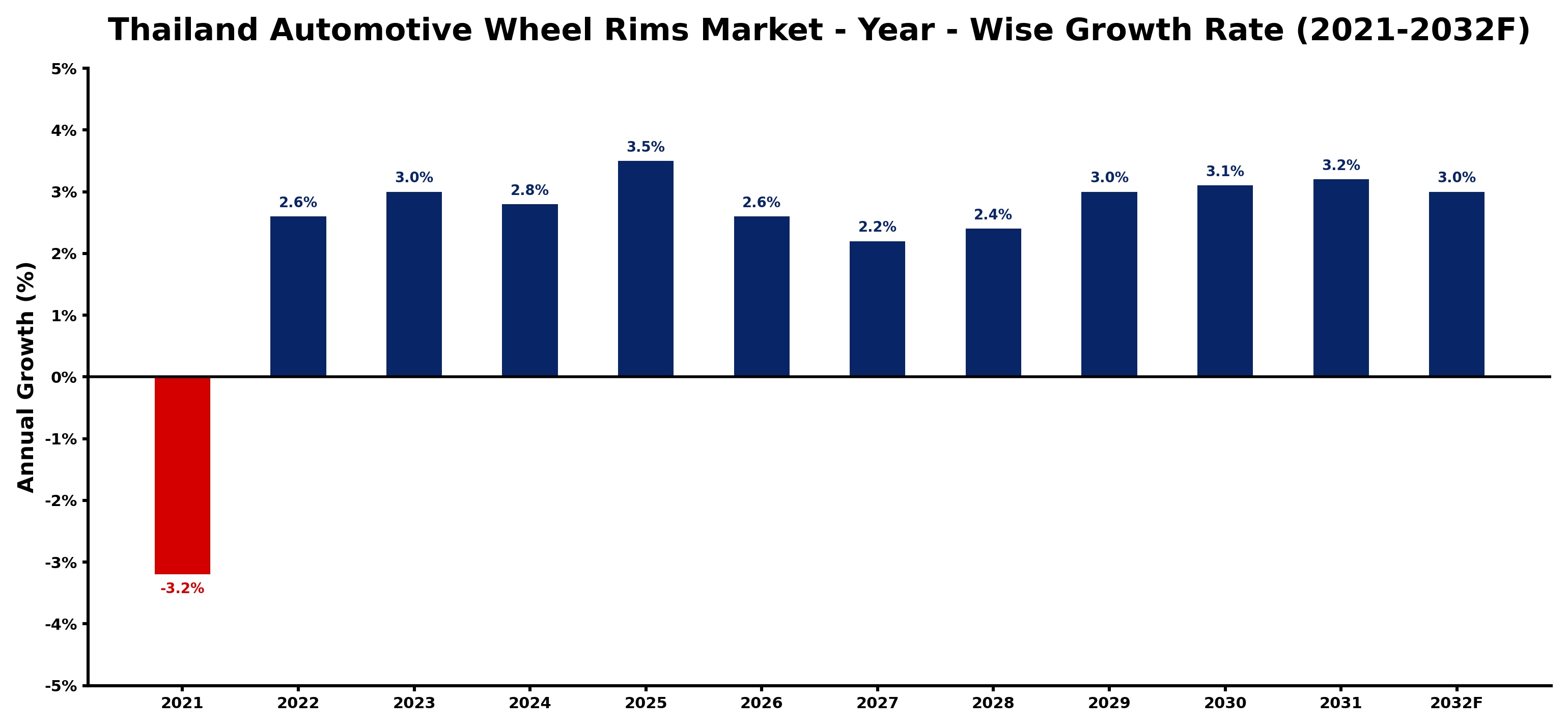
The table below presents the year‑wise growth rates along with the key drivers influencing the market
| Year | Growth Rate | Major Drivers |
| 2021 | -3.2% | Supply chain disruptions limited production |
| 2022 | 2.6% | Electric vehicle adoption increased demand |
| 2023 | 3.0% | Automotive industry recovery accelerated growth |
| 2024 | 2.8% | Technological advancements enhanced efficiency |
| 2025 | 3.5% | Rising consumer preferences for customization |
| 2026 | 2.6% | Sustainability trends drove innovation forward |
| 2027 | 2.2% | Increased vehicle sales supported market |
| 2028 | 2.4% | Export opportunities expanded significantly |
| 2029 | 3.0% | Investment in manufacturing capacity increased |
| 2030 | 3.1% | Collaborations with automakers enhanced offerings |
| 2031 | 3.2% | Rising disposable incomes boosted sales |
| 2032 | 3.0% | Market diversification attracted new entrants |
Note - Market size estimations and growth projections presented in this report are based on 6Wresearch’s advanced forecasting approach, validated with industry datasets as of June 2026.
Thailand Automotive Wheel Rims Market Synopsis
In recent years, Thailand's automotive wheel rims market has emerged as a vibrant sector characterized by dynamic growth and innovation. This shift is largely attributed to consumers' rising interest in customization and performance, driving manufacturers to innovate their product offerings.
The increased adoption of lightweight materials and advanced manufacturing technologies is notable, as consumers seek both aesthetics and functionality in their vehicle accessories. As the automotive landscape evolves, wheel rims are becoming not just functional components but also integral to vehicle personalization.
Thailand Automotive Wheel Rims Market Key Takeaways
- Rising consumer spending is propelling the demand for customized automotive products, including wheel rims.
- Technological advancements are fostering innovation, leading to lighter, more durable wheel rim solutions.
- The growing electric vehicle segment presents unique challenges and opportunities for wheel rim manufacturers.
- Market recovery post-COVID-19 is contributing to a resurgence in automotive production and, consequently, wheel rim demand.
- Consumers increasingly prioritize aesthetics alongside performance, fueling competitive differentiation among manufacturers.
Evaluation of Restraints in Thailand Automotive Wheel Rims Market
The Thailand automotive wheel rims market faces several limitations, primarily tied to evolving automotive trends and regulatory pressures. With the rise in stringent emissions regulations, manufacturers are compelled to explore lightweight materials, which complicates the material selection process. The challenge lies in balancing aesthetics and functionality while adhering to safety standards and cost-effectiveness. Additionally, the industry is navigating supply chain disruptions stemming from global events, including the COVID-19 pandemic, which has impacted the sourcing of essential materials.
Thailand Automotive Wheel Rims Market Trends
The current landscape of the Thailand automotive wheel rims market is influenced by several key trends. A prominent shift toward electric vehicles is compelling manufacturers to innovate their designs to accommodate new powertrain configurations. Simultaneously, a growing emphasis on personalization allows manufacturers to offer a broader range of stylish and technologically advanced options. Lightweighting continues to be a major focus, ensuring that performance remains paramount without compromising on durability.
Thailand Automotive Wheel Rims Market Opportunities
Opportunities within the Thailand automotive wheel rims market are abundant, particularly in the realm of customization. As the automotive sector continues to flourish, manufacturers who invest in R&D can capitalize on consumer trends for unique and stylish wheel rim designs. Moreover, the increasing production of electric vehicles presents a pivotal opportunity to redefine traditional wheel rim specifications, addressing aerodynamics and efficiency that align with contemporary automotive demands.
Government Initiatives in the Thailand Automotive Wheel Rims Market
The Thai government has actively supported the automotive sector through various initiatives aimed at enhancing local manufacturing capabilities and boosting investment. Policy measures include incentives for adopting sustainable manufacturing practices and promoting the use of advanced materials. These initiatives not only foster growth within the automotive wheel rims market but also align with the broader goal of improving environmental sustainability across the industry.
Future Insights of the Thailand Automotive Wheel Rims Market
Looking ahead to 2026-2032, the Thailand automotive wheel rims market is expected to thrive amid ongoing automotive advancements. As manufacturers focus on meeting the demands of an evolving consumer base, investments in innovative materials and design will take center stage. The integration of technology to enhance performance and aesthetic appeal will be crucial, especially as electric vehicles become increasingly common on Thai roads. In this context, adaptability and innovation will be key for companies aiming to secure their market position.
Thailand Automotive Wheel Rims Market Latest Developments (May 2025 - June 2026)
Recent developments in the Thailand automotive wheel rims market reflect a strong rebound following pandemic-related disruptions. Manufacturers are rapidly implementing innovative technologies to enhance production efficiency and product quality. Collaborations with automotive manufacturers are on the rise, enabling the integration of advanced materials that meet contemporary performance standards. Furthermore, consumer engagement in customization is leading to a wider variety of stylish options becoming available in the marketplace.
Thailand Automotive Wheel Rims Market - Key Attractiveness of the Report
- 10 Years of Market Numbers
- Historical Data Starting from 2022 to 2025
- Base Year: 2025
- Forecast Data until 2032
- Key Performance Indicators Impacting the Market
- Major Upcoming Developments and Projects
Key Highlights of the Report:
- Thailand Automotive Wheel Rims Market Outlook
- Market Size of Thailand Automotive Wheel Rims Market, 2025
- Forecast of Thailand Automotive Wheel Rims Market, 2032F
- Historical Data and Forecast of Thailand Automotive Wheel Rims Revenues & Volume for the Period 2022-2032F
- Thailand Automotive Wheel Rims Market Trend Evolution
- Thailand Automotive Wheel Rims Market Drivers and Challenges
- Thailand Automotive Wheel Rims Price Trends
- Thailand Automotive Wheel Rims Porter's Five Forces
- Thailand Automotive Wheel Rims Industry Life Cycle
- Historical Data and Forecast of Thailand Automotive Wheel Rims Market Revenues & Volume By Material Type for the Period 2022-2032F
- Historical Data and Forecast of Thailand Automotive Wheel Rims Market Revenues & Volume By Alloy for the Period 2022-2032F
- Historical Data and Forecast of Thailand Automotive Wheel Rims Market Revenues & Volume By Steel for the Period 2022-2032F
- Historical Data and Forecast of Thailand Automotive Wheel Rims Market Revenues & Volume By Carbon Fiber for the Period 2022-2032F
- Historical Data and Forecast of Thailand Automotive Wheel Rims Market Revenues & Volume By Sales Channel for the Period 2022-2032F
- Historical Data and Forecast of Thailand Automotive Wheel Rims Market Revenues & Volume By OEM for the Period 2022-2032F
- Historical Data and Forecast of Thailand Automotive Wheel Rims Market Revenues & Volume By Aftermarket for the Period 2022-2032F
- Historical Data and Forecast of Thailand Automotive Wheel Rims Market Revenues & Volume By Vehicle Type for the Period 2022-2032F
- Historical Data and Forecast of Thailand Automotive Wheel Rims Market Revenues & Volume By Passenger Cars for the Period 2022-2032F
- Historical Data and Forecast of Thailand Automotive Wheel Rims Market Revenues & Volume By Commercial Vehicles for the Period 2022-2032F
- Thailand Automotive Wheel Rims Import Export Trade Statistics
- Market Opportunity Assessment By Material Type
- Market Opportunity Assessment By Sales Channel
- Market Opportunity Assessment By Vehicle Type
- Thailand Automotive Wheel Rims Top Companies Market Share
- Thailand Automotive Wheel Rims Competitive Benchmarking By Technical and Operational Parameters
- Thailand Automotive Wheel Rims Company Profiles
- Thailand Automotive Wheel Rims Key Strategic Recommendations






































