Thailand Chainsaw Market (2026-2032) | Growth, Trends, Analysis, Share, Value, Industry, Size, Revenue, Companies, Forecast
Market Forecast By Product Type (Gas-Powered, Electric and Battery Powered, ), By Application (Residential Construction, Commercial and Industrial Construction) And Competitive Landscape
| Product Code: ETC286465 | Publication Date: Aug 2022 | Updated Date: Apr 2026 | Product Type: Market Research Report | |
| Publisher: 6Wresearch | Author: Ravi Bhandari | No. of Pages: 75 | No. of Figures: 35 | No. of Tables: 20 |
Chainsaw Market: Thailand vs Top 5 Major Economies in 2027 (Asia)
In the Asia region, the Chainsaw market in Thailand is projected to expand at a exponential growth rate of 34.00% by 2027. The largest economy is China, followed by India, Japan, Australia and South Korea.
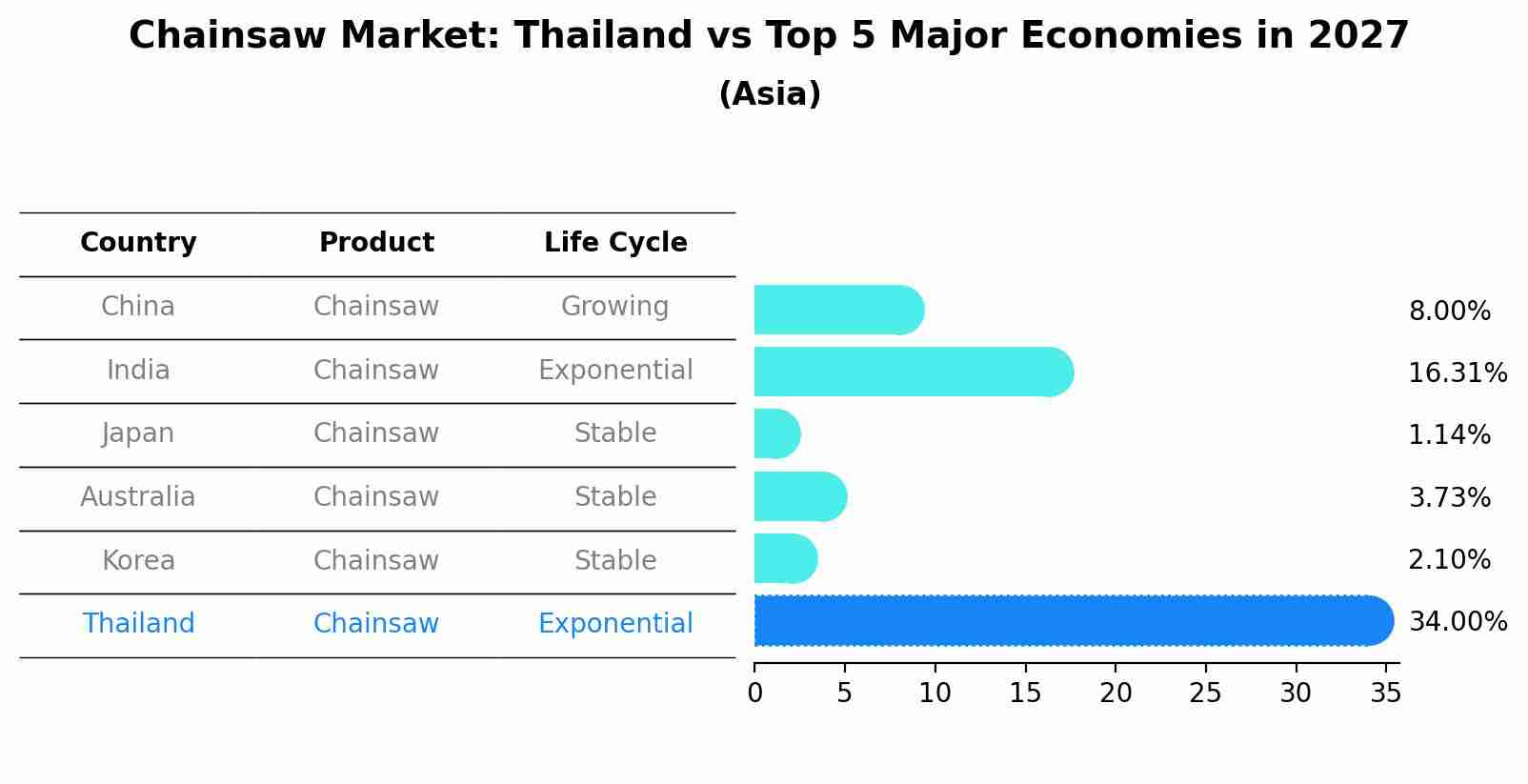
Thailand Chainsaw Market Growth Rate
According to 6Wresearch internal database and industry insights, the Thailand Chainsaw Market is projected to grow at a compound annual growth rate (CAGR) of 7% during the forecast period (2026-2032).
Topics Covered in the Thailand Chainsaw Market Report
Thailand Chainsaw Market report thoroughly covers the market by product type and application. The report provides a detailed analysis of ongoing market trends, opportunities/high-growth areas, and market drivers that will help stakeholders align strategies based on current and future market dynamics.
Thailand Chainsaw Market Highlights
| Report Name | Thailand Chainsaw Market |
| Forecast Period | 2026–2032 |
| CAGR | 7% |
| Growing Sector | Electric and Battery-Powered Chainsaws |
Thailand Chainsaw Market Synopsis
Thailand Chainsaw Market is expected to accomplish enormous expansion in the coming years due to a significant shift toward cordless power tools and the modernization of the country’s agricultural and forestry management systems. Along with this, the Thailand chainsaw market growth is further spurred by the government’s National Forest Policy and the integration of advanced landscaping solutions into the "Smart City" initiatives, which aims to improve urban canopy management and rural land productivity.
Evaluation of Growth Drivers in Thailand Chainsaw Market
Below are some major drivers and their influence on the market dynamics:
| Drivers | Primary Segment Affected | Why It Matters (Evidence) |
| National Forest Policy 2026 | Commercial & Industrial | The goal to increase forest cover to 40% of the land area drives demand for professional-grade felling and pruning tools. |
| Rise of Eco-Tourism Infrastructure | Residential Construction | The rise of boutique resorts and nature retreats in Northern Thailand creates a need for compact construction saws |
| Boom in Biomass Energy | Gas-Powered | Switching to wood pellets for energy production creates a need for saws with high torque for lumber processing. |
| Smart Urban Landscaping | Battery-Powered | Municipalities are transitioning to low-noise, zero-emission tools for maintenance in noise-sensitive urban zones. |
| Retail Expansion & E-commerce | Residential | The proliferation of specialized DIY platforms like HomePro makes high-end tools more accessible to casual users. |
Thailand Chainsaw Market is anticipated to grow at a CAGR of 7% during the forecast period (2026-2032). Due to increasing modernization of landscaping assets, rising investments in commercial construction, and strong demand from the agricultural sector, the market is expected to remain substantial. Apart from this, the rapid expansion of hardware retail chains has created high-demand environments for specialized safety gear and replacement parts.
Evaluation of Restraints in the Thailand Chainsaw Market
Below are some restraints and their influence on the market dynamics:
| Restraints | Primary Segment Affected | What This Means (Evidence) |
| Rising Cost of Advanced Equipment | Battery-Powered Chainsaws | Premium models remain unaffordable for small-scale users. |
| Inadequate Technical Expertise | All Segments | Inappropriate usage and maintenance decline product lifespan. |
| High Dependence on Imported Components | Equipment | High fluctuations in import prices affect overall market pricing. |
| Environmental Regulations | Gas-Powered Chainsaws | Firmer emission norms restrict usage of fuel-powered chainsaws. |
| Safety Concerns | Residential Users | Increasing risk of accidents restricts adoption among inexperienced users. |
Thailand Chainsaw Market Challenges
Thailand chainsaw industry is expected to continue its upward momentum during the forecast period. However, there is a lack of specialized maintenance technicians for advanced brushless motor systems in rural provinces, which makes some distributors hesitant to expand inventory beyond major metropolitan hubs. Apart from this, heavy dependence on imported engine parts and steel bars can act as a major hindrance for local companies compared to the integrated multinational companies.
Thailand Chainsaw Market Trends
Some of the key trends influencing the Thailand Chainsaw Market are:
- "Tool Skin" Platforms: There is an increasing trend of loyalty towards battery-sharing platforms, which can run multiple garden tools with a single battery pack.
- Inclusion of IoT Diagnostics: Large-scale commercial fleets are increasingly incorporating saws that are equipped with "Bluetooth" connectivity for real-time monitoring of runtime and maintenance intervals.
- Advent of Wood Carving & Artistry: The practice of utilizing specialized "carving bars" for intricate wooden sculptures, as seen in the tourism industry, is becoming popular within the private domain.
Investment Opportunities in the Thailand Chainsaw Market
Some of the investment opportunities that are available in the Thailand Chainsaw Market are as follows:
- Certified Training Academies: Entering a technical partnership to provide training to local professionals can guarantee brand loyalty in the forestry industry.
- Battery Recycling Programs: The establishment of local collection and recycling channels for lithium-ion tool batteries may prove to be a lucrative niche as environmental regulations become more stringent.
- Specialized Rental Hubs: The deployment of rental hubs for premium professional saws in construction-dense areas may cater to small-scale contractors.
Top 5 Leading Players in Thailand Chainsaw Market
Below is a comprehensive list of companies operating in the Thailand Chainsaw Market:
1. STIHL
| Company Name | STIHL |
| Headquarters | Waiblingen, Germany (Strong Regional Presence in Bangkok) |
| Established | 1926 (Global); 1990s (Thailand) |
| Website | - |
A dominant market leader providing a wide range of gasoline and battery-powered saws, known for high durability and a vast network of authorized service dealers across Thailand.
2. Husqvarna
| Company Name | Husqvarna |
| Headquarters | Stockholm, Sweden |
| Established | 1689 |
| Website | Click Here |
Renowned for professional-grade forestry equipment, Husqvarna leads the market in ergonomic design and advanced "AutoTune" engine technology for high-altitude logging.
3. Makita
| Company Name | Makita |
| Headquarters | Anjo, Japan (Bangkok Branch) |
| Established | 1915 |
| Website | Click Here |
A pioneer in the transition to cordless technology, Makita offers the most extensive 18V/40V battery-powered chainsaw lineup.
4. Harper
| Company Name | Harper |
| Headquarters | Bangkok, Thailand |
| Established | 2017 |
| Website | Click Here |
A local specialist focusing on high-quality, lightweight chainsaws that comply with Thai law (under 1 HP).
5. Zenoah (Komatsu Zenoah)
| Company Name | Zenoah (Komatsu Zenoah) |
| Headquarters | Kawagoe, Japan |
| Established | 1910 |
| Website | Click Here |
Highly favored by the Thai agricultural community for their lightweight "top-handle" saws used in fruit orchard maintenance and precision pruning.
Thailand Chainsaw Market: Government Initiatives
According to Thailand’s Department of Forestry Data, the National Forest Policy 2021-2025 actively introducing the modernization of timber harvesting through the subsidization of low-emission equipment for community forests. On the other hand, the Thai Industrial Standards Institute (TISI) offers tax incentives on the importation of energy-efficient electrical machinery under the Board of Investment (BOI) "Green Industry" scheme, providing financial relief for companies that establish assembly lines for battery-powered outdoor tools in industrial zones like Rayong and Chonburi.
Future Insights of the Thailand Chainsaw Market
Thailand Chainsaw Market is anticipated to witness growth, backed by the adoption of robotic-assisted clearing tools and AI-driven land survey integration. Also, sustainable medical solutions such as bio-degradable chain lubricants and energy-efficient motor systems are gaining traction as companies address regulatory pressures and environmental sustainability goals. Overall, the Thailand chainsaw industry is set for major expansion, underpinned by residential infrastructure development, diversification into specialized arboriculture, and modernization of traditional logging techniques.
Market Segmentation Analysis
The report offers a comprehensive study of the following market segments and their leading categories:
By Product Type – Electric and Battery-Powered to Lead the Market
Electric and Battery-Powered segment is projected to hold the dominant position in this industry, driven by the rapid urbanization of Thailand and the increasing demand for low-noise tools in residential neighborhoods. The segment's supremacy is further reinforced by the "BCG" (Bio-Circular-Green) economic model promoted by the government, which encourages the use of zero-emission machinery.
By Application – Residential Construction to Lead the Market
According to Sachin, Senior Research Analyst, 6Wresearch, Residential Construction segment is anticipated to dominate the Thailand chainsaw market share due to the ongoing housing boom in the Greater Bangkok area and the rising trend of "wood-centric" modern architecture. Also, surgical tool suppliers—specifically those providing precision cutting saws—are actively investing in this area as the demand for customized timber frames and high-end wooden outdoor decking requires high-precision, portable sawing solutions that can be used on-site without heavy infrastructure.
Key Attractiveness of the Report
- 10 Years of Market Numbers
- Historical Data Starting from 2022 to 2025
- Base Year: 2025
- Forecast Data until 2032
- Key Performance Indicators Impacting the Market
- Major Upcoming Developments and Projects
Key Highlights of the Report:
- Thailand Chainsaw Market Outlook
- Market Size of Thailand Chainsaw Market, 2025
- Forecast of Thailand Chainsaw Market, 2032
- Historical Data and Forecast of Thailand Chainsaw Revenues & Volume for the Period 2022-2032
- Thailand Chainsaw Market Trend Evolution
- Thailand Chainsaw Market Drivers and Challenges
- Thailand Chainsaw Price Trends
- Thailand Chainsaw Porter's Five Forces
- Thailand Chainsaw Industry Life Cycle
- Historical Data and Forecast of Thailand Chainsaw Market Revenues & Volume By Product Type for the Period 2022-2032
- Historical Data and Forecast of Thailand Chainsaw Market Revenues & Volume By Gas-Powered for the Period 2022-2032
- Historical Data and Forecast of Thailand Chainsaw Market Revenues & Volume By Electric and Battery Powered for the Period 2022-2032
- Historical Data and Forecast of Thailand Chainsaw Market Revenues & Volume By for the Period 2022-2032
- Historical Data and Forecast of Thailand Chainsaw Market Revenues & Volume By Application for the Period 2022-2032
- Historical Data and Forecast of Thailand Chainsaw Market Revenues & Volume By Residential Construction for the Period 2022-2032
- Historical Data and Forecast of Thailand Chainsaw Market Revenues & Volume By Commercial and Industrial Construction for the Period 2022-2032
- Thailand Chainsaw Import Export Trade Statistics
- Market Opportunity Assessment By Product Type
- Market Opportunity Assessment By Application
- Thailand Chainsaw Top Companies Market Share
- Thailand Chainsaw Competitive Benchmarking By Technical and Operational Parameters
- Thailand Chainsaw Company Profiles
- Thailand Chainsaw Key Strategic Recommendations
Market Covered
The report offers a comprehensive study of the following market segments:
By Product Type
- Gas-Powered
- Electric and Battery-Powered
By Application
- Residential Construction
- Commercial and Industrial Construction
Thailand Chainsaw Market (2026-2032): FAQs
Thailand Chainsaw Market is expected to grow at growth rate of 7% during the forecast period 2026-2032.
Key trends include the rise of battery-powered tools, integration of smart features, and increasing demand from DIY and gardening activities.
Major challenges include high equipment costs, lack of skilled operators, and strict environmental regulations on fuel-powered tools.
Battery-powered chainsaws are currently seeing the fastest transition due to noise-level regulations in urban areas and the increasing cost-efficiency of lithium-ion technology.
6Wresearch actively monitors the Thailand Chainsaw Market and publishes its comprehensive annual report, highlighting emerging trends, growth drivers, revenue analysis, and forecast outlook. Our insights help businesses to make data-backed strategic decisions with ongoing market dynamics. Our analysts track relevent industries related to the Thailand Chainsaw Market, allowing our clients with actionable intelligence and reliable forecasts tailored to emerging regional needs.
Yes, we provide customisation as per your requirements. To learn more, feel free to contact us on sales@6wresearch.com
Global Go To Market Strategy - 2030
Export potential enables firms to identify high-growth global markets with greater confidence by combining advanced trade intelligence with a structured quantitative methodology. The framework analyzes emerging demand trends and country-level import patterns while integrating macroeconomic and trade datasets such as GDP and population forecasts, bilateral import–export flows, tariff structures, elasticity differentials between developed and developing economies, geographic distance, and import demand projections. Using weighted trade values from 2020–2024 as the base period to project country-to-country export potential for 2030, these inputs are operationalized through calculated drivers such as gravity model parameters, tariff impact factors, and projected GDP per-capita growth. Through an analysis of hidden potentials, demand hotspots, and market conditions that are most favorable to success, this method enables firms to focus on target countries, maximize returns, and global expansion with data, backed by accuracy.
By factoring in the projected importer demand gap that is currently unmet and could be potential opportunity, it identifies the potential for the Exporter (Country) among 190 countries, against the general trade analysis, which identifies the biggest importer or exporter.
To discover high-growth global markets and optimize your business strategy:
Click Here
Pricing
- Single User License$ 1,995
- Department License$ 2,400
- Site License$ 3,120
- Global License$ 3,795

Leadership Perspectives from Industry Events
Search
Thought Leadership and Analyst Meet





Our Clients








6WResearch In News
- India Export Attractiveness Tracker 2026
- India Air Conditioner Market Set for Strong Rebound in 2026 After Weather-Led Correction and GST-Driven Recovery: 6Wresearch
- ADAS in India: How Automatic Emergency Braking, Blind Spot Detection & Driver Monitoring are Transforming Road Safety
- Doha a strategic location for EV manufacturing hub: IPA Qatar
- Demand for luxury TVs surging in the GCC, says Samsung
- Empowering Growth: The Thriving Journey of Bangladesh’s Cable Industry
Latest Reports
- Nicaragua RPG Gaming Market (2026-2032)
- New Zealand RPG Gaming Market (2026-2032)
- Netherlands RPG Gaming Market (2026-2032)
- Nauru RPG Gaming Market (2026-2032)
- Namibia RPG Gaming Market (2026-2032)
- Mozambique RPG Gaming Market (2026-2032)
- Montenegro RPG Gaming Market (2026-2032)
- Mongolia RPG Gaming Market (2026-2032)
- Monaco RPG Gaming Market (2026-2032)
- Micronesia RPG Gaming Market (2026-2032)
Industry Events and Analyst Meet

EV India Expo 2026

HIMTEX 2026

India Refining Summit 2026

India EV Show 2026

EV tech India Expo 2026
Whitepaper
- Middle East & Africa Commercial Security Market Click here to view more.
- Middle East & Africa Fire Safety Systems & Equipment Market Click here to view more.
- GCC Drone Market Click here to view more.
- Middle East Lighting Fixture Market Click here to view more.
- GCC Physical & Perimeter Security Market Click here to view more.


