Thailand Conveyors System Market Summary
The thailand conveyors system market was estimated at USD 152 Million in 2025 and is projected to reach USD 174 Million by 2032, growing at a CAGR of 3.1% from 2026 to 2032.
Thailand Conveyors System Market Year-wise Growth Rate and Key Drivers
This graph highlights how the Thailand Conveyors System Market has steadily grown over the past five years, supported by major growth factors.
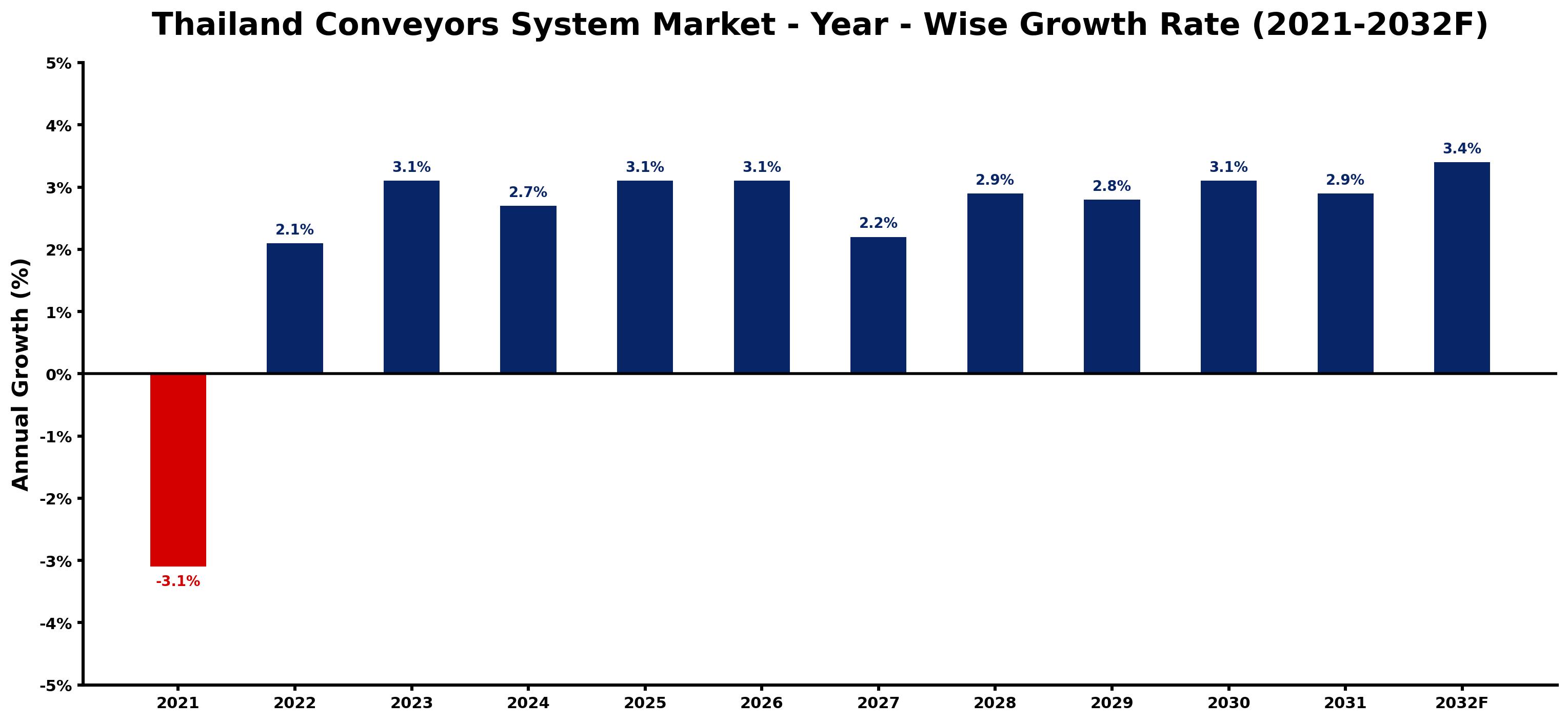
The table below presents the year wise growth rates along with the key drivers influencing the market
| Year | Growth Rate | Major Drivers |
| 2021 | -3.1% | Technology adoption delays hampered productivity improvements, leading to reduced investment in conveyor systems across industries. |
| 2022 | 2.1% | Local manufacturers sought cost-effective conveyor solutions due to labor shortages in Thailand. |
| 2023 | 3.1% | Infrastructure investments focused on enhancing supply chain efficiency across various sectors. |
| 2024 | 2.7% | E-commerce expansion prompted facilities to adopt automated systems for faster order processing. |
| 2025 | 3.1% | New industrial policies encouraged adoption of smart technologies in manufacturing processes. |
| 2026 | 3.1% | The construction sector's rebound fueled demand for conveyors in material handling applications. |
| 2027 | 2.2% | Technological advancements in conveyor design improved energy efficiency and reduced operational costs. |
| 2028 | 2.9% | Growing environmental awareness shifted preferences towards eco-friendly conveyor systems. |
| 2029 | 2.8% | Increased foreign direct investment resulted in technology transfer and market competitiveness. |
| 2030 | 3.1% | Rising urbanization in Thailand created a greater need for material handling systems. |
| 2031 | 2.9% | Emerging industries, particularly in green technology, required innovative conveyor solutions. |
| 2032 | 3.4% | Focus on automation and robotics in manufacturing drove further growth in conveyor adoption. |
Note - Market size estimations and growth projections presented in this report are based on 6Wresearch's advanced forecasting approach, validated with industry datasets as of June 2026.
Thailand Conveyors System Market Synopsis
The Thailand Conveyors System Market is projected to reach 3.1% and witness significant growth during the forecast period (2026-2032). This growth is primarily driven by the increasing demand for automation across numerous industries, including food and beverage, automotive, electronics, and logistics. Technological advancements have significantly enhanced efficiency and reduced costs in material handling operations, further accelerating the adoption of conveyor systems in Thailand.
Thailand Conveyors System Market Growth Drivers
One of the primary growth drivers in the Thailand Conveyors System Market is the rise of automation within manufacturing facilities. As companies increasingly invest in robotics to undertake tasks that are hazardous or arduous for human workers, the demand for conveyor systems has surged. Additionally, robotic arms aid in enhancing safety protocols by minimizing the risk of manual errors, which in turn reduces labour costs associated with manual handling.
- Increased automation has led to heightened demand for efficient material handling solutions, positioning conveyor systems as vital assets in production lines.
- The automotive industry has been a significant adopter of conveyor technologies, driven by the need for streamlined production processes and enhanced operational safety.
- The growing e-commerce sector has accelerated the need for integrated solutions, such as automated sortation machines, which are vital in managing logistics and distribution effectively.
- Companies are turning to conveyor systems as a response to rising labour costs and the scarcity of skilled workers, making automation an imperative for operational continuity.
- Investment in state-of-the-art technologies has made conveyor systems more attractive, as companies seek to enhance productivity while reducing overall operational costs.
Thailand Conveyors System Market Trends and Opportunities
The Thailand Conveyors System Market is witnessing a series of trends that are shaping its landscape. The ongoing shift towards smart manufacturing is a significant trend, driving the integration of Internet of Things (IoT) in conveyor systems to enhance monitoring and control capabilities.
- Manufacturers are increasingly focusing on sustainability, leading to innovations in eco-friendly conveyor systems designed to minimize energy consumption.
- With advances in technology, conveyor systems are becoming more versatile, allowing diverse applications across various industrial sectors.
- The automation trend is being supplemented by a growing need for real-time data analytics, enabling companies to optimize their operations through better decision-making.
- Collaborative robots (cobots) are emerging as an opportunity within the market, offering the ability to work alongside human operators while enhancing productivity.
- As Thailand continues to develop its infrastructure, the demand for advanced conveyor solutions in logistics and warehousing sectors is anticipated to rise significantly.
Thailand Conveyors System Market Challenges and Restraints
Despite the robust growth, the Thailand Conveyors System Market faces several challenges. High initial investment costs for installation, coupled with substantial maintenance fees associated with advanced conveyor systems, can deter small and medium-sized enterprises from adopting these technologies. Furthermore, economic fluctuations may hamper investment in new systems.
- Small scale enterprises often struggle with the upfront costs associated with modern conveyor systems, resulting in slower adoption rates.
- Maintenance challenges can inhibit system performance, leading to operational disruptions if not managed effectively.
- The need for specialized skilled labor for installation and maintenance poses additional challenges for manufacturers in the region.
- Technological advancements can often lead to rapid obsolescence of existing equipment, compelling businesses to continually invest in new machinery.
- The industry must navigate supply chain disruptions that can arise from global economic shifts, impacting the availability and cost of materials for conveyor systems.
Thailand Conveyors System Market Government Investment and Initiatives
The Thai government has been actively involved in fostering growth within the industrial sector, including initiatives aimed at enhancing automation and efficiency. Government policies encouraging investment in technology and infrastructure have laid a conducive foundation for the conveyor system market.
- Increased public spending on modernizing manufacturing facilities is likely to spur demand for advanced conveyor systems.
- Government incentives for automation and technology investments assist companies in transitioning towards more efficient production methodologies.
- Various development plans focus on enhancing logistics capabilities, thus promoting the adoption of automated material handling systems.
- Collaborative efforts between government and private entities to improve workforce skills in automation technologies support sustainable market growth.
- Environmental regulations and initiatives promoting sustainable practices are prompting manufacturers to invest in eco-friendly conveyor solutions, aligning with government objectives.
Thailand Conveyors System Market Latest Developments (May 2025 - June 2026)
Recent developments in the Thailand Conveyors System Market indicate a progressive shift towards more integrated and automated solutions. Companies have been increasingly adopting advanced technologies such as AI and IoT to optimize conveyor efficiency and track performance in real-time. Additionally, many businesses are exploring sustainable practices in line with global trends, leading to innovations in energy-efficient conveyor designs. The logistics sector is also experiencing transformation, with an emphasis on automated sortation systems to meet the surging demands of e-commerce.
Thailand Conveyors System Market - Key Attractiveness of the Report
- 10 Years of Market Numbers
- Historical Data Starting from 2022 to 2025
- Base Year: 2025
- Forecast Data until 2032
- Key Performance Indicators Impacting the Market
- Major Upcoming Developments and Projects
Key Highlights of the Report:
- Thailand Conveyors System Market Outlook
- Market Size of Thailand Conveyors System Market, 2025
- Forecast of Thailand Conveyors System Market, 2032
- Historical Data and Forecast of Thailand Conveyors System Revenues & Volume for the Period 2022-2032F
- Thailand Conveyors System Market Trend Evolution
- Thailand Conveyors System Market Drivers and Challenges
- Thailand Conveyors System Price Trends
- Thailand Conveyors System Porter's Five Forces
- Thailand Conveyors System Industry Life Cycle
- Historical Data and Forecast of Thailand Conveyors System Market Revenues & Volume By Type for the Period 2022-2032F
- Historical Data and Forecast of Thailand Conveyors System Market Revenues & Volume By Belt for the Period 2022-2032F
- Historical Data and Forecast of Thailand Conveyors System Market Revenues & Volume By Roller for the Period 2022-2032F
- Historical Data and Forecast of Thailand Conveyors System Market Revenues & Volume By Pallet for the Period 2022-2032F
- Historical Data and Forecast of Thailand Conveyors System Market Revenues & Volume By Overhead for the Period 2022-2032F
- Historical Data and Forecast of Thailand Conveyors System Market Revenues & Volume By Floor for the Period 2022-2032F
- Historical Data and Forecast of Thailand Conveyors System Market Revenues & Volume By Crescent for the Period 2022-2032F
- Historical Data and Forecast of Thailand Conveyors System Market Revenues & Volume By Tri-planar for the Period 2022-2032F
- Historical Data and Forecast of Thailand Belt Conveyors System Market Revenues & Volume By Others for the Period 2022-2032F
- Historical Data and Forecast of Thailand Conveyors System Market Revenues & Volume By End-Use Industry for the Period 2022-2032F
- Historical Data and Forecast of Thailand Conveyors System Market Revenues & Volume By Warehouse & Distribution for the Period 2022-2032F
- Historical Data and Forecast of Thailand Conveyors System Market Revenues & Volume By Food & Beverage for the Period 2022-2032F
- Historical Data and Forecast of Thailand Conveyors System Market Revenues & Volume By Automotive for the Period 2022-2032F
- Historical Data and Forecast of Thailand Conveyors System Market Revenues & Volume By Electronics for the Period 2022-2032F
- Historical Data and Forecast of Thailand Conveyors System Market Revenues & Volume By Mining for the Period 2022-2032F
- Historical Data and Forecast of Thailand Conveyors System Market Revenues & Volume By Airport for the Period 2022-2032F
- Thailand Conveyors System Import Export Trade Statistics
- Market Opportunity Assessment By Type
- Market Opportunity Assessment By End-Use Industry
- Thailand Conveyors System Top Companies Market Share
- Thailand Conveyors System Competitive Benchmarking By Technical and Operational Parameters
- Thailand Conveyors System Company Profiles
- Thailand Conveyors System Key Strategic Recommendations






































