Thailand Fennel Seeds Market Size, Share & Growth Rate
The Thailand Fennel Seeds Market was estimated at USD 235 Million in 2025 and is projected to reach USD 268 Million by 2032, growing at a CAGR of 1.9% from 2026 to 2032. This positive trajectory is fueled by the increasing culinary applications of fennel seeds and growing consumer awareness regarding their health benefits. As Thai cuisine continues to emphasize natural flavors, the demand for fennel seeds as a spice and digestive aid is expected to rise significantly.
Thailand Fennel Seeds Market Growth Rate Analysis (2021-2032)
The Thailand fennel seeds market has shown notable fluctuations in growth over recent years, starting with a decline of 3.1% in 2021, primarily due to reduced consumer demand and supply chain disruptions. However, recovery began in 2022, with a growth of 2.3% driven by rising health awareness and increased use of fennel seeds in traditional Thai medicine. This upward trend continued into 2023, where the market expanded by 3.4%, supported by investments in sustainable agriculture and the growing popularity of natural ingredients. Projections indicate continued growth, with rates around 2.7% to 3.2% anticipated through 2032, as consumer preferences pivot towards healthier food options and as technology plays a key role in increasing production efficiency.
Thailand Fennel Seeds Market Year-wise Growth Rate and Key Drivers
This graph highlights how the Thailand Fennel Seeds Market has steadily grown over the past five years, supported by major growth factors.
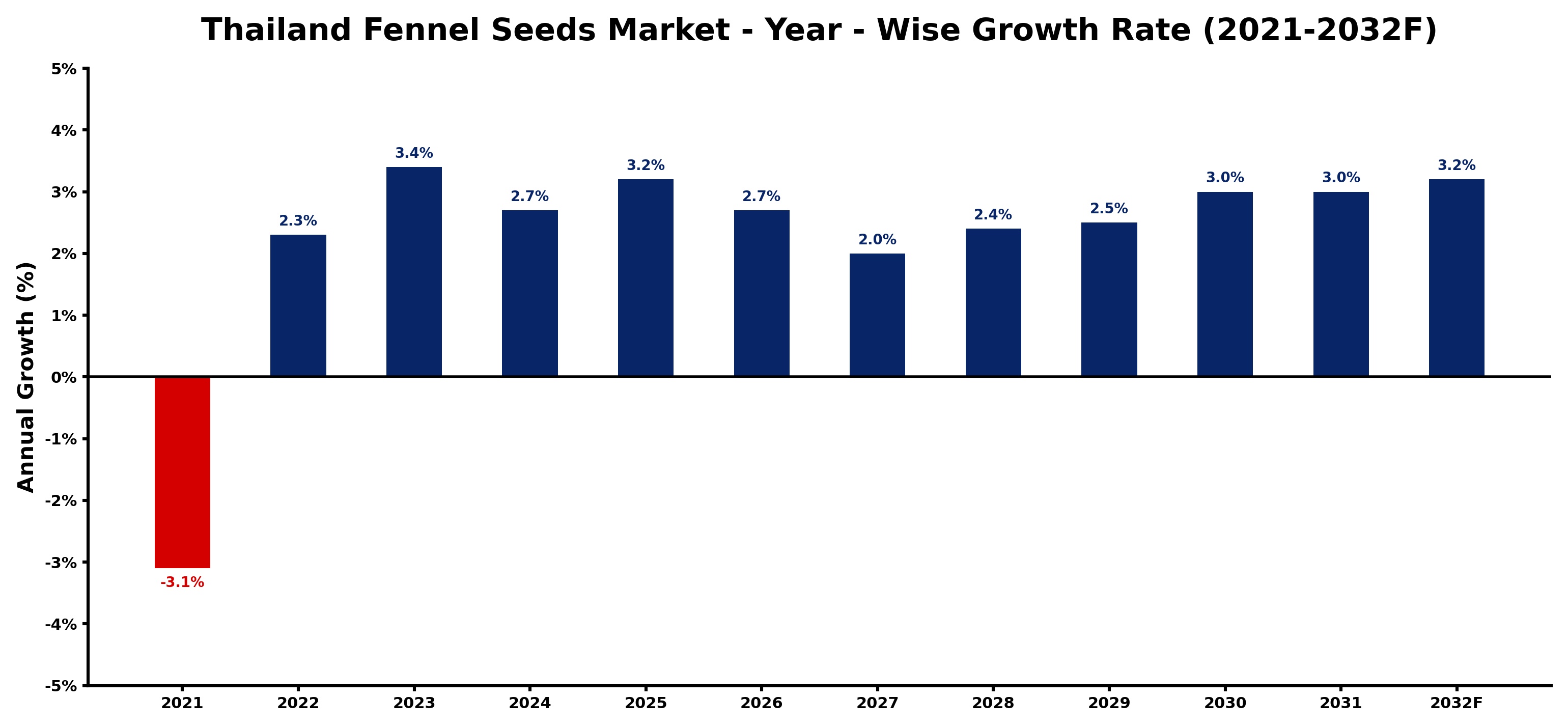
The table below presents the year‑wise growth rates along with the key drivers influencing the market
| Year | Growth Rate | Major Drivers |
| 2021 | -3.1% | Consumer demand faced significant decline |
| 2022 | 2.3% | Health trends increased product interest |
| 2023 | 3.4% | Culinary innovation expanded usage options |
| 2024 | 2.7% | E-commerce growth enhanced market reach |
| 2025 | 3.2% | Sustainable farming practices gained popularity |
| 2026 | 2.7% | Cultural cuisine integration drove sales |
| 2027 | 2.0% | Organic product demand strengthened market |
| 2028 | 2.4% | Export opportunities expanded significantly |
| 2029 | 2.5% | Local sourcing initiatives increased supply |
| 2030 | 3.0% | Consumer education boosted product awareness |
| 2031 | 3.0% | New product launches attracted attention |
| 2032 | 3.2% | Market diversification enhanced competitive landscape |
Note - Market size estimations and growth projections presented in this report are based on 6Wresearch’s advanced forecasting approach, validated with industry datasets as of June 2026.
Thailand Fennel Seeds Market Synopsis
In recent years, the Thai fennel seeds market has seen remarkable growth, largely driven by heightened interest in their nutritional and health-promoting properties. Fennel seeds are increasingly recognized not only for their culinary versatility but also for their potential medicinal applications, appealing to health-conscious consumers.
Currently, fennel seeds are finding their way into various sectors, including food and beverages, pharmaceuticals, and cosmetics. This adaptability showcases the seeds' broad appeal, solidifying their presence in the market and leading to a surge in exports, which totaled approximately USD 26 million recently.
Thailand Fennel Seeds Market Key Takeaways
- The market is experiencing steady growth due to increasing consumer awareness of health benefits.
- Fennel seeds are utilized across culinary, pharmaceutical, and cosmetic applications, enhancing their market appeal.
- Supply chain disruptions during COVID-19 have impacted availability but have also spurred innovations in sourcing.
- Entrepreneurs are encouraged to tap into premium product offerings targeting health-oriented consumers.
- Quality assurance remains a vital issue, with a competitive market necessitating vigilance against adulteration.
Evaluation of Restraints in Thailand Fennel Seeds Market
Despite its growth potential, the Thailand fennel seeds market grapples with significant challenges, primarily surrounding quality control and adulteration. Ensuring the purity and authenticity of fennel seeds is essential for maintaining consumer trust and market integrity. In an increasingly competitive landscape, where price wars are prevalent, the risk of substandard products entering the market increases, making it critical for stakeholders to adopt rigorous quality assurance measures. Additionally, the reliance on specific cultivation practices can pose challenges in maintaining consistent supply levels, impacting overall market stability.
Thailand Fennel Seeds Market Trends
Emerging trends in the Thailand fennel seeds market highlight a shift towards natural and organic ingredients across various sectors. As consumers become more health-conscious, there is a growing demand for natural remedies, leading to increased interest in fennel seeds as herbal supplements. Additionally, the culinary trend of integrating diverse spices into Thai cuisine drives innovation in product offerings, from gourmet blends to ready-to-use seasonings. This alignment with health trends and culinary creativity creates a fertile ground for market expansion.
Thailand Fennel Seeds Market Opportunities
The opportunities in the Thailand fennel seeds market are vast, particularly for entrepreneurs willing to invest in high-quality, sustainably sourced products. Targeting health-conscious consumers with premium fennel seed offerings can tap into the growing wellness trend. Furthermore, exploring partnerships with local restaurants, cafes, and health food stores presents significant potential for brand visibility and market penetration. The evolving landscape of e-commerce also provides a platform for wider distribution, allowing for direct access to consumers interested in specialty products.
Government Initiatives in the Thailand Fennel Seeds Market
The Thai government has been proactive in promoting agricultural exports, including fennel seeds, through various programs and incentives aimed at enhancing the agricultural sector's productivity. By providing financial assistance and training for best farming practices, authorities seek to improve the quality of agricultural outputs. Additionally, initiatives focusing on promoting organic farming and sustainable practices align with global trends, encouraging local producers to elevate their standards and reach international markets.
Future Insights of the Thailand Fennel Seeds Market
Looking ahead to the period between 2026 and 2032, the Thailand fennel seeds market is positioned for a promising outlook. The growth driven by health-conscious consumers and the culinary sector will likely continue to stimulate demand. Moreover, advancements in cultivation techniques and quality assurance processes will play a pivotal role in addressing current challenges, fostering an environment that favors sustainable growth. The integration of technology in agricultural practices will also enhance productivity, paving the way for an increasingly robust market.
Thailand Fennel Seeds Market Latest Developments (May 2025 - June 2026)
Recent developments within the Thailand fennel seeds market indicate a renewed focus on product innovation and sustainability. Several companies are exploring eco-friendly packaging solutions to appeal to environmentally conscious consumers. Additionally, the trend of culinary tourism has increased interest in locally sourced fennel seeds, leading to initiatives that promote their use in both traditional and modern recipes. These shifts reflect the market's adaptability and commitment to meeting evolving consumer preferences.
Thailand Fennel Seeds Market - Key Attractiveness of the Report
- 10 Years of Market Numbers
- Historical Data Starting from 2022 to 2025
- Base Year: 2025
- Forecast Data until 2032
- Key Performance Indicators Impacting the Market
- Major Upcoming Developments and Projects
Key Highlights of the Report:
- Thailand Fennel Seeds Market Outlook
- Market Size of Thailand Fennel Seeds Market, 2025
- Forecast of Thailand Fennel Seeds Market, 2032F
- Historical Data and Forecast of Thailand Fennel Seeds Revenues & Volume for the Period 2022-2032F
- Thailand Fennel Seeds Market Trend Evolution
- Thailand Fennel Seeds Market Drivers and Challenges
- Thailand Fennel Seeds Price Trends
- Thailand Fennel Seeds Porter's Five Forces
- Thailand Fennel Seeds Industry Life Cycle
- Historical Data and Forecast of Thailand Fennel Seeds Market Revenues & Volume By Types for the Period 2022-2032F
- Historical Data and Forecast of Thailand Fennel Seeds Market Revenues & Volume By Organic for the Period 2022-2032F
- Historical Data and Forecast of Thailand Fennel Seeds Market Revenues & Volume By Conventional for the Period 2022-2032F
- Historical Data and Forecast of Thailand Fennel Seeds Market Revenues & Volume By Application for the Period 2022-2032F
- Historical Data and Forecast of Thailand Fennel Seeds Market Revenues & Volume By Essential for the Period 2022-2032F
- Historical Data and Forecast of Thailand Fennel Seeds Market Revenues & Volume By Flavors for the Period 2022-2032F
- Historical Data and Forecast of Thailand Fennel Seeds Market Revenues & Volume By Seasoning Ingredient for the Period 2022-2032F
- Historical Data and Forecast of Thailand Fennel Seeds Market Revenues & Volume By Beverages for the Period 2022-2032F
- Historical Data and Forecast of Thailand Fennel Seeds Market Revenues & Volume By End-user for the Period 2022-2032F
- Historical Data and Forecast of Thailand Fennel Seeds Market Revenues & Volume By Households for the Period 2022-2032F
- Historical Data and Forecast of Thailand Fennel Seeds Market Revenues & Volume By Food Industry for the Period 2022-2032F
- Historical Data and Forecast of Thailand Fennel Seeds Market Revenues & Volume By Personal Care Industry for the Period 2022-2032F
- Thailand Fennel Seeds Import Export Trade Statistics
- Market Opportunity Assessment By Types
- Market Opportunity Assessment By Application
- Market Opportunity Assessment By End-user
- Thailand Fennel Seeds Top Companies Market Share
- Thailand Fennel Seeds Competitive Benchmarking By Technical and Operational Parameters
- Thailand Fennel Seeds Company Profiles
- Thailand Fennel Seeds Key Strategic Recommendations






































