Thailand Footwear Manufacturing Machinery Market Size, Share & Growth Rate
The Thailand Footwear Manufacturing Machinery Market was estimated at USD 190 Million in 2025 and is projected to reach USD 217 Million by 2032, growing at a CAGR of 1.9% from 2026 to 2032. This growth trajectory is primarily fueled by Thailand's reputation as a pivotal manufacturing hub for footwear, which attracts global brands seeking efficient production capabilities. The increasing demand for innovative, customizable footwear solutions further propels investments in advanced manufacturing technology, enhancing overall production quality and operational efficiency.
Thailand Footwear Manufacturing Machinery Market Year-wise Growth Rate and Key Drivers
This graph highlights how the Thailand Footwear Manufacturing Machinery Market has steadily grown over the years, supported by major growth factors.
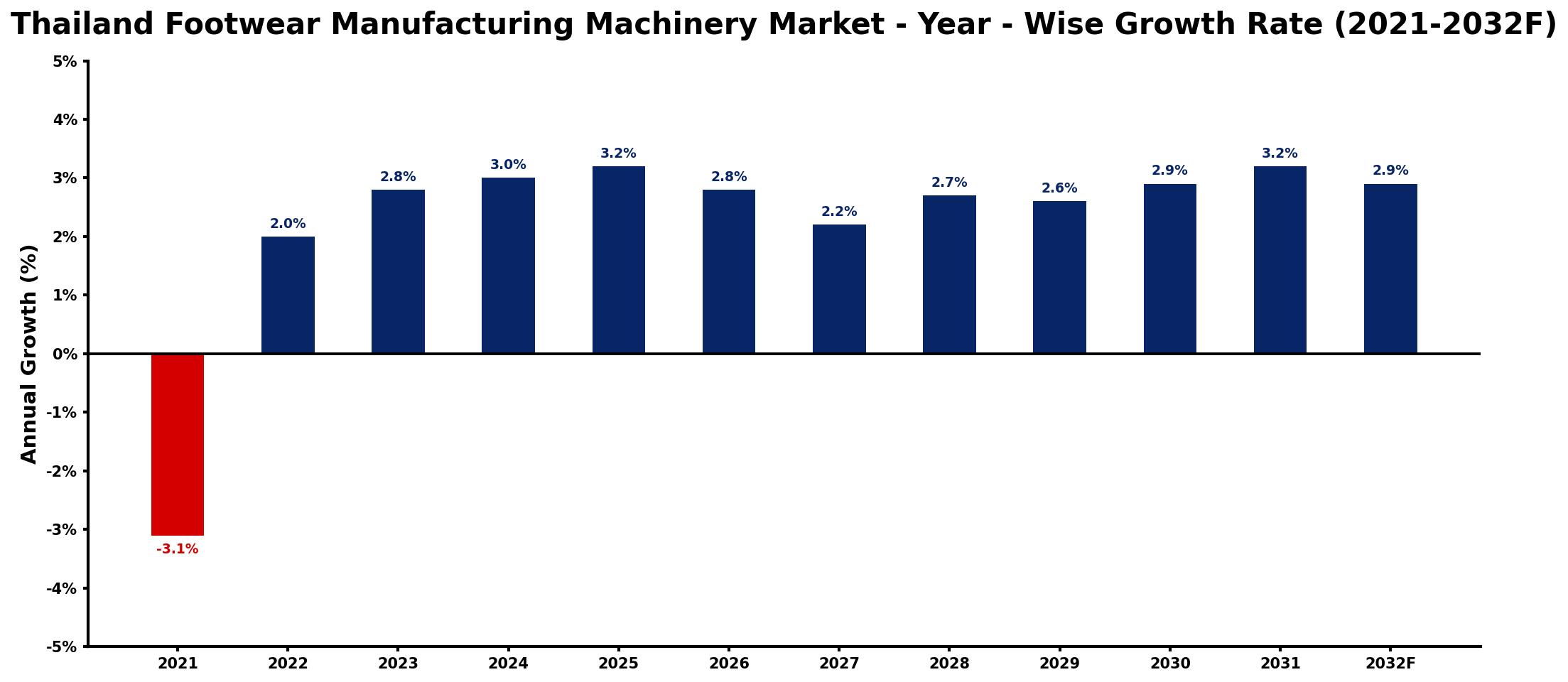
The table below presents the year‑wise growth rates along with the key drivers influencing the market
| Year | Growth Rate | Major Drivers |
| 2021 | -3.1% | decrease in production capacity |
| 2022 | 2.0% | rise in domestic investments |
| 2023 | 2.8% | increased capital investment inflows |
| 2024 | 3.0% | growth in retail sector |
| 2025 | 3.2% | expansion of local suppliers |
| 2026 | 2.8% | rising procurement volume requirements |
| 2027 | 2.2% | growing consumer preferences shift |
| 2028 | 2.7% | strengthened global trade relations |
| 2029 | 2.6% | increased demand for customization |
| 2030 | 2.9% | increased production capacity utilization |
| 2031 | 3.2% | growing downstream application demand |
| 2032 | 2.9% | growing automotive sector requirements |
Note: Market size estimations and growth projections presented in this report are based on 6Wresearch's proprietary forecasting methodology, utilizing the latest available industry data, government publications, and primary research inputs.
Thailand Footwear Manufacturing Machinery Market Synopsis
The Thailand Footwear Manufacturing Machinery market stands as a testament to the country's significant role in the global footwear landscape. With a blend of skilled labor and strategic investments, Thailand produces high-quality footwear that caters to both local and international demands.
In recent years, the market has witnessed a surge in the adoption of cutting-edge manufacturing technologies. As consumer preferences shift towards personalized and fashionable footwear, manufacturers are increasingly focusing on automating production processes to remain competitive.
Thailand Footwear Manufacturing Machinery Market Key Takeaways
- The market is driven by Thailand's prominent footwear manufacturing sector and its attraction for global brands.
- Investments in advanced machinery are necessary to meet the rising demand for customizable footwear.
- Automation and digitalization are reshaping production practices, though they come with retraining challenges.
- Quality control remains a critical concern amid increasing expectations for durable footwear products.
- Global competition necessitates the swift adoption of emerging technology trends to stay relevant.
Evaluation of Restraints in Thailand Footwear Manufacturing Machinery Market
Despite its growth potential, the Thailand Footwear Manufacturing Machinery market faces certain restraints that could hinder progress. The transition to automation, while essential for improving efficiency, often requires substantial financial investment. Manufacturers must grapple with the challenge of retraining their workforce to handle advanced machinery effectively. Furthermore, the increased pressure for high-quality output means that maintaining rigorous quality control standards is imperative, yet can be difficult amidst evolving production technologies. Additionally, as international competition intensifies, firms must remain vigilant in adapting to rapidly changing consumer preferences and emerging technological advancements.
Thailand Footwear Manufacturing Machinery Market Trends
Current trends within the Thailand Footwear Manufacturing Machinery market highlight a marked shift towards greater automation and digitization of production processes. Manufacturers are increasingly investing in smart machinery equipped with IoT capabilities, which enhance efficiency and monitoring of production lines. Sustainability is also gaining traction, with companies exploring eco-friendly materials and processes to meet consumer demand for sustainable products. Moreover, the rise of e-commerce has prompted manufacturers to adopt flexible production methods to swiftly respond to changing market needs.
Thailand Footwear Manufacturing Machinery Market Opportunities
Opportunities for growth in the Thailand Footwear Manufacturing Machinery market are abundant. The increasing demand for bespoke footwear designs invites manufacturers to invest in advanced, versatile machinery that allows for rapid prototyping and production modifications. Furthermore, as global consumer markets expand, the potential for Thailand to position itself as a leader in sustainable footwear production opens up new avenues for investment. Enhanced collaboration between machinery manufacturers and footwear companies can yield innovative solutions that drive the industry forward.
Government Initiatives in the Thailand Footwear Manufacturing Machinery Market
The Thai government plays a supportive role in bolstering the footwear manufacturing sector through various initiatives. Policies focused on boosting foreign direct investment aim to attract global players in the footwear industry. Additionally, incentives for research and development are promoting innovation in machinery and production techniques. The government is also investing in skill development programs to prepare the workforce for the transition to more automated and technologically advanced manufacturing environments, thereby enhancing the industry's competitiveness on the global stage.
Future Insights of the Thailand Footwear Manufacturing Machinery Market
Looking ahead to the 2026-2032 period, the Thailand Footwear Manufacturing Machinery market is poised for significant advancements driven by continuous technological innovation and shifts in consumer behavior. As manufacturers embrace automation and sustainable practices, the emphasis on efficiency and quality will define the market landscape. The ability to swiftly adapt to emerging trends, such as custom footwear and smart technologies, will be paramount for competitiveness. Overall, the focus will likely shift toward holistic solutions that encompass machinery, workforce training, and sustainability, setting the stage for a resilient and forward-thinking industry.
Thailand Footwear Manufacturing Machinery Market Latest Developments (2025 - 2026)
The Thailand Footwear Manufacturing Machinery market has experienced several noteworthy developments in recent months. Industry leaders are increasingly prioritizing automation, leading to the introduction of next-generation machinery that enhances production capabilities. A growing emphasis on sustainability has also prompted manufacturers to explore eco-friendly alternatives in their machinery processes. Additionally, partnerships between machinery manufacturers and footwear companies are being established to drive innovation and respond more effectively to market demands. The landscape is evolving rapidly, reflecting the dynamic nature of consumer preferences and technological advancements.
Thailand Footwear Manufacturing Machinery Market - Key Attractiveness of the Report
- 10 Years of Market Numbers
- Historical Data Starting from 2022 to 2025
- Base Year: 2025
- Forecast Data until 2032
- Key Performance Indicators Impacting the Market
- Major Upcoming Developments and Projects
Key Highlights of the Report:
- Thailand Footwear Manufacturing Machinery Market Outlook
- Market Size of Thailand Footwear Manufacturing Machinery Market, 2025
- Forecast of Thailand Footwear Manufacturing Machinery Market, 2032
- Historical Data and Forecast of Thailand Footwear Manufacturing Machinery Revenues & Volume for the Period 2022-2032F
- Thailand Footwear Manufacturing Machinery Market Trend Evolution
- Thailand Footwear Manufacturing Machinery Market Drivers and Challenges
- Thailand Footwear Manufacturing Machinery Price Trends
- Thailand Footwear Manufacturing Machinery Porter's Five Forces
- Thailand Footwear Manufacturing Machinery Industry Life Cycle
- Historical Data and Forecast of Thailand Footwear Manufacturing Machinery Market Revenues & Volume By Type for the Period 2022-2032F
- Historical Data and Forecast of Thailand Footwear Manufacturing Machinery Market Revenues & Volume By Pattern-making for the Period 2022-2032F
- Historical Data and Forecast of Thailand Footwear Manufacturing Machinery Market Revenues & Volume By Cutting for the Period 2022-2032F
- Historical Data and Forecast of Thailand Footwear Manufacturing Machinery Market Revenues & Volume By Finishing for the Period 2022-2032F
- Historical Data and Forecast of Thailand Footwear Manufacturing Machinery Market Revenues & Volume By Molds for the Period 2022-2032F
- Historical Data and Forecast of Thailand Footwear Manufacturing Machinery Market Revenues & Volume By Repair for the Period 2022-2032F
- Historical Data and Forecast of Thailand Footwear Manufacturing Machinery Market Revenues & Volume By Component Preparation for the Period 2022-2032F
- Historical Data and Forecast of Thailand Footwear Manufacturing Machinery Market Revenues & Volume By Stitching Machinery for the Period 2022-2032F
- Historical Data and Forecast of Thailand Pattern-making Footwear Manufacturing Machinery Market Revenues & Volume By Others for the Period 2022-2032F
- Historical Data and Forecast of Thailand Footwear Manufacturing Machinery Market Revenues & Volume By Technology for the Period 2022-2032F
- Historical Data and Forecast of Thailand Footwear Manufacturing Machinery Market Revenues & Volume By Manual for the Period 2022-2032F
- Historical Data and Forecast of Thailand Footwear Manufacturing Machinery Market Revenues & Volume By Semi-Automatic for the Period 2022-2032F
- Historical Data and Forecast of Thailand Footwear Manufacturing Machinery Market Revenues & Volume By Fully-Automatic for the Period 2022-2032F
- Historical Data and Forecast of Thailand Footwear Manufacturing Machinery Market Revenues & Volume By Application for the Period 2022-2032F
- Historical Data and Forecast of Thailand Footwear Manufacturing Machinery Market Revenues & Volume By Athletic for the Period 2022-2032F
- Historical Data and Forecast of Thailand Footwear Manufacturing Machinery Market Revenues & Volume By Casual for the Period 2022-2032F
- Historical Data and Forecast of Thailand Footwear Manufacturing Machinery Market Revenues & Volume By Military for the Period 2022-2032F
- Historical Data and Forecast of Thailand Footwear Manufacturing Machinery Market Revenues & Volume By Others for the Period 2022-2032F
- Thailand Footwear Manufacturing Machinery Import Export Trade Statistics
- Market Opportunity Assessment By Type
- Market Opportunity Assessment By Technology
- Thailand Footwear Manufacturing Machinery Top Companies Market Share
- Thailand Footwear Manufacturing Machinery Competitive Benchmarking By Technical and Operational Parameters
- Thailand Footwear Manufacturing Machinery Company Profiles
- Thailand Footwear Manufacturing Machinery Key Strategic Recommendations






































