Thailand Freezing Display Cabinet Market Size, Share & Growth Rate
The Thailand Freezing Display Cabinet Market was estimated at USD 190 Million in 2025 and is projected to reach USD 217 Million by 2032, growing at a CAGR of 1.9% from 2026 to 2032. This positive outlook is fueled by increasing consumer demand for frozen food products and a robust retail sector that continues to expand. Moreover, the push for energy-efficient and aesthetically pleasing display solutions is leading businesses to upgrade their refrigeration systems, thereby driving market growth.
Thailand Freezing Display Cabinet Market Year-wise Growth Rate and Key Drivers
This graph highlights how the Thailand Freezing Display Cabinet Market has steadily grown over the years, supported by major growth factors.
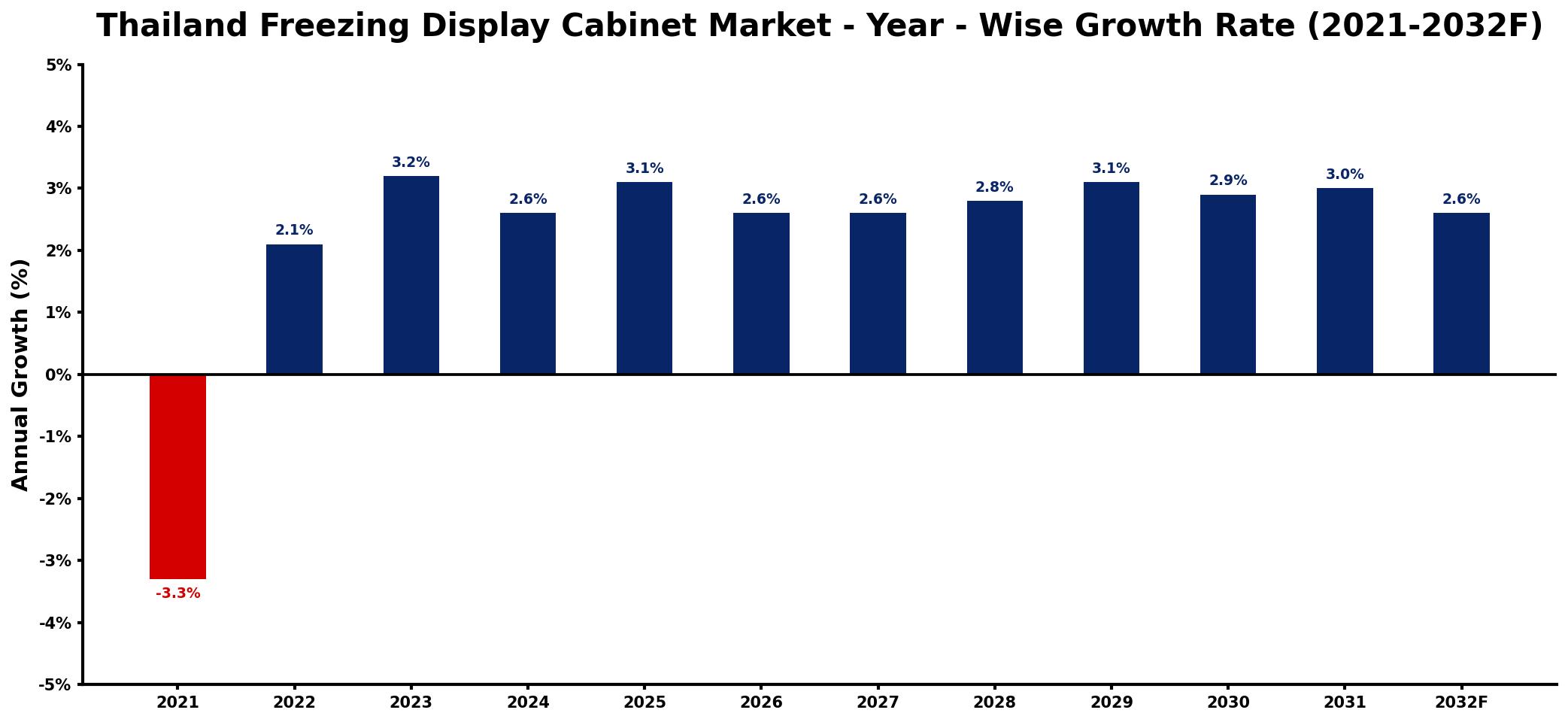
The table below presents the year‑wise growth rates along with the key drivers influencing the market
| Year | Growth Rate | Major Drivers |
| 2021 | -3.3% | decrease in retail sector demand |
| 2022 | 2.1% | rising consumer health consciousness |
| 2023 | 3.2% | expansion of food service industry |
| 2024 | 2.6% | increased investment in refrigeration |
| 2025 | 3.1% | growing trend of online grocery |
| 2026 | 2.6% | surge in convenience store openings |
| 2027 | 2.6% | enhanced focus on energy efficiency |
| 2028 | 2.8% | increased demand for frozen foods |
| 2029 | 3.1% | growing downstream application demand |
| 2030 | 2.9% | growth in food safety regulations |
| 2031 | 3.0% | rising popularity of meal kits |
| 2032 | 2.6% | development of smart technology solutions |
Note: Market size estimations and growth projections presented in this report are based on 6Wresearch's proprietary forecasting methodology, utilizing the latest available industry data, government publications, and primary research inputs.
Thailand Freezing Display Cabinet Market Synopsis
The Thailand Freezing Display Cabinet market has recently shown resilience, recovering from the pandemic's initial impact. As restaurants and food retailers adapt to changing consumer habits, there is a renewed focus on energy-efficient cabinets that align with sustainability trends. This shift not only caters to growing environmental concerns but also enhances the overall customer experience.
Looking forward, the market is poised for steady growth, driven by an expanding frozen food sector and a commitment to maintaining product quality through advanced refrigeration solutions. As competition intensifies, businesses will increasingly prioritize innovative display options that appeal to consumer preferences.
Thailand Freezing Display Cabinet Market Key Takeaways
- Growing demand for frozen food products is propelling investment in advanced freezing display cabinets.
- Energy efficiency and sustainability are becoming critical selling points for both manufacturers and consumers.
- The recovery of the foodservice sector post-COVID-19 is reshaping market dynamics and consumer expectations.
- Manufacturers are focusing on innovation to comply with stringent refrigerant regulations and quality standards.
- Increased aesthetic appeal of cabinets is influencing consumer purchasing decisions significantly.
Evaluation of Restraints in Thailand Freezing Display Cabinet Market
Despite the market's potential, various restraints hinder growth. The transition to more energy-efficient and environmentally friendly refrigerants poses challenges for manufacturers, who must invest in R&D while navigating regulatory pressures. Additionally, there is a constant need for reliable after-sales service; any malfunction can severely disrupt operations for businesses reliant on these cabinets. Meeting high-quality standards is essential, but it can also limit accessibility for smaller retailers.
Thailand Freezing Display Cabinet Market Trends
Several trends are shaping the Thailand Freezing Display Cabinet market. The shift towards eco-friendly technologies is gaining traction, as consumers increasingly demand sustainable options. Businesses are also leveraging digital technologies to monitor cabinet performance, enhancing efficiency and reducing energy costs. Moreover, the visual merchandising aspect is becoming crucial, with retailers seeking cabinets that not only preserve but also highlight their frozen offerings attractively.
Thailand Freezing Display Cabinet Market Opportunities
There are significant opportunities for growth within this market segment, particularly in integrating IoT solutions for smarter refrigeration systems. As businesses transition to automated and connected devices, those manufacturers that can provide innovative solutions will likely capture greater market share. Additionally, targeting emerging retail channels, such as online grocery delivery services, offers a promising avenue for expansion.
Government Initiatives in the Thailand Freezing Display Cabinet Market
The Thai government is increasingly supportive of sustainability initiatives, encouraging businesses to invest in energy-efficient equipment through various incentives. Public funding is directed toward improving energy consumption standards in commercial refrigeration, aimed at reducing the overall carbon footprint. Programs promoting eco-friendly technologies are gaining momentum, fostering a conducive environment for advancements in freezing display solutions.
Future Insights of the Thailand Freezing Display Cabinet Market
From 2026 to 2032, the Thailand Freezing Display Cabinet market is expected to evolve significantly. As consumer preferences continue to shift toward convenience and sustainability, manufacturers will need to adapt their product offerings accordingly. The anticipated growth in the foodservice sector, coupled with a focus on energy efficiency and visual appeal, will be key drivers influencing the market landscape. With ongoing innovations in technology and a strong push for eco-friendly solutions, the future appears promising.
Thailand Freezing Display Cabinet Market Latest Developments (2025 - 2026)
Recently, the market has witnessed an increase in collaborations between manufacturers and retailers aimed at enhancing product offerings. Innovations in energy-efficient technologies are at the forefront, as companies work to meet both consumer and regulatory demands. Simultaneously, the trend toward more visually appealing display cabinets continues, as businesses recognize the importance of showcasing their frozen products attractively.
Thailand Freezing Display Cabinet Market - Key Attractiveness of the Report
- 10 Years of Market Numbers
- Historical Data Starting from 2022 to 2025
- Base Year: 2025
- Forecast Data until 2032
- Key Performance Indicators Impacting the Market
- Major Upcoming Developments and Projects
Key Highlights of the Report:
- Thailand Freezing Display Cabinet Market Outlook
- Market Size of Thailand Freezing Display Cabinet Market, 2025
- Forecast of Thailand Freezing Display Cabinet Market, 2032
- Historical Data and Forecast of Thailand Freezing Display Cabinet Revenues & Volume for the Period 2022-2032F
- Thailand Freezing Display Cabinet Market Trend Evolution
- Thailand Freezing Display Cabinet Market Drivers and Challenges
- Thailand Freezing Display Cabinet Price Trends
- Thailand Freezing Display Cabinet Porter's Five Forces
- Thailand Freezing Display Cabinet Industry Life Cycle
- Historical Data and Forecast of Thailand Freezing Display Cabinet Market Revenues & Volume By Product for the Period 2022-2032F
- Historical Data and Forecast of Thailand Freezing Display Cabinet Market Revenues & Volume By Horizontal for the Period 2022-2032F
- Historical Data and Forecast of Thailand Freezing Display Cabinet Market Revenues & Volume By Vertical for the Period 2022-2032F
- Historical Data and Forecast of Thailand Freezing Display Cabinet Market Revenues & Volume By Hybrid for the Period 2022-2032F
- Historical Data and Forecast of Thailand Freezing Display Cabinet Market Revenues & Volume By Application for the Period 2022-2032F
- Historical Data and Forecast of Thailand Freezing Display Cabinet Market Revenues & Volume By Supermarket for the Period 2022-2032F
- Historical Data and Forecast of Thailand Freezing Display Cabinet Market Revenues & Volume By Hotel for the Period 2022-2032F
- Historical Data and Forecast of Thailand Freezing Display Cabinet Market Revenues & Volume By Restaurant for the Period 2022-2032F
- Historical Data and Forecast of Thailand Freezing Display Cabinet Market Revenues & Volume By Entertainment Center for the Period 2022-2032F
- Thailand Freezing Display Cabinet Import Export Trade Statistics
- Market Opportunity Assessment By Product
- Market Opportunity Assessment By Application
- Thailand Freezing Display Cabinet Top Companies Market Share
- Thailand Freezing Display Cabinet Competitive Benchmarking By Technical and Operational Parameters
- Thailand Freezing Display Cabinet Company Profiles
- Thailand Freezing Display Cabinet Key Strategic Recommendations






































