Thailand Herbal Cosmetics Market Size, Share & Growth Rate
The Thailand Herbal Cosmetics Market was estimated at USD 161 Million in 2025 and is projected to reach USD 185 Million by 2032, growing at a CAGR of 2.0% from 2026 to 2032. This growth trajectory is fueled by a significant shift in consumer preferences towards natural and herbal products, reflecting a broader global trend of wellness and sustainability. The rich heritage of Thai herbal remedies further supports this demand, as consumers increasingly seek trusted and effective alternatives to conventional cosmetic formulations.
Thailand Herbal Cosmetics Market Year-wise Growth Rate and Key Drivers
This graph highlights how the Thailand Herbal Cosmetics Market has steadily grown over the years, supported by major growth factors.
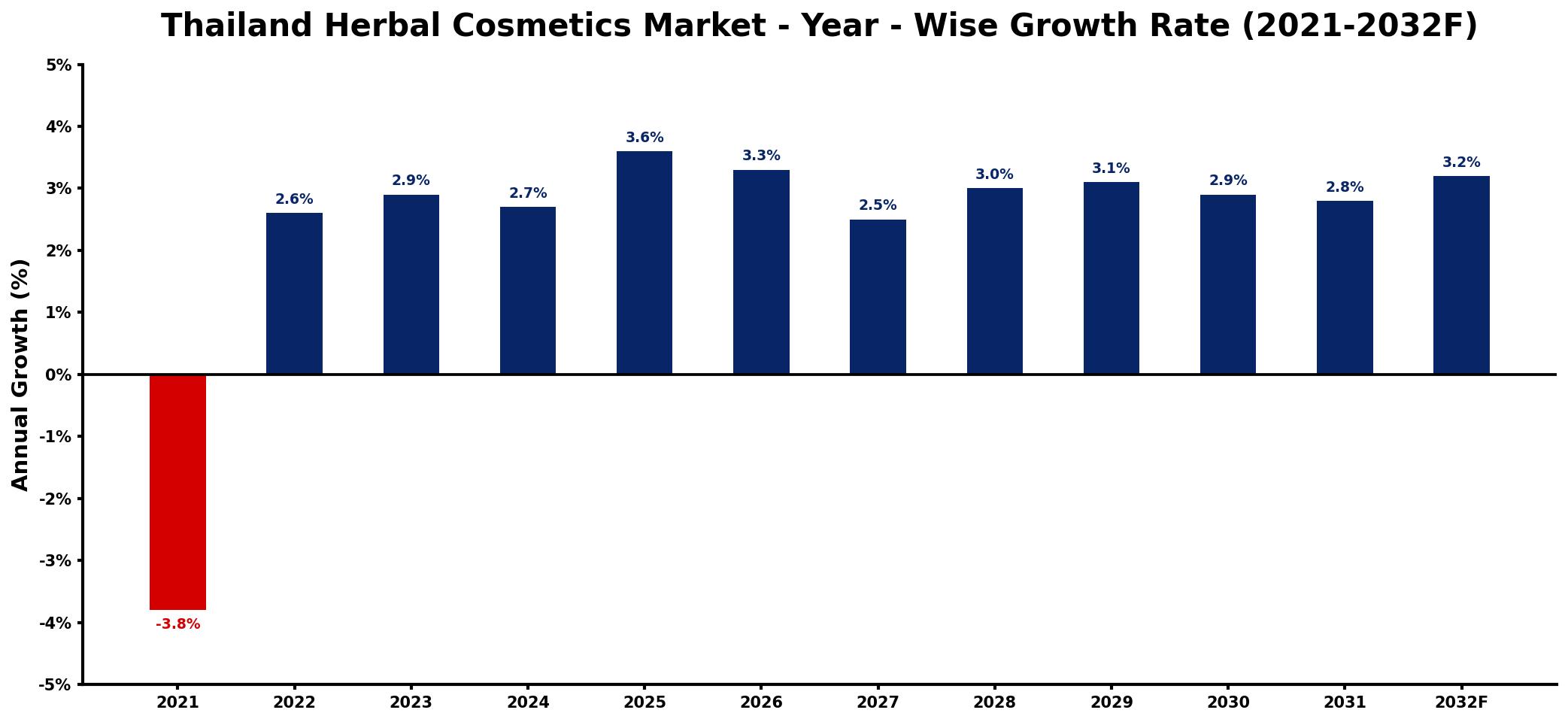
The table below presents the year‑wise growth rates along with the key drivers influencing the market
| Year | Growth Rate | Major Drivers |
| 2021 | -3.8% | Consumer interest shifted downward |
| 2022 | 2.6% | Increased focus on sustainability initiatives |
| 2023 | 2.9% | Rise in online shopping platforms |
| 2024 | 2.7% | Growing demand for natural ingredients |
| 2025 | 3.6% | Expansion of wellness tourism sector |
| 2026 | 3.3% | Emerging trends in eco-friendly packaging |
| 2027 | 2.5% | Investment in local production facilities |
| 2028 | 3.0% | Collaborations with influencers increased |
| 2029 | 3.1% | Growth in organic certification programs |
| 2030 | 2.9% | Enhanced distribution networks established |
| 2031 | 2.8% | Rising awareness of skin health |
| 2032 | 3.2% | Increased research on traditional remedies |
Note: Market size estimations and growth projections presented in this report are based on 6Wresearch's proprietary forecasting methodology, utilizing the latest available industry data, government publications, and primary research inputs.
Thailand Herbal Cosmetics Market Synopsis
The Thailand Herbal Cosmetics Market is characterized by a vibrant blend of traditional knowledge and modern cosmetic science, appealing to a growing demographic that prioritizes safety and efficacy in their beauty products. The appeal of herbal ingredients lies in their perceived safety, attracting a diverse range of consumers who are more informed about the benefits of natural options.
As a nation rich in biodiversity, Thailand boasts a plethora of native herbs and plants, which are integral to the formulation of herbal cosmetics. This unique positioning offers local brands a competitive edge over international players by leveraging traditional Thai beauty secrets, thereby fostering a strong sense of national pride in the products offered.
Thailand Herbal Cosmetics Market Key Takeaways
- Growing consumer inclination towards herbal and eco-friendly products drives market expansion.
- Competitive landscape features both domestic and international brands vying for consumer attention.
- Enhanced consumer education is vital to highlight the advantages of herbal cosmetics over synthetic alternatives.
- The market is adapting to evolving trends by leveraging e-commerce platforms for broader reach.
- Government initiatives are increasingly supportive of natural beauty products, fostering market growth.
Evaluation of Restraints in Thailand Herbal Cosmetics Market
Despite the thriving potential, the Thailand Herbal Cosmetics Market is challenged by stringent regulatory requirements surrounding the use of herbal ingredients. Companies must navigate complex safety testing and labeling protocols to ensure compliance, which can deter smaller entrants with limited resources. Additionally, the necessity for consumer education presents another layer of difficulty, as many potential customers may not fully understand the benefits or the efficacy of herbal cosmetics compared to their synthetic counterparts.
Thailand Herbal Cosmetics Market Trends
The market is experiencing notable trends such as the rising popularity of personalized beauty products tailored to individual skin types and concerns. There is also a strong inclination towards clean beauty, with consumers demanding products free from harmful chemicals and additives. Eco-consciousness is reshaping consumer behavior, prompting brands to adopt sustainable practices in sourcing and packaging. Furthermore, social media influences are playing a crucial role in shaping trends and consumer preferences, making it essential for brands to engage in effective digital marketing strategies.
Thailand Herbal Cosmetics Market Opportunities
The demand for herbal cosmetics presents significant opportunities for innovation, particularly in creating unique formulations that capitalize on Thailand's rich botanical diversity. Developing products that cater to specific skin issues or conditions can enhance consumer loyalty and market share. Additionally, as international interest in Thai herbal products grows, opportunities for export to other regions are expanding. Companies can also benefit from forming partnerships with local agricultural producers to ensure a sustainable supply chain, which aligns with growing consumer interest in ethically sourced ingredients.
Government Initiatives in the Thailand Herbal Cosmetics Market
The Thai government is increasingly recognizing the importance of the herbal cosmetics sector, implementing policies that promote the cultivation and use of local herbs in cosmetic formulations. Various programs are being initiated to support research and development in herbal product innovation, as well as to ensure adherence to safety and quality standards. Additionally, public spending is being directed towards raising awareness of the benefits of herbal cosmetics, thus fostering a more favorable environment for both manufacturers and consumers alike.
Future Insights of the Thailand Herbal Cosmetics Market
Looking ahead to 2026-2032, the Thailand Herbal Cosmetics Market is expected to witness sustained growth, driven by evolving consumer preferences that prioritize wellness and sustainability. Innovations in product formulations, combined with robust digital marketing strategies, will likely enhance brand visibility and consumer engagement. Furthermore, as health-consciousness continues to rise, the demand for products made from natural ingredients will strengthen, creating a favorable landscape for market expansion.
Thailand Herbal Cosmetics Market Latest Developments (2025 - 2026)
In recent months, the Thailand Herbal Cosmetics Market has seen a surge in new product launches focusing on natural and herbal formulations. Brands are increasingly utilizing online platforms for product distribution, enhancing accessibility for consumers. There's also been a notable rise in collaborative initiatives between brands and local farmers to source raw materials sustainably. These movements are indicative of a broader industry shift towards transparency and ethical practices, aligning with consumer expectations for environmental responsibility.
Thailand Herbal Cosmetics Market - Key Attractiveness of the Report
- 10 Years of Market Numbers
- Historical Data Starting from 2022 to 2025
- Base Year: 2025
- Forecast Data until 2032
- Key Performance Indicators Impacting the Market
- Major Upcoming Developments and Projects
The market was estimated at USD 161 Million in 2025 and is projected to reach USD 185 Million by 2032, growing at a CAGR of 2.0% from 2026 to 2032. This indicates a stable demand for herbal products among Thai consumers.
The formulations typically incorporate a range of native herbs and botanical extracts, leveraging Thailands rich biodiversity to offer unique benefits and enhance skin health.
Increasing consumer awareness about the benefits of herbal ingredients drives demand, necessitating companies to educate potential buyers about product efficacy compared to synthetic alternatives.
New entrants often encounter rigorous regulatory requirements related to herbal ingredient usage and safety testing, making it challenging to penetrate the market effectively.
The pandemic initially reduced spending on non-essential products, yet it concurrently spurred interest in natural and herbal products as consumers became more health-conscious.
Yes, there is a noticeable trend towards sustainability, with consumers increasingly favoring brands that adopt eco-friendly and cruelty-free practices in their production and packaging.
Key Highlights of the Report:
- Thailand Herbal Cosmetics Market Outlook
- Market Size of Thailand Herbal Cosmetics Market, 2025
- Forecast of Thailand Herbal Cosmetics Market, 2032
- Historical Data and Forecast of Thailand Herbal Cosmetics Revenues & Volume for the Period 2022-2032F
- Thailand Herbal Cosmetics Market Trend Evolution
- Thailand Herbal Cosmetics Market Drivers and Challenges
- Thailand Herbal Cosmetics Price Trends
- Thailand Herbal Cosmetics Porter's Five Forces
- Thailand Herbal Cosmetics Industry Life Cycle
- Historical Data and Forecast of Thailand Herbal Cosmetics Market Revenues & Volume By Physical State for the Period 2022-2032F
- Historical Data and Forecast of Thailand Herbal Cosmetics Market Revenues & Volume By Solid for the Period 2022-2032F
- Historical Data and Forecast of Thailand Herbal Cosmetics Market Revenues & Volume By Semi-solid for the Period 2022-2032F
- Historical Data and Forecast of Thailand Herbal Cosmetics Market Revenues & Volume By Liquid for the Period 2022-2032F
- Historical Data and Forecast of Thailand Herbal Cosmetics Market Revenues & Volume By Product for the Period 2022-2032F
- Historical Data and Forecast of Thailand Herbal Cosmetics Market Revenues & Volume By Skin Care Product for the Period 2022-2032F
- Historical Data and Forecast of Thailand Herbal Cosmetics Market Revenues & Volume By Hair Care Product for the Period 2022-2032F
- Historical Data and Forecast of Thailand Herbal Cosmetics Market Revenues & Volume By Baby Care Product for the Period 2022-2032F
- Historical Data and Forecast of Thailand Herbal Cosmetics Market Revenues & Volume By Oral Care Product for the Period 2022-2032F
- Historical Data and Forecast of Thailand Herbal Cosmetics Market Revenues & Volume By Make-up Product for the Period 2022-2032F
- Historical Data and Forecast of Thailand Herbal Cosmetics Market Revenues & Volume By Distribution Channel for the Period 2022-2032F
- Historical Data and Forecast of Thailand Herbal Cosmetics Market Revenues & Volume By Supermarket for the Period 2022-2032F
- Historical Data and Forecast of Thailand Herbal Cosmetics Market Revenues & Volume By Pharmacy for the Period 2022-2032F
- Historical Data and Forecast of Thailand Herbal Cosmetics Market Revenues & Volume By Departmental Store for the Period 2022-2032F
- Historical Data and Forecast of Thailand Herbal Cosmetics Market Revenues & Volume By Beauty Spa/Salon for the Period 2022-2032F
- Historical Data and Forecast of Thailand Herbal Cosmetics Market Revenues & Volume By Internet Retailing for the Period 2022-2032F
- Historical Data and Forecast of Thailand Herbal Cosmetics Market Revenues & Volume By Specialty Store for the Period 2022-2032F
- Thailand Herbal Cosmetics Import Export Trade Statistics
- Market Opportunity Assessment By Physical State
- Market Opportunity Assessment By Product
- Market Opportunity Assessment By Distribution Channel
- Thailand Herbal Cosmetics Top Companies Market Share
- Thailand Herbal Cosmetics Competitive Benchmarking By Technical and Operational Parameters
- Thailand Herbal Cosmetics Company Profiles
- Thailand Herbal Cosmetics Key Strategic Recommendations






































