Thailand Higher Education Market Size & Growth Rate (2026-2032)
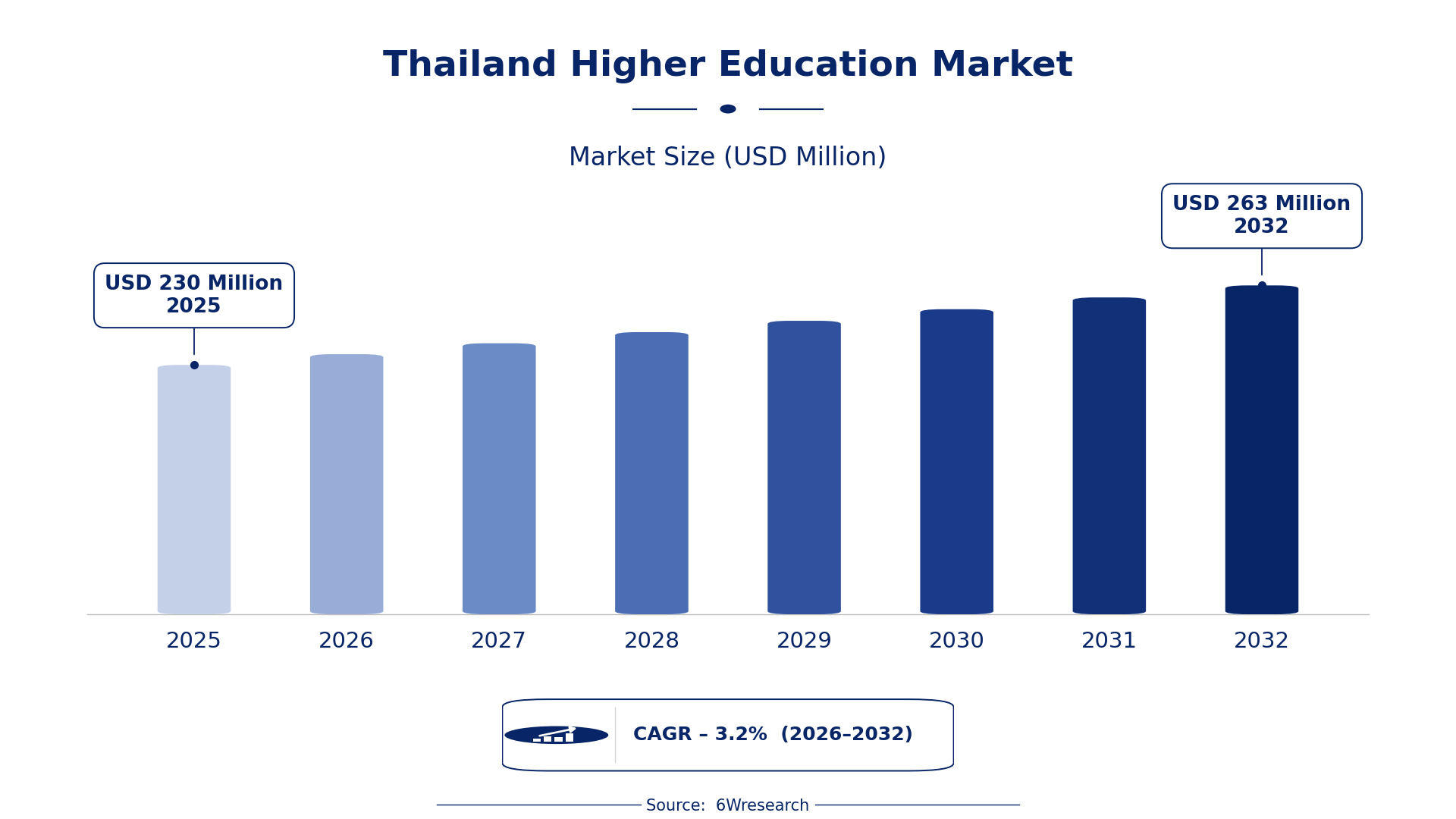
The Thailand Higher Education Market was estimated at USD 230 Million in 2025 and is projected to reach USD 263 Million by 2032, growing at a CAGR of 3.2% from 2026 to 2032.
Thailand Higher Education Market Synopsis
The demand for innovative educational technologies is reshaping the Thailand Higher Education Market. Institutions are increasingly integrating digital learning platforms and administrative tools to enhance educational delivery and student engagement.
As universities pivot towards a more accessible and quality-driven educational framework, the emphasis on technology adoption continues to grow. This shift is not merely a response to market demands but a strategic initiative aimed at improving overall academic standards.
Thailand Higher Education Market Year-wise Growth Rate and Key Drivers
This graph illustrates the annual growth rates of the Thailand Higher Education Market from 2021 to 2032, highlighting a steady upward trajectory and projected expansion over the forecast period.
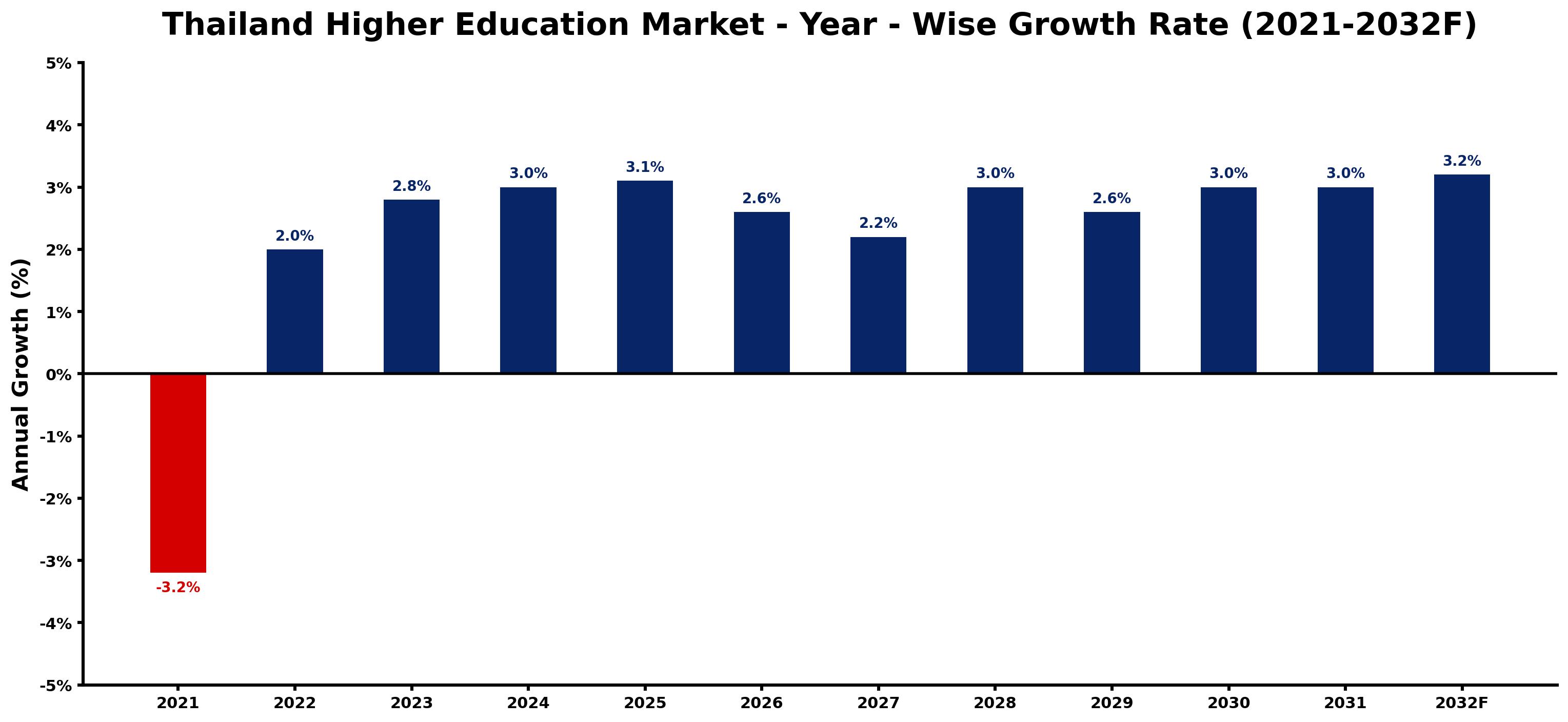
The table below presents the year‑wise growth rates along with the key drivers influencing the market
| Year | Growth Rate | Major Drivers |
| 2021 | -3.2% | COVID-19 travel restrictions limited international student enrollment |
| 2022 | 2.0% | Increased investment in digital learning technologies nationwide. |
| 2023 | 2.8% | Government initiatives promoting STEM education in universities. |
| 2024 | 3.0% | Higher enrollment rates from rural areas due to scholarships. |
| 2025 | 3.1% | Collaboration with international institutions enhances program diversity. |
| 2026 | 2.6% | Growing middle-class population demands higher education access. |
| 2027 | 2.2% | Focus on research funding boosts university initiatives. |
| 2028 | 3.0% | International partnerships drive cross-border education programs. |
| 2029 | 2.6% | Attraction of international faculty enhances academic reputation. |
| 2030 | 3.0% | Emergence of online degree programs attracts non-traditional students. |
| 2031 | 3.0% | Government policies supporting lifelong learning and adult education. |
| 2032 | 3.2% | Increased focus on entrepreneurship programs in universities. |
Note: Market size estimations and growth projections presented in this report are based on 6Wresearch's proprietary forecasting methodology, utilizing the latest available industry data, government publications, and primary research inputs.
Thailand Higher Education Market Key Takeaways
Below are some of the specific key takeaways from the market, including:
- Growing integration of digital learning platforms to facilitate remote education.
- Increased focus on administrative efficiency through advanced management systems.
- Significant investments by educational institutions in technology-driven solutions.
- Government policies supporting digital transformation in higher education.
- Emerging trends of hybrid learning models catering to diverse student needs.
Evaluation of Restraints in Thailand Higher Education Market
The Thailand Higher Education Market faces notable constraints that hinder its progress. The challenge of implementing advanced technologies across diverse educational institutions often stems from budgetary limitations and varying levels of digital readiness. Additionally, ensuring equitable access to educational resources remains a pressing concern, particularly for underserved communities. Balancing the integration of digital tools with traditional teaching methods without compromising academic integrity is another hurdle institutions must navigate.
Thailand Higher Education Market Trends
Several trends are currently shaping the Thailand Higher Education Market. The shift towards hybrid learning, which combines in-person and online education, is gaining traction. Institutions are increasingly utilizing Learning Management Systems (LMS) to offer more personalized educational experiences. There’s also a noticeable rise in collaboration tools that foster student engagement and group work. on top of that, as the demand for lifelong learning increases, educational programs tailored for adult learners are becoming more common.
Thailand Higher Education Market Opportunities
Opportunities for growth within the Thailand Higher Education Market are abundant. The ongoing digital transformation presents a lucrative avenue for tech companies offering innovative solutions tailored for education. There is a growing demand for online courses and certifications, especially in emerging fields like data science and artificial intelligence. Additionally, partnerships between educational institutions and technology providers can create synergies that enhance the learning environment.
Government Initiatives in the Thailand Higher Education Market
The Thai government is actively shaping the Higher Education Market through various initiatives aimed at enhancing educational quality and accessibility. A strong regulatory framework supports the integration of technology in education, prioritizing digital infrastructure and learning resources. These policies are crucial in fostering an environment conducive to innovation and improvement in academic delivery.
- A national digital infrastructure upgrade programme launched in early 2025 to enhance connectivity in educational institutions.
- Current initiatives focused on expanding online learning resources to ensure equitable access to education.
- A planned public-private partnership expected to boost technological investments in higher education by 2028.
- Regulatory measures introduced in 2025 mandating universities to adopt comprehensive digital strategies.
- A recent initiative aimed at increasing funding for research and development in educational technologies.
Future Insights of the Thailand Higher Education Market
Looking ahead to 2026-2032, the Thailand Higher Education Market is set to experience continued evolution driven by technological advancements and changing student expectations. As institutions increasingly prioritize quality and accessibility, the integration of advanced digital solutions will become paramount. The focus on personalized learning experiences and hybrid models will redefine educational delivery, catering to a broader range of learners. on top of that, ongoing government support will further accelerate this transformation, ensuring that the market remains dynamic and responsive to emerging needs.
Thailand Higher Education Market Latest Developments
Recent developments within the Thailand Higher Education Market highlight a strong push towards technology integration and enhanced educational experiences. Over the past year, institutions have made significant strides in adopting digital solutions, reflecting a broader commitment to innovation in education.
- A major technology vendor launched a new online learning platform in Q2 2025, designed to improve student engagement.
- An initiative that began in early 2025 is currently underway, focusing on training educators in digital teaching methodologies.
- A collaboration between universities and tech companies announced in late 2025 aims to develop tailored educational software solutions.
- Expansions of existing e-learning programs are ongoing, enhancing course offerings for adult learners.
- Upcoming in early 2026, a nationwide campaign will promote digital literacy among students and faculty.
Thailand Higher Education Market - Key Attractiveness of the Report
- 10 Years of Market Numbers
- Historical Data Starting from 2022 to 2025
- Base Year: 2025
- Forecast Data until 2032
- Key Performance Indicators Impacting the Market
- Major Upcoming Developments and Projects
Key Highlights of the Report:
- Thailand Higher Education Market Outlook
- Market Size of Thailand Higher Education Market, 2025
- Forecast of Thailand Higher Education Market, 2032
- Historical Data and Forecast of Thailand Higher Education Revenues & Volume for the Period 2022-2032F
- Thailand Higher Education Market Trend Evolution
- Thailand Higher Education Market Drivers and Challenges
- Thailand Higher Education Price Trends
- Thailand Higher Education Porter's Five Forces
- Thailand Higher Education Industry Life Cycle
- Historical Data and Forecast of Thailand Higher Education Market Revenues & Volume By Component for the Period 2022-2032F
- Historical Data and Forecast of Thailand Higher Education Market Revenues & Volume By Solutions for the Period 2022-2032F
- Historical Data and Forecast of Thailand Higher Education Market Revenues & Volume By Services for the Period 2022-2032F
- Historical Data and Forecast of Thailand Higher Education Market Revenues & Volume By Deployment Type for the Period 2022-2032F
- Historical Data and Forecast of Thailand Higher Education Market Revenues & Volume By On-premises for the Period 2022-2032F
- Historical Data and Forecast of Thailand Higher Education Market Revenues & Volume By Cloud for the Period 2022-2032F
- Historical Data and Forecast of Thailand Higher Education Market Revenues & Volume By Vertical for the Period 2022-2032F
- Historical Data and Forecast of Thailand Higher Education Market Revenues & Volume By State Universities for the Period 2022-2032F
- Historical Data and Forecast of Thailand Higher Education Market Revenues & Volume By Community Colleges for the Period 2022-2032F
- Historical Data and Forecast of Thailand Higher Education Market Revenues & Volume By Private Colleges for the Period 2022-2032F
- Thailand Higher Education Import Export Trade Statistics
- Market Opportunity Assessment By Component
- Market Opportunity Assessment By Deployment Type
- Market Opportunity Assessment By Vertical
- Thailand Higher Education Top Companies Market Share
- Thailand Higher Education Competitive Benchmarking By Technical and Operational Parameters
- Thailand Higher Education Company Profiles
- Thailand Higher Education Key Strategic Recommendations






































