Thailand Insecticide Market Size, Share & Growth Rate
The Thailand Insecticide Market was estimated at USD 160 Million in 2025 and is projected to reach USD 183 Million by 2032, growing at a CAGR of 1.9% from 2026 to 2032. This growth trajectory is primarily driven by Thailand's robust agricultural sector, which emphasizes the need for effective crop protection. Additionally, public health initiatives aimed at combating vector-borne diseases have amplified the demand for insecticides, further solidifying the market's upward momentum.
Thailand Insecticide Market Year-wise Growth Rate and Key Drivers
This graph highlights how the Thailand Insecticide Market has steadily grown over the years, supported by major growth factors.
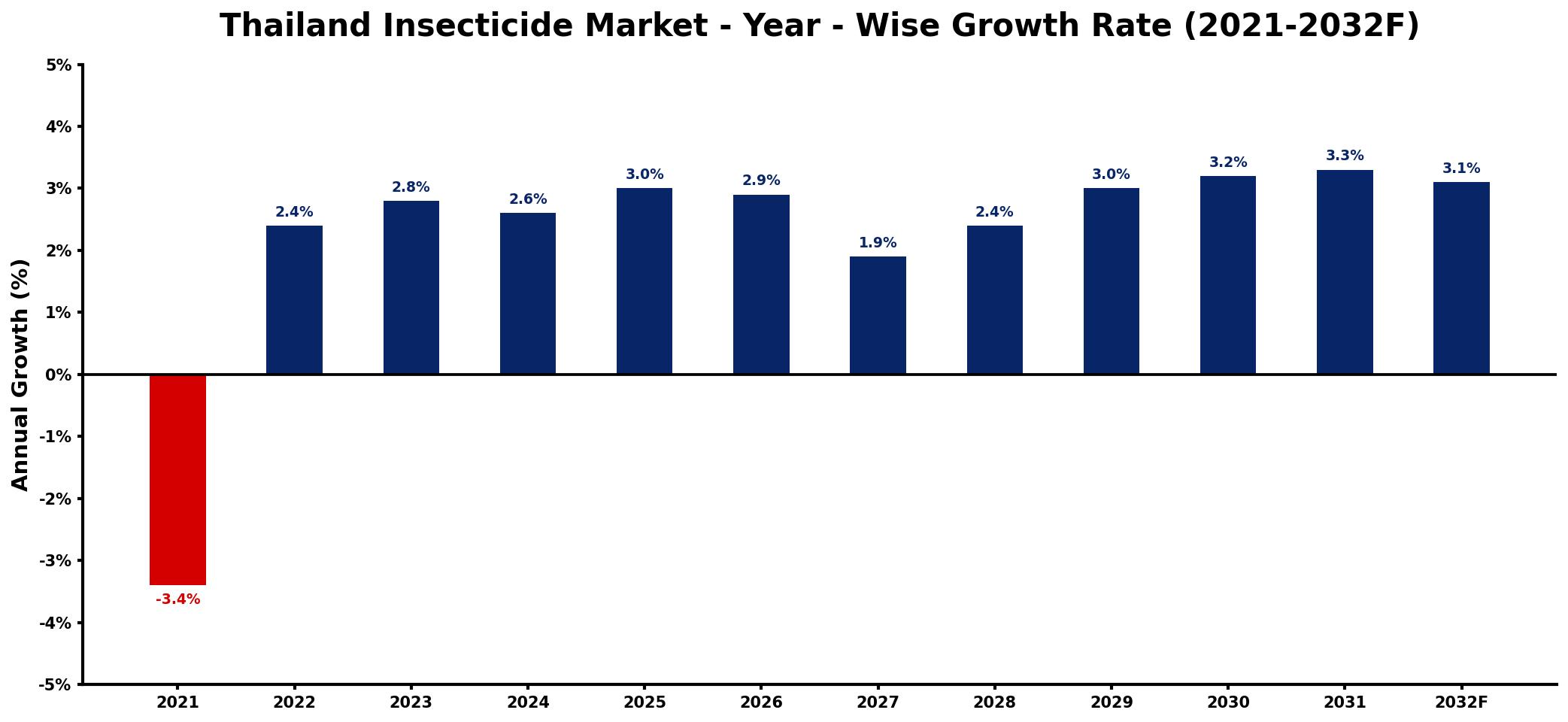
The table below presents the year‑wise growth rates along with the key drivers influencing the market
| Year | Growth Rate | Major Drivers |
| 2021 | -3.4% | decreased agricultural pest demand |
| 2022 | 2.4% | rising awareness of pest control |
| 2023 | 2.8% | increased agricultural investment trends |
| 2024 | 2.6% | expansion in organic farming practices |
| 2025 | 3.0% | growth in urban gardening initiatives |
| 2026 | 2.9% | enhanced distribution network efficiency |
| 2027 | 1.9% | development of eco-friendly alternatives |
| 2028 | 2.4% | increased government support programs |
| 2029 | 3.0% | growing export market opportunities |
| 2030 | 3.2% | advancements in agricultural technology |
| 2031 | 3.3% | strengthened collaboration with farmers |
| 2032 | 3.1% | rising consumer health consciousness |
Note: Market size estimations and growth projections presented in this report are based on 6Wresearch's proprietary forecasting methodology, utilizing the latest available industry data, government publications, and primary research inputs.
Thailand Insecticide Market Synopsis
In recent years, the Thailand Insecticide Market has experienced heightened activity, fueled by increased agricultural production and public health efforts. However, as the market matures, the focus is shifting towards safer and more sustainable formulations, aligning with global trends in environmental awareness.
Looking forward, the market is set to navigate challenges such as regulatory pressures and public scrutiny regarding chemical safety. Nevertheless, the consistent need for pest management in agriculture and urban settings remains a pivotal growth driver, ensuring that demand for insecticides will persist.
Thailand Insecticide Market Key Takeaways
- The market is positioned to benefit from an expanding agricultural sector and the ongoing need for food security.
- Urbanization trends are catalyzing demand for residential and commercial pest control solutions.
- Increased awareness among farmers about the economic benefits of insecticides is enhancing market adoption.
- Regulatory initiatives are steering product development towards safer and environmentally friendly formulations.
- The COVID-19 pandemic has shifted focus towards agricultural and public health insecticides, showcasing resilience in these sectors.
Evaluation of Restraints in Thailand Insecticide Market
Despite its growth potential, the Thailand Insecticide Market faces significant restraints. Regulatory measures around chemical usage are becoming increasingly stringent, often limiting the availability of certain active ingredients. Furthermore, there are growing concerns about the environmental impact and health risks associated with traditional insecticides. As a result, manufacturers are compelled to invest in research and innovation to develop safer alternatives, which can be both time-consuming and costly, potentially hindering swift market expansion.
Thailand Insecticide Market Trends
Emerging trends in the Thailand Insecticide Market highlight a shift towards integrated pest management (IPM) practices, where insecticides are used in conjunction with biological pest control methods. This approach not only enhances pest control efficacy but also minimizes environmental impact. Additionally, the rise of precision agriculture is influencing the insecticide market, as farmers increasingly adopt data-driven techniques to optimize pesticide application, thereby improving overall crop yields while reducing chemical use.
Thailand Insecticide Market Opportunities
Genuine growth opportunities exist within the realm of organic and biopesticides, as consumer preferences lean towards safer food production methods. Investment in R&D for innovative formulations that align with sustainable agriculture practices is crucial. Additionally, collaborations with local farmers and agricultural cooperatives can create unique market avenues, enhancing product reach and tailored solutions for pest management challenges faced by the farming community.
Government Initiatives in the Thailand Insecticide Market
The Thai government has implemented various policies aimed at fostering sustainable agricultural practices, which include promoting integrated pest management and the use of eco-friendly insecticides. Public spending on agricultural modernization and pest control programs has increased, supporting research and innovation in safer insecticide options. These initiatives reflect a commitment to food security and public health while addressing environmental concerns.
Future Insights of the Thailand Insecticide Market
From 2026 to 2032, the Thailand Insecticide Market is expected to continue its growth trajectory, driven by the dual forces of agricultural needs and public health imperatives. As urbanization persists, the demand for pest control in urban settings is likely to increase, presenting new challenges and opportunities for market players. Additionally, ongoing advancements in sustainable insecticide formulations will play a vital role in shaping the market landscape, as stakeholders strive to balance efficacy with safety.
Thailand Insecticide Market Latest Developments (2025 - 2026)
Recent developments in the Thailand Insecticide Market indicate a focus on the adoption of biopesticides and novel delivery systems that enhance product efficacy while minimizing environmental impact. There have been initiatives aimed at educating farmers on the benefits of integrated pest management practices, encouraging the use of safer insecticides. Collaboration between stakeholders in the agricultural sector has also strengthened, aiming to improve supply chain efficiencies and product availability.
Thailand Insecticide Market - Key Attractiveness of the Report
- 10 Years of Market Numbers
- Historical Data Starting from 2022 to 2025
- Base Year: 2025
- Forecast Data until 2032
- Key Performance Indicators Impacting the Market
- Major Upcoming Developments and Projects
Key Highlights of the Report:
- Thailand Insecticide Market Outlook
- Market Size of Thailand Insecticide Market, 2025
- Forecast of Thailand Insecticide Market, 2032
- Historical Data and Forecast of Thailand Insecticide Revenues & Volume for the Period 2022-2032F
- Thailand Insecticide Market Trend Evolution
- Thailand Insecticide Market Drivers and Challenges
- Thailand Insecticide Price Trends
- Thailand Insecticide Porter's Five Forces
- Thailand Insecticide Industry Life Cycle
- Historical Data and Forecast of Thailand Insecticide Market Revenues & Volume By Type for the Period 2022-2032F
- Historical Data and Forecast of Thailand Insecticide Market Revenues & Volume By Pyrethroids for the Period 2022-2032F
- Historical Data and Forecast of Thailand Insecticide Market Revenues & Volume By Organophosphorus for the Period 2022-2032F
- Historical Data and Forecast of Thailand Insecticide Market Revenues & Volume By Carbamates for the Period 2022-2032F
- Historical Data and Forecast of Thailand Insecticide Market Revenues & Volume By Organochlorine for the Period 2022-2032F
- Historical Data and Forecast of Thailand Insecticide Market Revenues & Volume By Botanicals for the Period 2022-2032F
- Historical Data and Forecast of Thailand Insecticide Market Revenues & Volume By Other Types for the Period 2022-2032F
- Historical Data and Forecast of Thailand Insecticide Market Revenues & Volume By Crop Type for the Period 2022-2032F
- Historical Data and Forecast of Thailand Insecticide Market Revenues & Volume By Cereals & Grains for the Period 2022-2032F
- Historical Data and Forecast of Thailand Insecticide Market Revenues & Volume By Oilseeds & Pulses for the Period 2022-2032F
- Historical Data and Forecast of Thailand Insecticide Market Revenues & Volume By Fruits & Vegetables for the Period 2022-2032F
- Historical Data and Forecast of Thailand Insecticide Market Revenues & Volume By Other Crop Types for the Period 2022-2032F
- Historical Data and Forecast of Thailand Insecticide Market Revenues & Volume By Formulation for the Period 2022-2032F
- Historical Data and Forecast of Thailand Insecticide Market Revenues & Volume By Wettable Powder for the Period 2022-2032F
- Historical Data and Forecast of Thailand Insecticide Market Revenues & Volume By Emulsifiable Concentrate for the Period 2022-2032F
- Historical Data and Forecast of Thailand Insecticide Market Revenues & Volume By Suspension Concentrate for the Period 2022-2032F
- Historical Data and Forecast of Thailand Insecticide Market Revenues & Volume By Oil Emulsion In Water for the Period 2022-2032F
- Historical Data and Forecast of Thailand Insecticide Market Revenues & Volume By Microencapsulated Suspension for the Period 2022-2032F
- Historical Data and Forecast of Thailand Insecticide Market Revenues & Volume By Granules for the Period 2022-2032F
- Historical Data and Forecast of Thailand Insecticide Market Revenues & Volume By Other Formulations for the Period 2022-2032F
- Historical Data and Forecast of Thailand Insecticide Market Revenues & Volume By Form for the Period 2022-2032F
- Historical Data and Forecast of Thailand Insecticide Market Revenues & Volume By Sprays for the Period 2022-2032F
- Historical Data and Forecast of Thailand Insecticide Market Revenues & Volume By Baits for the Period 2022-2032F
- Historical Data and Forecast of Thailand Insecticide Market Revenues & Volume By Strips for the Period 2022-2032F
- Thailand Insecticide Import Export Trade Statistics
- Market Opportunity Assessment By Type
- Market Opportunity Assessment By Crop Type
- Market Opportunity Assessment By Formulation
- Market Opportunity Assessment By Form
- Thailand Insecticide Top Companies Market Share
- Thailand Insecticide Competitive Benchmarking By Technical and Operational Parameters
- Thailand Insecticide Company Profiles
- Thailand Insecticide Key Strategic Recommendations






































