Thailand Mimosa Extract Market Size, Share & Growth Rate
The Thailand Mimosa Extract Market was estimated at USD 170 Million in 2025 and is projected to reach USD 195 Million by 2032, growing at a CAGR of 2.0% from 2026 to 2032. This growth trajectory is significantly influenced by the booming cosmetics and personal care sectors, where mimosa extract is valued for its skin-soothing and anti-aging properties. As consumer preferences increasingly shift toward natural alternatives, the demand for mimosa extract is likely to rise, driven by ongoing innovations in product formulations.
Thailand Mimosa Extract Market Year-wise Growth Rate and Key Drivers
This graph highlights how the Thailand Mimosa Extract Market has steadily grown over the years, supported by major growth factors.
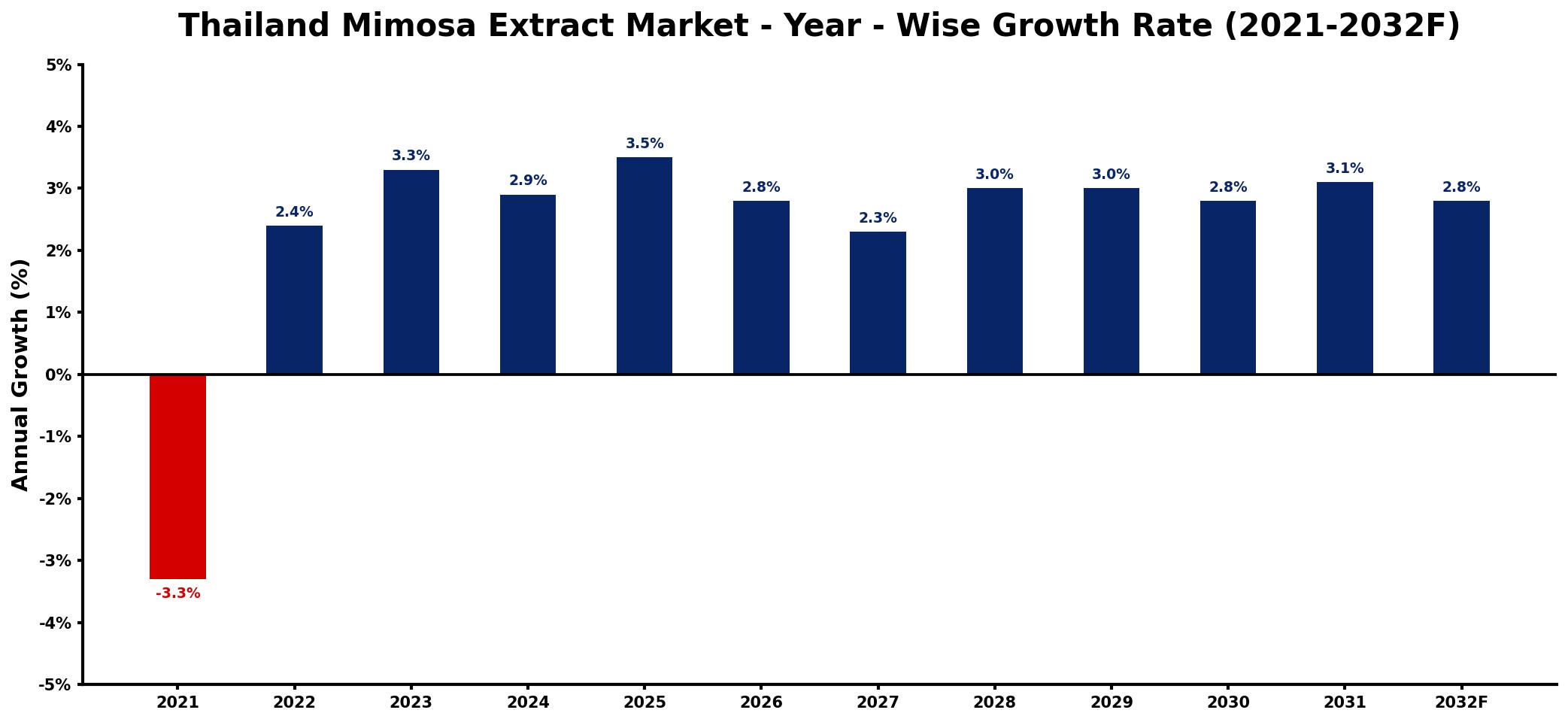
The table below presents the year‑wise growth rates along with the key drivers influencing the market
| Year | Growth Rate | Major Drivers |
| 2021 | -3.3% | decrease in consumer interest |
| 2022 | 2.4% | rise in wellness trends |
| 2023 | 3.3% | expansion of herbal market |
| 2024 | 2.9% | increased investment in botanicals |
| 2025 | 3.5% | growing popularity of natural remedies |
| 2026 | 2.8% | enhanced product availability online |
| 2027 | 2.3% | emergence of new applications |
| 2028 | 3.0% | expanding healthcare application demand |
| 2029 | 3.0% | broader consumer awareness initiatives |
| 2030 | 2.8% | heightened focus on sustainability |
| 2031 | 3.1% | increased research and development |
| 2032 | 2.8% | growing demand for organic products |
Note: Market size estimations and growth projections presented in this report are based on 6Wresearch's proprietary forecasting methodology, utilizing the latest available industry data, government publications, and primary research inputs.
Thailand Mimosa Extract Market Synopsis
The unique characteristics of mimosa extract, especially its applications in skincare, are propelling the market forward. In Thailand, traditional herbal medicine practices coupled with modern wellness trends create a fertile ground for the adoption of mimosa extracts across various sectors.
Thailand's rich biodiversity and favorable climate conditions further support the sustainable cultivation of mimosa trees. As local and global demand for herbal extracts continues to grow, stakeholders in Thailand are positioned to leverage these advantages for competitive gain in the emerging market.
Thailand Mimosa Extract Market Key Takeaways
- The mimosa extract market is integral to Thailands herbal and natural remedies sector, driven by increased consumer awareness and demand for natural ingredients.
- Cosmetics and personal care products are the primary consumers of mimosa extract, reflecting broader industry trends toward natural beauty solutions.
- Sustainable harvesting practices and strict quality control measures are critical for maintaining product integrity and meeting international standards.
- The post-COVID recovery phase has reignited interest in natural ingredients, setting the stage for significant market growth.
- Key players in the market are focusing on innovations in formulations to enhance the appeal of mimosa extract in various applications.
Evaluation of Restraints in Thailand Mimosa Extract Market
Despite the growth potential, the Thailand mimosa extract market faces several restraints. Sustainable harvesting practices must be implemented to prevent the depletion of mimosa tree populations, which is essential for long-term viability. Additionally, ensuring consistent quality to meet international standards poses a challenge for producers. The competitive landscape is also intensifying, with global players entering the market, making it crucial for local businesses to adapt through strategic pricing and enhanced product offerings.
Thailand Mimosa Extract Market Trends
Emerging trends in the Thailand mimosa extract market include an increasing focus on sustainability and eco-friendly practices. Consumers are gravitating toward products that emphasize natural ingredients and minimal environmental impact. Furthermore, innovative product formulations that combine mimosa extract with other botanical ingredients are becoming popular, enhancing the appeal of cosmetic products. The rise of online retail platforms is also shaping consumer purchasing behaviors, enabling easier access to a wider array of mimosa-based products.
Thailand Mimosa Extract Market Opportunities
The Thailand mimosa extract market presents several growth opportunities. Expanding applications in the food and beverage sector, particularly in health supplements and functional foods, are promising avenues for innovation. Moreover, the increasing demand for natural and organic ingredients in various industries positions mimosa extract as a valuable asset. Collaborative ventures between local growers and manufacturers could also enhance product offerings and market reach.
Government Initiatives in the Thailand Mimosa Extract Market
The Thai government has been actively promoting the herbal industry through various initiatives aimed at enhancing the cultivation and use of indigenous plants like mimosa. Supportive policies are fostering research and development in herbal extracts, alongside efforts to boost export potential. Incentives for sustainable practices and public awareness campaigns regarding the benefits of herbal medicine are also part of the broader strategy to elevate the status of natural remedies within the healthcare framework.
Future Insights of the Thailand Mimosa Extract Market
Looking ahead, the Thailand mimosa extract market is poised for steady growth through 2032. Increased awareness of the benefits of natural ingredients among consumers will likely sustain the demand. Additionally, innovation in extraction techniques and product formulations is expected to enhance the market's robustness. The integration of sustainable practices in cultivation will be essential for maintaining supply integrity while addressing the environmental impacts associated with extraction.
Thailand Mimosa Extract Market Latest Developments (2025 - 2026)
Recent developments in the Thailand mimosa extract market indicate a shift toward greater transparency and traceability in the supply chain. Industry stakeholders are increasingly adopting sustainability standards to bolster consumer confidence. Additionally, partnerships between local farmers and companies are fostering community engagement and sustainable harvesting practices. Innovations in product formulations continue to be introduced, enhancing the functionality and appeal of mimosa extract in various sectors.
Thailand Mimosa Extract Market - Key Attractiveness of the Report
- 10 Years of Market Numbers
- Historical Data Starting from 2022 to 2025
- Base Year: 2025
- Forecast Data until 2032
- Key Performance Indicators Impacting the Market
- Major Upcoming Developments and Projects
Key Highlights of the Report:
- Thailand Mimosa Extract Market Outlook
- Market Size of Thailand Mimosa Extract Market, 2025
- Forecast of Thailand Mimosa Extract Market, 2032
- Historical Data and Forecast of Thailand Mimosa Extract Revenues & Volume for the Period 2022-2032F
- Thailand Mimosa Extract Market Trend Evolution
- Thailand Mimosa Extract Market Drivers and Challenges
- Thailand Mimosa Extract Price Trends
- Thailand Mimosa Extract Porter's Five Forces
- Thailand Mimosa Extract Industry Life Cycle
- Historical Data and Forecast of Thailand Mimosa Extract Market Revenues & Volume By End User for the Period 2022-2032F
- Historical Data and Forecast of Thailand Mimosa Extract Market Revenues & Volume By Forestry for the Period 2022-2032F
- Historical Data and Forecast of Thailand Mimosa Extract Market Revenues & Volume By Paper & Wood Products for the Period 2022-2032F
- Thailand Mimosa Extract Import Export Trade Statistics
- Market Opportunity Assessment By End User
- Thailand Mimosa Extract Top Companies Market Share
- Thailand Mimosa Extract Competitive Benchmarking By Technical and Operational Parameters
- Thailand Mimosa Extract Company Profiles
- Thailand Mimosa Extract Key Strategic Recommendations






































