Thailand Non-grape Wine Market Summary
The thailand non-grape wine market was estimated at USD 93 Million in 2025 and is projected to reach USD 106 Million by 2032, growing at a CAGR of 2.9% from 2026 to 2032.
Thailand Non-grape Wine Market Year-wise Growth Rate and Key Drivers
This graph highlights how the Thailand Non-grape Wine Market has steadily grown over the past five years, supported by major growth factors.
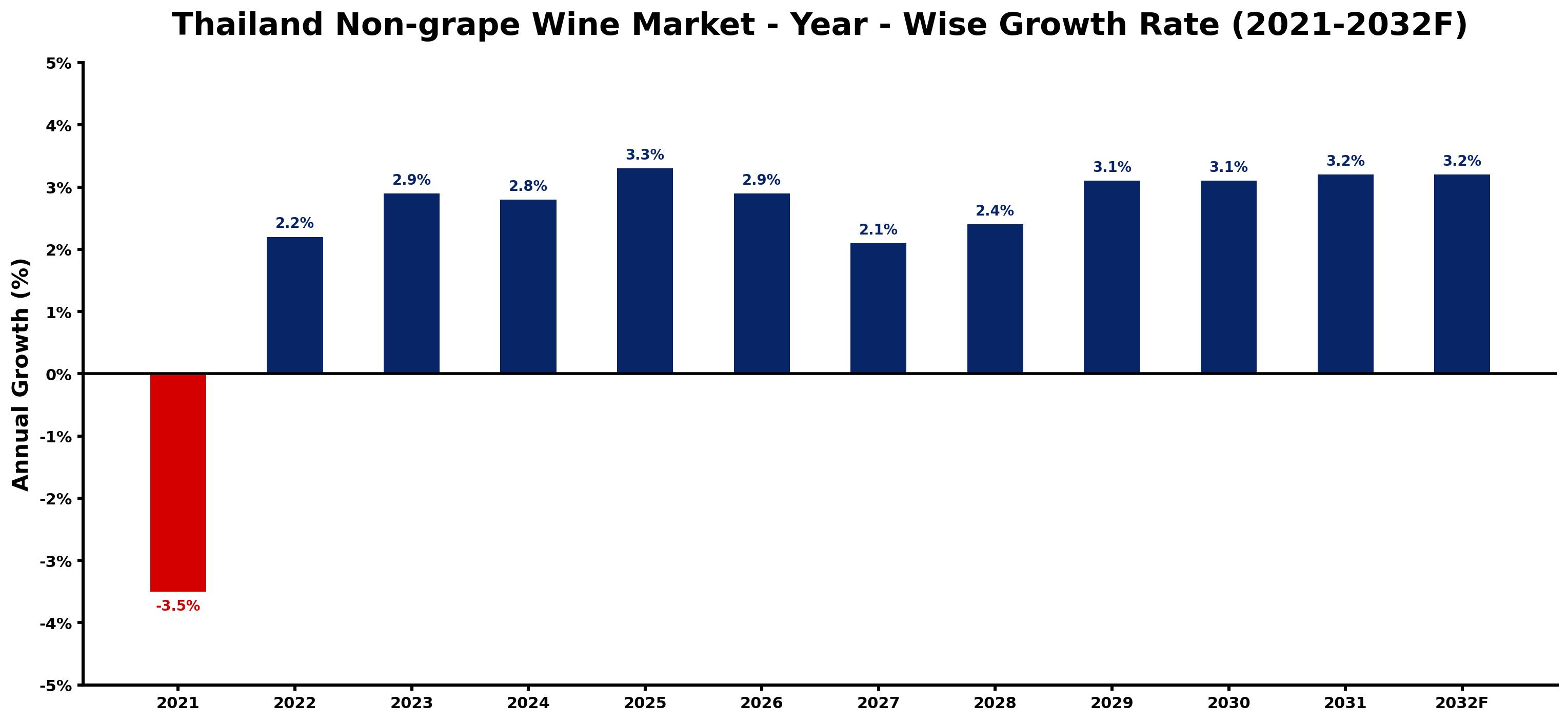
The table below presents the year wise growth rates along with the key drivers influencing the market
| Year | Growth Rate | Major Drivers |
| 2021 | -3.5% | Increased competition from imported wines led to a significant decline in local nongrape wine sales. |
| 2022 | 2.2% | Rising interest in organic and natural wines aligns with health-conscious consumer trends. |
| 2023 | 2.9% | Local wineries start gaining recognition, enhancing the credibility of non-grape options. |
| 2024 | 2.8% | Emerging wine tourism initiatives highlight Thailand's unique non-grape wine offerings. |
| 2025 | 3.3% | Increased visibility of non-grape wines in restaurants attracts a diverse clientele. |
| 2026 | 2.9% | Cultural festivals showcase local non-grape wines, boosting consumer awareness significantly. |
| 2027 | 2.1% | Sustainable farming practices enhance production quality, appealing to environmentally conscious buyers. |
| 2028 | 2.4% | Retail collaborations create innovative wine-tasting experiences, fostering direct consumer engagement. |
| 2029 | 3.1% | Digital platforms enable niche market growth, connecting producers with interested consumers. |
| 2030 | 3.1% | Increasing expatriate populations introduce diverse wine preferences, expanding market dynamics. |
| 2031 | 3.2% | Social media influences wine choices, driving curiosity towards unique non-grape varieties. |
| 2032 | 3.2% | Enhanced distribution networks facilitate access to non-grape wines across Thailand's regions. |
Note - Market size estimations and growth projections presented in this report are based on 6Wresearch's advanced forecasting approach, validated with industry datasets as of June 2026.
Thailand Non-grape Wine Market Synopsis
The Thailand Non-grape Wine Market is projected to reach 2.9% and witness significant growth during the forecast period (2026-2032). Non-grape wines, crafted from a variety of fruits including tropical selections, berries, and other indigenous produce, have emerged as an innovative segment in the beverage industry. This growth is driven by shifting consumer preferences toward unique flavors and local products that resonate with cultural identity.
Thailand Non-grape Wine Market Growth Drivers
Several factors are propelling the growth of the Thailand non-grape wine market. Firstly, Thailand's tropical climate, coupled with its rich biodiversity, allows for the cultivation of a wide range of fruits ideal for wine production:
- The abundant variety of locally sourced fruits enhances the unique flavor profiles of non-grape wines, appealing to a growing consumer base that seeks novel drinking experiences.
- Consumers' increasing interest in authentic, locally produced beverages has led to a demand for unique products that reflect regional identities and agricultural heritage.
- Tourism plays a significant role; visitors to Thailand frequently look for local wine experiences, thus bolstering sales for non-grape wines as part of cultural exploration.
- The rising health consciousness among consumers is also notable, as many non-grape wines are perceived to be lower in sugar and packed with antioxidants.
- Innovative marketing strategies that highlight the essence of Thai fruits in wine production are resonating with consumers who are eager to support local industries.
Thailand Non-grape Wine Market Challenges and Restraints
Despite its growth potential, the Thailand non-grape wine market faces several challenges that could impede expansion. A primary concern relates to consumer education and awareness:
- As non-grape wines are relatively novel in the Thai beverage landscape, many consumers may lack knowledge regarding their diverse offerings and quality, necessitating substantial educational efforts.
- Regulatory challenges also pose a threat; the production and marketing of non-grape wines must navigate a complex web of licensing and compliance requirements.
- Smaller producers may find it particularly difficult to meet these regulations compared to larger, established wineries, potentially limiting market participation.
- The impact of COVID-19 showcased vulnerabilities in distribution channels, as restrictions affected the hospitality industry and, consequently, sales for non-grape wines.
- Lastly, competition from established alcoholic beverages, particularly grape wines and spirits, continues to challenge the market share of non-grape wines.
Thailand Non-grape Wine Market Government Investment and Initiatives
The Thai government has recognized the potential of the non-grape wine sector as part of the country's broader agricultural and tourism strategies. Investment initiatives aim to promote sustainable agricultural practices that support local fruit cultivation:
- Policies focused on enhancing the agricultural sector have created incentives for local producers to experiment with non-grape wine production, thus diversifying the beverage market.
- Public funding is being channeled towards research programs that explore innovative fermentation techniques and flavor enhancement for non-grape wines.
- The government is facilitating training opportunities for local farmers and winemakers to better understand the production process and quality control methods.
- In addition, initiatives to promote wine tourism provide a platform for local producers to showcase their products, fostering a connection between agriculture and cultural heritage.
- Collaboration with educational institutions is also encouraged to develop curricula that focus on viticulture and winemaking, thereby nurturing the next generation of wine producers.
Thailand Non-grape Wine Market Latest Developments (May 2025 - June 2026)
In the period from May 2025 to June 2026, the Thailand non-grape wine market has seen numerous developments reflecting the evolving landscape of consumer preferences and production techniques:
- Innovative product launches using a variety of tropical fruits have gained traction, showcasing the diverse palates that can be catered to within the market.
- Increased partnerships among local wineries and tourism operators have enhanced the visibility of non-grape wines, strengthening market awareness and distribution channels.
- Trade events and festivals celebrating local wines have been organized, promoting not only non-grape wines but also supporting the agricultural sectors from which these fruits are sourced.
- Sustainability has become a focal point, with many producers adopting eco-friendly practices to appeal to the environmentally conscious consumer segment.
- The rise of online retail platforms has provided greater access to non-grape wines, facilitating direct-to-consumer sales and expanding market reach.
Thailand Non-grape Wine Market - Key Attractiveness of the Report
- 10 Years of Market Numbers
- Historical Data Starting from 2022 to 2025
- Base Year: 2025
- Forecast Data until 2032
- Key Performance Indicators Impacting the Market
- Major Upcoming Developments and Projects
Key Highlights of the Report:
- Thailand Non-grape Wine Market Outlook
- Market Size of Thailand Non-grape Wine Market, 2025
- Forecast of Thailand Non-grape Wine Market, 2032
- Historical Data and Forecast of Thailand Non-grape Wine Revenues & Volume for the Period 2022-2032F
- Thailand Non-grape Wine Market Trend Evolution
- Thailand Non-grape Wine Market Drivers and Challenges
- Thailand Non-grape Wine Price Trends
- Thailand Non-grape Wine Porter's Five Forces
- Thailand Non-grape Wine Industry Life Cycle
- Historical Data and Forecast of Thailand Non-grape Wine Market Revenues & Volume By Product Type for the Period 2022-2032F
- Historical Data and Forecast of Thailand Non-grape Wine Market Revenues & Volume By Fermented Fruit Wine for the Period 2022-2032F
- Historical Data and Forecast of Thailand Non-grape Wine Market Revenues & Volume By Distilled Fruit Wine for the Period 2022-2032F
- Historical Data and Forecast of Thailand Non-grape Wine Market Revenues & Volume By Preparation Fruit Wine for the Period 2022-2032F
- Historical Data and Forecast of Thailand Non-grape Wine Market Revenues & Volume By Sparkling Fruit Wine for the Period 2022-2032F
- Historical Data and Forecast of Thailand Non-grape Wine Market Revenues & Volume By Application for the Period 2022-2032F
- Historical Data and Forecast of Thailand Non-grape Wine Market Revenues & Volume By Household for the Period 2022-2032F
- Historical Data and Forecast of Thailand Non-grape Wine Market Revenues & Volume By Commercial for the Period 2022-2032F
- Thailand Non-grape Wine Import Export Trade Statistics
- Market Opportunity Assessment By Product Type
- Market Opportunity Assessment By Application
- Thailand Non-grape Wine Top Companies Market Share
- Thailand Non-grape Wine Competitive Benchmarking By Technical and Operational Parameters
- Thailand Non-grape Wine Company Profiles
- Thailand Non-grape Wine Key Strategic Recommendations






































