Thailand Nuclear Medicine Radioisotopes Market Size, Share & Growth Rate
The Thailand Nuclear Medicine Radioisotopes Market was estimated at USD 241 Million in 2025 and is projected to reach USD 277 Million by 2032, growing at a CAGR of 2.0% from 2026 to 2032. This growth trajectory is fueled by a rising demand for accurate diagnostic tools and the increasing prevalence of chronic diseases, compelling hospitals and medical facilities to integrate advanced radioisotope technologies into their operations.
Thailand Nuclear Medicine Radioisotopes Market Year-wise Growth Rate and Key Drivers
This graph highlights how the Thailand Nuclear Medicine Radioisotopes Market has steadily grown over the years, supported by major growth factors.
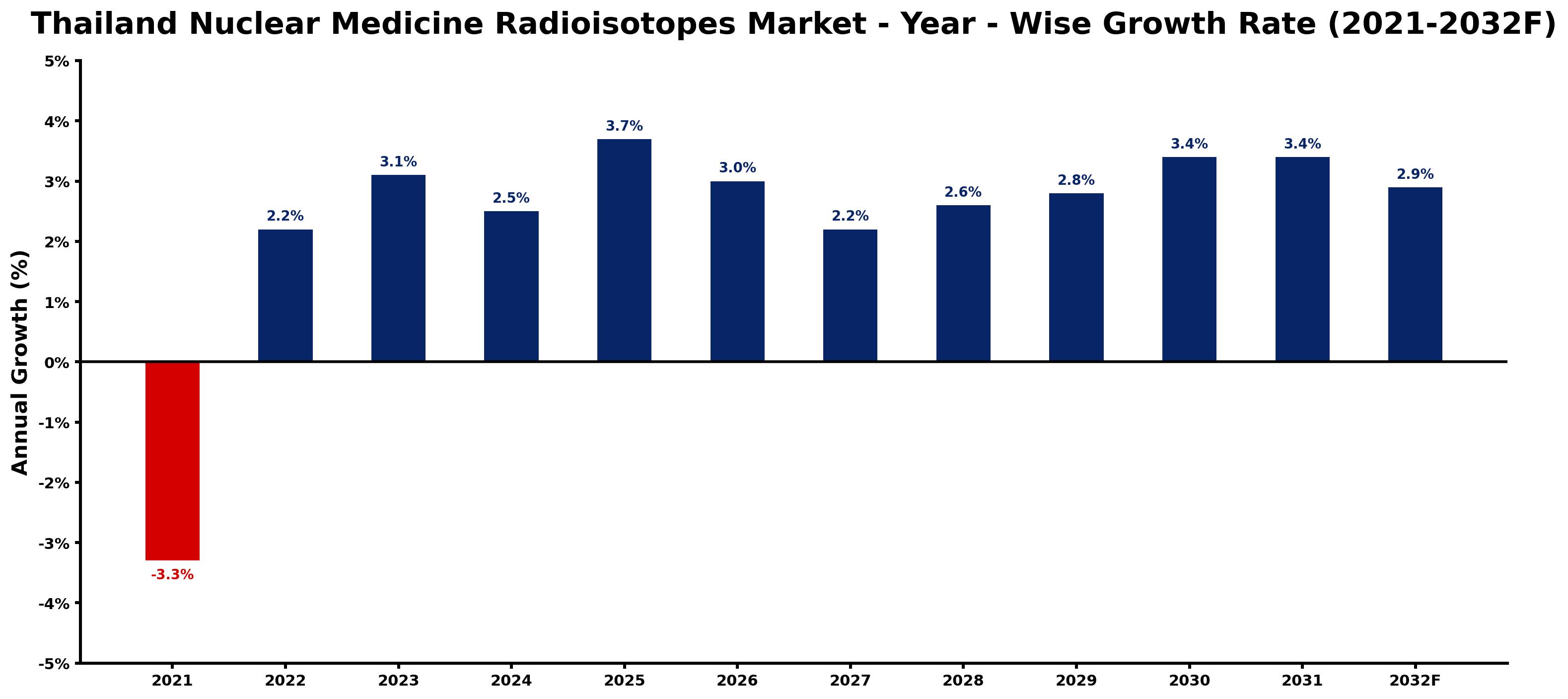
The table below presents the year‑wise growth rates along with the key drivers influencing the market
| Year | Growth Rate | Major Drivers |
| 2021 | -3.3% | decrease in healthcare investments |
| 2022 | 2.2% | growing adoption of diagnostics |
| 2023 | 3.1% | expansion of healthcare infrastructure |
| 2024 | 2.5% | increased public health funding |
| 2025 | 3.7% | rising demand for imaging |
| 2026 | 3.0% | increased domestic production output |
| 2027 | 2.2% | growth in preventive healthcare |
| 2028 | 2.6% | advancements in technology applications |
| 2029 | 2.8% | strengthening partnerships with hospitals |
| 2030 | 3.4% | increased regulatory support initiatives |
| 2031 | 3.4% | increased pharmaceutical industry usage |
| 2032 | 2.9% | growing awareness of benefits |
Note: Market size estimations and growth projections presented in this report are based on 6Wresearch's proprietary forecasting methodology, utilizing the latest available industry data, government publications, and primary research inputs.
Thailand Nuclear Medicine Radioisotopes Market Synopsis
The primary force shaping the Thailand Nuclear Medicine Radioisotopes Market is the growing adoption of nuclear medicine in hospitals and healthcare settings. As more healthcare providers seek innovative solutions for medical diagnostics and treatment, the reliance on radioisotopes has become increasingly pronounced.
Currently, the market is characterized by the frequent use of isotopes such as technetium-99m (Tc-99m) and fluorine-18 (F-18), which are crucial for various diagnostic imaging procedures. While the market remains relatively small compared to regional counterparts, the increasing interest from foreign suppliers is gradually improving the landscape.
Thailand Nuclear Medicine Radioisotopes Market Key Takeaways
- The market is projected to see steady growth, driven by technological advancements in medical imaging.
- Increasing prevalence of chronic diseases is creating higher demand for diagnostic tools utilizing radioisotopes.
- Production and distribution challenges hinder the availability of radioisotopes, impacting market expansion.
- Active suppliers are emerging to fill the gap, bolstering competition within the local market.
- Innovative solutions in nuclear medicine are vital for improving healthcare outcomes and diagnostic accuracy.
Evaluation of Restraints in Thailand Nuclear Medicine Radioisotopes Market
Despite its growth potential, the Thailand Nuclear Medicine Radioisotopes Market is constrained by a complex regulatory environment that governs the production and usage of radioactive substances. Safety concerns surrounding radioactive materials necessitate stringent compliance measures, which can deter new suppliers and innovations. Furthermore, the need for specialized infrastructure to handle these isotopes complicates access for hospitals and healthcare providers, thereby limiting market potential.
Thailand Nuclear Medicine Radioisotopes Market Trends
Several current and emerging trends are shaping the demand for nuclear medicine radioisotopes in Thailand. The ongoing evolution of diagnostic technologies, particularly in PET and SPECT imaging, showcases a growing integration of advanced isotopes. Additionally, there is an increasing focus on personalized medicine, which necessitates tailored radioisotope applications for effective patient treatment. These trends indicate a shift toward more sophisticated approaches in both diagnostics and therapeutics.
Thailand Nuclear Medicine Radioisotopes Market Opportunities
Significant growth and investment opportunities exist within the Thailand Nuclear Medicine Radioisotopes Market. The rising number of healthcare facilities adopting advanced diagnostic tools presents a ripe environment for suppliers to introduce innovative isotopes and technologies. Furthermore, partnerships with international vendors can enhance local capabilities, expand product offerings, and improve accessibility to essential medical radioisotopes, ultimately benefiting patient care.
Government Initiatives in the Thailand Nuclear Medicine Radioisotopes Market
The Thai government has shown commitment to advancing healthcare through various initiatives aimed at enhancing nuclear medicine capabilities. Public spending on healthcare infrastructure and research grants for innovative medical technologies are being prioritized. Moreover, regulatory frameworks are being evaluated to streamline the approval processes for new radioisotopes and ensure safety standards, thereby encouraging investment and research in this crucial area of medicine.
Future Insights of the Thailand Nuclear Medicine Radioisotopes Market
Looking ahead to 2026-2032, the Thailand Nuclear Medicine Radioisotopes Market is poised for gradual expansion, driven by increasing healthcare demand and the continuous evolution of diagnostic techniques. As more hospitals adopt innovative technologies, the market will likely witness an uptick in both local and imported radioisotopes. Efforts to overcome regulatory challenges and enhance infrastructure will play a crucial role in determining the pace of this growth, ultimately shaping the future of nuclear medicine in the country.
Thailand Nuclear Medicine Radioisotopes Market Latest Developments (2025 - 2026)
Recent developments in the Thailand Nuclear Medicine Radioisotopes Market indicate a focus on collaboration between local suppliers and international manufacturers. There has been increased investment in research and development of novel isotopes to meet the rising demand for advanced imaging solutions. Additionally, efforts to improve the distribution network for radioisotopes are gaining traction, facilitating better access for medical facilities across the country.
Thailand Nuclear Medicine Radioisotopes Market - Key Attractiveness of the Report
- 10 Years of Market Numbers
- Historical Data Starting from 2022 to 2025
- Base Year: 2025
- Forecast Data until 2032
- Key Performance Indicators Impacting the Market
- Major Upcoming Developments and Projects
Key Highlights of the Report:
- Thailand Nuclear Medicine Radioisotopes Market Outlook
- Market Size of Thailand Nuclear Medicine Radioisotopes Market, 2025
- Forecast of Thailand Nuclear Medicine Radioisotopes Market, 2032
- Historical Data and Forecast of Thailand Nuclear Medicine Radioisotopes Revenues & Volume for the Period 2022-2032F
- Thailand Nuclear Medicine Radioisotopes Market Trend Evolution
- Thailand Nuclear Medicine Radioisotopes Market Drivers and Challenges
- Thailand Nuclear Medicine Radioisotopes Price Trends
- Thailand Nuclear Medicine Radioisotopes Porter's Five Forces
- Thailand Nuclear Medicine Radioisotopes Industry Life Cycle
- Historical Data and Forecast of Thailand Nuclear Medicine Radioisotopes Market Revenues & Volume By Types for the Period 2022-2032F
- Historical Data and Forecast of Thailand Nuclear Medicine Radioisotopes Market Revenues & Volume By Technetium-99m (Tc-99m) for the Period 2022-2032F
- Historical Data and Forecast of Thailand Nuclear Medicine Radioisotopes Market Revenues & Volume By Thallium-201 (Tl-201) for the Period 2022-2032F
- Historical Data and Forecast of Thailand Nuclear Medicine Radioisotopes Market Revenues & Volume By Iodine (I-123) for the Period 2022-2032F
- Historical Data and Forecast of Thailand Nuclear Medicine Radioisotopes Market Revenues & Volume By Fluorine-18 for the Period 2022-2032F
- Historical Data and Forecast of Thailand Nuclear Medicine Radioisotopes Market Revenues & Volume By Rubidium-82 (Rb-82) for the Period 2022-2032F
- Historical Data and Forecast of Thailand Nuclear Medicine Radioisotopes Market Revenues & Volume By Iodine-131 (I-131) for the Period 2022-2032F
- Historical Data and Forecast of Thailand Nuclear Medicine Radioisotopes Market Revenues & Volume By Actinium-225 (Ac-225) for the Period 2022-2032F
- Historical Data and Forecast of Thailand Technetium-99m (Tc-99m) Nuclear Medicine Radioisotopes Market Revenues & Volume By Others for the Period 2022-2032F
- Historical Data and Forecast of Thailand Nuclear Medicine Radioisotopes Market Revenues & Volume By Application for the Period 2022-2032F
- Historical Data and Forecast of Thailand Nuclear Medicine Radioisotopes Market Revenues & Volume By Oncology for the Period 2022-2032F
- Historical Data and Forecast of Thailand Nuclear Medicine Radioisotopes Market Revenues & Volume By Cardiology for the Period 2022-2032F
- Historical Data and Forecast of Thailand Nuclear Medicine Radioisotopes Market Revenues & Volume By Thyroid for the Period 2022-2032F
- Historical Data and Forecast of Thailand Nuclear Medicine Radioisotopes Market Revenues & Volume By Neurology for the Period 2022-2032F
- Historical Data and Forecast of Thailand Nuclear Medicine Radioisotopes Market Revenues & Volume By Others for the Period 2022-2032F
- Thailand Nuclear Medicine Radioisotopes Import Export Trade Statistics
- Market Opportunity Assessment By Types
- Market Opportunity Assessment By Application
- Thailand Nuclear Medicine Radioisotopes Top Companies Market Share
- Thailand Nuclear Medicine Radioisotopes Competitive Benchmarking By Technical and Operational Parameters
- Thailand Nuclear Medicine Radioisotopes Company Profiles
- Thailand Nuclear Medicine Radioisotopes Key Strategic Recommendations






































