Thailand Printed Signage Market: Import Trend Analysis
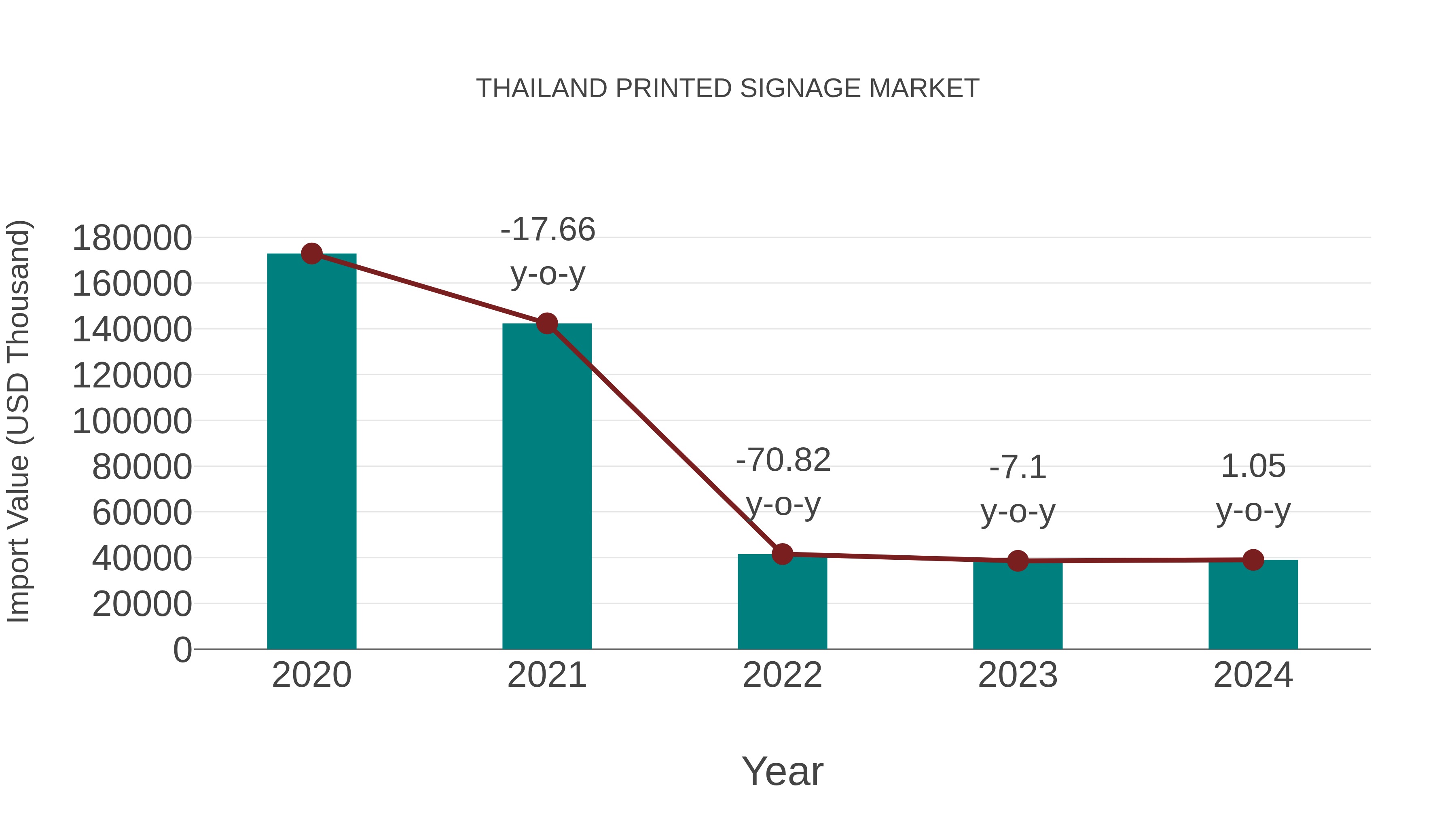
Thailand import trend for the printed signage market saw a growth rate of 1.05% from 2023 to 2024, following a compound annual growth rate (CAGR) of -31.08% from 2020 to 2024. This significant recovery in import momentum in 2024 may be attributed to increased demand for signage products as businesses sought to enhance visibility and communication strategies post-pandemic.
Thailand Printed Signage Market Synopsis
The Thailand Printed Signage Market is witnessing steady growth due to increasing demand from various sectors such as retail, hospitality, and transportation. The market is driven by the growing economy, urbanization, and the rising trend of using visually appealing signage for branding and advertising purposes. Digital printing technology is gaining popularity in the market, offering advantages such as customization, quick turnaround times, and cost-effectiveness. Outdoor signage dominates the market, with a significant presence of large format and LED displays. Key players in the Thailand Printed Signage Market include companies offering a wide range of services from design to installation. The market is expected to continue its growth trajectory, driven by advancements in printing technology and the increasing focus on visual communication strategies by businesses across different industries.
Thailand Printed Signage Market Trends
The current trends in the Thailand Printed Signage Market are focused on sustainability and personalization. There is a growing demand for eco-friendly materials and practices in the production of printed signage, driven by increasing environmental awareness among consumers and businesses. Additionally, there is a trend towards personalized and customized signage solutions to stand out in a competitive market and appeal to specific target audiences. Digital printing technology is also shaping the market, allowing for more intricate designs and faster turnaround times. Overall, the Thailand Printed Signage Market is moving towards more sustainable, personalized, and technologically advanced solutions to meet the evolving needs of businesses and consumers.
Thailand Printed Signage Market Challenges
In the Thailand Printed Signage Market, one of the main challenges faced is the increasing competition from digital signage solutions. The shift towards digital signage, which offers dynamic and interactive content, has led to a decline in demand for traditional printed signage. Additionally, the industry is also facing challenges related to environmental sustainability, as the disposal of printed signage materials can have negative impacts on the environment. Another challenge is the need for constant innovation to cater to changing consumer preferences and technological advancements. Companies in the Thailand Printed Signage Market must adapt to these challenges by investing in digital capabilities, adopting sustainable practices, and continuously evolving their product offerings to stay competitive in the market.
Thailand Printed Signage Market Investment Opportunities
The Thailand Printed Signage Market presents promising investment opportunities due to the country`s growing economy and increasing demand for visually appealing and informative signage across various industries such as retail, hospitality, and transportation. With businesses looking to enhance their brand visibility and improve customer engagement, there is a rising need for high-quality printed signage solutions. Investing in advanced printing technologies, eco-friendly materials, and innovative design capabilities can help capitalize on this trend. Additionally, the shift towards digital signage and personalized advertising offers avenues for investment in interactive and dynamic signage solutions. Overall, the Thailand Printed Signage Market offers a fertile ground for investors seeking to tap into the booming advertising and marketing sector in the country.
Jordan Agar Market Government Policies
The Thailand Printed Signage Market is subject to government policies aimed at regulating the industry`s environmental impact, safety standards, and advertising practices. The Thai government has implemented regulations to ensure that printed signage materials are eco-friendly and comply with environmental standards. In terms of safety, there are policies in place to ensure that signage installations adhere to building codes and do not pose hazards to the public. Additionally, advertising practices related to printed signage are regulated to prevent misleading or deceptive marketing strategies. Overall, government policies in Thailand aim to promote sustainable and responsible practices within the printed signage industry to protect the environment, public safety, and consumer interests.
Thailand Printed Signage Market Future Outlook
The future outlook for the Thailand Printed Signage Market appears promising, driven by increasing urbanization, infrastructure development, and a growing focus on marketing and branding by businesses. The market is expected to witness steady growth due to the rising demand for printed signage in retail, hospitality, transportation, and other sectors. Technological advancements in printing technologies, such as digital printing and UV printing, are also expected to fuel market growth by offering more cost-effective and customizable solutions. Additionally, the trend towards eco-friendly and sustainable signage materials is likely to create new opportunities for market players. Overall, the Thailand Printed Signage Market is projected to expand, driven by the country`s economic growth and increasing investments in advertising and promotional activities.
Key Highlights of the Report:
- Thailand Printed Signage Market Outlook
- Market Size of Thailand Printed Signage Market, 2025
- Forecast of Thailand Printed Signage Market, 2032
- Historical Data and Forecast of Thailand Printed Signage Revenues & Volume for the Period 2022 - 2032F
- Thailand Printed Signage Market Trend Evolution
- Thailand Printed Signage Market Drivers and Challenges
- Thailand Printed Signage Price Trends
- Thailand Printed Signage Porter's Five Forces
- Thailand Printed Signage Industry Life Cycle
- Historical Data and Forecast of Thailand Printed Signage Market Revenues & Volume By Product for the Period 2022 - 2032F
- Historical Data and Forecast of Thailand Printed Signage Market Revenues & Volume By Billboard for the Period 2022 - 2032F
- Historical Data and Forecast of Thailand Printed Signage Market Revenues & Volume By Backlit Display for the Period 2022 - 2032F
- Historical Data and Forecast of Thailand Printed Signage Market Revenues & Volume By Pop Display for the Period 2022 - 2032F
- Historical Data and Forecast of Thailand Printed Signage Market Revenues & Volume By Banner for the Period 2022 - 2032F
- Historical Data and Forecast of Thailand Printed Signage Market Revenues & Volume By Corporate Graphics for the Period 2022 - 2032F
- Historical Data and Forecast of Thailand Printed Signage Market Revenues & Volume By Others for the Period 2022 - 2032F
- Historical Data and Forecast of Thailand Printed Signage Market Revenues & Volume By Type for the Period 2022 - 2032F
- Historical Data and Forecast of Thailand Printed Signage Market Revenues & Volume By Indoor Printed Signage for the Period 2022 - 2032F
- Historical Data and Forecast of Thailand Printed Signage Market Revenues & Volume By Outdoor Printed Signage for the Period 2022 - 2032F
- Historical Data and Forecast of Thailand Printed Signage Market Revenues & Volume By End-user Vertical for the Period 2022 - 2032F
- Historical Data and Forecast of Thailand Printed Signage Market Revenues & Volume By BFSI for the Period 2022 - 2032F
- Historical Data and Forecast of Thailand Printed Signage Market Revenues & Volume By Retail for the Period 2022 - 2032F
- Historical Data and Forecast of Thailand Printed Signage Market Revenues & Volume By Sports and Leisure for the Period 2022 - 2032F
- Historical Data and Forecast of Thailand Printed Signage Market Revenues & Volume By Entertainment for the Period 2022 - 2032F
- Historical Data and Forecast of Thailand Printed Signage Market Revenues & Volume By Transportation and Logistics for the Period 2022 - 2032F
- Historical Data and Forecast of Thailand Printed Signage Market Revenues & Volume By Healthcare for the Period 2022 - 2032F
- Historical Data and Forecast of Thailand Printed Signage Market Revenues & Volume By Others for the Period 2022 - 2032F
- Thailand Printed Signage Import Export Trade Statistics
- Market Opportunity Assessment By Product
- Market Opportunity Assessment By Type
- Market Opportunity Assessment By End-user Vertical
- Thailand Printed Signage Top Companies Market Share
- Thailand Printed Signage Competitive Benchmarking By Technical and Operational Parameters
- Thailand Printed Signage Company Profiles
- Thailand Printed Signage Key Strategic Recommendations






































