Thailand Revenue Assurance Market Size, Share & Growth Rate
The Thailand Revenue Assurance Market was estimated at USD 267 Million in 2025 and is projected to reach USD 348 Million by 2032, growing at a CAGR of 3.9% from 2026 to 2032. This growth trajectory is significantly influenced by the increasing demand for enhanced service quality and reliability within the telecom sector, which is driving operators to invest in robust assurance solutions. As the market continues to mature, the need for real-time performance monitoring and optimization becomes paramount, aligning with the evolving digital landscape in Thailand.
Thailand Revenue Assurance Market Year-wise Growth Rate and Key Drivers
This graph highlights how the Thailand Revenue Assurance Market has steadily grown over the years, supported by major growth factors.
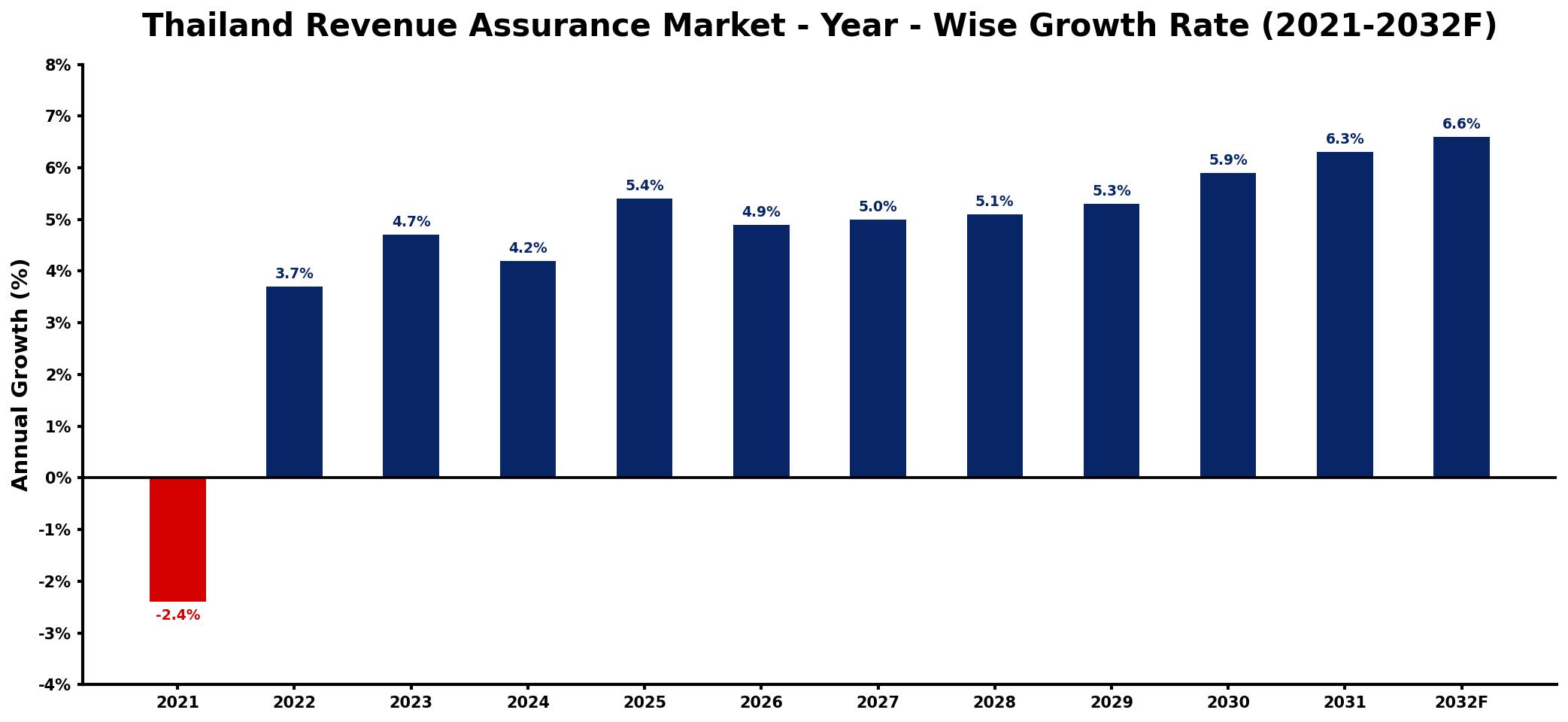
The table below presents the year‑wise growth rates along with the key drivers influencing the market
| Year | Growth Rate | Major Drivers |
| 2021 | -2.4% | decreased demand for technology services |
| 2022 | 3.7% | increased focus on digital transformation |
| 2023 | 4.7% | growth in mobile payment solutions |
| 2024 | 4.2% | expansion of e-commerce platforms |
| 2025 | 5.4% | rising adoption of cloud services |
| 2026 | 4.9% | enhanced regulatory compliance requirements |
| 2027 | 5.0% | growing cybersecurity investment trends |
| 2028 | 5.1% | increased integration of AI technologies |
| 2029 | 5.3% | expanding manufacturing base activity |
| 2030 | 5.9% | surge in data analytics applications |
| 2031 | 6.3% | growing importance of customer experience |
| 2032 | 6.6% | increased emphasis on sustainability practices |
Note: Market size estimations and growth projections presented in this report are based on 6Wresearch's proprietary forecasting methodology, utilizing the latest available industry data, government publications, and primary research inputs.
Thailand Revenue Assurance Market Synopsis
The Thailand Revenue Assurance Market has recently gained momentum as telecom operators focus on improving service quality and minimizing revenue leakage. As the digital infrastructure of the nation expands, ensuring effective revenue management through sophisticated assurance solutions is becoming critical for businesses aiming to maintain competitive advantages.
Looking ahead, the market is set to capitalize on these advancements, fostering increased investment in innovative technologies that enhance service delivery. Furthermore, the ongoing integration of automation and data analytics into revenue assurance practices promises to refine operational efficiencies, positioning the market for sustained growth.
Thailand Revenue Assurance Market Key Takeaways
- Strong projected growth, reaching USD 348 Million by 2032 due to heightened service quality demands.
- Significant focus on real-time monitoring and performance optimization across telecommunications networks.
- Increased reliance on digital services has transformed assurance solutions into essential tools for operators.
- Ongoing advancements in automation and analytics are reshaping the operational landscape of revenue assurance.
- Competitive pressures are driving telecom operators to adopt advanced assurance technologies for customer satisfaction.
Evaluation of Restraints in Thailand Revenue Assurance Market
Despite the promising growth outlook, the Thailand Revenue Assurance Market faces several restraints that could hinder progress. One primary concern is the challenge of meeting ever-evolving customer expectations regarding service reliability and availability. In a multi-vendor ecosystem, coordinating assurance processes and managing disparate technologies can be complex and resource-intensive. Additionally, the rapid pace of technological change necessitates constant adaptation, making it difficult for operators to maintain optimal performance levels and address issues effectively and efficiently.
Thailand Revenue Assurance Market Trends
Several trends are currently shaping the Thailand Revenue Assurance Market. The shift toward automation in network management is gaining traction, allowing operators to streamline processes and reduce human error. Moreover, the integration of advanced analytics tools is enabling more sophisticated insights into revenue management, fostering proactive decision-making. The growing prominence of artificial intelligence in assurance solutions is also anticipated to revolutionize troubleshooting efforts, ensuring rapid responses to service disruptions. Finally, the increasing convergence of services, such as voice and data, is driving the need for integrated assurance platforms that can handle multifaceted service portfolios.
Thailand Revenue Assurance Market Opportunities
As the market landscape evolves, notable growth opportunities are emerging for stakeholders. With the rise of 5G technology, telecom operators are incentivized to enhance their revenue assurance capabilities to mitigate risks associated with new service offerings. Furthermore, the increasing demand for cloud-based assurance solutions presents a significant avenue for investment. These solutions not only enhance scalability but also reduce operational costs. Lastly, growing consumer expectations for seamless service delivery and personalized experiences are prompting businesses to invest in advanced revenue assurance strategies that can better support user engagement and retention.
Government Initiatives in the Thailand Revenue Assurance Market
The Thai government has been actively involved in initiatives aimed at bolstering the digital economy, which directly impacts the Revenue Assurance Market. Investments in digital infrastructure and policy frameworks that promote technological innovation are creating a conducive environment for telecom operators to enhance their service quality. Programs aimed at expanding internet access and improving digital literacy are also enhancing consumer engagement, prompting operators to refine their assurance processes to meet increasing expectations for quality and performance.
Future Insights of the Thailand Revenue Assurance Market
Looking toward 2026-2032, the Thailand Revenue Assurance Market is poised for continued evolution, driven by advancements in technology and the ongoing demand for quality telecommunications services. The incorporation of machine learning and predictive analytics into revenue assurance practices will enable operators to anticipate and address issues before they escalate. As customer expectations continue to rise, telecom operators that prioritize innovative assurance solutions will not only enhance customer satisfaction but also secure a competitive edge in the market. The focus will likely shift toward holistic approaches that integrate revenue assurance with broader operational strategies, ensuring a seamless customer experience across all service touchpoints.
Thailand Revenue Assurance Market Latest Developments (2025 - 2026)
In recent months, the Thailand Revenue Assurance Market has witnessed a surge in investments aimed at upgrading network monitoring and assurance capabilities. Companies are increasingly adopting cloud-based platforms to leverage greater flexibility and scalability in their operations. Additionally, there has been a marked focus on enhancing the integration of artificial intelligence within assurance solutions, aiming to improve operational efficiency and reduce downtime. Operators are also exploring collaborations to share insights and best practices in revenue assurance, reflecting a growing recognition of the need for collective industry advancement.
Thailand Revenue Assurance Market - Key Attractiveness of the Report
- 10 Years of Market Numbers
- Historical Data Starting from 2022 to 2025
- Base Year: 2025
- Forecast Data until 2032
- Key Performance Indicators Impacting the Market
- Major Upcoming Developments and Projects
Key Highlights of the Report:
- Thailand Revenue Assurance Market Outlook
- Market Size of Thailand Revenue Assurance Market, 2025
- Forecast of Thailand Revenue Assurance Market, 2032
- Historical Data and Forecast of Thailand Revenue Assurance Revenues & Volume for the Period 2022-2032F
- Thailand Revenue Assurance Market Trend Evolution
- Thailand Revenue Assurance Market Drivers and Challenges
- Thailand Revenue Assurance Price Trends
- Thailand Revenue Assurance Porter's Five Forces
- Thailand Revenue Assurance Industry Life Cycle
- Historical Data and Forecast of Thailand Revenue Assurance Market Revenues & Volume By Component for the Period 2022-2032F
- Historical Data and Forecast of Thailand Revenue Assurance Market Revenues & Volume By Software for the Period 2022-2032F
- Historical Data and Forecast of Thailand Revenue Assurance Market Revenues & Volume By Services for the Period 2022-2032F
- Historical Data and Forecast of Thailand Revenue Assurance Market Revenues & Volume By Planning and Consulting for the Period 2022-2032F
- Historical Data and Forecast of Thailand Revenue Assurance Market Revenues & Volume By Implementation and Customization for the Period 2022-2032F
- Historical Data and Forecast of Thailand Revenue Assurance Market Revenues & Volume By Support and Maintenance for the Period 2022-2032F
- Historical Data and Forecast of Thailand Revenue Assurance Market Revenues & Volume By Managed Services for the Period 2022-2032F
- Historical Data and Forecast of Thailand Revenue Assurance Market Revenues & Volume By End-User for the Period 2022-2032F
- Historical Data and Forecast of Thailand Revenue Assurance Market Revenues & Volume By TSPs for the Period 2022-2032F
- Historical Data and Forecast of Thailand Revenue Assurance Market Revenues & Volume By Enterprises for the Period 2022-2032F
- Historical Data and Forecast of Thailand Revenue Assurance Market Revenues & Volume By Deployment Mode for the Period 2022-2032F
- Historical Data and Forecast of Thailand Revenue Assurance Market Revenues & Volume By Cloud for the Period 2022-2032F
- Historical Data and Forecast of Thailand Revenue Assurance Market Revenues & Volume By On-premises for the Period 2022-2032F
- Historical Data and Forecast of Thailand Revenue Assurance Market Revenues & Volume By Vertical for the Period 2022-2032F
- Historical Data and Forecast of Thailand Revenue Assurance Market Revenues & Volume By Telecom for the Period 2022-2032F
- Historical Data and Forecast of Thailand Revenue Assurance Market Revenues & Volume By Utilities for the Period 2022-2032F
- Historical Data and Forecast of Thailand Revenue Assurance Market Revenues & Volume By BFSI for the Period 2022-2032F
- Historical Data and Forecast of Thailand Revenue Assurance Market Revenues & Volume By Hospitality for the Period 2022-2032F
- Historical Data and Forecast of Thailand Revenue Assurance Market Revenues & Volume By Others for the Period 2022-2032F
- Thailand Revenue Assurance Import Export Trade Statistics
- Market Opportunity Assessment By Component
- Market Opportunity Assessment By End-User
- Market Opportunity Assessment By Deployment Mode
- Market Opportunity Assessment By Vertical
- Thailand Revenue Assurance Top Companies Market Share
- Thailand Revenue Assurance Competitive Benchmarking By Technical and Operational Parameters
- Thailand Revenue Assurance Company Profiles
- Thailand Revenue Assurance Key Strategic Recommendations






































