Thailand Silk Yarn Market Size, Share & Growth Rate
The Thailand Silk Yarn Market was estimated at USD 148 Million in 2025 and is projected to reach USD 170 Million by 2032, growing at a CAGR of 2.0% from 2026 to 2032. This growth trajectory is primarily driven by the increasing global demand for luxury textiles, with silk being at the forefront due to its unparalleled quality and natural allure. The emphasis on sustainability has further positioned Thai silk yarn favorably, as consumers gravitate towards eco-friendly and ethically sourced materials, creating a robust market environment.
Thailand Silk Yarn Market Year-wise Growth Rate and Key Drivers
This graph highlights how the Thailand Silk Yarn Market has steadily grown over the years, supported by major growth factors.
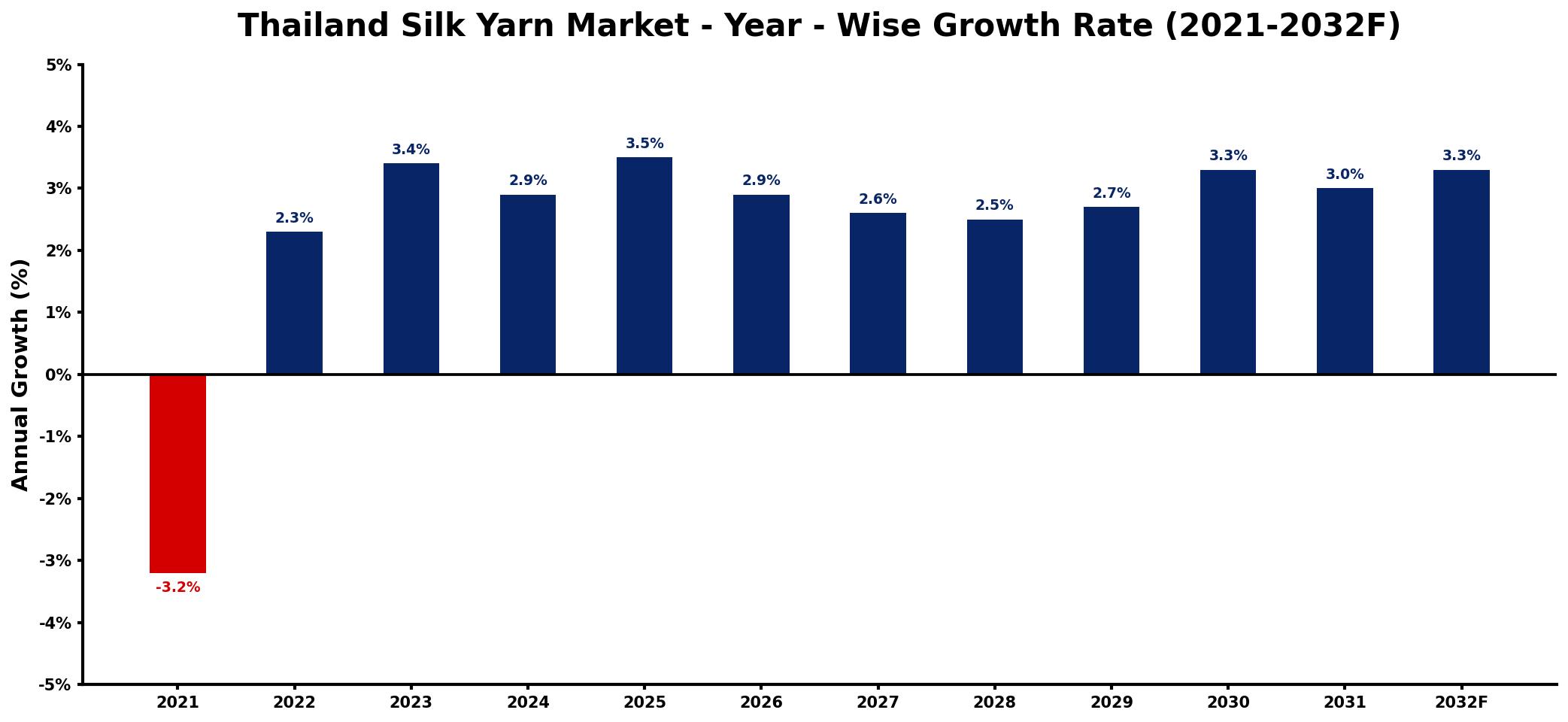
The table below presents the year‑wise growth rates along with the key drivers influencing the market
| Year | Growth Rate | Major Drivers |
| 2021 | -3.2% | decreased consumer spending trends |
| 2022 | 2.3% | increased demand for sustainable textiles |
| 2023 | 3.4% | growing interest in artisanal crafts |
| 2024 | 2.9% | expansion of fashion industry collaborations |
| 2025 | 3.5% | rising popularity of eco-friendly products |
| 2026 | 2.9% | enhanced export opportunities emerging |
| 2027 | 2.6% | increased investments in production technologies |
| 2028 | 2.5% | growing awareness of cultural heritage |
| 2029 | 2.7% | strengthening international trade flows |
| 2030 | 3.3% | increased participation in trade fairs |
| 2031 | 3.0% | rising interest in traditional craftsmanship |
| 2032 | 3.3% | growing collaboration with designers |
Note: Market size estimations and growth projections presented in this report are based on 6Wresearch's proprietary forecasting methodology, utilizing the latest available industry data, government publications, and primary research inputs.
Thailand Silk Yarn Market Synopsis
In recent years, Thailand has solidified its status as a premier producer of high-quality silk yarn, attracting both local artisans and international designers. Known for its incredible softness and sheen, Thai silk yarn is not only utilized in apparel but also in exclusive crafts and home decor, highlighting its versatility.
The market is characterized by a blend of traditional practices and modern innovations, with many producers adhering to sustainable farming techniques. As the global textile industry evolves, the demand for authentic and premium silk products remains unwavering, making Thailand a key player in the international silk yarn arena.
Thailand Silk Yarn Market Key Takeaways
- Robust growth projected in the coming years, bolstered by increasing global luxury textile demand.
- Sustainability trends are reshaping consumer preferences toward eco-friendly materials like silk.
- Thailands rich heritage in silk production enhances its appeal to both domestic and international markets.
- Government support initiatives are improving the quality and efficiency of silk farming and processing.
- The rise of e-commerce platforms is expanding the market reach for Thai silk yarn producers.
Evaluation of Restraints in Thailand Silk Yarn Market
Despite its potential, the Thailand Silk Yarn Market faces certain limitations, particularly concerning the labor-intensive nature of silk production. The reliance on skilled artisans can hinder scalability, as the workforce diminishes over time due to urban migration. Furthermore, fluctuations in raw silk prices can lead to instability in production costs, affecting profitability for smaller producers. Addressing these challenges will be crucial for sustaining long-term growth in this vibrant market.
Thailand Silk Yarn Market Trends
The market is currently witnessing a shift towards innovative production techniques that enhance sustainability without compromising quality. There's also a growing focus on the intersection of technology and tradition, as digital platforms enable artisans to showcase their silk yarn creations to a global audience. Additionally, collaborations between traditional weavers and contemporary fashion designers are becoming more commonplace, promoting the evolution of silk applications in modern fashion.
Thailand Silk Yarn Market Opportunities
Investment opportunities in the Thailand Silk Yarn Market are abundant, particularly in enhancing sustainable farming practices and adopting advanced processing technologies. As consumers become more discerning about their purchases, brands that prioritize ethical sourcing and transparency will likely capture a larger market share. Moreover, the rising popularity of handmade and artisanal products provides a unique avenue for local producers to tap into niche markets with high profit margins.
Government Initiatives in the Thailand Silk Yarn Market
The Thai government has implemented several initiatives aimed at revitalizing the silk industry. These include programs to promote sericulture, enhance training for artisans, and support research into more efficient silk farming techniques. Public spending on infrastructure improvements in rural areas also aids silk production, ensuring that the industry remains competitive in the global marketplace. Such efforts reflect a commitment to preserving this cultural heritage while promoting sustainable practices.
Future Insights of the Thailand Silk Yarn Market
Looking ahead to 2026-2032, the Thailand Silk Yarn Market is expected to continue its upward trajectory, buoyed by increasing international demand for high-quality silk. The trend towards sustainability will shape production practices and consumer choices, driving innovation within the sector. Additionally, as global fashion trends increasingly favor unique, artisanal materials, Thai silk is well-positioned to capture the attention of both traditional and contemporary designers alike.
Thailand Silk Yarn Market Latest Developments (2025 - 2026)
Recent developments in the Thailand Silk Yarn Market include ongoing collaborations between local weavers and international fashion houses, showcasing the adaptability of Thai silk in modern design. Furthermore, exhibitions promoting Thai silk craftsmanship are gaining traction, increasing visibility and appreciation of the product. Initiatives to support digital marketing among silk producers are also emerging, allowing artisans to more effectively reach global consumers.
Thailand Silk Yarn Market - Key Attractiveness of the Report
- 10 Years of Market Numbers
- Historical Data Starting from 2022 to 2025
- Base Year: 2025
- Forecast Data until 2032
- Key Performance Indicators Impacting the Market
- Major Upcoming Developments and Projects
Key Highlights of the Report:
- Thailand Silk Yarn Market Outlook
- Market Size of Thailand Silk Yarn Market, 2025
- Forecast of Thailand Silk Yarn Market, 2032
- Historical Data and Forecast of Thailand Silk Yarn Revenues & Volume for the Period 2022-2032F
- Thailand Silk Yarn Market Trend Evolution
- Thailand Silk Yarn Market Drivers and Challenges
- Thailand Silk Yarn Price Trends
- Thailand Silk Yarn Porter's Five Forces
- Thailand Silk Yarn Industry Life Cycle
- Historical Data and Forecast of Thailand Silk Yarn Market Revenues & Volume By Production Analysis for the Period 2022-2032F
- Historical Data and Forecast of Thailand Silk Yarn Market Revenues & Volume By Volume for the Period 2022-2032F
- Historical Data and Forecast of Thailand Silk Yarn Market Revenues & Volume By Consumption Analysis for the Period 2022-2032F
- Historical Data and Forecast of Thailand Silk Yarn Market Revenues & Volume By Value for the Period 2022-2032F
- Historical Data and Forecast of Thailand Silk Yarn Market Revenues & Volume By Volume for the Period 2022-2032F
- Historical Data and Forecast of Thailand Silk Yarn Market Revenues & Volume By Export Analysis for the Period 2022-2032F
- Historical Data and Forecast of Thailand Silk Yarn Market Revenues & Volume By Value for the Period 2022-2032F
- Historical Data and Forecast of Thailand Silk Yarn Market Revenues & Volume By Volume for the Period 2022-2032F
- Historical Data and Forecast of Thailand Silk Yarn Market Revenues & Volume By Import Analysis for the Period 2022-2032F
- Historical Data and Forecast of Thailand Silk Yarn Market Revenues & Volume By Value for the Period 2022-2032F
- Historical Data and Forecast of Thailand Silk Yarn Market Revenues & Volume By Volume for the Period 2022-2032F
- Thailand Silk Yarn Import Export Trade Statistics
- Market Opportunity Assessment By Production Analysis
- Market Opportunity Assessment By Consumption Analysis
- Market Opportunity Assessment By Export Analysis
- Market Opportunity Assessment By Import Analysis
- Thailand Silk Yarn Top Companies Market Share
- Thailand Silk Yarn Competitive Benchmarking By Technical and Operational Parameters
- Thailand Silk Yarn Company Profiles
- Thailand Silk Yarn Key Strategic Recommendations






































