Thailand Stainless Steel Round Bar Market Size, Share & Growth Rate
The Thailand Stainless Steel Round Bar Market was estimated at USD 363 Million in 2025 and is projected to reach USD 481 Million by 2032, growing at a CAGR of 4.1% from 2026 to 2032. This growth trajectory is propelled by Thailand's burgeoning construction and manufacturing sectors, which increasingly depend on the durability and versatility of stainless steel round bars. Additionally, the automotive industry's reliance on these materials for precision components further underscores the expanding market demand.
Thailand Stainless Steel Round Bar Market Year-wise Growth Rate and Key Drivers
This graph highlights how the Thailand Stainless Steel Round Bar Market has steadily grown over the years, supported by major growth factors.
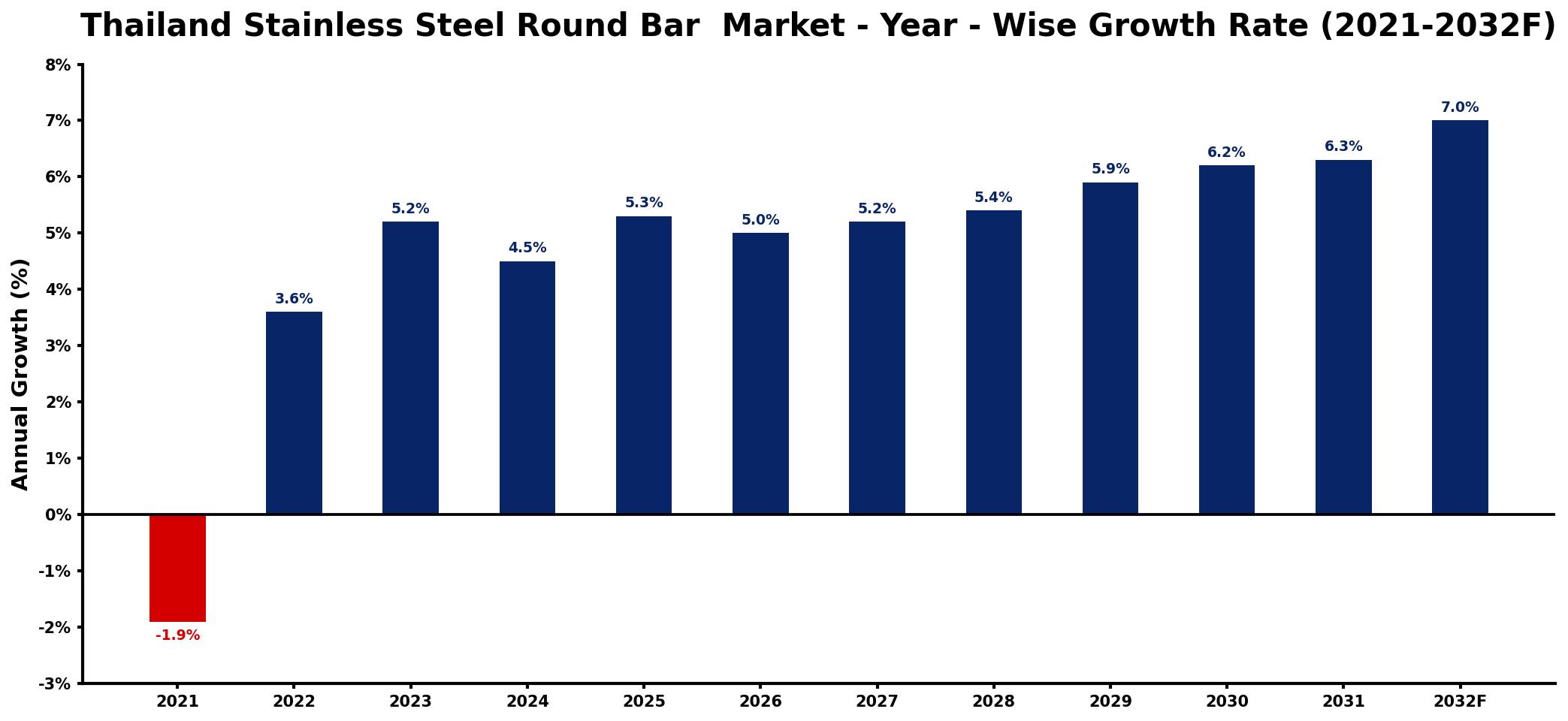
The table below presents the year‑wise growth rates along with the key drivers influencing the market
| Year | Growth Rate | Major Drivers |
| 2021 | -1.9% | decreased industrial construction projects |
| 2022 | 3.6% | rising demand from automotive sector |
| 2023 | 5.2% | expansion of infrastructure initiatives |
| 2024 | 4.5% | increased investments in manufacturing |
| 2025 | 5.3% | growth in renewable energy projects |
| 2026 | 5.0% | higher exports to neighboring countries |
| 2027 | 5.2% | development of urban construction markets |
| 2028 | 5.4% | increased demand from aerospace industry |
| 2029 | 5.9% | expansion in transportation sector |
| 2030 | 6.2% | growing focus on sustainability practices |
| 2031 | 6.3% | higher demand from electronics sector |
| 2032 | 7.0% | increased government infrastructure funding |
Note: Market size estimations and growth projections presented in this report are based on 6Wresearch's proprietary forecasting methodology, utilizing the latest available industry data, government publications, and primary research inputs.
Thailand Stainless Steel Round Bar Market Synopsis
The Thailand stainless steel round bar market has seen a notable resurgence as the economy rebounds from the challenges posed by the pandemic. Increased government infrastructure investments and a recovering real estate sector are driving significant demand. As Thailand emerges as a leading supplier of high-quality stainless steel products, the market is poised for continued expansion.
Recent momentum contrasts with the previous downturn caused by COVID-19, which had temporarily stifled growth. Now, with construction activities and manufacturing on the rise, stainless steel round bars are increasingly recognized as essential components in various applications, reinforcing their critical role in Thailand's industrial landscape.
Thailand Stainless Steel Round Bar Market Key Takeaways
- The market is witnessing robust growth driven by the construction and automotive sectors.
- High corrosion resistance and durability are key features driving the demand for stainless steel round bars.
- Thailand's reputation as a supplier of high-quality products positions it favorably in the global market.
- Investment in government infrastructure projects continues to be a major market catalyst.
- Challenges related to global pricing and sustainability remain critical considerations for stakeholders.
Evaluation of Restraints in Thailand Stainless Steel Round Bar Market
Despite the promising growth outlook, the Thailand stainless steel round bar market grapples with several restraints. Fluctuations in global stainless steel prices can significantly impact local manufacturers' profit margins, creating an unstable market environment. Additionally, maintaining high product quality and compliance with international standards is imperative for local producers to compete effectively. With sustainability concerns on the rise, manufacturers are also challenged to innovate processes that minimize energy consumption and waste, ensuring they meet both regulatory expectations and consumer demands.
Thailand Stainless Steel Round Bar Market Trends
The market is currently shaped by several emerging trends, notably an increasing emphasis on sustainable practices in production. Companies are investing in advanced technologies to enhance energy efficiency and reduce their carbon footprint. Moreover, the integration of smart manufacturing techniques is gaining traction, leading to improved precision and quality in stainless steel round bar production. The growing demand for lightweight materials in automotive applications is also reshaping product development strategies within the industry.
Thailand Stainless Steel Round Bar Market Opportunities
Opportunities for growth and investment in the Thailand stainless steel round bar market are abundant, particularly within the automotive and construction sectors. The ongoing expansion of infrastructure projects offers a solid platform for increased consumption of stainless steel products. Moreover, as the global demand for high-quality stainless steel continues to rise, Thailand stands well-positioned to capitalize on its reputation as a reliable supplier. Innovations in manufacturing processes and materials could further unlock new avenues for market entrants.
Government Initiatives in the Thailand Stainless Steel Round Bar Market
The Thai government is actively promoting initiatives to bolster the metallurgical sector, including public spending on infrastructure and construction. These initiatives aim to enhance local production capabilities and ensure compliance with international quality standards. Various programs are in place to encourage innovation and sustainability in manufacturing, helping domestic producers adapt to the evolving demands of the global market.
Future Insights of the Thailand Stainless Steel Round Bar Market
Looking ahead to the period between 2026 and 2032, the Thailand stainless steel round bar market is set to experience significant growth. The combination of rising infrastructure investments and a robust automotive industry will likely drive further demand. Additionally, an increased focus on sustainability and product innovation will encourage manufacturers to adapt and thrive. As Thailand solidifies its position as a top-tier supplier, the market is expected to flourish in response to global trends and local needs.
Thailand Stainless Steel Round Bar Market Latest Developments (2025 - 2026)
Recent developments in the Thailand stainless steel round bar market reflect a commitment to enhancing product quality and sustainability. Manufacturers are increasingly adopting advanced production techniques to optimize efficiency and reduce waste. Additionally, partnerships between local companies and international firms are fostering innovation in product offerings, with an emphasis on meeting diverse market requirements. The growing demand in emerging industries is prompting players to expand their production capabilities and improve supply chain dynamics.
Thailand Stainless Steel Round Bar Market - Key Attractiveness of the Report
- 10 Years of Market Numbers
- Historical Data Starting from 2022 to 2025
- Base Year: 2025
- Forecast Data until 2032
- Key Performance Indicators Impacting the Market
- Major Upcoming Developments and Projects
Key Highlights of the Report:
- Thailand Stainless Steel Round Bar Market Outlook
- Market Size of Thailand Stainless Steel Round Bar Market, 2025
- Forecast of Thailand Stainless Steel Round Bar Market, 2032
- Historical Data and Forecast of Thailand Stainless Steel Round Bar Revenues & Volume for the Period 2022-2032F
- Thailand Stainless Steel Round Bar Market Trend Evolution
- Thailand Stainless Steel Round Bar Market Drivers and Challenges
- Thailand Stainless Steel Round Bar Price Trends
- Thailand Stainless Steel Round Bar Porter's Five Forces
- Thailand Stainless Steel Round Bar Industry Life Cycle
- Historical Data and Forecast of Thailand Stainless Steel Round Bar Market Revenues & Volume By Product for the Period 2022-2032F
- Historical Data and Forecast of Thailand Stainless Steel Round Bar Market Revenues & Volume By Cr-Ni for the Period 2022-2032F
- Historical Data and Forecast of Thailand Stainless Steel Round Bar Market Revenues & Volume By Duplex & Super Duplex for the Period 2022-2032F
- Historical Data and Forecast of Thailand Stainless Steel Round Bar Market Revenues & Volume By High Nickel Alloys for the Period 2022-2032F
- Thailand Stainless Steel Round Bar Import Export Trade Statistics
- Market Opportunity Assessment By Product
- Thailand Stainless Steel Round Bar Top Companies Market Share
- Thailand Stainless Steel Round Bar Competitive Benchmarking By Technical and Operational Parameters
- Thailand Stainless Steel Round Bar Company Profiles
- Thailand Stainless Steel Round Bar Key Strategic Recommendations






































