Thailand Textile Fabric Market Size, Share & Growth Rate
The Thailand Textile Fabric Market was estimated at USD 108 Million in 2025 and is projected to reach USD 124 Million by 2032, growing at a CAGR of 2.0% from 2026 to 2032. This growth trajectory is primarily driven by the country's dynamic fashion industry, which is constantly evolving to meet diverse consumer demands. Additionally, the increasing influence of e-commerce platforms has expanded market access for manufacturers, leading to heightened demand for innovative fabric solutions.
Thailand Textile Fabric Market Year-wise Growth Rate and Key Drivers
This graph highlights how the Thailand Textile Fabric Market has steadily grown over the years, supported by major growth factors.
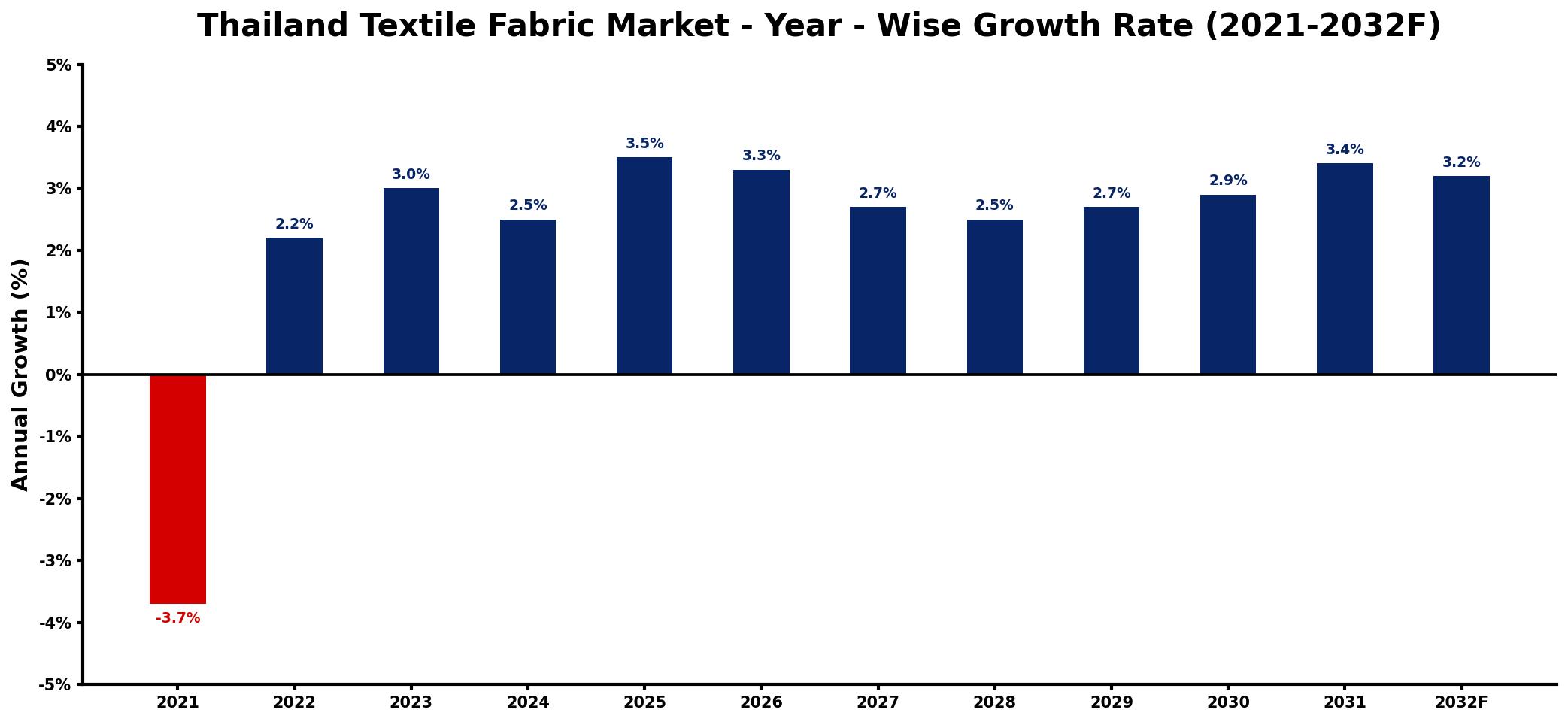
The table below presents the year‑wise growth rates along with the key drivers influencing the market
| Year | Growth Rate | Major Drivers |
| 2021 | -3.7% | decrease in consumer spending |
| 2022 | 2.2% | rise in domestic production capacity |
| 2023 | 3.0% | increased demand for sustainable materials |
| 2024 | 2.5% | growing interest in eco-friendly options |
| 2025 | 3.5% | expansion of export markets |
| 2026 | 3.3% | higher investments in technology |
| 2027 | 2.7% | increased collaboration with designers |
| 2028 | 2.5% | growth in online retail channels |
| 2029 | 2.7% | emergence of new fashion trends |
| 2030 | 2.9% | enhanced focus on quality standards |
| 2031 | 3.4% | booming local fashion industry |
| 2032 | 3.2% | rising popularity of customization |
Note: Market size estimations and growth projections presented in this report are based on 6Wresearch's proprietary forecasting methodology, utilizing the latest available industry data, government publications, and primary research inputs.
Thailand Textile Fabric Market Synopsis
The Thai textile fabric market is characterized by a rich blend of traditional craftsmanship and modern technological innovations. With an increasing interest in sustainable production, manufacturers are actively exploring eco-friendly materials, appealing to a growing demographic of environmentally conscious consumers.
Furthermore, the market serves a broad spectrum of applications, from high-fashion garments to durable industrial textiles, highlighting its versatility. This diversity is crucial as it enables businesses to cater to various sectors, including fashion, home furnishings, and technical textiles for industrial uses.
Thailand Textile Fabric Market Key Takeaways
- The market is witnessing a significant shift towards sustainable and innovative fabric technologies.
- Thai manufacturers are capitalizing on e-commerce to enhance their export capabilities.
- There is a strong demand for versatile textiles catering to both fashion and industrial applications.
- Consumer preferences are leaning towards comfortable and functional fabrics, particularly in the athleisure segment.
- Traditional textiles are experiencing a renaissance as interest in cultural heritage grows.
Evaluation of Restraints in Thailand Textile Fabric Market
Despite its potential, the Thailand textile fabric market contends with several constraints. One of the most prominent challenges stems from intense competition posed by low-cost manufacturers in neighboring Southeast Asian countries, which creates significant price pressures. Additionally, the growing consumer demand for sustainability necessitates ongoing investments in eco-friendly production methods, potentially straining resources. Furthermore, the repercussions of the COVID-19 pandemic have led to disruptions in supply chains and shifts in consumer behavior, requiring agile adaptations from market participants.
Thailand Textile Fabric Market Trends
Current trends indicate a rising demand for smart textiles that offer added functionality, such as moisture-wicking, temperature regulation, and even integrated technology. This growing segment is attracting attention from both designers and consumers seeking performance-oriented fabrics. Furthermore, the inclination towards casual and athleisure wear has propelled the market towards softer, more breathable textiles, aligning with modern lifestyle preferences. Additionally, the resurgence of traditional textile practices speaks to a broader cultural trend that values heritage alongside innovation.
Thailand Textile Fabric Market Opportunities
The future holds notable growth opportunities for stakeholders within the Thailand textile fabric market. The increasing demand for sustainable materials presents a fertile ground for innovation, pushing manufacturers to develop eco-friendly alternatives that meet both regulatory and consumer expectations. Moreover, as the digital landscape evolves, businesses that leverage e-commerce and digital marketing stand to expand their market presence significantly. Targeting international markets with unique offerings that highlight Thailand's rich textile heritage could further enhance export potentials.
Government Initiatives in the Thailand Textile Fabric Market
The Thai government is actively promoting the textile and apparel sector through various initiatives aimed at enhancing competitiveness and sustainability. This includes support for research and development in textile innovations, as well as incentives for businesses that adopt environmentally responsible practices. Public spending on infrastructure improvements is also targeted to facilitate smoother logistics and supply chain operations, enabling manufacturers to meet both domestic and international demands more effectively.
Future Insights of the Thailand Textile Fabric Market
Looking ahead to the period from 2026 to 2032, the Thailand textile fabric market is poised for steady growth, driven by an increasing emphasis on sustainability and innovation. The integration of advanced technologies and smart textiles will likely reshape consumer preferences and expectations. Additionally, as global fashion trends continue to evolve, Thai manufacturers will need to remain agile, ensuring they can respond swiftly to shifting demands while maintaining high-quality standards. The overall outlook remains optimistic, supported by both local and international market dynamics.
Thailand Textile Fabric Market Latest Developments (2025 - 2026)
Recent developments within the Thailand textile fabric market indicate a concerted effort among manufacturers to embrace digital transformation and sustainability. Innovations in fabric technology are becoming increasingly prevalent, with companies exploring new eco-friendly materials and production techniques. Additionally, various industry stakeholders are focusing on enhancing their online presence, tapping into e-commerce platforms to reach a broader audience, particularly in the post-pandemic recovery phase.
Thailand Textile Fabric Market - Key Attractiveness of the Report
- 10 Years of Market Numbers
- Historical Data Starting from 2022 to 2025
- Base Year: 2025
- Forecast Data until 2032
- Key Performance Indicators Impacting the Market
- Major Upcoming Developments and Projects
Key Highlights of the Report:
- Thailand Textile Fabric Market Outlook
- Market Size of Thailand Textile Fabric Market, 2025
- Forecast of Thailand Textile Fabric Market, 2032
- Historical Data and Forecast of Thailand Textile Fabric Revenues & Volume for the Period 2022-2032F
- Thailand Textile Fabric Market Trend Evolution
- Thailand Textile Fabric Market Drivers and Challenges
- Thailand Textile Fabric Price Trends
- Thailand Textile Fabric Porter's Five Forces
- Thailand Textile Fabric Industry Life Cycle
- Historical Data and Forecast of Thailand Textile Fabric Market Revenues & Volume By Fabric Type for the Period 2022-2032F
- Historical Data and Forecast of Thailand Textile Fabric Market Revenues & Volume By Cotton for the Period 2022-2032F
- Historical Data and Forecast of Thailand Textile Fabric Market Revenues & Volume By 65/35% for the Period 2022-2032F
- Historical Data and Forecast of Thailand Textile Fabric Market Revenues & Volume By 50/50% for the Period 2022-2032F
- Historical Data and Forecast of Thailand Textile Fabric Market Revenues & Volume By 35/65% for the Period 2022-2032F
- Historical Data and Forecast of Thailand Textile Fabric Market Revenues & Volume By 40/60% for the Period 2022-2032F
- Historical Data and Forecast of Thailand Textile Fabric Market Revenues & Volume By 10/90% for the Period 2022-2032F
- Historical Data and Forecast of Thailand Textile Fabric Market Revenues & Volume By Polyester for the Period 2022-2032F
- Historical Data and Forecast of Thailand Cotton Textile Fabric Market Revenues & Volume By Others for the Period 2022-2032F
- Historical Data and Forecast of Thailand Textile Fabric Market Revenues & Volume By Application for the Period 2022-2032F
- Historical Data and Forecast of Thailand Textile Fabric Market Revenues & Volume By T-Shirt for the Period 2022-2032F
- Historical Data and Forecast of Thailand Textile Fabric Market Revenues & Volume By Sportswear for the Period 2022-2032F
- Historical Data and Forecast of Thailand Textile Fabric Market Revenues & Volume By Outdoor Clothing for the Period 2022-2032F
- Historical Data and Forecast of Thailand Textile Fabric Market Revenues & Volume By Performance Wear for the Period 2022-2032F
- Thailand Textile Fabric Import Export Trade Statistics
- Market Opportunity Assessment By Fabric Type
- Market Opportunity Assessment By Application
- Thailand Textile Fabric Top Companies Market Share
- Thailand Textile Fabric Competitive Benchmarking By Technical and Operational Parameters
- Thailand Textile Fabric Company Profiles
- Thailand Textile Fabric Key Strategic Recommendations






































