Thailand Thread Rolling Machine Market Size, Share & Growth Rate
The Thailand Thread Rolling Machine Market was estimated at USD 154 Million in 2025 and is projected to reach USD 177 Million by 2032, growing at a CAGR of 2.0% from 2026 to 2032. This growth trajectory is primarily fueled by the expansion of manufacturing activities, particularly in the automotive and construction sectors, which rely heavily on threaded components. Additionally, the ongoing infrastructure projects across Thailand contribute significantly to the rising demand for precision machinery.
Thailand Thread Rolling Machine Market Year-wise Growth Rate and Key Drivers
This graph highlights how the Thailand Thread Rolling Machine Market has steadily grown over the years, supported by major growth factors.
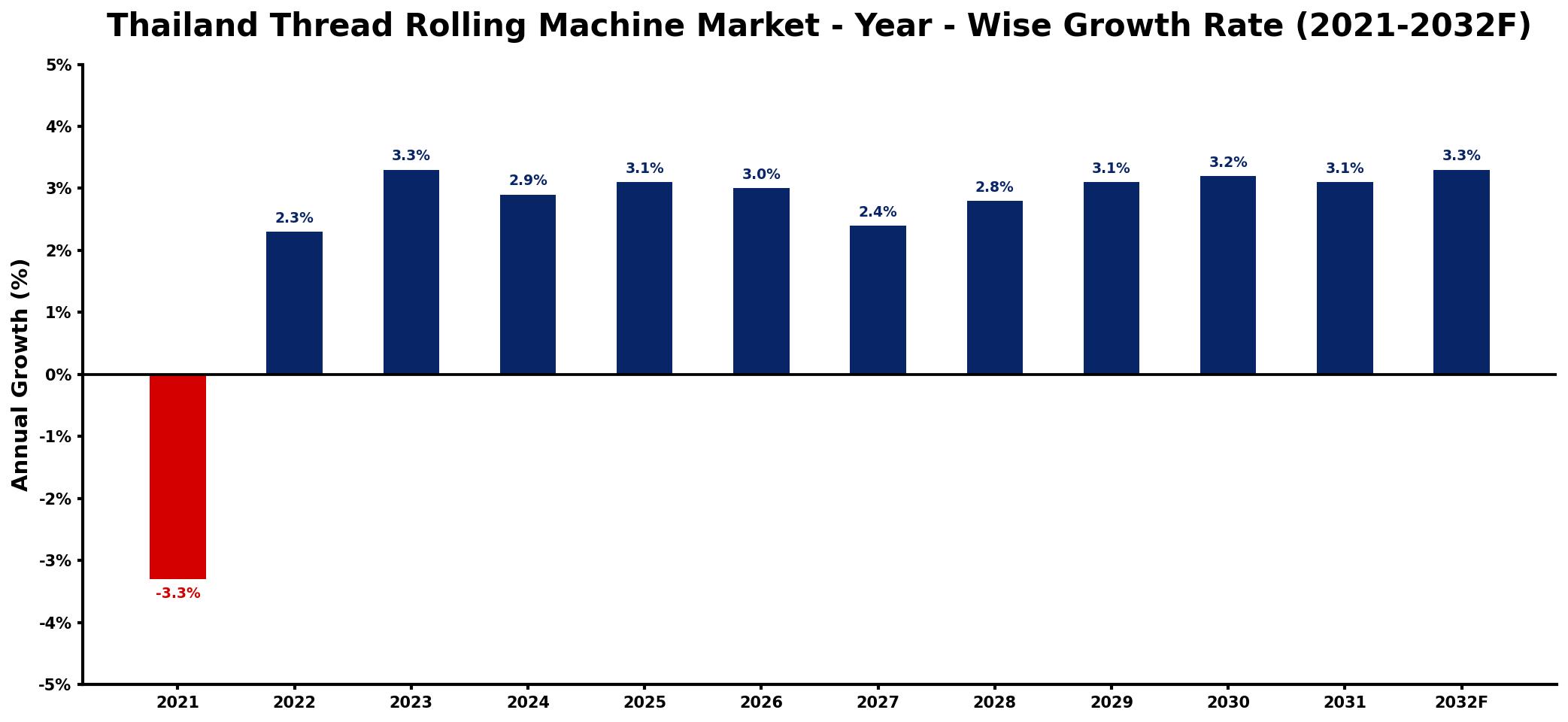
The table below presents the year‑wise growth rates along with the key drivers influencing the market
| Year | Growth Rate | Major Drivers |
| 2021 | -3.3% | decreased manufacturing output in industry |
| 2022 | 2.3% | rising automotive sector requirements |
| 2023 | 3.3% | increased investment in infrastructure |
| 2024 | 2.9% | growing demand for precision components |
| 2025 | 3.1% | expansion of renewable energy projects |
| 2026 | 3.0% | surge in construction activities nationwide |
| 2027 | 2.4% | enhanced focus on local sourcing |
| 2028 | 2.8% | growth in aerospace manufacturing sector |
| 2029 | 3.1% | innovation in industrial automation solutions |
| 2030 | 3.2% | expanding electronics production capabilities |
| 2031 | 3.1% | increased adoption of advanced technologies |
| 2032 | 3.3% | strengthened partnerships in regional markets |
Note: Market size estimations and growth projections presented in this report are based on 6Wresearch's proprietary forecasting methodology, utilizing the latest available industry data, government publications, and primary research inputs.
Thailand Thread Rolling Machine Market Synopsis
The Thailand Thread Rolling Machine Market is gaining momentum, reflecting the country's robust manufacturing environment. As industries focus on automation and efficiency, the need for high-precision machinery has never been more critical, particularly for sectors like aerospace, automotive, and machinery manufacturing.
Notably, the market's growth is closely linked to the evolution of construction activities in Thailand. With government initiatives pushing infrastructure development, companies are investing in advanced machinery, highlighting the essential role of thread rolling machines in producing high-quality threaded components.
Thailand Thread Rolling Machine Market Key Takeaways
- The market is projected to grow from USD 154 Million in 2025 to USD 177 Million by 2032.
- Automation trends are driving demand for more precise and efficient thread rolling machines.
- Infrastructure development in Thailand is a key catalyst for market growth.
- Skilled labor requirements are a significant challenge for machine operators and maintenance personnel.
- COVID-19 impacted initial demand but has shown signs of recovery as the economy reopened.
Evaluation of Restraints in Thailand Thread Rolling Machine Market
Despite its growth potential, the Thailand Thread Rolling Machine Market faces notable restraints. A primary concern is the ongoing need for skilled operators who can effectively manage and maintain these complex machines. The intricacies involved in thread rolling processes necessitate a level of expertise that is sometimes lacking in the available labor pool. Moreover, fluctuations in economic conditions can significantly influence machinery demand, making it challenging for manufacturers to forecast market trends and adjust production strategies accordingly. These factors can create a bottleneck in achieving optimal market performance.
Thailand Thread Rolling Machine Market Trends
Emerging trends in the Thailand Thread Rolling Machine Market indicate a strong shift towards automation and smart manufacturing. Companies are increasingly adopting advanced technologies, including CNC (Computer Numerical Control) and IoT (Internet of Things) capabilities, to enhance production efficiency. This transformation aims not only to optimize operational costs but also to improve the quality and precision of threaded components. Furthermore, there is a growing focus on sustainability, prompting manufacturers to explore eco-friendly practices within the production process.
Thailand Thread Rolling Machine Market Opportunities
The landscape of the Thailand Thread Rolling Machine Market presents numerous growth and investment opportunities. The ongoing infrastructure projects offer a fertile ground for expanding the client base and enhancing product offerings tailored to specific industry needs. Additionally, as industries aim for higher efficiency and quality, there is a substantial opportunity for suppliers to introduce innovative machines equipped with the latest technology. Companies that can provide customized solutions catering to particular manufacturing requirements are well-positioned to capitalize on this evolving market.
Government Initiatives in the Thailand Thread Rolling Machine Market
The Thai government has been actively promoting industrial growth through various initiatives aimed at enhancing the manufacturing sector. Programs that encourage investment in infrastructure development and modernization of machinery align closely with the needs of the thread rolling machine market. Support for technological advancements and skill development initiatives for workers further bolster the market's potential, helping to create an environment conducive to growth and innovation.
Future Insights of the Thailand Thread Rolling Machine Market
Looking ahead to 2026-2032, the Thailand Thread Rolling Machine Market is poised for steady advancement. The integration of smart technologies, coupled with a sustained focus on quality and precision, will likely define the next phase of market evolution. Additionally, as the country continues to invest in infrastructure and industrial capabilities, the demand for sophisticated thread rolling machines will persist. Companies that remain agile and responsive to market dynamics will undoubtedly thrive in this competitive landscape.
Thailand Thread Rolling Machine Market Latest Developments (2025 - 2026)
In recent months, the Thailand Thread Rolling Machine Market has seen significant industry activity as manufacturers adapt to evolving demands. Efforts have been made to enhance the automation capabilities of thread rolling machines, with a focus on increasing productivity and precision. Simultaneously, there has been a concerted push for sustainability, prompting players in the market to innovate their processes to minimize environmental impact while maintaining quality output. The evolving landscape signifies a responsive industry keen on embracing technological advancements and market opportunities.
Thailand Thread Rolling Machine Market - Key Attractiveness of the Report
- 10 Years of Market Numbers
- Historical Data Starting from 2022 to 2025
- Base Year: 2025
- Forecast Data until 2032
- Key Performance Indicators Impacting the Market
- Major Upcoming Developments and Projects
Key Highlights of the Report:
- Thailand Thread Rolling Machine Market Outlook
- Market Size of Thailand Thread Rolling Machine Market, 2025
- Forecast of Thailand Thread Rolling Machine Market, 2032
- Historical Data and Forecast of Thailand Thread Rolling Machine Revenues & Volume for the Period 2022-2032F
- Thailand Thread Rolling Machine Market Trend Evolution
- Thailand Thread Rolling Machine Market Drivers and Challenges
- Thailand Thread Rolling Machine Price Trends
- Thailand Thread Rolling Machine Porter's Five Forces
- Thailand Thread Rolling Machine Industry Life Cycle
- Historical Data and Forecast of Thailand Thread Rolling Machine Market Revenues & Volume By Type for the Period 2022-2032F
- Historical Data and Forecast of Thailand Thread Rolling Machine Market Revenues & Volume By Two Axis Thread Rolling Machine for the Period 2022-2032F
- Historical Data and Forecast of Thailand Thread Rolling Machine Market Revenues & Volume By Three Axis Thread Rolling Machine for the Period 2022-2032F
- Historical Data and Forecast of Thailand Thread Rolling Machine Market Revenues & Volume By Application for the Period 2022-2032F
- Historical Data and Forecast of Thailand Thread Rolling Machine Market Revenues & Volume By Construction for the Period 2022-2032F
- Historical Data and Forecast of Thailand Thread Rolling Machine Market Revenues & Volume By Industrial for the Period 2022-2032F
- Historical Data and Forecast of Thailand Thread Rolling Machine Market Revenues & Volume By Others for the Period 2022-2032F
- Thailand Thread Rolling Machine Import Export Trade Statistics
- Market Opportunity Assessment By Type
- Market Opportunity Assessment By Application
- Thailand Thread Rolling Machine Top Companies Market Share
- Thailand Thread Rolling Machine Competitive Benchmarking By Technical and Operational Parameters
- Thailand Thread Rolling Machine Company Profiles
- Thailand Thread Rolling Machine Key Strategic Recommendations






































