Thailand Typewriter Market Size, Share & Growth Rate
The Thailand Typewriter Market was estimated at USD 194 Million in 2025 and is projected to reach USD 222 Million by 2032, growing at a CAGR of 1.9% from 2026 to 2032. This growth trajectory can largely be attributed to the sustained demand from government institutions and legal offices that still rely on typewriters for official documentation. Furthermore, a niche segment of collectors and vintage enthusiasts continues to foster a sense of nostalgia, supporting a steady albeit small market presence.
Thailand Typewriter Market Year-wise Growth Rate and Key Drivers
This graph highlights how the Thailand Typewriter Market has steadily grown over the years, supported by major growth factors.
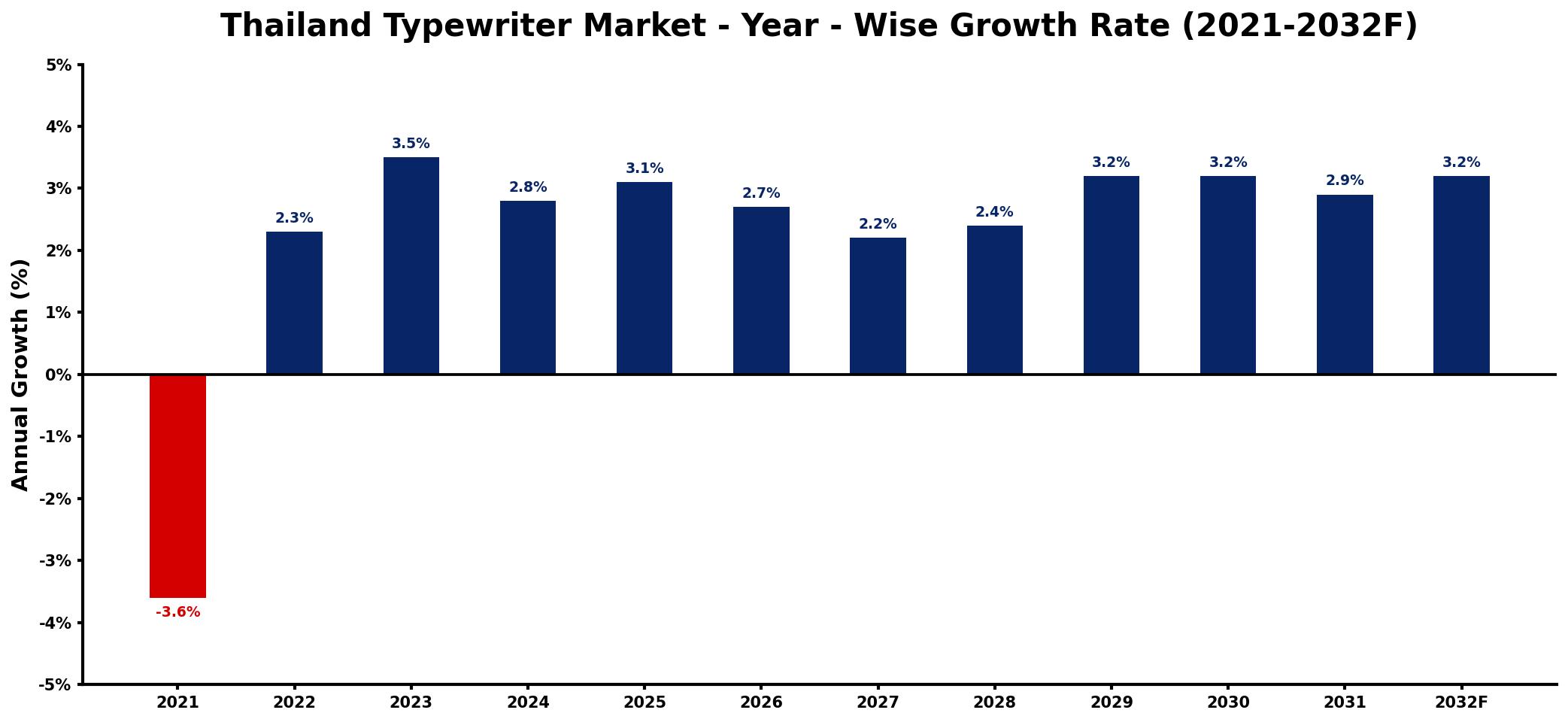
The table below presents the year‑wise growth rates along with the key drivers influencing the market
| Year | Growth Rate | Major Drivers |
| 2021 | -3.6% | decreased consumer interest in nostalgia |
| 2022 | 2.3% | rising demand for vintage collectibles |
| 2023 | 3.5% | growing popularity of retro aesthetics |
| 2024 | 2.8% | increased investments in stationery |
| 2025 | 3.1% | expansion of artisan craftsmanship market |
| 2026 | 2.7% | surge in home office setups |
| 2027 | 2.2% | increased focus on sustainability initiatives |
| 2028 | 2.4% | growth in educational resource markets |
| 2029 | 3.2% | enhanced digital marketing strategies |
| 2030 | 3.2% | rise in creative writing communities |
| 2031 | 2.9% | strengthened local manufacturing capabilities |
| 2032 | 3.2% | enhanced product quality standards |
Note: Market size estimations and growth projections presented in this report are based on 6Wresearch's proprietary forecasting methodology, utilizing the latest available industry data, government publications, and primary research inputs.
Thailand Typewriter Market Synopsis
The Thailand Typewriter Market has experienced a unique dichotomy in its recent momentum; while the overall industry continues to face decline, specific niches are seeing a resurgence. Typewriters are utilized primarily in government and legal sectors where physical documentation remains a necessity. As technological advancements take hold, however, the long-term prospects for the market present challenges.
Despite the overarching trend toward digitalization, certain segments such as refurbished and vintage typewriters have gained traction among collectors. This juxtaposition of technology advancement and nostalgia highlights the market's complex dynamics, yet indicates an eventual stagnation as fewer new users enter the fold.
Thailand Typewriter Market Key Takeaways
- The market is characterized by continued use in official settings, particularly in government and legal institutions.
- Vintage typewriters have cultivated a dedicated collector base, fueling demand in niche segments.
- Technological advancements and digitalization are the primary forces challenging market growth.
- Refurbished typewriters are becoming increasingly popular as the supply of new models dwindles.
- The market is currently stable, with slight growth projected despite ongoing obsolescence.
Evaluation of Restraints in Thailand Typewriter Market
The Thailand Typewriter Market grapples with significant restraints that hinder its expansion. The most pressing challenge is technological obsolescence; as businesses and individuals gravitate toward digital platforms, reliance on typewriters diminishes. This shift has resulted in a decreased market size and demand. Furthermore, as production of new typewriters has largely ceased, maintaining a supply of spare parts for existing models presents logistical challenges. The presence of counterfeit and low-quality products in the market poses reputational risks, making quality control essential for any remaining manufacturers.
Thailand Typewriter Market Trends
Several trends are shaping the Thailand Typewriter Market, notably the rise in nostalgia and appreciation for vintage items. This cultural phenomenon has led to an increased interest in collecting typewriters, fostering a unique sub-market. Additionally, the refurbishment sector has gained momentum, as consumers seek sustainable and durable alternatives to modern devices. Interestingly, some segments of the population have begun embracing typewriters as a means of disconnecting from digital distractions, promoting a more focused writing experience.
Thailand Typewriter Market Opportunities
The market presents genuine opportunities primarily through the refurbishment and resale of vintage typewriters. Businesses that pivot toward these niches can harness the collector's interest and the demand for sustainable products. Moreover, partnerships with educational institutions for creative writing workshops using typewriters can foster renewed interest. Such initiatives could stimulate a renaissance for typewriters, albeit on a smaller scale compared to their historical prominence.
Government Initiatives in the Thailand Typewriter Market
The Thai government has historically supported the preservation of traditional practices and crafts, which may indirectly benefit the typewriter market. Initiatives promoting cultural heritage and vintage items can incentivize the niche market of collectors and refurbishers. Additionally, public programs that encourage sustainable practices can further provide a platform for typewriter refurbishing businesses, contributing to environmental conservation efforts while promoting a traditional mode of writing.
Future Insights of the Thailand Typewriter Market
Looking forward to the period from 2026 to 2032, the Thailand Typewriter Market is expected to navigate a challenging landscape. The steady yet slow growth reflects the enduring relevance of typewriters in specific niches, particularly in governmental and legal domains. However, as digital solutions continue to evolve, the long-term survival of typewriters will heavily depend on the ability of market players to innovate and adapt to changing consumer preferences, potentially tapping into the nostalgia trend more effectively.
Thailand Typewriter Market Latest Developments (2025 - 2026)
Recent industry directions indicate a growing focus on refurbishing vintage typewriters, as enthusiasts and collectors seek authentic writing instruments. Various local markets and online platforms have begun showcasing refurbished models, capturing interest from a younger demographic. Additionally, workshops aimed at educating the public about the history and use of typewriters have gained traction, creating community engagement around this once ubiquitous technology.
Thailand Typewriter Market - Key Attractiveness of the Report
- 10 Years of Market Numbers
- Historical Data Starting from 2022 to 2025
- Base Year: 2025
- Forecast Data until 2032
- Key Performance Indicators Impacting the Market
- Major Upcoming Developments and Projects
Key Highlights of the Report:
- Thailand Typewriter Market Outlook
- Market Size of Thailand Typewriter Market, 2025
- Forecast of Thailand Typewriter Market, 2032
- Historical Data and Forecast of Thailand Typewriter Revenues & Volume for the Period 2022-2032F
- Thailand Typewriter Market Trend Evolution
- Thailand Typewriter Market Drivers and Challenges
- Thailand Typewriter Price Trends
- Thailand Typewriter Porter's Five Forces
- Thailand Typewriter Industry Life Cycle
- Historical Data and Forecast of Thailand Typewriter Market Revenues & Volume By Type for the Period 2022-2032F
- Historical Data and Forecast of Thailand Typewriter Market Revenues & Volume By Standard Typewriter for the Period 2022-2032F
- Historical Data and Forecast of Thailand Typewriter Market Revenues & Volume By Portable Typewriter for the Period 2022-2032F
- Historical Data and Forecast of Thailand Typewriter Market Revenues & Volume By Noiseless Typewriter for the Period 2022-2032F
- Historical Data and Forecast of Thailand Typewriter Market Revenues & Volume By Electric Typewriter for the Period 2022-2032F
- Historical Data and Forecast of Thailand Typewriter Market Revenues & Volume By Variable Typewriter for the Period 2022-2032F
- Historical Data and Forecast of Thailand Typewriter Market Revenues & Volume By Automatic Typewriter for the Period 2022-2032F
- Historical Data and Forecast of Thailand Typewriter Market Revenues & Volume By Electronic Typewriter for the Period 2022-2032F
- Historical Data and Forecast of Thailand Standard Typewriter Typewriter Market Revenues & Volume By Typewriter with Additional Attachments for the Period 2022-2032F
- Historical Data and Forecast of Thailand Typewriter Market Revenues & Volume By Application for the Period 2022-2032F
- Historical Data and Forecast of Thailand Typewriter Market Revenues & Volume By Commerical for the Period 2022-2032F
- Historical Data and Forecast of Thailand Typewriter Market Revenues & Volume By Industrial for the Period 2022-2032F
- Historical Data and Forecast of Thailand Typewriter Market Revenues & Volume By Others for the Period 2022-2032F
- Thailand Typewriter Import Export Trade Statistics
- Market Opportunity Assessment By Type
- Market Opportunity Assessment By Application
- Thailand Typewriter Top Companies Market Share
- Thailand Typewriter Competitive Benchmarking By Technical and Operational Parameters
- Thailand Typewriter Company Profiles
- Thailand Typewriter Key Strategic Recommendations






































