Thailand Warm Air Heating Equipment Market Size, Share & Growth Rate
The Thailand Warm Air Heating Equipment Market was estimated at USD 370 Million in 2025 and is projected to reach USD 493 Million by 2032, growing at a CAGR of 4.2% from 2026 to 2032. This growth trajectory is primarily driven by the increasing need for climate control solutions across various sectors, particularly as Thailand's construction and renovation activities continue to expand. Furthermore, a rising awareness of energy efficiency and sustainable practices in heating systems plays a vital role in shaping market dynamics.
Thailand Warm Air Heating Equipment Market Year-wise Growth Rate and Key Drivers
This graph highlights how the Thailand Warm Air Heating Equipment Market has steadily grown over the years, supported by major growth factors.
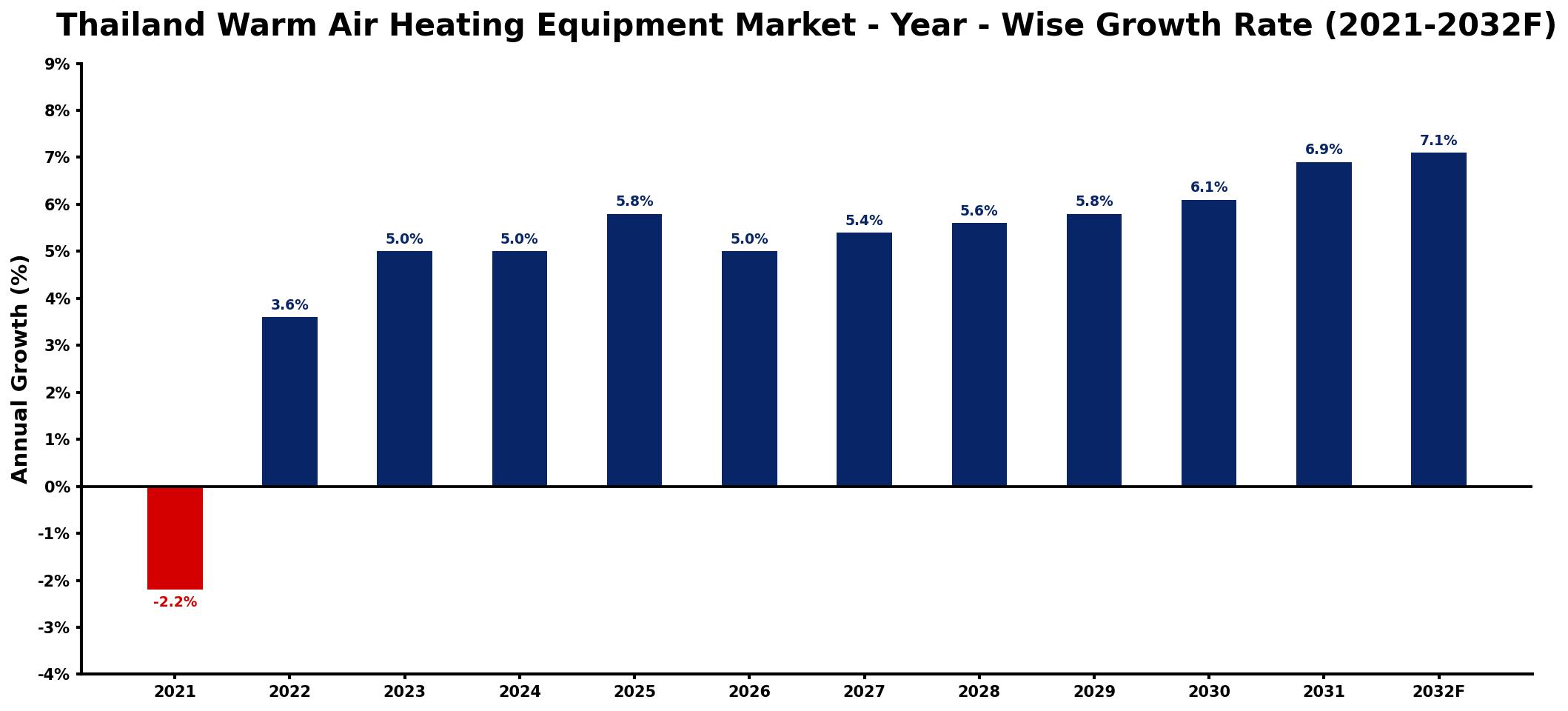
The table below presents the year‑wise growth rates along with the key drivers influencing the market
| Year | Growth Rate | Major Drivers |
| 2021 | -2.2% | decreased consumer spending on renovations |
| 2022 | 3.6% | rise in residential construction projects |
| 2023 | 5.0% | increased focus on energy efficiency |
| 2024 | 5.0% | growing demand for smart technologies |
| 2025 | 5.8% | expansion of renewable energy initiatives |
| 2026 | 5.0% | increased investments in infrastructure development |
| 2027 | 5.4% | surge in urban population growth |
| 2028 | 5.6% | enhanced government sustainability policies |
| 2029 | 5.8% | growing popularity of eco-friendly solutions |
| 2030 | 6.1% | increase in disposable income levels |
| 2031 | 6.9% | rising awareness of climate change |
| 2032 | 7.1% | increased production capacity utilization |
Note: Market size estimations and growth projections presented in this report are based on 6Wresearch's proprietary forecasting methodology, utilizing the latest available industry data, government publications, and primary research inputs.
Thailand Warm Air Heating Equipment Market Synopsis
The strongest force shaping the Thailand Warm Air Heating Equipment Market is the burgeoning construction sector, which is fostering demand for efficient climate control solutions. This necessity is particularly pronounced in industrial settings where maintaining optimal working conditions is crucial, thus driving the adoption of advanced heating technologies.
Additionally, urbanization and a growing population are compelling residential and commercial sectors to invest in warm air heating equipment. As the nation experiences colder and rainy seasons, the demand for comfortable indoor environments intensifies, further propelling market growth.
Thailand Warm Air Heating Equipment Market Key Takeaways
- The market is witnessing a shift towards sustainable and energy-efficient heating solutions.
- Infrastructure development in urban areas is significantly driving demand for heating equipment.
- Compliance with environmental regulations is influencing product offerings and market dynamics.
- Alternative heating technologies are emerging as competitors in specific applications.
- The recovery from COVID-19 is expected to result in a robust market rebound.
Evaluation of Restraints in Thailand Warm Air Heating Equipment Market
Despite its growth potential, the Thailand Warm Air Heating Equipment Market faces several challenges. The tropical climate predominantly limits the demand for warm air systems to specific industrial and commercial applications. Moreover, energy efficiency concerns and stringent environmental regulations necessitate compliance, which can be a burden for manufacturers. Competing technologies, such as radiant heating and heat pumps, may also impact the market's growth by offering alternative solutions that are perceived as more efficient in certain settings.
Thailand Warm Air Heating Equipment Market Trends
A notable trend within the Thailand Warm Air Heating Equipment Market is the growing adoption of heating systems powered by renewable energy sources. As businesses seek to enhance their sustainability profiles, solutions like solar-powered heaters and heat pumps are gaining traction. Additionally, technological advancements in automation and smart controls are elevating the efficiency of heating systems, aligning with the broader push for energy conservation and reduced operational costs.
Thailand Warm Air Heating Equipment Market Opportunities
The market offers numerous growth and investment opportunities, particularly within the industrial sector, which is poised for significant expansion. Companies can capitalize on the increasing focus on energy efficiency and sustainability by developing innovative heating solutions that cater to this demand. Furthermore, the ongoing infrastructure projects present a ripe environment for integrating warm air heating systems into new commercial and residential developments.
Government Initiatives in the Thailand Warm Air Heating Equipment Market
The Thai government has enacted several initiatives aimed at promoting clean energy and energy-efficient technologies. These include various incentives for adopting renewable energy sources and support for research and development in sustainable heating solutions. Public spending on infrastructure is also expected to include provisions for energy-efficient systems, aligning with the nations goals to reduce carbon emissions and foster a greener economy.
Future Insights of the Thailand Warm Air Heating Equipment Market
Looking ahead to 2026-2032, the Thailand Warm Air Heating Equipment Market is expected to witness dynamic growth, fueled by continued urbanization and infrastructure development. The anticipated shift toward green technologies will drive demand for energy-efficient heating systems, while ongoing improvements in manufacturing processes and product offerings will enhance market competitiveness. The recovery phase following the COVID-19 pandemic will also catalyze growth, positioning the market for a robust rebound as economic activities normalize.
Thailand Warm Air Heating Equipment Market Latest Developments (2025 - 2026)
Recent developments in the Thailand Warm Air Heating Equipment Market indicate a strong pivot toward energy-efficient and environmentally friendly heating solutions. Many manufacturers are enhancing their product lines to include smart technology features that allow for better energy management. Additionally, collaborations between technology firms and heating equipment providers are emerging to drive innovation, further improving system efficiencies and customer engagement in the residential and industrial sectors.
Thailand Warm Air Heating Equipment Market - Key Attractiveness of the Report
- 10 Years of Market Numbers
- Historical Data Starting from 2022 to 2025
- Base Year: 2025
- Forecast Data until 2032
- Key Performance Indicators Impacting the Market
- Major Upcoming Developments and Projects
Key Highlights of the Report:
- Thailand Warm Air Heating Equipment Market Outlook
- Market Size of Thailand Warm Air Heating Equipment Market, 2025
- Forecast of Thailand Warm Air Heating Equipment Market, 2032
- Historical Data and Forecast of Thailand Warm Air Heating Equipment Revenues & Volume for the Period 2022-2032F
- Thailand Warm Air Heating Equipment Market Trend Evolution
- Thailand Warm Air Heating Equipment Market Drivers and Challenges
- Thailand Warm Air Heating Equipment Price Trends
- Thailand Warm Air Heating Equipment Porter's Five Forces
- Thailand Warm Air Heating Equipment Industry Life Cycle
- Historical Data and Forecast of Thailand Warm Air Heating Equipment Market Revenues & Volume By Product Type for the Period 2022-2032F
- Historical Data and Forecast of Thailand Warm Air Heating Equipment Market Revenues & Volume By Heat Pumps for the Period 2022-2032F
- Historical Data and Forecast of Thailand Warm Air Heating Equipment Market Revenues & Volume By Humidifying Equipment for the Period 2022-2032F
- Historical Data and Forecast of Thailand Warm Air Heating Equipment Market Revenues & Volume By Fuel Type for the Period 2022-2032F
- Historical Data and Forecast of Thailand Warm Air Heating Equipment Market Revenues & Volume By Electric Powered for the Period 2022-2032F
- Historical Data and Forecast of Thailand Warm Air Heating Equipment Market Revenues & Volume By Gas-Powered for the Period 2022-2032F
- Historical Data and Forecast of Thailand Warm Air Heating Equipment Market Revenues & Volume By Hybrid for the Period 2022-2032F
- Historical Data and Forecast of Thailand Warm Air Heating Equipment Market Revenues & Volume By Solar Powered for the Period 2022-2032F
- Historical Data and Forecast of Thailand Warm Air Heating Equipment Market Revenues & Volume By Application for the Period 2022-2032F
- Historical Data and Forecast of Thailand Warm Air Heating Equipment Market Revenues & Volume By Air to Air for the Period 2022-2032F
- Historical Data and Forecast of Thailand Warm Air Heating Equipment Market Revenues & Volume By Air to Water for the Period 2022-2032F
- Historical Data and Forecast of Thailand Warm Air Heating Equipment Market Revenues & Volume By Implementation for the Period 2022-2032F
- Historical Data and Forecast of Thailand Warm Air Heating Equipment Market Revenues & Volume By New Construction for the Period 2022-2032F
- Historical Data and Forecast of Thailand Warm Air Heating Equipment Market Revenues & Volume By Maintenance for the Period 2022-2032F
- Historical Data and Forecast of Thailand Warm Air Heating Equipment Market Revenues & Volume By End User Industry for the Period 2022-2032F
- Historical Data and Forecast of Thailand Warm Air Heating Equipment Market Revenues & Volume By Residential for the Period 2022-2032F
- Historical Data and Forecast of Thailand Warm Air Heating Equipment Market Revenues & Volume By Commercial for the Period 2022-2032F
- Historical Data and Forecast of Thailand Warm Air Heating Equipment Market Revenues & Volume By Industrial for the Period 2022-2032F
- Historical Data and Forecast of Thailand Warm Air Heating Equipment Market Revenues & Volume By Business Type for the Period 2022-2032F
- Historical Data and Forecast of Thailand Warm Air Heating Equipment Market Revenues & Volume By Original Equipment Manufacturer (OEM) for the Period 2022-2032F
- Historical Data and Forecast of Thailand Warm Air Heating Equipment Market Revenues & Volume By Aftermarket for the Period 2022-2032F
- Thailand Warm Air Heating Equipment Import Export Trade Statistics
- Market Opportunity Assessment By Product Type
- Market Opportunity Assessment By Fuel Type
- Market Opportunity Assessment By Application
- Market Opportunity Assessment By Implementation
- Market Opportunity Assessment By End User Industry
- Market Opportunity Assessment By Business Type
- Thailand Warm Air Heating Equipment Top Companies Market Share
- Thailand Warm Air Heating Equipment Competitive Benchmarking By Technical and Operational Parameters
- Thailand Warm Air Heating Equipment Company Profiles
- Thailand Warm Air Heating Equipment Key Strategic Recommendations






































