Thailand Wind Energy Market Size, Share & Growth Rate
The Thailand Wind Energy Market was estimated at USD 133 Million in 2025 and is projected to reach USD 152 Million by 2032, growing at a CAGR of 1.9% from 2026 to 2032. This growth trajectory is underpinned by an increasing commitment from the Thai government to bolster renewable energy sources and reduce greenhouse gas emissions. With favorable wind conditions in coastal regions and advancing turbine technology, the market is poised for significant advancements in the coming years.
Thailand Wind Energy Market Year-wise Growth Rate and Key Drivers
This graph highlights how the Thailand Wind Energy Market has steadily grown over the years, supported by major growth factors.
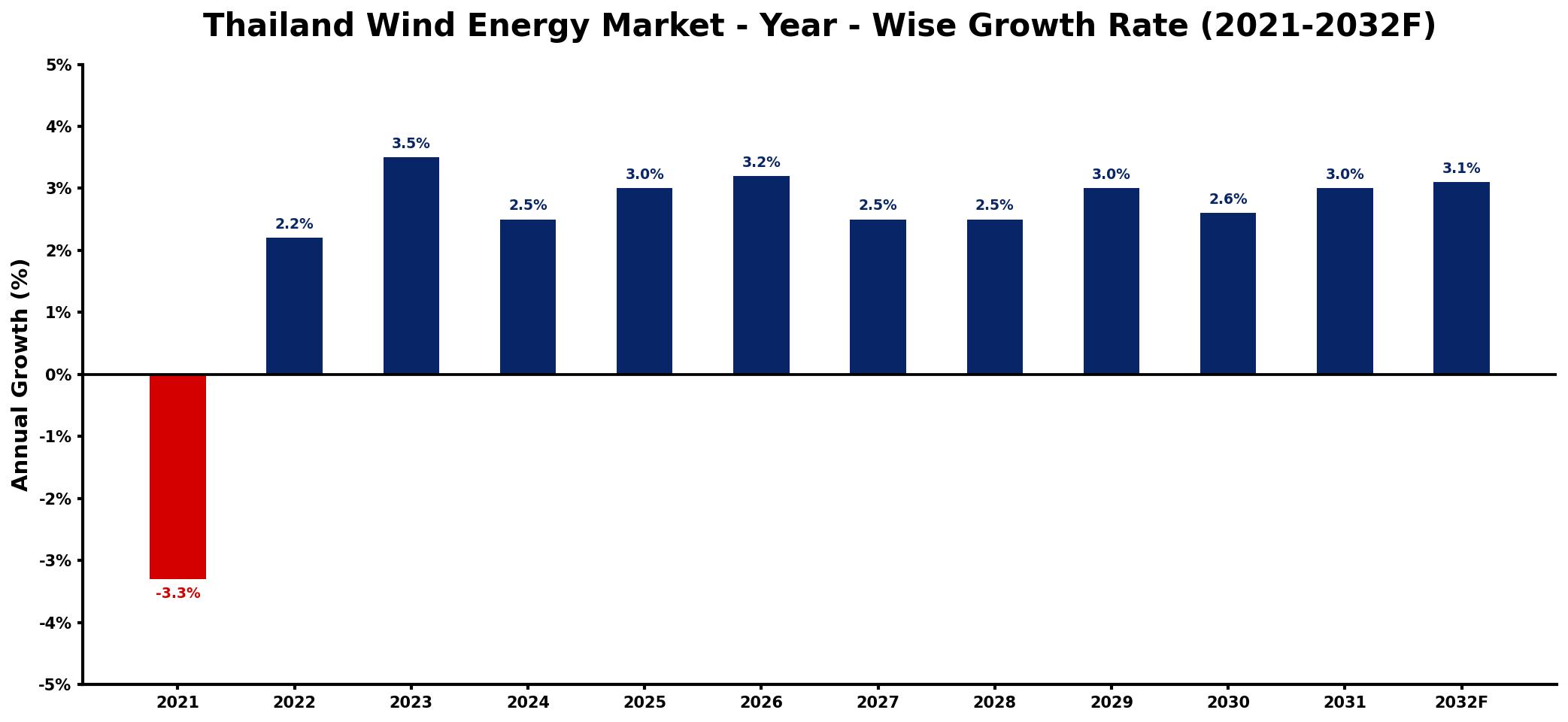
The table below presents the year‑wise growth rates along with the key drivers influencing the market
| Year | Growth Rate | Major Drivers |
| 2021 | -3.3% | decrease in renewable investments |
| 2022 | 2.2% | rise in environmental awareness initiatives |
| 2023 | 3.5% | expansion of clean technology sectors |
| 2024 | 2.5% | increased government policy support |
| 2025 | 3.0% | growing private sector investments |
| 2026 | 3.2% | development of innovative financing models |
| 2027 | 2.5% | surge in corporate sustainability commitments |
| 2028 | 2.5% | enhanced grid integration capabilities |
| 2029 | 3.0% | growing demand for green jobs |
| 2030 | 2.6% | improved raw material availability |
| 2031 | 3.0% | strengthening international trade flows |
| 2032 | 3.1% | rising end-use demand growth |
Note: Market size estimations and growth projections presented in this report are based on 6Wresearch's proprietary forecasting methodology, utilizing the latest available industry data, government publications, and primary research inputs.
Thailand Wind Energy Market Synopsis
Recently, the Thailand Wind Energy Market has shown remarkable momentum, with various projects coming online and new investments pouring in. However, as the country looks toward a greener future, the market is set to evolve further, driven by both technological innovations and supportive governmental policies.
As Thailand's renewable energy goals become more ambitious, the wind energy sector stands at a pivotal point. By leveraging its geographic advantages and the latest advancements in turbine efficiency, the market is well-positioned for sustainable growth, aligning with global energy transition trends.
Thailand Wind Energy Market Key Takeaways
- Government support and renewable energy policies are vital growth drivers in the Thailand Wind Energy Market.
- Investment in advanced turbine technologies is enhancing energy generation efficiency.
- Coastal regions exhibit strong wind resources, ideal for wind farm development.
- Ongoing international collaborations are fostering growth and technology transfer in the sector.
- Despite facing challenges, the market remains resilient and committed to achieving its renewable energy targets.
Evaluation of Restraints in Thailand Wind Energy Market
The Thailand Wind Energy Market grapples with several restraints that impact its potential. Regulatory hurdles can often delay project approvals, complicating timelines for development. Furthermore, Thailand's varied geography presents challenges in identifying optimal sites for wind farms, where wind consistency and intensity are reliable. The high initial investments required for infrastructure development and integration into the existing grid also pose significant barriers. Companies operating in this space must navigate these complexities to capitalize on the burgeoning demand for wind energy.
Thailand Wind Energy Market Trends
The Thailand Wind Energy Market is witnessing several key trends that are shaping its future. The adoption of larger and more efficient wind turbines is increasing the feasibility and output of new projects. Additionally, the integration of energy storage solutions is becoming critical to address the intermittent nature of wind energy, ensuring a more reliable power supply. There is also a growing emphasis on local partnerships to enhance project viability and stakeholder engagement, fostering community support for new installations.
Thailand Wind Energy Market Opportunities
With the global transition towards sustainable energy, the Thailand Wind Energy Market presents significant growth and investment opportunities. As the government continues to push for renewable energy adoption, private investors and developers can explore untapped areas with strong wind potential, particularly in less developed coastal regions. Moreover, as technology advances, opportunities for innovation in turbine design and efficiency improvements are ripe for exploration, offering the potential for enhanced profitability.
Government Initiatives in the Thailand Wind Energy Market
The Thai government is actively promoting the wind energy sector through various initiatives aimed at fostering renewable energy development. Policies designed to reduce reliance on fossil fuels, combined with financial incentives for renewable projects, have created a conducive environment for growth. Additionally, public spending on infrastructure improvements supports the integration of wind energy into the national grid, facilitating better access and distribution. Ongoing governmental programs further aim to enhance stakeholder collaboration, ensuring a united approach towards achieving energy sustainability.
Future Insights of the Thailand Wind Energy Market
Looking ahead to the period from 2026 to 2032, the Thailand Wind Energy Market is expected to capitalize on both domestic and international momentum in renewable energy. Increased focus on sustainability will drive further investments and technology adoption. Furthermore, as the government solidifies its commitment to renewable energy targets, the landscape will likely become increasingly favorable for wind energy projects. Continued advancements in turbine technology will also play a critical role, allowing for more efficient and cost-effective energy generation.
Thailand Wind Energy Market Latest Developments (2025 - 2026)
In the recent period, the Thailand Wind Energy Market has seen heightened activity, with several new projects initiated in response to governmental policies promoting renewable energy. Developers are increasingly focusing on innovative approaches to site selection and project execution, often involving local communities in the process. Additionally, collaborations with international partners have been established, paving the way for knowledge sharing and technology transfer, which are vital to boosting the sectors capabilities.
Thailand Wind Energy Market - Key Attractiveness of the Report
- 10 Years of Market Numbers
- Historical Data Starting from 2022 to 2025
- Base Year: 2025
- Forecast Data until 2032
- Key Performance Indicators Impacting the Market
- Major Upcoming Developments and Projects
Key Highlights of the Report:
- Thailand Wind Energy Market Outlook
- Market Size of Thailand Wind Energy Market, 2025
- Forecast of Thailand Wind Energy Market, 2032
- Historical Data and Forecast of Thailand Wind Energy Revenues & Volume for the Period 2022-2032F
- Thailand Wind Energy Market Trend Evolution
- Thailand Wind Energy Market Drivers and Challenges
- Thailand Wind Energy Price Trends
- Thailand Wind Energy Porter's Five Forces
- Thailand Wind Energy Industry Life Cycle
- Historical Data and Forecast of Thailand Wind Energy Market Revenues & Volume By Type for the Period 2022-2032F
- Historical Data and Forecast of Thailand Wind Energy Market Revenues & Volume By Offshore for the Period 2022-2032F
- Historical Data and Forecast of Thailand Wind Energy Market Revenues & Volume By Onshore for the Period 2022-2032F
- Historical Data and Forecast of Thailand Wind Energy Market Revenues & Volume By End User for the Period 2022-2032F
- Historical Data and Forecast of Thailand Wind Energy Market Revenues & Volume By Industrial for the Period 2022-2032F
- Historical Data and Forecast of Thailand Wind Energy Market Revenues & Volume By Commercial for the Period 2022-2032F
- Historical Data and Forecast of Thailand Wind Energy Market Revenues & Volume By Residential for the Period 2022-2032F
- Thailand Wind Energy Import Export Trade Statistics
- Market Opportunity Assessment By Type
- Market Opportunity Assessment By End User
- Thailand Wind Energy Top Companies Market Share
- Thailand Wind Energy Competitive Benchmarking By Technical and Operational Parameters
- Thailand Wind Energy Company Profiles
- Thailand Wind Energy Key Strategic Recommendations






































