Tunisia Accounting Software Market Size, Share & Growth Rate
The Tunisia Accounting Software Market was estimated at USD 274 Million in 2025 and is projected to reach USD 365 Million by 2032, growing at a CAGR of 4.2% from 2026 to 2032. This promising growth is driven primarily by the accelerating digital transformation among businesses, particularly within small and medium enterprises (SMEs). As these organizations increasingly recognize the importance of streamlined financial operations, the demand for innovative and cost-effective accounting software continues to rise.
Tunisia Accounting Software Market Year-wise Growth Rate and Key Drivers
This graph highlights how the Tunisia Accounting Software Market has steadily grown over the years, supported by major growth factors.
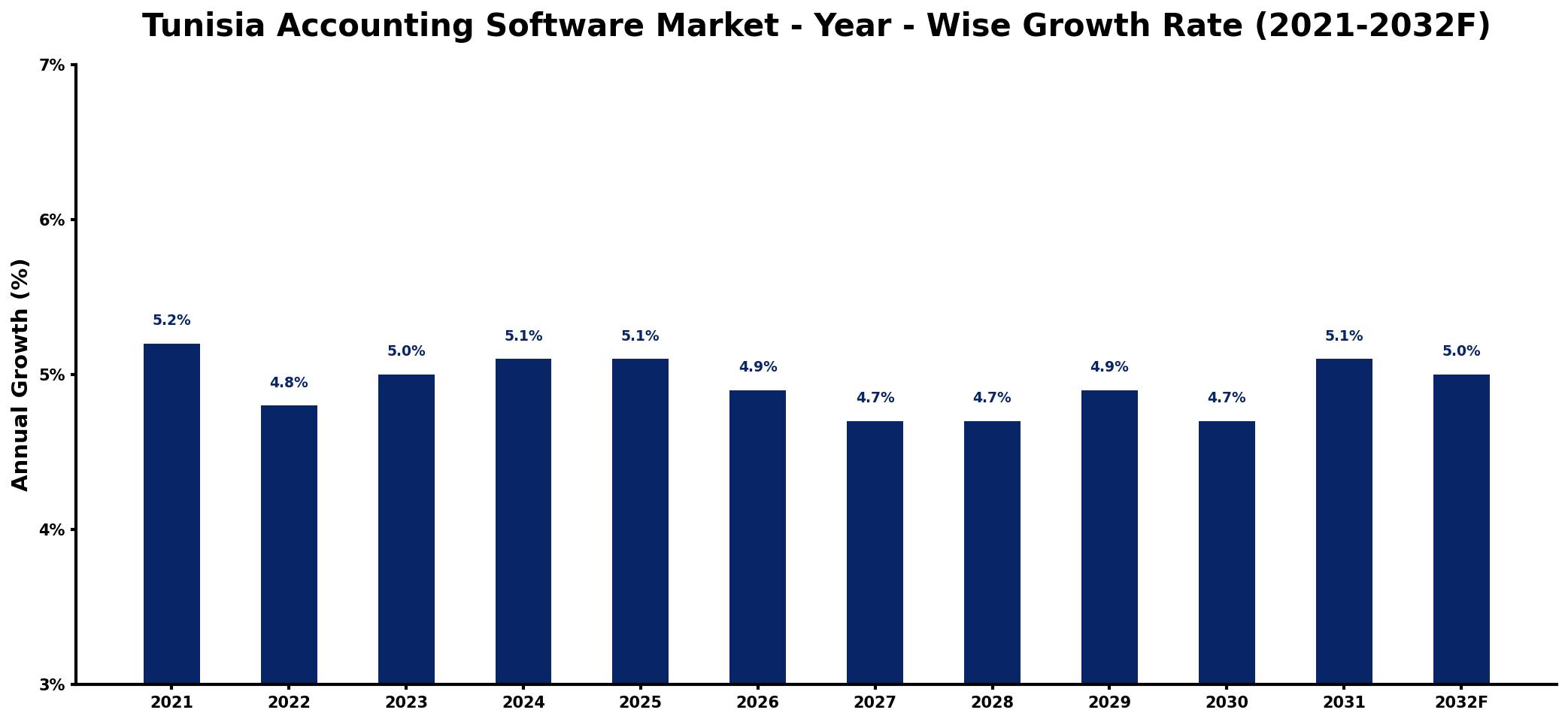
The table below presents the year‑wise growth rates along with the key drivers influencing the market
| Year | Growth Rate | Major Drivers |
| 2021 | 5.2% | increased digital transformation initiatives |
| 2022 | 4.8% | growing small business investments |
| 2023 | 5.0% | rise in e-commerce transactions |
| 2024 | 5.1% | enhanced regulatory compliance requirements |
| 2025 | 5.1% | expansion of online financial services |
| 2026 | 4.9% | increased focus on data security |
| 2027 | 4.7% | growth in remote work adoption |
| 2028 | 4.7% | increased demand for automation solutions |
| 2029 | 4.9% | emphasis on financial literacy programs |
| 2030 | 4.7% | rising popularity of cloud solutions |
| 2031 | 5.1% | rising export shipment volumes |
| 2032 | 5.0% | growing interest in AI technologies |
Note: Market size estimations and growth projections presented in this report are based on 6Wresearch's proprietary forecasting methodology, utilizing the latest available industry data, government publications, and primary research inputs.
Tunisia Accounting Software Market Synopsis
Recently, the Tunisia accounting software market has gained momentum, thanks to the widespread adoption of cloud-based solutions and heightened awareness of their benefits. However, while businesses are eager to embrace these advancements, a more significant transformation lies ahead as they seek comprehensive solutions that integrate various financial management tasks.
Looking forward, the market trajectory indicates an upward shift, driven by continuous government initiatives aimed at promoting digitalization. This environment is conducive for software vendors to innovate and refine their offerings, ensuring that local businesses are equipped with state-of-the-art accounting technologies.
Tunisia Accounting Software Market Key Takeaways
- The increasing reliance on cloud-based solutions is reshaping the market landscape.
- SMEs are a key driver of growth, seeking efficient and cost-effective accounting solutions.
- Government policies are fostering a more favorable environment for digital transformation.
- Automation and real-time access are becoming essential features sought by businesses.
- Vendor focus on user-friendly interfaces is enhancing customer satisfaction and adoption.
Evaluation of Restraints in Tunisia Accounting Software Market
Despite the robust growth potential, the Tunisia accounting software market is impeded by several critical restraints. Low awareness and understanding of accounting software benefits among SMEs remain significant barriers, preventing wider adoption. Additionally, the fragmented landscape poses challenges for businesses trying to identify solutions that align with their unique needs. Furthermore, limited internet connectivity and concerns around cybersecurity deter some companies from embracing cloud-based options. Finally, the shortage of skilled professionals in both accounting and technology hampers effective implementation and use of these solutions, ultimately slowing market progress.
Tunisia Accounting Software Market Trends
Current trends in the Tunisia accounting software market highlight an increasing demand for automation, real-time data access, and enhanced security features. Businesses are actively seeking integrated solutions that combine accounting with other financial management functions, such as invoicing and inventory management. Additionally, vendors are prioritizing user experience by developing intuitive interfaces and mobile applications to facilitate ease of use, particularly among the fast-growing segment of tech-savvy SMEs.
Tunisia Accounting Software Market Opportunities
The Tunisia accounting software market is ripe with investment opportunities as businesses increasingly move toward digital solutions. Local software development firms can thrive by creating tailored accounting tools that meet the specific needs of Tunisian enterprises. Additionally, international firms can explore partnerships and collaborations to tap into this growing market. Cloud-based solutions are particularly attractive, offering scalability and remote access that align with modern business practices. Moreover, providing training and support services for users presents a lucrative avenue for investors eager to engage with this evolving landscape.
Government Initiatives in the Tunisia Accounting Software Market
The Tunisian government has implemented various policies aimed at enhancing transparency and efficiency in financial reporting. Regulations mandating accurate financial record-keeping and timely reporting encourage businesses to adopt advanced accounting solutions. Furthermore, government initiatives promoting digital technologies and providing incentives like tax breaks or subsidies for software adoption signal a commitment to modernizing accounting practices, which is essential for strengthening economic competitiveness.
Future Insights of the Tunisia Accounting Software Market
Looking ahead to 2026-2032, the Tunisia accounting software market is anticipated to witness steady growth as digital transformation continues to reshape business operations. Factors such as the increasing number of SMEs, heightened awareness regarding automation benefits, and a growing emphasis on efficient financial management will drive demand for innovative accounting software. Cloud-based solutions are expected to take center stage, offering scalability and cost-effectiveness, while vendors will focus on compliance, data security, and customization to better meet the unique needs of Tunisian businesses.
Tunisia Accounting Software Market Latest Developments (2025 - 2026)
Recent industry developments indicate a strong push towards more integrated accounting solutions within the Tunisian market. Vendors are increasingly rolling out updates to enhance user experience, focusing on mobile accessibility and intuitive design. Additionally, collaborative efforts among local firms and international providers have begun to emerge, aiming to create tailored solutions that address the specific challenges faced by Tunisian businesses. The regulatory environment continues to evolve, further encouraging the adoption of digital accounting practices.
Tunisia Accounting Software Market - Key Attractiveness of the Report
- 10 Years of Market Numbers
- Historical Data Starting from 2022 to 2025
- Base Year: 2025
- Forecast Data until 2032
- Key Performance Indicators Impacting the Market
- Major Upcoming Developments and Projects
Key Highlights of the Report:
- Tunisia Accounting Software Market Outlook
- Market Size of Tunisia Accounting Software Market, 2025
- Forecast of Tunisia Accounting Software Market, 2032
- Historical Data and Forecast of Tunisia Accounting Software Revenues & Volume for the Period 2022-2032F
- Tunisia Accounting Software Market Trend Evolution
- Tunisia Accounting Software Market Drivers and Challenges
- Tunisia Accounting Software Price Trends
- Tunisia Accounting Software Porter's Five Forces
- Tunisia Accounting Software Industry Life Cycle
- Historical Data and Forecast of Tunisia Accounting Software Market Revenues & Volume By Component for the Period 2022-2032F
- Historical Data and Forecast of Tunisia Accounting Software Market Revenues & Volume By Software for the Period 2022-2032F
- Historical Data and Forecast of Tunisia Accounting Software Market Revenues & Volume By Services for the Period 2022-2032F
- Historical Data and Forecast of Tunisia Accounting Software Market Revenues & Volume By Enterprise Size for the Period 2022-2032F
- Historical Data and Forecast of Tunisia Accounting Software Market Revenues & Volume By Large for the Period 2022-2032F
- Historical Data and Forecast of Tunisia Accounting Software Market Revenues & Volume By Small & Medium for the Period 2022-2032F
- Historical Data and Forecast of Tunisia Accounting Software Market Revenues & Volume By Type for the Period 2022-2032F
- Historical Data and Forecast of Tunisia Accounting Software Market Revenues & Volume By Spreadsheets for the Period 2022-2032F
- Historical Data and Forecast of Tunisia Accounting Software Market Revenues & Volume By ERP for the Period 2022-2032F
- Historical Data and Forecast of Tunisia Accounting Software Market Revenues & Volume By Custom Accounting Software for the Period 2022-2032F
- Historical Data and Forecast of Tunisia Accounting Software Market Revenues & Volume By Tax Management Software for the Period 2022-2032F
- Historical Data and Forecast of Tunisia Accounting Software Market Revenues & Volume By End-use Industry for the Period 2022-2032F
- Historical Data and Forecast of Tunisia Accounting Software Market Revenues & Volume By BFSI for the Period 2022-2032F
- Historical Data and Forecast of Tunisia Accounting Software Market Revenues & Volume By IT & Telecommunication for the Period 2022-2032F
- Historical Data and Forecast of Tunisia Accounting Software Market Revenues & Volume By Government & Public Sector for the Period 2022-2032F
- Historical Data and Forecast of Tunisia Accounting Software Market Revenues & Volume By Automotive for the Period 2022-2032F
- Historical Data and Forecast of Tunisia Accounting Software Market Revenues & Volume By Retail & Consumer Goods for the Period 2022-2032F
- Historical Data and Forecast of Tunisia Accounting Software Market Revenues & Volume By Oil & Gas for the Period 2022-2032F
- Historical Data and Forecast of Tunisia Accounting Software Market Revenues & Volume By Manufacturing for the Period 2022-2032F
- Historical Data and Forecast of Tunisia Accounting Software Market Revenues & Volume By Others for the Period 2022-2032F
- Tunisia Accounting Software Import Export Trade Statistics
- Market Opportunity Assessment By Component
- Market Opportunity Assessment By Enterprise Size
- Market Opportunity Assessment By Type
- Market Opportunity Assessment By End-use Industry
- Tunisia Accounting Software Top Companies Market Share
- Tunisia Accounting Software Competitive Benchmarking By Technical and Operational Parameters
- Tunisia Accounting Software Company Profiles
- Tunisia Accounting Software Key Strategic Recommendations






































