Tunisia Centrifugal Industrial Dryer Market Size, Share & Growth Rate
The Tunisia Centrifugal Industrial Dryer Market was estimated at USD 230 Million in 2025 and is projected to reach USD 254 Million by 2032, growing at a CAGR of 1.4% from 2026 to 2032. This growth is primarily driven by the rising need for efficient drying technologies across various sectors, including food processing, textiles, and pharmaceuticals. As industrialization accelerates, manufacturers are increasingly prioritizing energy efficiency and product quality, pushing the market toward innovative drying solutions.
Tunisia Centrifugal Industrial Dryer Market Year-wise Growth Rate and Key Drivers
This graph highlights how the Tunisia Centrifugal Industrial Dryer Market has steadily grown over the years, supported by major growth factors.
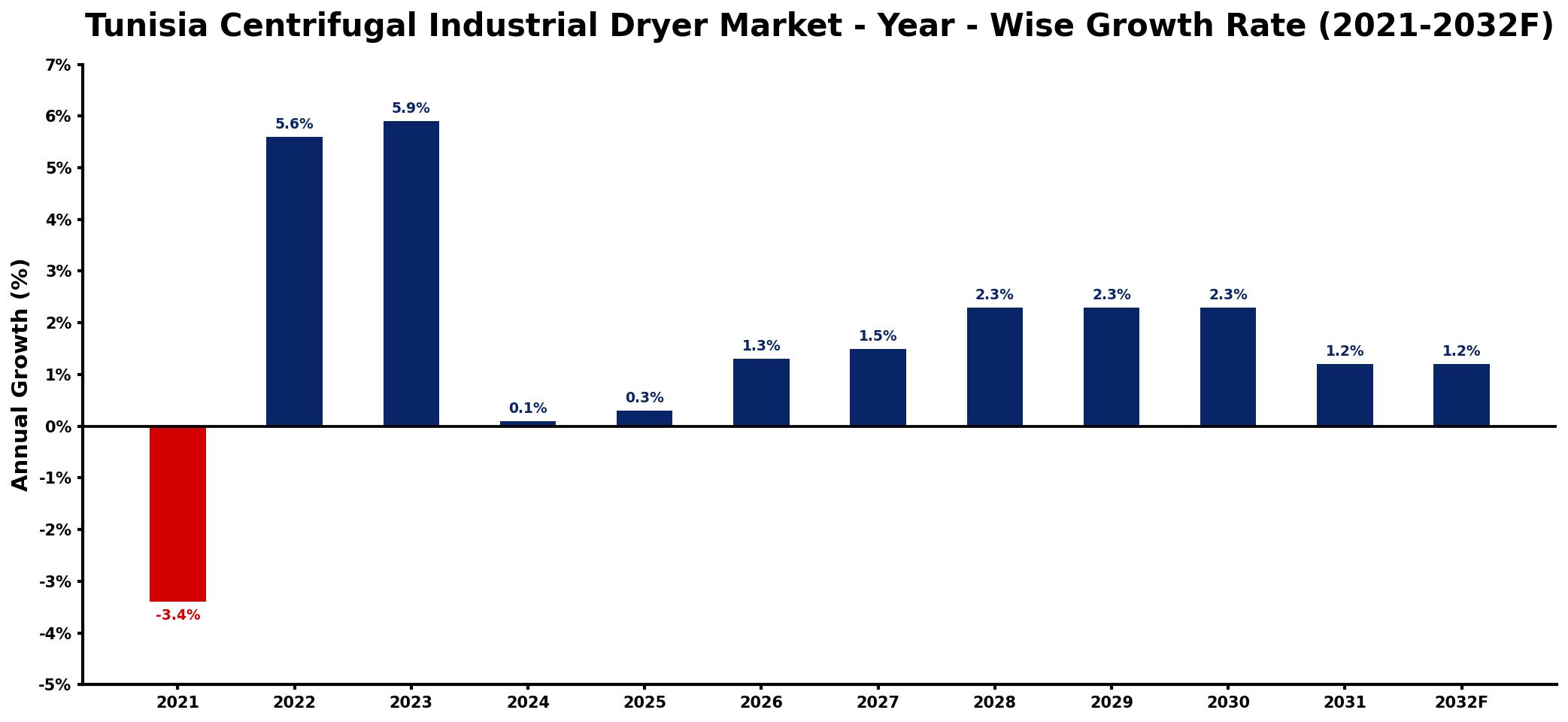
The table below presents the year‑wise growth rates along with the key drivers influencing the market
| Year | Growth Rate | Major Drivers |
| 2021 | -3.4% | decreased manufacturing output levels |
| 2022 | 5.6% | rising demand from food processing |
| 2023 | 5.9% | expansion in textile production capacity |
| 2024 | 0.1% | increased investments in agriculture |
| 2025 | 0.3% | growing interest in energy efficiency |
| 2026 | 1.3% | enhanced technological advancements adoption |
| 2027 | 1.5% | growing export opportunities emerging |
| 2028 | 2.3% | increased focus on sustainable practices |
| 2029 | 2.3% | expansion of processing facilities occurring |
| 2030 | 2.3% | increased automation in manufacturing |
| 2031 | 1.2% | growing demand from pharmaceutical sector |
| 2032 | 1.2% | rising investments in infrastructure projects |
Note: Market size estimations and growth projections presented in this report are based on 6Wresearch's proprietary forecasting methodology, utilizing the latest available industry data, government publications, and primary research inputs.
Tunisia Centrifugal Industrial Dryer Market Synopsis
The Tunisia Centrifugal Industrial Dryer Market is gaining momentum as industries seek faster and more efficient drying processes. With the surge in production demands, companies are adopting advanced drying technologies that enhance productivity while minimizing energy consumption.
Moreover, there is a growing awareness of sustainable practices, prompting a shift toward eco-friendly dryers that align with environmental regulations. This evolving landscape presents both opportunities and challenges for market participants.
Tunisia Centrifugal Industrial Dryer Market Key Takeaways
- The market is projected to grow steadily, reaching USD 254 Million by 2032.
- Key industries driving demand include food processing, pharmaceuticals, and textiles.
- Technological advancements are crucial for improving energy efficiency and drying capacity.
- Sustainability is becoming a significant focus, pushing manufacturers toward greener solutions.
- Collaborative ventures with local entities may enhance market penetration and innovation.
Evaluation of Restraints in Tunisia Centrifugal Industrial Dryer Market
Despite the market's growth potential, several constraints hinder its progress. Intense competition from both local and international suppliers creates pricing pressures that can affect profitability. Additionally, fluctuations in raw material costs pose challenges for maintaining competitive pricing. Companies must also navigate the complexities of evolving regulatory requirements while ensuring product quality and reliability to meet the stringent demands of key industries.
Tunisia Centrifugal Industrial Dryer Market Trends
A significant trend in the Tunisia Centrifugal Industrial Dryer Market is the increasing integration of smart technologies and IoT capabilities. Manufacturers are focusing on enhancing dryer performance through automated controls and real-time monitoring systems. Furthermore, the adoption of heat recovery systems and improved insulation reflects a broader shift towards energy efficiency, reducing both operational costs and environmental impact. This trend highlights the market's commitment to meeting modern industrial demands while fostering sustainability.
Tunisia Centrifugal Industrial Dryer Market Opportunities
Investment opportunities abound in the Tunisia Centrifugal Industrial Dryer Market, particularly as the demand for innovative drying solutions escalates. The transition toward more energy-efficient and customizable dryers presents a lucrative avenue for investment. Additionally, collaborating with local manufacturers to tailor solutions for specific industries can lead to significant competitive advantages. The growing emphasis on sustainable practices further creates avenues for introducing eco-friendly dryer technologies that meet regulatory and consumer expectations.
Government Initiatives in the Tunisia Centrifugal Industrial Dryer Market
The Tunisian government is actively promoting the development of the Centrifugal Industrial Dryer Market through a series of supportive policies. These initiatives include offering tax incentives and subsidies for investments in advanced drying technologies. Furthermore, financial assistance for research and development encourages innovation within the sector, while established regulations ensure compliance with product quality and safety standards, fostering a favorable environment for both domestic and foreign investors.
Future Insights of the Tunisia Centrifugal Industrial Dryer Market
Looking ahead to 2026-2032, the Tunisia Centrifugal Industrial Dryer Market is set for continued expansion driven by ongoing industrialization and modernization efforts. The push for energy efficiency and cost-effective manufacturing solutions will further encourage the adoption of advanced drying technologies. As the government enhances its infrastructure and promotes investments, the market is well-positioned to attract new entrants and facilitate innovation, ensuring a competitive landscape for years to come.
Tunisia Centrifugal Industrial Dryer Market Latest Developments (2025 - 2026)
Recent developments in the Tunisia Centrifugal Industrial Dryer Market have highlighted the acceleration of technology integration and sustainability efforts. As industries evolve, there is a noticeable trend towards incorporating AI and machine learning to optimize drying processes. Simultaneously, manufacturers are increasingly focusing on compliance with environmental standards, leading to the development of eco-friendly drying solutions. These trends reflect a proactive response to changing market dynamics and consumer expectations.
Tunisia Centrifugal Industrial Dryer Market - Key Attractiveness of the Report
- 10 Years of Market Numbers
- Historical Data Starting from 2022 to 2025
- Base Year: 2025
- Forecast Data until 2032
- Key Performance Indicators Impacting the Market
- Major Upcoming Developments and Projects
Key Highlights of the Report:
- Tunisia Centrifugal Industrial Dryer Market Outlook
- Market Size of Tunisia Centrifugal Industrial Dryer Market, 2025
- Forecast of Tunisia Centrifugal Industrial Dryer Market, 2032
- Historical Data and Forecast of Tunisia Centrifugal Industrial Dryer Revenues & Volume for the Period 2022-2032F
- Tunisia Centrifugal Industrial Dryer Market Trend Evolution
- Tunisia Centrifugal Industrial Dryer Market Drivers and Challenges
- Tunisia Centrifugal Industrial Dryer Price Trends
- Tunisia Centrifugal Industrial Dryer Porter's Five Forces
- Tunisia Centrifugal Industrial Dryer Industry Life Cycle
- Historical Data and Forecast of Tunisia Centrifugal Industrial Dryer Market Revenues & Volume By Application for the Period 2022-2032F
- Historical Data and Forecast of Tunisia Centrifugal Industrial Dryer Market Revenues & Volume By Metal Finishing for the Period 2022-2032F
- Historical Data and Forecast of Tunisia Centrifugal Industrial Dryer Market Revenues & Volume By Food Processing for the Period 2022-2032F
- Historical Data and Forecast of Tunisia Centrifugal Industrial Dryer Market Revenues & Volume By Plastic Recycling for the Period 2022-2032F
- Historical Data and Forecast of Tunisia Centrifugal Industrial Dryer Market Revenues & Volume By Chemical for the Period 2022-2032F
- Historical Data and Forecast of Tunisia Centrifugal Industrial Dryer Market Revenues & Volume By Pharmaceutical for the Period 2022-2032F
- Historical Data and Forecast of Tunisia Centrifugal Industrial Dryer Market Revenues & Volume By Type for the Period 2022-2032F
- Historical Data and Forecast of Tunisia Centrifugal Industrial Dryer Market Revenues & Volume By Direct for the Period 2022-2032F
- Historical Data and Forecast of Tunisia Centrifugal Industrial Dryer Market Revenues & Volume By Indirect for the Period 2022-2032F
- Tunisia Centrifugal Industrial Dryer Import Export Trade Statistics
- Market Opportunity Assessment By Application
- Market Opportunity Assessment By Type
- Tunisia Centrifugal Industrial Dryer Top Companies Market Share
- Tunisia Centrifugal Industrial Dryer Competitive Benchmarking By Technical and Operational Parameters
- Tunisia Centrifugal Industrial Dryer Company Profiles
- Tunisia Centrifugal Industrial Dryer Key Strategic Recommendations






































