Tunisia Cloud Managed Services Market Size & Growth Rate (2026-2032)
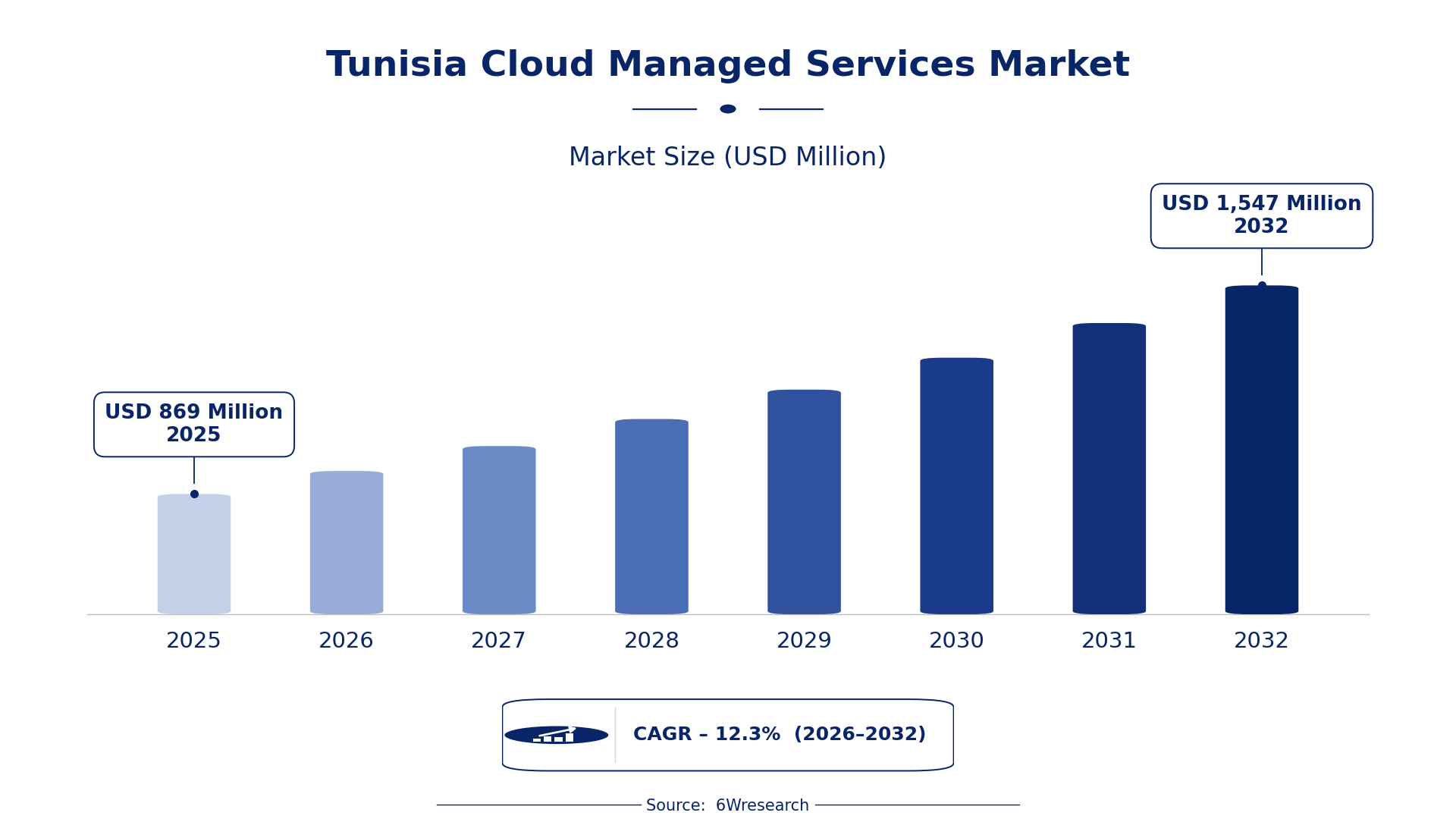
The Tunisia Cloud Managed Services Market was estimated at USD 869 Million in 2025 and is projected to reach USD 1547 Million by 2032, growing at a CAGR of 12.3% from 2026 to 2032.
Tunisia Cloud Managed Services Market Synopsis
The Tunisia Cloud Managed Services Market is witnessing a transformative phase, fueled by a rising demand for outsourced IT management and operational efficiency. This momentum reflects a shift in how businesses prioritize technology investments, with a growing inclination towards managed services to mitigate complexity and enhance performance.
Looking ahead, the market is set to expand significantly. Organizations are increasingly adopting cloud solutions to streamline operations, presenting managed service providers with an opportunity to capitalize on this trend. The focus on digital transformation initiatives and hybrid cloud architectures will further catalyze market growth.
Tunisia Cloud Managed Services Market Year-wise Growth Rate and Key Drivers
This graph illustrates the annual growth rates of the Tunisia Cloud Managed Services Market from 2021 to 2032, highlighting a steady upward trajectory and projected expansion over the forecast period.
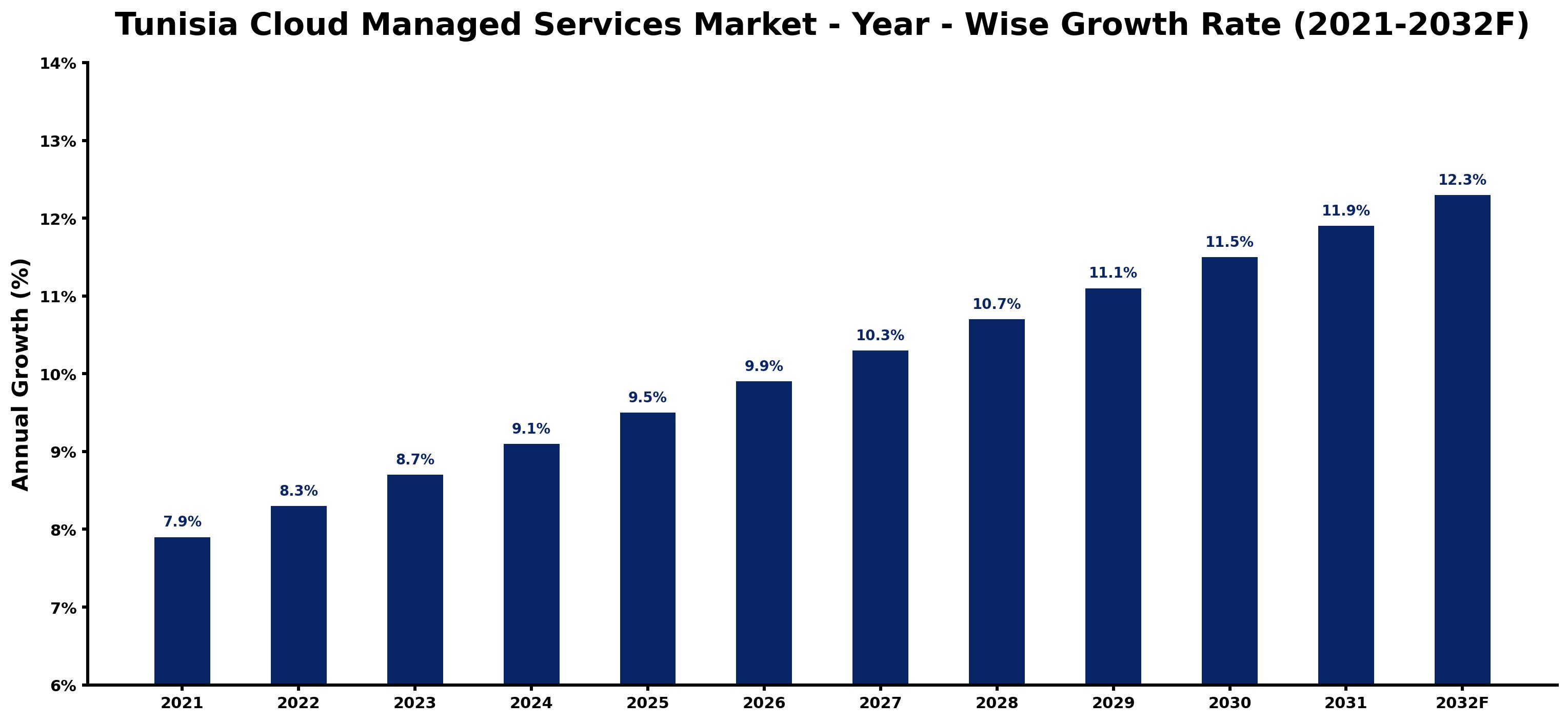
The table below presents the year‑wise growth rates along with the key drivers influencing the market
| Year | Growth Rate | Major Drivers |
| 2021 | 7.9% | Increase in smartphone penetration boosting cloud adoption. |
| 2022 | 8.3% | Emergence of local startups leveraging cloud solutions. |
| 2023 | 8.7% | Shift to e-commerce necessitating scalable IT infrastructure. |
| 2024 | 9.1% | National cybersecurity strategy promoting cloud security services. |
| 2025 | 9.5% | Increased internet connectivity enhancing remote services uptake. |
| 2026 | 9.9% | Government incentives for tech SMEs to utilize cloud. |
| 2027 | 10.3% | Rise in data privacy regulations impacting cloud storage demand. |
| 2028 | 10.7% | Growing interest in AI and big data solutions. |
| 2029 | 11.1% | Improvements in local data center facilities supporting services. |
| 2030 | 11.5% | Collaborations between universities and tech firms for cloud education. |
| 2031 | 11.9% | Growing interest in digital transformation among traditional sectors. |
| 2032 | 12.3% | Enhanced cloud solutions to support Tunisia's tourism sector rejuvenation. |
Note: Market size estimations and growth projections presented in this report are based on 6Wresearch's proprietary forecasting methodology, utilizing the latest available industry data, government publications, and primary research inputs.
Tunisia Cloud Managed Services Market Key Takeaways
Below are some of the specific key takeaways from the market, including:
- The market is projected to nearly double in size by 2032, driven by increased adoption of cloud technologies.
- Technological advancements in automation and monitoring are vital for enhancing service delivery.
- Organizations are prioritizing cost-effective solutions to manage IT complexities.
- Data privacy and security concerns remain critical factors influencing service selection.
- The government’s regulatory framework is pivotal in shaping market dynamics and ensuring compliance.
Evaluation of Restraints in Tunisia Cloud Managed Services Market
The Tunisia Cloud Managed Services Market faces notable challenges that could hinder its potential. High implementation costs often deter small to medium-sized enterprises from adopting these services. The shortage of skilled IT professionals adds another layer of complexity, limiting the ability of organizations to fully utilize cloud solutions. on top of that, concerns surrounding data privacy and security remain at the forefront, with businesses wary of entrusting sensitive information to third-party providers. A lack of consumer awareness regarding the benefits of managed cloud services further exacerbates these challenges.
Tunisia Cloud Managed Services Market Trends
Several trends are emerging that will shape the future of the Tunisia Cloud Managed Services Market. The shift towards hybrid cloud solutions is gaining traction, allowing organizations to blend on-premises and cloud-based resources effectively. Proactive monitoring and automation tools are becoming essential for optimizing IT performance, reducing downtime, and enhancing security measures. Additionally, the push for regulatory compliance is prompting businesses to seek managed services that align with industry standards.
Tunisia Cloud Managed Services Market Opportunities
There are substantial growth opportunities within the Tunisia Cloud Managed Services Market. Companies that can provide tailored solutions addressing the unique needs of various sectors will be well-positioned. The increasing emphasis on cybersecurity presents a prime opportunity for managed service providers to differentiate themselves through advanced security solutions. on top of that, as digital transformation initiatives gain momentum, the demand for scalable and flexible managed services will continue to rise, inviting further investment and innovation.
Government Initiatives in the Tunisia Cloud Managed Services Market
Government policies play a crucial role in shaping the Tunisia Cloud Managed Services Market, emphasizing the importance of cybersecurity and IT management. Regulatory frameworks are designed to ensure compliance with service level agreements (SLAs) and industry-specific regulations, which are essential for building trust among consumers. By supporting enterprise IT management through various initiatives, the government aims to bolster digital transformation and operational continuity.
- A regulatory framework introduced in 2025 mandating compliance with cybersecurity standards for cloud service providers.
- A national digital infrastructure upgrade programme currently underway, focusing on enhancing cloud connectivity across major urban centers.
- Incentives for managed service providers announced in 2024 to promote innovation and reduce operational costs.
- A planned public-private initiative expected to expand access to cloud services in rural areas by 2028.
Future Insights of the Tunisia Cloud Managed Services Market
As we look towards 2026-2032, the Tunisia Cloud Managed Services Market is set for significant evolution. Increasing digital transformation efforts will drive demand for more integrated and efficient IT management solutions. The continuous development of hybrid cloud architectures will likely reshape service offerings, allowing businesses to optimize their IT environments effectively. on top of that, the emphasis on security and compliance will remain paramount, compelling managed service providers to innovate and adapt to new challenges.
Tunisia Cloud Managed Services Market Latest Developments
Recent activity in the Tunisia Cloud Managed Services Market indicates a growing interest in cloud solutions among enterprises. Over the past year, various initiatives have been launched to enhance service offerings and improve operational efficiencies. This momentum reflects a broader commitment to leveraging technology for business growth and competitiveness.
- An initiative that began in early 2025 focusing on enhancing cloud security protocols is currently underway.
- A major technology vendor announced the rollout of a new cloud optimization tool expected to launch by mid-2026.
- A leading regional operator initiated a partnership with a cybersecurity firm in Q1 2025 to bolster managed service security.
- Expansion of data center capabilities in Tunisia is planned, with a projected completion date set for late 2026.
Tunisia Cloud Managed Services Market - Key Attractiveness of the Report
- 10 Years of Market Numbers
- Historical Data Starting from 2022 to 2025
- Base Year: 2025
- Forecast Data until 2032
- Key Performance Indicators Impacting the Market
- Major Upcoming Developments and Projects
Key Highlights of the Report:
- Tunisia Cloud Managed Services Market Outlook
- Market Size of Tunisia Cloud Managed Services Market, 2025
- Forecast of Tunisia Cloud Managed Services Market, 2032
- Historical Data and Forecast of Tunisia Cloud Managed Services Revenues & Volume for the Period 2022-2032F
- Tunisia Cloud Managed Services Market Trend Evolution
- Tunisia Cloud Managed Services Market Drivers and Challenges
- Tunisia Cloud Managed Services Price Trends
- Tunisia Cloud Managed Services Porter's Five Forces
- Tunisia Cloud Managed Services Industry Life Cycle
- Historical Data and Forecast of Tunisia Cloud Managed Services Market Revenues & Volume By Service Type for the Period 2022-2032F
- Historical Data and Forecast of Tunisia Cloud Managed Services Market Revenues & Volume By Managed Security Services for the Period 2022-2032F
- Historical Data and Forecast of Tunisia Cloud Managed Services Market Revenues & Volume By Managed Network Services for the Period 2022-2032F
- Historical Data and Forecast of Tunisia Cloud Managed Services Market Revenues & Volume By Managed Infrastructure Services for the Period 2022-2032F
- Historical Data and Forecast of Tunisia Cloud Managed Services Market Revenues & Volume By Managed Communication & Collaboration Services for the Period 2022-2032F
- Historical Data and Forecast of Tunisia Cloud Managed Services Market Revenues & Volume By Managed Mobility Services for the Period 2022-2032F
- Historical Data and Forecast of Tunisia Cloud Managed Services Market Revenues & Volume By Managed Business Services for the Period 2022-2032F
- Historical Data and Forecast of Tunisia Cloud Managed Services Market Revenues & Volume By Security Services for the Period 2022-2032F
- Historical Data and Forecast of Tunisia Cloud Managed Services Market Revenues & Volume By Managed Identity & Access Management for the Period 2022-2032F
- Historical Data and Forecast of Tunisia Cloud Managed Services Market Revenues & Volume By Managed Antivirus/Anti-Malware for the Period 2022-2032F
- Historical Data and Forecast of Tunisia Cloud Managed Services Market Revenues & Volume By Managed Firewall for the Period 2022-2032F
- Historical Data and Forecast of Tunisia Cloud Managed Services Market Revenues & Volume By Managed Risk & Compliance Management for the Period 2022-2032F
- Historical Data and Forecast of Tunisia Cloud Managed Services Market Revenues & Volume By Managed Vulnerability Management for the Period 2022-2032F
- Historical Data and Forecast of Tunisia Cloud Managed Services Market Revenues & Volume By Managed Security Information & Event Management for the Period 2022-2032F
- Historical Data and Forecast of Tunisia Cloud Managed Services Market Revenues & Volume By Managed Intrusion Detection System/Intrusion Prevention System for the Period 2022-2032F
- Historical Data and Forecast of Tunisia Cloud Managed Services Market Revenues & Volume By Managed Data Loss Prevention for the Period 2022-2032F
- Historical Data and Forecast of Tunisia Cloud Managed Services Market Revenues & Volume By Network Services for the Period 2022-2032F
- Historical Data and Forecast of Tunisia Cloud Managed Services Market Revenues & Volume By Managed Network Provisioning for the Period 2022-2032F
- Historical Data and Forecast of Tunisia Cloud Managed Services Market Revenues & Volume By Managed Network Monitoring & Management for the Period 2022-2032F
- Historical Data and Forecast of Tunisia Cloud Managed Services Market Revenues & Volume By Infrastructure Services for the Period 2022-2032F
- Historical Data and Forecast of Tunisia Cloud Managed Services Market Revenues & Volume By Storage Management for the Period 2022-2032F
- Historical Data and Forecast of Tunisia Cloud Managed Services Market Revenues & Volume By Server Management for the Period 2022-2032F
- Historical Data and Forecast of Tunisia Cloud Managed Services Market Revenues & Volume By Managed Print Services for the Period 2022-2032F
- Historical Data and Forecast of Tunisia Cloud Managed Services Market Revenues & Volume By Managed Communication & Collaboration Services for the Period 2022-2032F
- Historical Data and Forecast of Tunisia Cloud Managed Services Market Revenues & Volume By Managed Voice Over Internet Protocol for the Period 2022-2032F
- Historical Data and Forecast of Tunisia Cloud Managed Services Market Revenues & Volume By Managed Unified Communication as a Service for the Period 2022-2032F
- Historical Data and Forecast of Tunisia Cloud Managed Services Market Revenues & Volume By Managed Mobility Services for the Period 2022-2032F
- Historical Data and Forecast of Tunisia Cloud Managed Services Market Revenues & Volume By Device Management Services for the Period 2022-2032F
- Historical Data and Forecast of Tunisia Cloud Managed Services Market Revenues & Volume By Application Management Services for the Period 2022-2032F
- Historical Data and Forecast of Tunisia Cloud Managed Services Market Revenues & Volume By Managed Business Services for the Period 2022-2032F
- Historical Data and Forecast of Tunisia Cloud Managed Services Market Revenues & Volume By Business Process Services for the Period 2022-2032F
- Historical Data and Forecast of Tunisia Cloud Managed Services Market Revenues & Volume By Continuity & Disaster Recovery Services for the Period 2022-2032F
- Historical Data and Forecast of Tunisia Cloud Managed Services Market Revenues & Volume By Other Managed Business Services for the Period 2022-2032F
- Historical Data and Forecast of Tunisia Cloud Managed Services Market Revenues & Volume By Organization Size for the Period 2022-2032F
- Historical Data and Forecast of Tunisia Cloud Managed Services Market Revenues & Volume By SMEs for the Period 2022-2032F
- Historical Data and Forecast of Tunisia Cloud Managed Services Market Revenues & Volume By Large Enterprises for the Period 2022-2032F
- Tunisia Cloud Managed Services Import Export Trade Statistics
- Market Opportunity Assessment By Service Type
- Market Opportunity Assessment By Security Services
- Market Opportunity Assessment By Network Services
- Market Opportunity Assessment By Infrastructure Services
- Market Opportunity Assessment By Managed Communication & Collaboration Services
- Market Opportunity Assessment By Managed Mobility Services
- Market Opportunity Assessment By Managed Business Services
- Market Opportunity Assessment By Organization Size
- Tunisia Cloud Managed Services Top Companies Market Share
- Tunisia Cloud Managed Services Competitive Benchmarking By Technical and Operational Parameters
- Tunisia Cloud Managed Services Company Profiles
- Tunisia Cloud Managed Services Key Strategic Recommendations






































