Tunisia Publishing Market Summary
The tunisia publishing market was estimated at USD 378 Million in 2025 and is projected to reach USD 502 Million by 2032, growing at a CAGR of 4.7% from 2026 to 2032.
Tunisia Publishing Market Year-wise Growth Rate and Key Drivers
This graph highlights how the Tunisia Publishing Market has steadily grown over the past five years, supported by major growth factors.
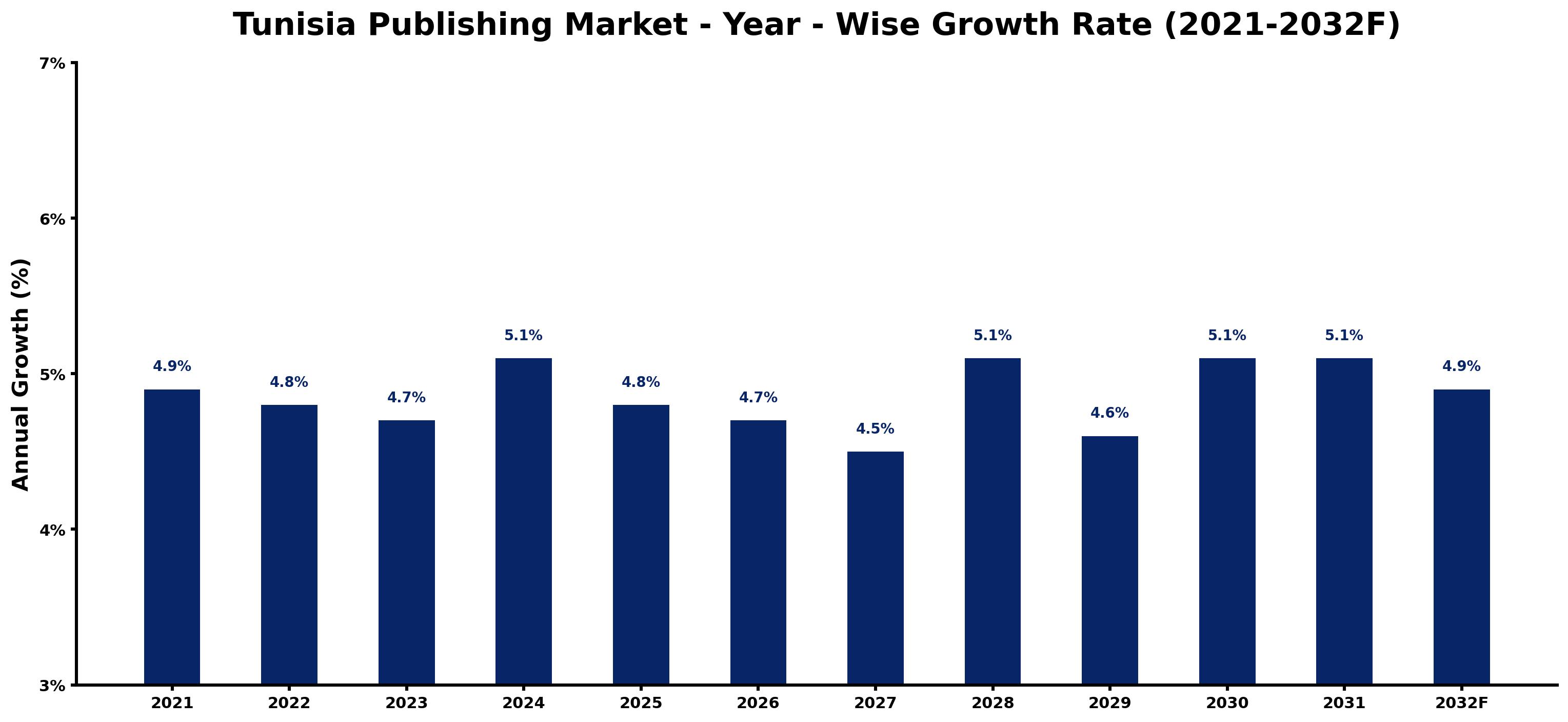
The table below presents the year wise growth rates along with the key drivers influencing the market
| Year | Growth Rate | Major Drivers |
| 2021 | 4.9% | Digital transformation initiatives sparked a shift toward e-books and online platforms. |
| 2022 | 4.8% | Local authors gained prominence, attracting attention from niche audiences and readers. |
| 2023 | 4.7% | Adoption of mobile reading apps broadened access to literature among youth demographics. |
| 2024 | 5.1% | Collaboration between schools and publishers expanded educational content availability significantly. |
| 2025 | 4.8% | Increased interest in regional literature highlighted Tunisia's rich cultural heritage and stories. |
| 2026 | 4.7% | International partnerships emerged, enhancing distribution networks for Tunisian publications abroad. |
| 2027 | 4.5% | Enhanced logistics and shipping options improved delivery times for both local and international markets. |
| 2028 | 5.1% | Social media campaigns connected authors directly with readers, fostering community and engagement. |
| 2029 | 4.6% | Local book fairs and events increased visibility for emerging authors and new titles. |
| 2030 | 5.1% | Multilingual publishing became essential, catering to diverse linguistic communities across Tunisia. |
| 2031 | 5.1% | Focus on sustainability prompted publishers to explore eco-friendly materials and practices. |
| 2032 | 4.9% | Integration of AI in publishing streamlined processes and personalized reader recommendations effectively. |
Note - Market size estimations and growth projections presented in this report are based on 6Wresearch's advanced forecasting approach, validated with industry datasets as of June 2026.
Tunisia Publishing Market Synopsis
The Tunisia Publishing Market is projected to reach 4.7% and witness significant growth during the forecast period (2026-2032). This growth is primarily fueled by the digital transformation of the publishing landscape, as well as increasing literacy rates and changing consumer preferences. The market comprises various segments including books, newspapers, and magazines, with a notable shift toward digital content such as e-books and online media platforms.
Tunisia Publishing Market Growth Drivers
Several key drivers are shaping the Tunisia Publishing Market as it evolves. Firstly, the persistent rise in literacy rates across the nation facilitates a broader audience for both educational and recreational reading materials. The government's commitment to enhancing educational standards is leading to an increased demand for textbooks and scholarly publications.
- The digital transition is crucial, with a growing uptake of e-books and digital platforms, catering to the tech-savvy population.
- The local cultural emphasis on literature and the arts fosters a robust environment for diverse publishing ventures.
- Improved internet penetration enables wider access to online reading materials, expanding market reach significantly.
- The increasing popularity of online news platforms reflects changing reader preferences, pushing traditional publications to adapt.
- Collaborations among educational institutions and publishers are driving the development of customized educational content to meet curriculum needs.
Tunisia Publishing Market Challenges and Restraints
Despite the promising growth landscape, the Tunisia Publishing Market faces several challenges that could hinder its progress. One of the main issues is the declining readership of traditional print media, exacerbated by the fierce competition posed by digital alternatives.
- The high costs associated with printing and distribution create financial pressures on publishers and limit their operational scope.
- Intellectual property concerns, including piracy, pose a significant threat to the revenue streams of publishers.
- Limited funding and support for local authors restrict the variety and quality of content that can be produced.
- Market fragmentation leads to difficulties in achieving economies of scale, affecting the overall profitability of publishing houses.
- Changing consumer preferences require constant adaptation, with publishers needing to innovate to remain competitive.
Tunisia Publishing Market Government Investment and Initiatives
Government initiatives play a vital role in the development of the Tunisia Publishing Market. Policies aimed at promoting literacy and cultural dissemination include subsidies for local publishing houses and reduced taxes on book sales to encourage reading.
- The Tunisian government actively supports the digitization of content, making it easier for publishers to transition to digital platforms.
- Public funding initiatives are aimed at promoting local authors and their works, ensuring a diverse publishing ecosystem.
- Education reforms and literacy programs are part of broader government strategies to enhance access to knowledge.
- Regulatory measures are being introduced to protect intellectual property rights, fostering a safer environment for publishers.
- Collaboration between government entities and educational institutions helps align publishing outputs with national educational goals.
Tunisia Publishing Market Latest Developments (May 2025 - June 2026)
In recent months, the Tunisia Publishing Market has witnessed notable shifts that signal its adaptive nature. Emerging trends indicate a marked increase in e-book consumption as technological advancements continue to shape reading habits.
- Publishers are investing in digital marketing strategies to engage a younger, more tech-oriented audience.
- Grassroots movements focusing on local literature have gained momentum, highlighting the importance of cultural representation in publishing.
- Partnerships between technology firms and publishing houses are facilitating innovative content delivery methods.
- There is a concerted effort to enhance distribution channels for both print and digital formats, improving access for consumers.
- Ongoing discussions regarding regulatory reforms aim to further protect the rights of authors and publishers alike.
Tunisia Publishing Market - Key Attractiveness of the Report
- 10 Years of Market Numbers
- Historical Data Starting from 2022 to 2025
- Base Year: 2025
- Forecast Data until 2032
- Key Performance Indicators Impacting the Market
- Major Upcoming Developments and Projects
Key Highlights of the Report:
- Tunisia Publishing Market Outlook
- Market Size of Tunisia Publishing Market, 2025
- Forecast of Tunisia Publishing Market, 2032
- Historical Data and Forecast of Tunisia Publishing Revenues & Volume for the Period 2022-2032F
- Tunisia Publishing Market Trend Evolution
- Tunisia Publishing Market Drivers and Challenges
- Tunisia Publishing Price Trends
- Tunisia Publishing Porter's Five Forces
- Tunisia Publishing Industry Life Cycle
- Historical Data and Forecast of Tunisia Publishing Market Revenues & Volume By Types for the Period 2022-2032F
- Historical Data and Forecast of Tunisia Publishing Market Revenues & Volume By Newspaper for the Period 2022-2032F
- Historical Data and Forecast of Tunisia Publishing Market Revenues & Volume By Journals for the Period 2022-2032F
- Historical Data and Forecast of Tunisia Publishing Market Revenues & Volume By Catalogues for the Period 2022-2032F
- Historical Data and Forecast of Tunisia Publishing Market Revenues & Volume By Magazine for the Period 2022-2032F
- Historical Data and Forecast of Tunisia Publishing Market Revenues & Volume By Books for the Period 2022-2032F
- Historical Data and Forecast of Tunisia Publishing Market Revenues & Volume By E-Books for the Period 2022-2032F
- Historical Data and Forecast of Tunisia Publishing Market Revenues & Volume By Platform for the Period 2022-2032F
- Historical Data and Forecast of Tunisia Publishing Market Revenues & Volume By Digital? for the Period 2022-2032F
- Historical Data and Forecast of Tunisia Publishing Market Revenues & Volume By Paper for the Period 2022-2032F
- Tunisia Publishing Import Export Trade Statistics
- Market Opportunity Assessment By Types
- Market Opportunity Assessment By Platform
- Tunisia Publishing Top Companies Market Share
- Tunisia Publishing Competitive Benchmarking By Technical and Operational Parameters
- Tunisia Publishing Company Profiles
- Tunisia Publishing Key Strategic Recommendations






































