Tunisia Retail And Wholesale Market Size, Share & Growth Rate
The Tunisia Retail And Wholesale Market was estimated at USD 571 Million in 2025 and is projected to reach USD 1006 Million by 2032, growing at a CAGR of 8.4% from 2026 to 2032. This growth trajectory is primarily fueled by increasing consumer purchasing power and urbanization, along with a rapidly expanding middle class. The rising trend toward e-commerce and digital shopping also plays a pivotal role in reshaping how consumers engage with retail and wholesale offerings in the country.
Tunisia Retail And Wholesale Market Year-wise Growth Rate and Key Drivers
This graph highlights how the Tunisia Retail And Wholesale Market has steadily grown over the years, supported by major growth factors.
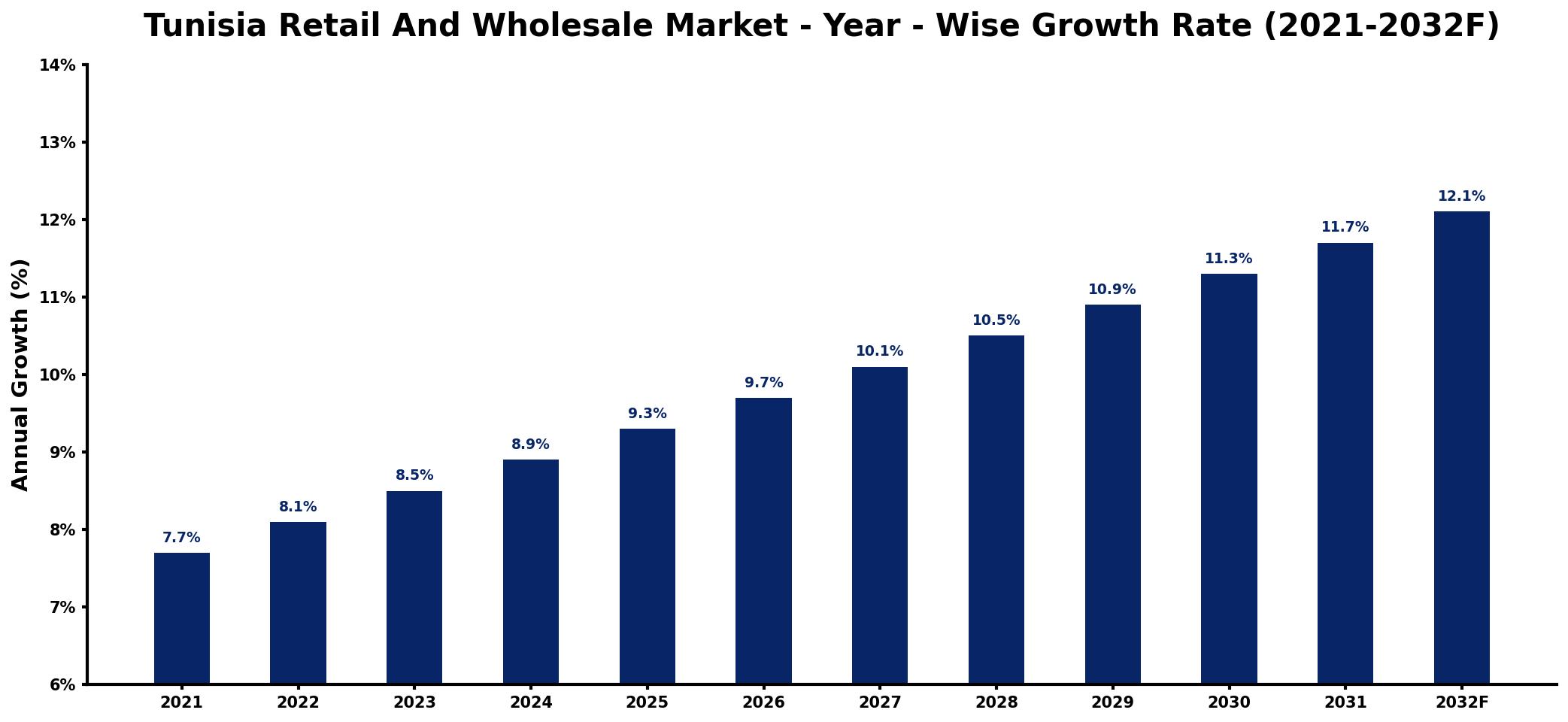
The table below presents the year‑wise growth rates along with the key drivers influencing the market
| Year | Growth Rate | Major Drivers |
| 2021 | 7.7% | Increased consumer spending patterns |
| 2022 | 8.1% | Expansion of e-commerce platforms |
| 2023 | 8.5% | Growth in tourism activities |
| 2024 | 8.9% | Rising urban population demands |
| 2025 | 9.3% | Investment in logistics infrastructure |
| 2026 | 9.7% | Emergence of local brands |
| 2027 | 10.1% | Higher disposable income levels |
| 2028 | 10.5% | Diverse product offerings increase |
| 2029 | 10.9% | Strengthened supply chain networks |
| 2030 | 11.3% | Innovative marketing strategies adopted |
| 2031 | 11.7% | Technological advancements in distribution |
| 2032 | 12.1% | Increased foreign direct investments |
Note: Market size estimations and growth projections presented in this report are based on 6Wresearch's proprietary forecasting methodology, utilizing the latest available industry data, government publications, and primary research inputs.
Tunisia Retail And Wholesale Market Synopsis
In Tunisia, traditional markets coexist with modern shopping centers and a burgeoning online retail scene. This unique blend caters to a diverse consumer base, reflecting both the cultural heritage and contemporary demands for convenience. Notably, the food and beverages sector remains a strong driver, with consumers increasingly leaning towards local products as well as international brands.
The recent economic reforms and government initiatives aimed at enhancing infrastructure further amplify the market's growth potential. However, underlying challenges such as high unemployment rates and economic fluctuations continue to influence consumer behavior and spending patterns, necessitating a nuanced understanding of the evolving market landscape.
Tunisia Retail And Wholesale Market Key Takeaways
- The market is witnessing a surge in e-commerce, driven by increased online shopping adoption.
- A growing middle-class demographic is raising the demand for diverse and quality products.
- Government initiatives are focused on improving infrastructure and supporting local enterprises.
- Consumer preferences are increasingly leaning towards sustainability and ethical sourcing.
- Investment opportunities abound in food, electronics, fashion, and digital retail channels.
Evaluation of Restraints in Tunisia Retail And Wholesale Market
Despite the promising growth outlook, the Tunisia retail and wholesale market grapples with several restraints that impede its full potential. Economic instability remains a significant concern, as it creates an unpredictable environment for consumer spending and business investment. Political uncertainties also contribute to this volatility, affecting both strategic planning and operational execution within the sector. Additionally, the relatively limited consumer base in Tunisia poses a challenge, restricting the scalability of various retail initiatives.
Tunisia Retail And Wholesale Market Trends
The retail landscape in Tunisia is rapidly evolving, with a marked shift towards digitalization. E-commerce is not merely a trend but a necessary adaptation as consumers demand convenience and varied product offerings. Omnichannel retailing is gaining traction as businesses strive to create a cohesive shopping experience across online and offline platforms. Furthermore, sustainability has emerged as a significant factor, with consumers actively seeking eco-friendly products and brands that demonstrate social responsibility.
Tunisia Retail And Wholesale Market Opportunities
The Tunisia retail and wholesale market is ripe with investment opportunities across various sectors. With a significant middle-class segment willing to spend on quality goods, businesses can tap into the growing demand for both local and international products. E-commerce platforms are increasingly attractive due to their potential to reach a wider audience. Additionally, there are opportunities to cater to small businesses in the wholesale sector by providing tailored solutions and support, ensuring both parties benefit from this evolving marketplace.
Government Initiatives in the Tunisia Retail And Wholesale Market
The Tunisian government has implemented a variety of policies aimed at bolstering the retail and wholesale market. These include trade agreements that promote local products, financial support for small and medium-sized enterprises, and initiatives to combat counterfeiting. Additionally, there is a concerted effort to enhance infrastructure and logistics to ensure efficiency in supply chain operations, thereby enabling retailers and wholesalers to serve their customers better.
Future Insights of the Tunisia Retail And Wholesale Market
Looking ahead to 2026-2032, the Tunisia retail and wholesale market is set for sustained growth. As economic conditions improve and consumer confidence rises, the demand for a broader range of products will likely increase. Urbanization will continue to transform shopping habits, making e-commerce an integral part of the consumer experience. However, businesses must remain agile, adapting to regulatory changes and infrastructure challenges to fully capitalize on the markets potential.
Tunisia Retail And Wholesale Market Latest Developments (2025 - 2026)
Recent developments in the Tunisia retail and wholesale market highlight a significant shift towards digital platforms, with many retailers expanding their online presence to cater to changing consumer preferences. There is also an increase in collaborations between local producers and international brands, aiming to boost product offerings. Furthermore, businesses are focusing on improving supply chain efficiencies to enhance customer service and reduce costs in this competitive environment.
Tunisia Retail And Wholesale Market - Key Attractiveness of the Report
- 10 Years of Market Numbers
- Historical Data Starting from 2022 to 2025
- Base Year: 2025
- Forecast Data until 2032
- Key Performance Indicators Impacting the Market
- Major Upcoming Developments and Projects
Key Highlights of the Report:
- Tunisia Retail And Wholesale Market Outlook
- Market Size of Tunisia Retail And Wholesale Market, 2025
- Forecast of Tunisia Retail And Wholesale Market, 2032
- Historical Data and Forecast of Tunisia Retail And Wholesale Revenues & Volume for the Period 2022-2032F
- Tunisia Retail And Wholesale Market Trend Evolution
- Tunisia Retail And Wholesale Market Drivers and Challenges
- Tunisia Retail And Wholesale Price Trends
- Tunisia Retail And Wholesale Porter's Five Forces
- Tunisia Retail And Wholesale Industry Life Cycle
- Historical Data and Forecast of Tunisia Retail And Wholesale Market Revenues & Volume By Type for the Period 2022-2032F
- Historical Data and Forecast of Tunisia Retail And Wholesale Market Revenues & Volume By Retail for the Period 2022-2032F
- Historical Data and Forecast of Tunisia Retail And Wholesale Market Revenues & Volume By Wholesale for the Period 2022-2032F
- Historical Data and Forecast of Tunisia Retail And Wholesale Market Revenues & Volume By Ownership for the Period 2022-2032F
- Historical Data and Forecast of Tunisia Retail And Wholesale Market Revenues & Volume By Retail Chain/Wholesale Chain for the Period 2022-2032F
- Historical Data and Forecast of Tunisia Retail And Wholesale Market Revenues & Volume By Independent Retailer/Independent Wholesalers for the Period 2022-2032F
- Historical Data and Forecast of Tunisia Retail And Wholesale Market Revenues & Volume By Price Range for the Period 2022-2032F
- Historical Data and Forecast of Tunisia Retail And Wholesale Market Revenues & Volume By Premium for the Period 2022-2032F
- Historical Data and Forecast of Tunisia Retail And Wholesale Market Revenues & Volume By Mid-Range for the Period 2022-2032F
- Historical Data and Forecast of Tunisia Retail And Wholesale Market Revenues & Volume By Economy for the Period 2022-2032F
- Historical Data and Forecast of Tunisia Retail And Wholesale Market Revenues & Volume By Distribution Channel for the Period 2022-2032F
- Historical Data and Forecast of Tunisia Retail And Wholesale Market Revenues & Volume By Supermarkets/Hypermarkets for the Period 2022-2032F
- Historical Data and Forecast of Tunisia Retail And Wholesale Market Revenues & Volume By Convenience Stores for the Period 2022-2032F
- Historical Data and Forecast of Tunisia Retail And Wholesale Market Revenues & Volume By Department Stores for the Period 2022-2032F
- Historical Data and Forecast of Tunisia Retail And Wholesale Market Revenues & Volume By Specialty Stores for the Period 2022-2032F
- Tunisia Retail And Wholesale Import Export Trade Statistics
- Market Opportunity Assessment By Type
- Market Opportunity Assessment By Ownership
- Market Opportunity Assessment By Price Range
- Market Opportunity Assessment By Distribution Channel
- Tunisia Retail And Wholesale Top Companies Market Share
- Tunisia Retail And Wholesale Competitive Benchmarking By Technical and Operational Parameters
- Tunisia Retail And Wholesale Company Profiles
- Tunisia Retail And Wholesale Key Strategic Recommendations






































