Tunisia Window Covering Market Size, Share & Growth Rate
The Tunisia Window Covering Market was estimated at USD 410 Million in 2025 and is projected to reach USD 582 Million by 2032, growing at a CAGR of 5.1% from 2026 to 2032. This growth is primarily fueled by a surge in urbanization, as more individuals migrate to urban centers seeking modern living environments. Additionally, an increasing number of renovation projects and the rising disposable income of consumers further stimulate demand for sophisticated window covering solutions, including custom blinds, shades, and curtains.
Tunisia Window Covering Market Growth Rate Analysis (2021-2032)
The Tunisia window covering market has shown a stable growth pattern, starting with a 6.1% increase in 2021 and maintaining a similar pace through 2022 and 2023, both at 6.3%. This growth can be attributed to rising consumer demand for energy-efficient solutions and an expanding middle class investing in home aesthetics. However, growth is expected to gradually stabilize, dipping to 5.8% by 2025 as inflation and material costs create downward pressure. The market rebounds slightly to 6.0% in 2030, supported by advancements in digitalization and smart technologies in window covering solutions. Overall, while fluctuations occur, the sector remains attractive for investments and innovation.
Tunisia Window Covering Market Year-wise Growth Rate and Key Drivers
This graph highlights how the Tunisia Window Covering Market has steadily grown over the past five years, supported by major growth factors.
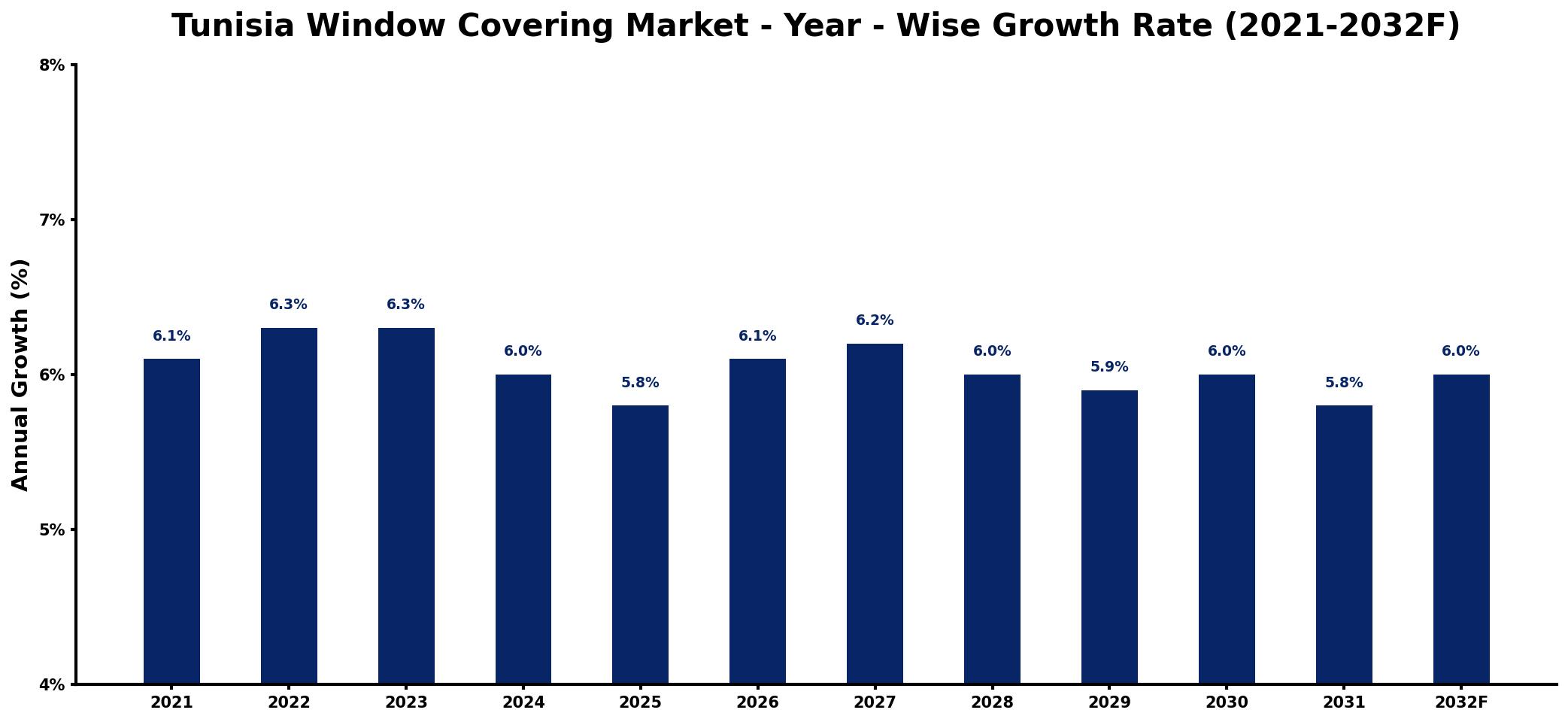
The table below presents the year‑wise growth rates along with the key drivers influencing the market
| Year | Growth Rate | Major Drivers |
| 2021 | 6.1% | Increased residential construction activity |
| 2022 | 6.3% | Rising demand for energy efficiency |
| 2023 | 6.3% | Growth in home renovation projects |
| 2024 | 6.0% | Expansion of interior design trends |
| 2025 | 5.8% | Surge in online retail investments |
| 2026 | 6.1% | Growing awareness of aesthetics |
| 2027 | 6.2% | Increase in disposable income levels |
| 2028 | 6.0% | Diversification of product offerings |
| 2029 | 5.9% | Strengthening real estate market |
| 2030 | 6.0% | Technological advancements in materials |
| 2031 | 5.8% | Boost in sustainable living initiatives |
| 2032 | 6.0% | Rising interest in smart homes |
Note: Market size estimations and growth projections presented in this report are based on 6Wresearch's proprietary forecasting methodology, utilizing the latest available industry data, government publications, and primary research inputs.
Tunisia Window Covering Market Synopsis
The Tunisia window covering market has recently experienced significant momentum driven by aesthetic trends and a shift towards energy-efficient solutions. However, as the market matures, it faces challenges related to regional disparities in consumer preferences and purchasing power, which could shape its trajectory going forward.
Looking ahead, the market is likely to capitalize on technological advancements in materials and design, as well as a growing emphasis on sustainable building practices. This evolving landscape presents both opportunities and hurdles that stakeholders must navigate to remain competitive.
Tunisia Window Covering Market Key Takeaways
- The market reflects increasing consumer demand for stylish and customizable window solutions.
- Urbanization and rising disposable incomes are key drivers enhancing market opportunities.
- There is a notable shift toward energy-efficient window coverings amid rising environmental awareness.
- Raw material fluctuations and regulatory compliance represent significant operational challenges.
- Government policies are steering focus towards eco-friendly materials and sustainable building practices.
Evaluation of Restraints in Tunisia Window Covering Market
The Tunisia window covering market encounters several restraints that may impede its growth trajectory. One of the most pressing challenges is the variability in consumer preferences across different regions, which complicates product development and marketing strategies. Manufacturers must stay attuned to these diverse demands while managing production costs effectively, particularly given the fluctuations in raw material prices. Compliance with local regulations also necessitates an investment in quality assurance, adding another layer of complexity to an already competitive market environment.
Tunisia Window Covering Market Trends
Emerging trends in the Tunisia window covering market include a growing inclination toward smart and automated window treatment solutions. As technology continues to advance, consumers are increasingly interested in integrated systems that offer convenience and energy efficiency. Furthermore, sustainable design practices are influencing material selection, prompting manufacturers to explore innovative eco-friendly fabrics and manufacturing processes. These trends are likely to shape product offerings and consumer choices in the coming years.
Tunisia Window Covering Market Opportunities
The window covering market in Tunisia is rife with opportunities, particularly for businesses focusing on customizable solutions that cater to specific consumer tastes. The expansion of the commercial sector also presents avenues for growth, as businesses seek to enhance their interiors with stylish window treatments. Additionally, the increasing awareness of energy efficiency offers potential for products designed with sustainability in mind, making them appealing to environmentally conscious consumers.
Government Initiatives in the Tunisia Window Covering Market
Government initiatives play a crucial role in shaping the Tunisia window covering market, particularly through regulations that promote energy efficiency and the use of sustainable materials. Policies encouraging the adoption of eco-friendly building practices have prompted manufacturers to align their offerings with these standards. Public spending on urban development projects is also influencing market dynamics by driving demand for quality window coverings in both residential and commercial spaces.
Future Insights of the Tunisia Window Covering Market
From 2026 to 2032, the Tunisia window covering market is expected to continue its upward trajectory. The anticipated growth is supported by ongoing urbanization trends and the rising standards of living among consumers. As businesses and homeowners alike prioritize aesthetics and functionality in their choices, companies that innovate in design and sustainability will likely gain a competitive edge. The integration of smart technology into window coverings is poised to redefine consumer experiences, making this sector an exciting area to watch.
Tunisia Window Covering Market Latest Developments (2025 - 2026)
In the first half of 2026, the Tunisia window covering market has seen a shift towards more innovative product designs that incorporate smart technology. Retailers are increasingly showcasing products that not only offer aesthetic appeal but also promote energy efficiency. Consumer interest in sustainable materials has spurred manufacturers to invest in eco-friendly solutions, reflecting broader global trends. Additionally, strategic partnerships between suppliers and manufacturers are emerging to enhance product offerings and meet rising consumer expectations.
Tunisia Window Covering Market - Key Attractiveness of the Report
- 10 Years of Market Numbers
- Historical Data Starting from 2022 to 2025
- Base Year: 2025
- Forecast Data until 2032
- Key Performance Indicators Impacting the Market
- Major Upcoming Developments and Projects
Key Highlights of the Report:
- Tunisia Window Covering Market Outlook
- Market Size of Tunisia Window Covering Market, 2025
- Forecast of Tunisia Window Covering Market, 2032
- Historical Data and Forecast of Tunisia Window Covering Revenues & Volume for the Period 2022-2032F
- Tunisia Window Covering Market Trend Evolution
- Tunisia Window Covering Market Drivers and Challenges
- Tunisia Window Covering Price Trends
- Tunisia Window Covering Porter's Five Forces
- Tunisia Window Covering Industry Life Cycle
- Historical Data and Forecast of Tunisia Window Covering Market Revenues & Volume By Type for the Period 2022-2032F
- Historical Data and Forecast of Tunisia Window Covering Market Revenues & Volume By Blinds & Shades for the Period 2022-2032F
- Historical Data and Forecast of Tunisia Window Covering Market Revenues & Volume By Curtains for the Period 2022-2032F
- Historical Data and Forecast of Tunisia Window Covering Market Revenues & Volume By Shutters for the Period 2022-2032F
- Historical Data and Forecast of Tunisia Window Covering Market Revenues & Volume By Others for the Period 2022-2032F
- Historical Data and Forecast of Tunisia Window Covering Market Revenues & Volume By Application for the Period 2022-2032F
- Historical Data and Forecast of Tunisia Window Covering Market Revenues & Volume By Residential for the Period 2022-2032F
- Historical Data and Forecast of Tunisia Window Covering Market Revenues & Volume By Commercial for the Period 2022-2032F
- Historical Data and Forecast of Tunisia Window Covering Market Revenues & Volume By Distribution Channel for the Period 2022-2032F
- Historical Data and Forecast of Tunisia Window Covering Market Revenues & Volume By Online for the Period 2022-2032F
- Historical Data and Forecast of Tunisia Window Covering Market Revenues & Volume By Offline for the Period 2022-2032F
- Historical Data and Forecast of Tunisia Window Covering Market Revenues & Volume By Supermarkets/Hypermarkets for the Period 2022-2032F
- Historical Data and Forecast of Tunisia Window Covering Market Revenues & Volume By Specialty Stores for the Period 2022-2032F
- Historical Data and Forecast of Tunisia Window Covering Market Revenues & Volume By Multi Brand Stores for the Period 2022-2032F
- Tunisia Window Covering Import Export Trade Statistics
- Market Opportunity Assessment By Type
- Market Opportunity Assessment By Application
- Market Opportunity Assessment By Distribution Channel
- Tunisia Window Covering Top Companies Market Share
- Tunisia Window Covering Competitive Benchmarking By Technical and Operational Parameters
- Tunisia Window Covering Company Profiles
- Tunisia Window Covering Key Strategic Recommendations






































