Fitness Equipment Market: Turkiye vs Top 5 Major Economies in 2027 (Europe)
By 2027, the Fitness Equipment market in Turkiye is anticipated to reach a growth rate of 8.77%, as part of an increasingly competitive Europe region, where Germany remains at the forefront, supported by United Kingdom, France, Italy and Russia, driving innovations and market adoption across sectors.
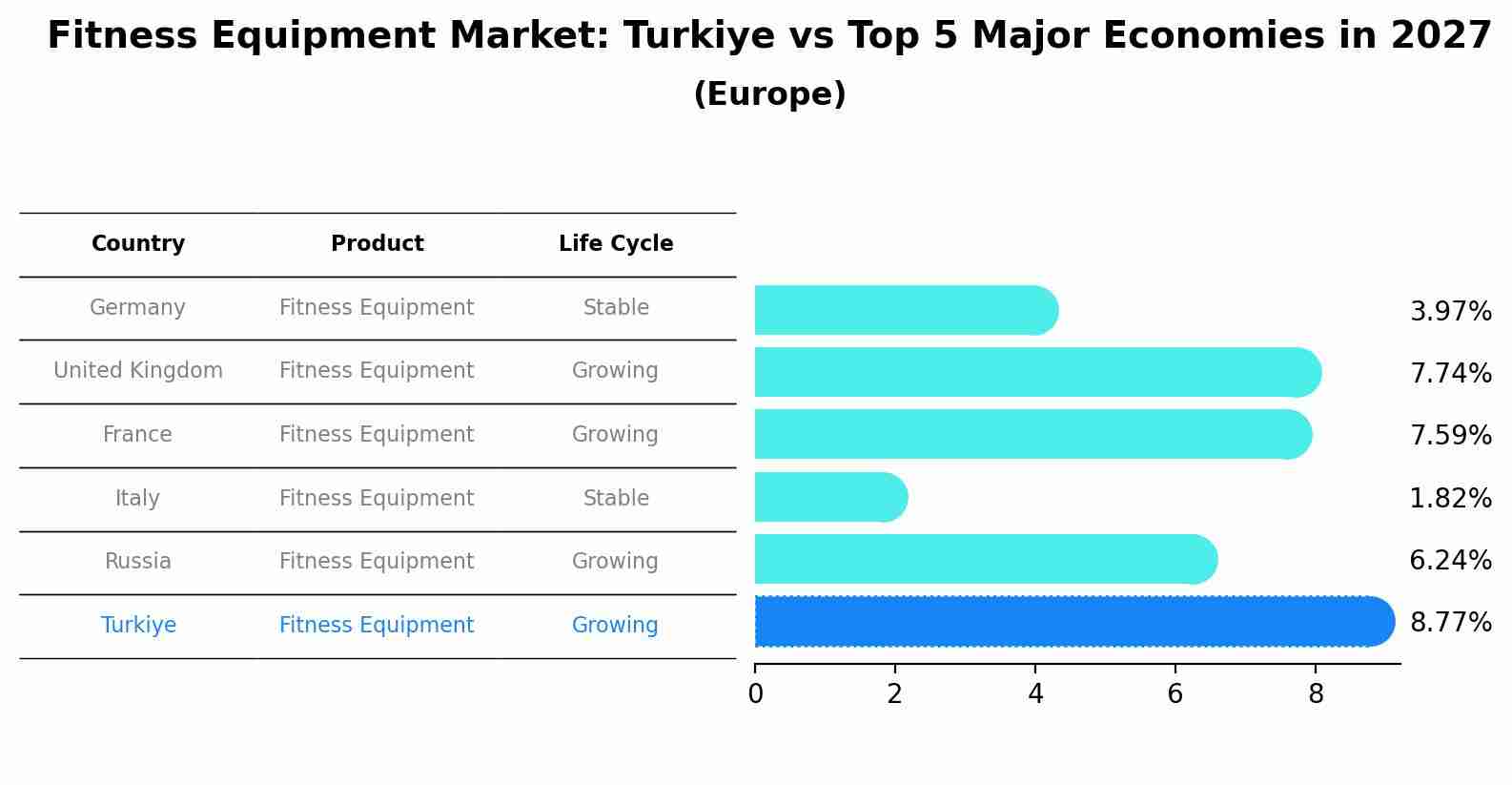
Turkey Fitness Equipment Market Growth Rate
According to 6Wresearch internal database and industry insights, the Turkey Fitness Equipment Market is growing at a compound annual growth rate (CAGR) of 6.40% during the forecast period (2026-2032).
Topics Covered in the Turkey Fitness Equipment Market Report
Turkey Fitness Equipment Market report thoroughly covers the market by type and end-users. The market report provides an unbiased and detailed analysis of ongoing market trends, opportunities/high growth areas, and market drivers, which would help stakeholders devise and align their market strategies according to the current and future market dynamics.
Turkey Fitness Equipment Market Highlights
| Report Name | Turkey Fitness Equipment Market |
| Forecast Period | 2026-2032 |
| CAGR | 6.40% |
| Growing Sector | Home Consumer |
Turkey Fitness Equipment Market Synopsis
The Turkey Fitness Equipment Market is expected to witness a steady growth driven by increasing health awareness and growth of fitness culture across the country. The rising disposable income and changing lifestyles are encouraging individuals to invest in fitness equipment for both home and commercial use. The expansion of gyms, health clubs, and wellness centers is also contributing to the demand for advanced fitness equipment. Moreover, the growing popularity of home workouts and digital fitness platforms is further expanding market’s growth in Turkey.
Evaluation of Growth Drivers in the Turkey Fitness Equipment Market
Below mentioned some growth drivers and their impact on market dynamics:
| Drivers | Primary Segments Affected | Why It Matters |
| Rising Health Awareness | Type (All Segments) | Encourages more individuals to invest in fitness equipment for regular exercise. |
| Growth of Fitness Centers | End-users (Health club/gym) | Increases demand for commercial-grade equipment in gyms and fitness facilities. |
| Home Workout Trends | End-users (Home consumer) | Fuels demand for compact and convenient fitness equipment to use at home. |
| Technological Integration | Type (Cardio Equipment) | Enhances functionality and user’s engagement through smart features. |
| Government Health Campaigns | End-users (All Segments) | Promotes fitness awareness, supporting higher adoption across segments. |
The Turkey Fitness Equipment Market is projected to grow significantly, with a CAGR of 6.40% during the forecast period of 2026-2032. The market is growing owing to increased participation in fitness activities and the increasing demand for both home and commercial fitness equipment. Government programs aiming at promotion of healthy lifestyles and physical activities are further supporting market’s growth. Along with that, the technological innovations such as smart fitness equipment and connected devices are improving user engagement, thereby contributing to market’s expansion.
Evaluation of Restraints in the Turkey Fitness Equipment Market
Below mentioned are some major restraints and their influence on market dynamics:
| Restraints | Primary Segments Affected | What This Means |
| High Equipment Costs | All Segments | Limits affordability and reduces adoption among price-sensitive consumers. |
| Limited Space in Urban Areas | Home Consumer | Restricts use of large equipment and limits demand for bulky fitness machines. |
| Economic Fluctuations | All Segments | Impacts consumer spending and delays purchasing decisions. |
| Maintenance Costs | Type (All Segments) | Increase in long term ownership costs which affects repeat purchases. |
| Competition from Low-cost Imports | Type & End-users | Creates pricing pressure and reduces margins for local manufacturers. |
Turkey Fitness Equipment Market Challenges
In the Turkey Fitness Equipment Market, high equipment costs can lower adoption among price-sensitive consumers. Besides, limited living space in urban areas restricts the usage of large fitness equipment at home. Apart from this, economic changes affect the purchasing power of consumers, which also influences the demand for high-end fitness products. Maintenance and servicing costs can discourage long-term usage. Also, competition from low-cost imported equipment is a challenge for domestic manufacturers.
Turkey Fitness Equipment Market Trends
Some major trends contributing to the Turkey Fitness Equipment Market Growth are:
- Smart Fitness Equipment Adoption: The increasing use of connected devices and smart fitness equipment improves user’s engagement and performance tracking, while enabling real-time monitoring and personalized fitness insights.
- Personalized Fitness Programs: Combination of digital platforms offering customized workout plans is expanding equipment usage, which helps users achieve their targeted fitness goals more efficiently.
- Growth of Home Fitness Solutions: Rise of preferred options for home workouts is fueling the demand for compact and multifunctional fitness equipment, as consumers look for convenience and flexibility in their fitness routines.
Investment Opportunities in the Turkey Fitness Equipment Market
Here are some investment opportunities in the Turkey Fitness Equipment Industry:
- Smart Equipment Development: Funding in technologically advanced fitness equipment provides a steady growth potential owing to increasing digital combination, enabling features like real-time tracking and improved user’s experience.
- Home Fitness Solutions: Developing a compact and affordable home fitness equipment caters to expand residential demand, as consumers prioritize convenience and space-efficient workout options.
- Expansion of Gym Chains: By investing in commercial fitness centers and health clubs ensures consistent demand for fitness equipment, while also supporting the growth of organized fitness infrastructure.
Top 5 Leading Players in the Turkey Fitness Equipment Market
Here are some top companies contributing to Turkey Fitness Equipment Market Share:
1. Technogym S.p.A.
| Company Name | Technogym S.p.A. |
| Headquarters | Italy |
| Established | 1983 |
| Website | Click here |
Technogym is a leading global provider of fitness equipment, offering advanced cardio and strength training solutions. The company focuses on innovation and digital integration to enhance user experience.
2. Johnson Health Tech
| Company Name | Johnson Health Tech |
| Headquarters | Taiwan |
| Established | 1975 |
| Website | Click here |
Johnson Health Tech manufactures a wide range of fitness equipment for home and commercial use. The company emphasizes quality, durability, and advanced technology in its products.
3. Life Fitness
| Company Name | Life Fitness |
| Headquarters | USA |
| Established | 1968 |
| Website | Click here |
Life Fitness provides a comprehensive range of fitness equipment, including cardio and strength training machines. The company is known for its focus on performance and innovation.
4. Precor Incorporated
| Company Name | Precor Incorporated |
| Headquarters | USA |
| Established | 1980 |
| Website | Click here |
Precor specializes in high-quality fitness equipment designed for both commercial and residential use. The company focuses on ergonomic design and user-friendly features.
5. Matrix Fitness
| Company Name | Matrix Fitness |
| Headquarters | USA |
| Established | 2001 |
| Website | Click here |
Matrix Fitness offers premium fitness equipment with advanced features and durable designs. The company targets both commercial gyms and home users with its diverse product portfolio.
Government Regulations Introduced in the Turkey Fitness Equipment Market
According to Turkish government data, the development of the Turkey Fitness Equipment Market is influenced by initiatives promoting public health and wellness. Programs such as the "Healthy Living Program" and investments in public sports infrastructure contribute to the physical activity of citizens. Moreover, the regulations ensuring product safety and quality standards for fitness equipment helps to maintain reliability and consumer trust. These measures support market's growth while promoting healthier lifestyles.
Future Insights of the Turkey Fitness Equipment Market
The outcome for the Turkey Fitness Equipment Market appears to be positive, supported by rising health awareness and expanding fitness infrastructure. The increasing demand for home fitness solutions and the growth of commercial fitness centers will continue to fuel market's expansion. Technological advancements in smart fitness equipment and digital fitness platforms are predicted to further improve market growth. Furthermore, the government programs promoting active lifestyles and wellness will create new opportunities for industry players.
Market Segmentation Analysis
The report offers a comprehensive study of the subsequent market segments and their leading categories.
Cardiovascular Training Equipment to Dominate the Market - By Type
According to Kanak Phartiyal, Senior Research Analyst at 6Wresearch, cardiovascular training equipment dominates the Turkey Fitness Equipment Market owing to its widespread use for enhancing heart health and overall fitness. Equipment such as treadmills, stationary bikes, and ellipticals are highly popular among both home users and commercial gyms. The demand for the machines in Turkey is driven by the growing focus on weight management and cardiovascular health.
Health Club/Gym to Dominate the Market – By End-users
The health club/gym segment is the fastest growing in Turkey owing to the rapid expansion of fitness centers and growing membership rates. Commercial gyms invest heavily in advanced fitness equipment to attract and retain customers. The growing fitness culture and expanding demand for professional training environments are significantly contributing to the dominance of this segment.
Key attractiveness of the report
- 10 Years Market Numbers.
- Historical Data Starting from 2022 to 2025.
- Base Year: 2025
- Forecast Data until 2032.
- Key Performance Indicators Impacting the Market.
- Major Upcoming Developments and Projects.
Key Highlights of the Report:
- Turkey Fitness Equipment Market Outlook
- Market Size of Turkey Fitness Equipment Market, 2025
- Forecast of Turkey Fitness Equipment Market, 2032
- Historical Data and Forecast of Turkey Fitness Equipment Revenues & Volume for the Period 2022 - 2032
- Turkey Fitness Equipment Market Trend Evolution
- Turkey Fitness Equipment Market Drivers and Challenges
- Turkey Fitness Equipment Price Trends
- Turkey Fitness Equipment Porter's Five Forces
- Turkey Fitness Equipment Industry Life Cycle
- Historical Data and Forecast of Turkey Fitness Equipment Market Revenues & Volume By Type for the Period 2022 - 2032
- Historical Data and Forecast of Turkey Fitness Equipment Market Revenues & Volume By Cardiovascular Training Equipment for the Period 2022 - 2032
- Historical Data and Forecast of Turkey Fitness Equipment Market Revenues & Volume By Strength Training Equipment for the Period 2022 - 2032
- Historical Data and Forecast of Turkey Fitness Equipment Market Revenues & Volume By Other Equipment for the Period 2022 - 2032
- Historical Data and Forecast of Turkey Fitness Equipment Market Revenues & Volume By End-users for the Period 2022 - 2032
- Historical Data and Forecast of Turkey Fitness Equipment Market Revenues & Volume By Home consumer for the Period 2022 - 2032
- Historical Data and Forecast of Turkey Fitness Equipment Market Revenues & Volume By Health club/gym for the Period 2022 - 2032
- Historical Data and Forecast of Turkey Fitness Equipment Market Revenues & Volume By Other commercial user for the Period 2022 - 2032
- Turkey Fitness Equipment Import Export Trade Statistics
- Market Opportunity Assessment By Type
- Market Opportunity Assessment By End-users
- Turkey Fitness Equipment Top Companies Market Share
- Turkey Fitness Equipment Competitive Benchmarking By Technical and Operational Parameters
- Turkey Fitness Equipment Company Profiles
- Turkey Fitness Equipment Key Strategic Recommendations
Market covered
The report subsequently covers the market by following segments and subsegments.
By Type
- Cardiovascular Training Equipment
- Strength Training Equipment
- Other Equipment
By End-users
- Home consumer
- Health club/gym
- Other commercial user






































