Turkey Online Grocery Market Size, Share & Growth Rate
The Turkey Online Grocery Market was estimated at USD 1454 Million in 2025 and is projected to reach USD 2111 Million by 2032, growing at a CAGR of 5.5% from 2026 to 2032. This growth trajectory is primarily driven by the increasing internet penetration and a shifting consumer landscape that values convenience and a broader selection of products. As technology continues to evolve, enhanced delivery solutions and innovative digital platforms are further catalyzing this market expansion.
Turkey Online Grocery Market Year-wise Growth Rate and Key Drivers
This graph highlights how the Turkey Online Grocery Market has steadily grown over the years, supported by major growth factors.
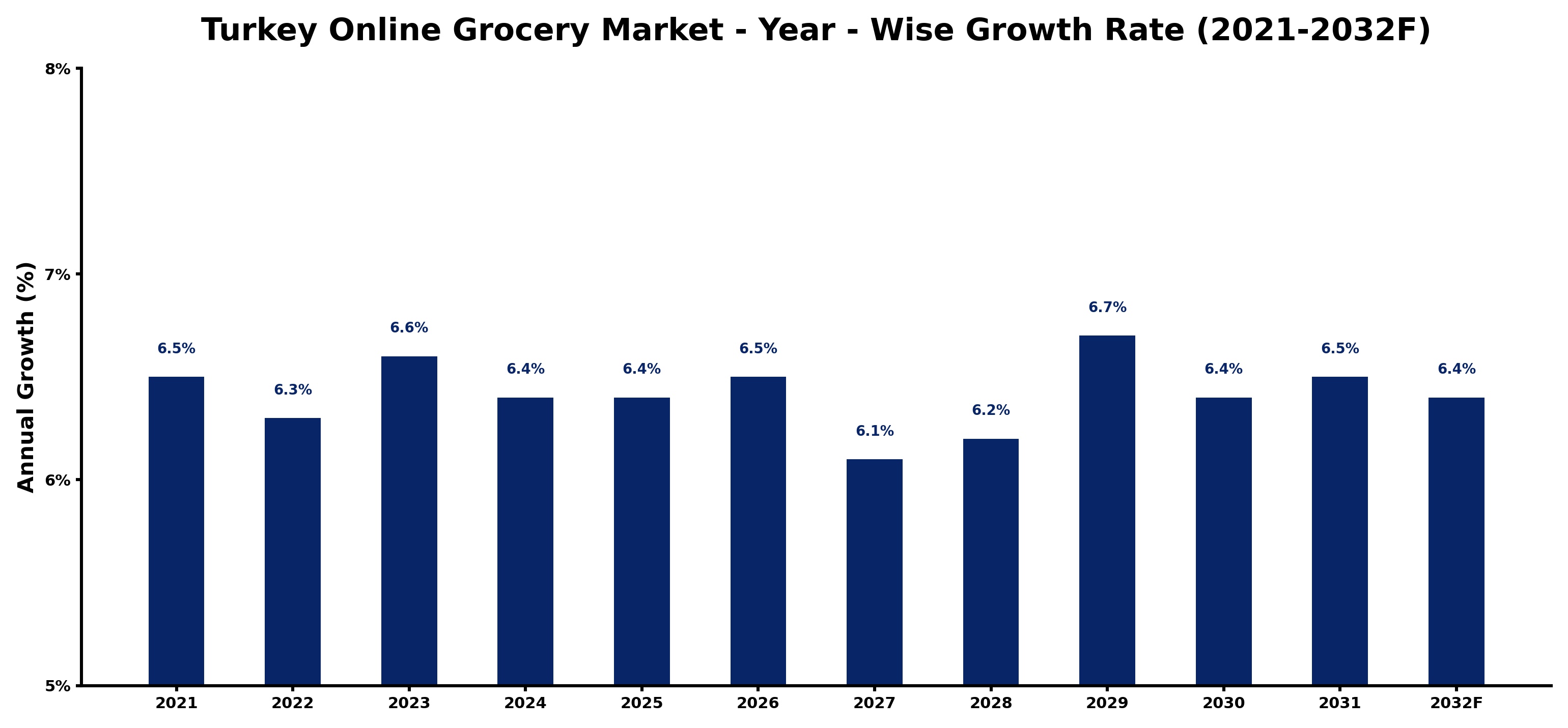
The table below presents the year‑wise growth rates along with the key drivers influencing the market
| Year | Growth Rate | Major Drivers |
| 2021 | 6.5% | E-commerce adoption accelerated shopping |
| 2022 | 6.3% | Mobile app usage enhanced convenience |
| 2023 | 6.6% | Subscription services gained popularity |
| 2024 | 6.4% | Home delivery options expanded rapidly |
| 2025 | 6.4% | Local sourcing improved freshness perception |
| 2026 | 6.5% | Consumer trust in online shopping |
| 2027 | 6.1% | Sustainable packaging attracted eco-conscious buyers |
| 2028 | 6.2% | Promotional campaigns increased customer engagement |
| 2029 | 6.7% | Technological advancements improved logistics |
| 2030 | 6.4% | Social media influence drove sales |
| 2031 | 6.5% | Personalized shopping experiences enhanced loyalty |
| 2032 | 6.4% | Health-conscious products gained traction |
Note - Market size estimations and growth projections presented in this report are based on 6Wresearch’s advanced forecasting approach, validated with industry datasets as of June 2026.
Turkey Online Grocery Market Synopsis
The Turkish online grocery market is currently in a dynamic phase, marked by an increasing preference for e-commerce among consumers. As busy lifestyles become the norm, shoppers are drawn to the ease of ordering groceries from the comfort of their homes, leading to an uptick in online grocery transactions.
Additionally, the COVID-19 pandemic has played a pivotal role in reshaping consumer habits, further accelerating the adoption of online grocery shopping. Today, Turkish consumers enjoy a wide array of products at competitive prices, signaling a fundamental shift in how groceries are purchased.
Turkey Online Grocery Market Key Takeaways
- The market is driven by increasing internet penetration and evolving consumer behaviors prioritizing convenience.
- Innovative technologies, such as AI-powered recommendations and mobile apps, are transforming the shopping experience.
- Fresh produce and organic offerings are increasingly available, catering to diverse consumer preferences.
- Logistical capabilities are crucial, with a focus on improving delivery times and handling perishable goods.
- Government policies support e-commerce growth, fostering a conducive environment for online grocery shopping.
Evaluation of Restraints in Turkey Online Grocery Market
While the Turkey Online Grocery Market is witnessing substantial growth, certain restraints could impact its trajectory. Low internet penetration in rural areas limits access to online platforms, potentially excluding a significant portion of the population. Moreover, older demographics may show slower adoption rates for online shopping due to familiarity with traditional purchasing methods. The challenge of delivering fresh and perishable items poses logistical hurdles, requiring innovative solutions to ensure quality and safety. Lastly, competition with brick-and-mortar stores, along with concerns about food safety and quality, may undermine consumer trust in online platforms, necessitating strategies to enhance transparency and reliability.
Turkey Online Grocery Market Trends
Current trends in the Turkey Online Grocery Market showcase an expansion of platforms catering to health-conscious consumers. The increasing availability of organic and specialty products reflects a shift in consumer preferences toward healthier options. Additionally, the rise of same-day and next-day delivery services emphasizes the demand for convenience in shopping experiences. Technological advancements, such as AI and data analytics, enable companies to personalize offerings, thereby enhancing customer satisfaction and loyalty. As this landscape evolves, a focus on seamless integration of online and offline shopping experiences is becoming increasingly important.
Turkey Online Grocery Market Opportunities
The Turkey Online Grocery Market presents substantial investment opportunities fueled by the rise in e-commerce and changing consumer preferences. Investors can explore avenues in online grocery delivery services, which are becoming essential as consumers prioritize convenience. The development of virtual supermarkets and enhanced digital platforms that offer personalized shopping experiences represents another area for growth. With a tech-savvy population increasingly demanding efficiency, there is a potential for high returns in technologies that improve online shopping dynamics.
Government Initiatives in the Turkey Online Grocery Market
The Turkish government has taken proactive steps to promote the online grocery market through supportive policies and regulations. Initiatives to bolster e-commerce, including financial assistance for small businesses to transition online, underline the government's commitment to facilitating this sector's growth. Regulations aimed at consumer protection and data privacy foster a trustworthy environment for online transactions. Furthermore, ongoing efforts to enhance logistics infrastructure are crucial for ensuring efficient delivery services, thereby aiding the overall development of the online grocery landscape in Turkey.
Future Insights of the Turkey Online Grocery Market
Looking ahead to 2026-2032, the Turkey Online Grocery Market is on track for robust growth fueled by shifting consumer lifestyles and increasing digital engagement. The younger population, with its affinity for technology and e-commerce, is expected to drive demand further. The proliferation of digital payment methods and improvements in delivery logistics will also play significant roles in shaping the market. As companies strive to enhance the online shopping experience, innovations in technology and product offerings will likely characterize this evolving market.
Turkey Online Grocery Market Latest Developments (May 2025 - June 2026)
Recent developments in the Turkey Online Grocery Market indicate a strong push toward enhancing user engagement through advanced digital platforms. Companies are focusing on the implementation of AI-driven solutions to better personalize shopping experiences, ensuring that offerings align with consumer preferences. Additionally, there's a noticeable trend towards partnerships with local farms and suppliers to improve the supply chain for fresh produce, reflecting a commitment to quality and local sourcing. The emphasis on creating a seamless omnichannel experience is also becoming increasingly prominent, with businesses integrating online and offline sales channels to cater to evolving consumer habits.
Turkey Online Grocery Market - Key Attractiveness of the Report
- 10 Years of Market Numbers
- Historical Data Starting from 2022 to 2025
- Base Year: 2025
- Forecast Data until 2032
- Key Performance Indicators Impacting the Market
- Major Upcoming Developments and Projects
Key Highlights of the Report:
- Turkey Online Grocery Market Outlook
- Market Size of Turkey Online Grocery Market, 2025
- Forecast of Turkey Online Grocery Market, 2032
- Historical Data and Forecast of Turkey Online Grocery Revenues & Volume for the Period 2022-2032F
- Turkey Online Grocery Market Trend Evolution
- Turkey Online Grocery Market Drivers and Challenges
- Turkey Online Grocery Price Trends
- Turkey Online Grocery Porter's Five Forces
- Turkey Online Grocery Industry Life Cycle
- Historical Data and Forecast of Turkey Online Grocery Market Revenues & Volume By Product Type for the Period 2022-2032F
- Historical Data and Forecast of Turkey Online Grocery Market Revenues & Volume By Food Grains for the Period 2022-2032F
- Historical Data and Forecast of Turkey Online Grocery Market Revenues & Volume By Bread, Bakery and Dairy Products for the Period 2022-2032F
- Historical Data and Forecast of Turkey Online Grocery Market Revenues & Volume By Fruits and Vegetables for the Period 2022-2032F
- Historical Data and Forecast of Turkey Online Grocery Market Revenues & Volume By Personal Care for the Period 2022-2032F
- Historical Data and Forecast of Turkey Online Grocery Market Revenues & Volume By Dry and Baking Products for the Period 2022-2032F
- Historical Data and Forecast of Turkey Online Grocery Market Revenues & Volume By Household Products for the Period 2022-2032F
- Historical Data and Forecast of Turkey Online Grocery Market Revenues & Volume By Meat and Meat Products for the Period 2022-2032F
- Historical Data and Forecast of Turkey Food Grains Online Grocery Market Revenues & Volume By Others for the Period 2022-2032F
- Historical Data and Forecast of Turkey Online Grocery Market Revenues & Volume By Platform for the Period 2022-2032F
- Historical Data and Forecast of Turkey Online Grocery Market Revenues & Volume By App-based for the Period 2022-2032F
- Historical Data and Forecast of Turkey Online Grocery Market Revenues & Volume By Web-based for the Period 2022-2032F
- Turkey Online Grocery Import Export Trade Statistics
- Market Opportunity Assessment By Product Type
- Market Opportunity Assessment By Platform
- Turkey Online Grocery Top Companies Market Share
- Turkey Online Grocery Competitive Benchmarking By Technical and Operational Parameters
- Turkey Online Grocery Company Profiles
- Turkey Online Grocery Key Strategic Recommendations






































