Turkey Policy Management in Telecom Market Size & Growth Rate (2026-2032)
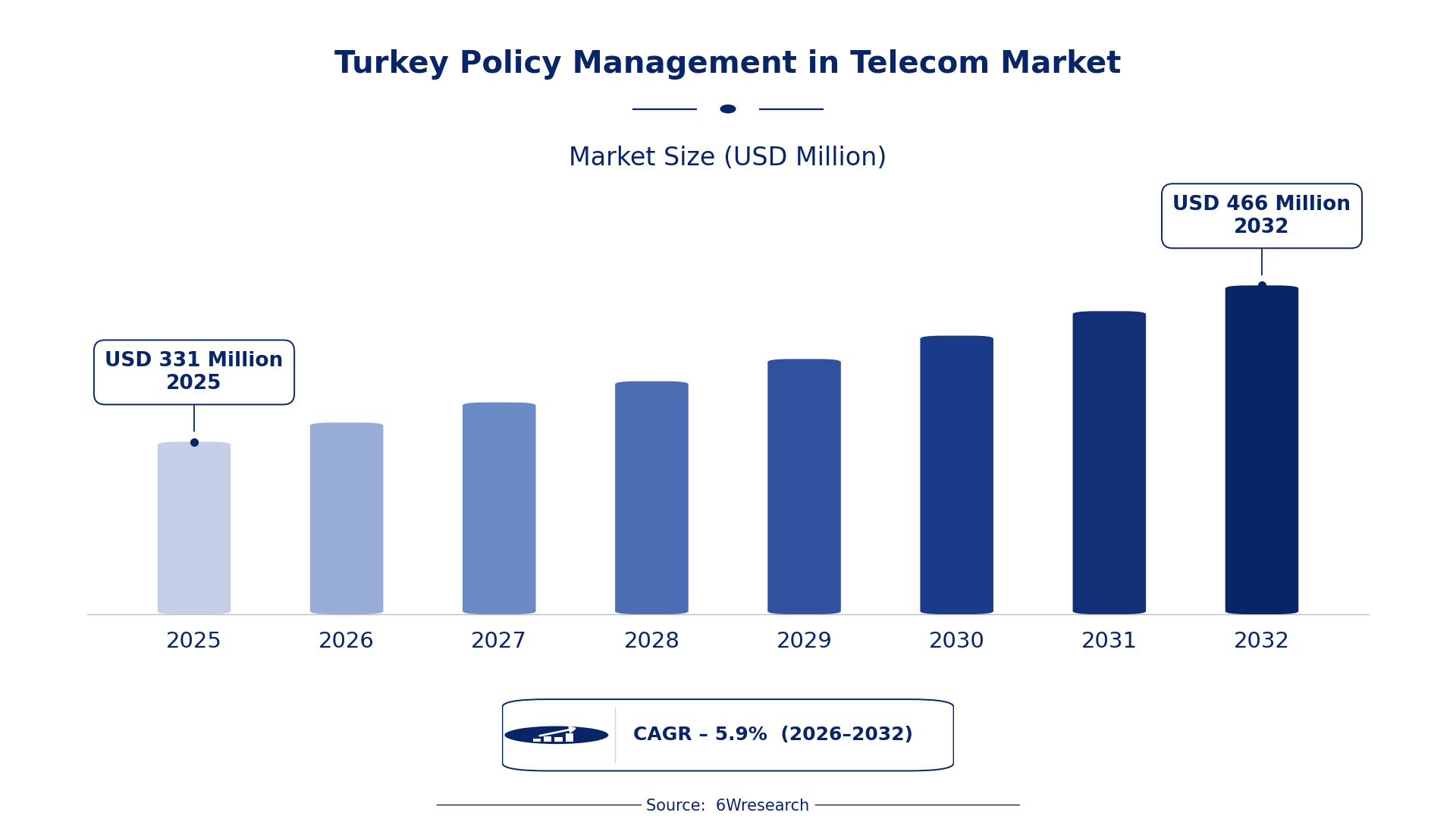
The Turkey Policy Management in Telecom Market was estimated at USD 331 Million in 2025 and is projected to reach USD 466 Million by 2032, growing at a CAGR of 5.9% from 2026 to 2032.
Turkey Policy Management in Telecom Market Synopsis
The Turkey Policy Management in Telecom Market is experiencing a transformative phase, driven largely by the rising complexity of telecom networks and the pressing need for optimal resource management. Operators are increasingly adopting policy management solutions to enhance operational efficiency, ensure regulatory compliance, and improve service differentiation.
The advent of 5G technology plays a critical role in shaping market dynamics, with the government prioritizing the enhancement of digital infrastructure. While growth opportunities abound, operators face challenges such as high implementation costs and the requirement for advanced security measures.
Turkey Policy Management in Telecom Market Year-wise Growth Rate and Key Drivers
This graph illustrates the annual growth rates of the Turkey Policy Management in Telecom Market from 2021 to 2032, highlighting a steady upward trajectory and projected expansion over the forecast period.
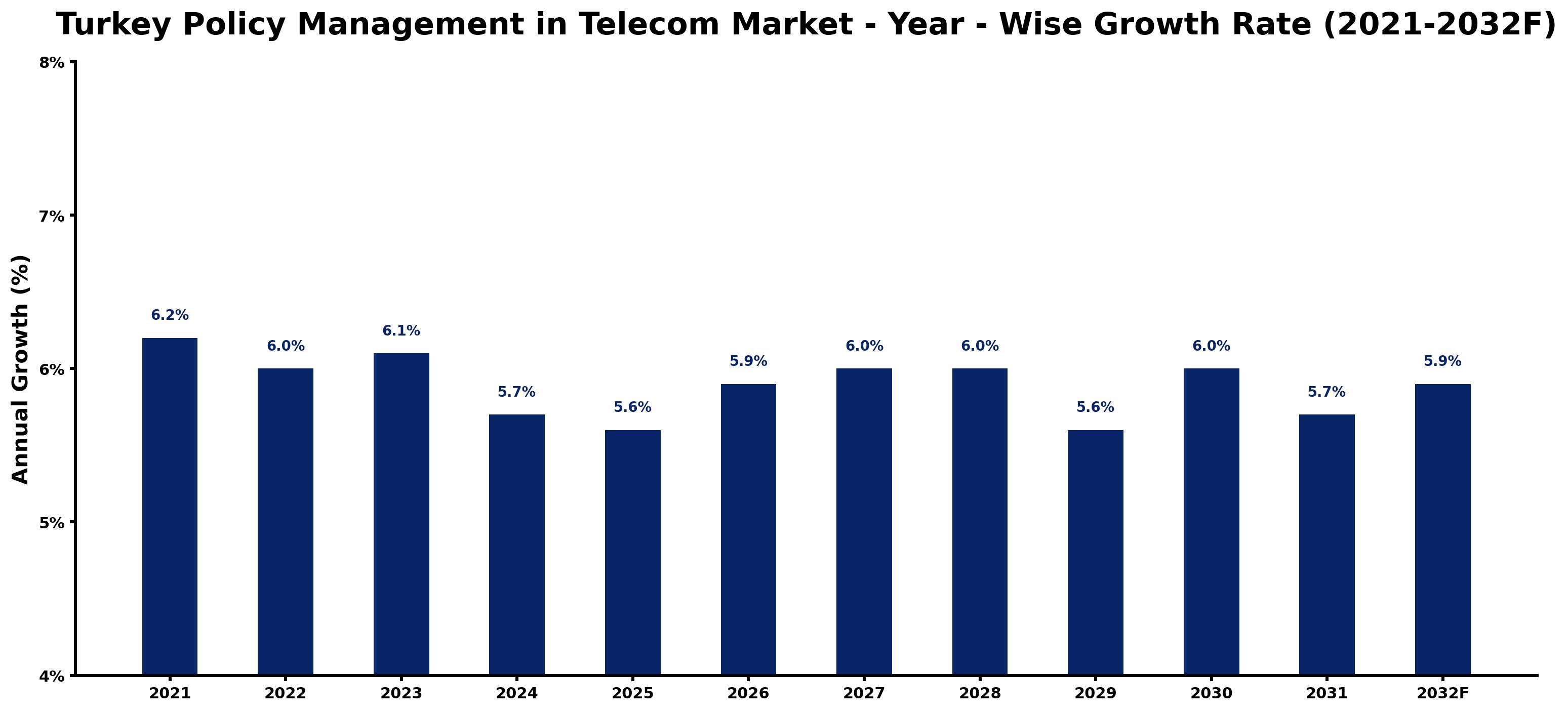
The table below presents the year‑wise growth rates along with the key drivers influencing the market
| Year | Growth Rate | Major Drivers |
| 2021 | 6.2% | Regulatory support from BTK for telecom innovation. |
| 2022 | 6.0% | Increased mobile data consumption driving policy adjustments. |
| 2023 | 6.1% | Government push for 5G deployment enhancing telecom regulations. |
| 2024 | 5.7% | Rising smartphone penetration influencing telecom policy reforms. |
| 2025 | 5.6% | Incentives for rural telecom coverage expansion by authorities. |
| 2026 | 5.9% | Focus on digital transformation mandates by Turkish government. |
| 2027 | 6.0% | Demand for cybersecurity laws shaping telecom management policies. |
| 2028 | 6.0% | Evolving consumer privacy regulations impacting telecom policy adaptation. |
| 2029 | 5.6% | Collaboration between government and telecom firms for growth. |
| 2030 | 6.0% | Increased foreign investment in telecom policy strategies. |
| 2031 | 5.7% | Emerging technologies prompting regulatory updates by BTK. |
| 2032 | 5.9% | Smart city initiatives driving telecom policy requirements. |
Note: Market size estimations and growth projections presented in this report are based on 6Wresearch's proprietary forecasting methodology, utilizing the latest available industry data, government publications, and primary research inputs.
Turkey Policy Management in Telecom Market Key Takeaways
Below are some of the specific key takeaways from the market, including:
- The market is expected to see continued growth driven by the adoption of advanced telecom technologies.
- Dynamic policy management solutions are being increasingly utilized for efficient data traffic management.
- Government initiatives are focusing on promoting competition and consumer protection in the telecom sector.
- Operators are increasingly investing in software-defined networking (SDN) to support network efficiency.
- Compliance with complex regulatory standards remains a major consideration for market players.
Evaluation of Restraints in Turkey Policy Management in Telecom Market
Several constraints are stifling the potential of the Turkey Policy Management in Telecom Market. Rapid advancements in technology require that solutions remain perpetually updated, which escalates the costs associated with research and development. Furthermore, the convoluted regulatory environment poses significant hurdles, demanding compliance with various stringent protocols that can limit operational flexibility. Balancing these factors is essential for operators looking to implement effective policy management solutions.
Turkey Policy Management in Telecom Market Trends
Several trends are influencing the Turkey Policy Management in Telecom Market. The integration of artificial intelligence (AI) in policy management systems is becoming more prevalent, enabling operators to enhance predictive analytics and optimize network performance. Increased customer expectations are driving service providers to adopt more customer-centric policy frameworks, focusing on personalized service delivery. Additionally, the trend towards virtualization of network functions is encouraging telecom companies to invest in policy management solutions that promote agility and efficiency.
Turkey Policy Management in Telecom Market Opportunities
The market presents a wealth of investment opportunities, particularly in upgrading existing infrastructure to accommodate 5G networks. Operators can capitalize on policy management solutions that cater to the demands of a more connected consumer base. There's also a significant opportunity for technology vendors to provide innovations that enhance compliance tracking and reporting, reducing the burden of regulatory adherence. Furthermore, partnerships between telecom operators and technology providers can lead to the development of customized solutions tailored to specific operational challenges.
Government Initiatives in the Turkey Policy Management in Telecom Market
The regulatory framework governing the Turkey Policy Management in Telecom Market is actively evolving. Recent government initiatives emphasize the enhancement of digital infrastructure while protecting consumer rights and promoting market competitiveness. This focus is critical in ensuring that operators can adapt to technological advancements while complying with regulatory demands.
- A national digital infrastructure upgrade programme initiated in 2025 aims to expand broadband access across urban and rural areas.
- Current efforts include the ongoing establishment of a regulatory body responsible for overseeing compliance with data protection laws in telecom operations.
- Upcoming plans for 2027 involve the introduction of a new regulatory framework aimed at ensuring billing transparency and fair pricing structures.
- Recently launched initiatives are focused on enhancing cybersecurity measures for telecom networks to protect against rising threats.
- A public-private partnership was formed in 2025 to develop shared infrastructure solutions, enhancing efficiency and reducing operational costs for telecom providers.
Future Insights of the Turkey Policy Management in Telecom Market
Looking ahead, the Turkey Policy Management in Telecom Market is set to expand significantly through 2032. The growth of 5G and the increasing adoption of IoT technologies will create new demands for sophisticated policy management solutions. Operators will need to adapt to a rapidly changing environment, focusing on agility and compliance. Emphasizing customer experience will likely become a central strategy for telecom operators aiming to differentiate their services in a competitive landscape.
Turkey Policy Management in Telecom Market Latest Developments
Recent activity in the Turkey Policy Management in Telecom Market highlights a trend toward modernization and increased regulatory compliance. Operators are focusing on enhancing their service offerings through innovative policy management solutions. The past year has seen a flurry of initiatives and investments aimed at upgrading capabilities and infrastructure.
- A major technology vendor launched an advanced policy management solution in Q1 2025, designed to integrate AI for enhanced data management.
- Operators are currently upgrading their systems with new policy frameworks that improve data traffic management, a project that began in mid-2025 and remains underway.
- By late 2025, a collaborative initiative between multiple telecom companies will roll out a shared infrastructure project expected to improve service delivery.
- A service upgrade focused on enhanced customer experience was initiated in early 2025 and continues to be developed with ongoing feedback from users.
- A planned expansion of regulatory training programs for telecom staff is expected to be launched in 2026, focusing on the latest compliance requirements.
Turkey Policy Management in Telecom Market - Key Attractiveness of the Report
- 10 Years of Market Numbers
- Historical Data Starting from 2022 to 2025
- Base Year: 2025
- Forecast Data until 2032
- Key Performance Indicators Impacting the Market
- Major Upcoming Developments and Projects
Key Highlights of the Report:
- Turkey Policy Management in Telecom Market Outlook
- Market Size of Turkey Policy Management in Telecom Market, 2025
- Forecast of Turkey Policy Management in Telecom Market, 2032
- Historical Data and Forecast of Turkey Policy Management in Telecom Revenues & Volume for the Period 2022-2032F
- Turkey Policy Management in Telecom Market Trend Evolution
- Turkey Policy Management in Telecom Market Drivers and Challenges
- Turkey Policy Management in Telecom Price Trends
- Turkey Policy Management in Telecom Porter's Five Forces
- Turkey Policy Management in Telecom Industry Life Cycle
- Historical Data and Forecast of Turkey Policy Management in Telecom Market Revenues & Volume By Network for the Period 2022-2032F
- Historical Data and Forecast of Turkey Policy Management in Telecom Market Revenues & Volume By Fixed for the Period 2022-2032F
- Historical Data and Forecast of Turkey Policy Management in Telecom Market Revenues & Volume By Wireless for the Period 2022-2032F
- Historical Data and Forecast of Turkey Policy Management in Telecom Market Revenues & Volume By Component for the Period 2022-2032F
- Historical Data and Forecast of Turkey Policy Management in Telecom Market Revenues & Volume By Solutions for the Period 2022-2032F
- Historical Data and Forecast of Turkey Policy Management in Telecom Market Revenues & Volume By Services for the Period 2022-2032F
- Historical Data and Forecast of Turkey Policy Management in Telecom Market Revenues & Volume By Deployment for the Period 2022-2032F
- Historical Data and Forecast of Turkey Policy Management in Telecom Market Revenues & Volume By Cloud for the Period 2022-2032F
- Historical Data and Forecast of Turkey Policy Management in Telecom Market Revenues & Volume By On-Premises for the Period 2022-2032F
- Turkey Policy Management in Telecom Import Export Trade Statistics
- Market Opportunity Assessment By Network
- Market Opportunity Assessment By Component
- Market Opportunity Assessment By Deployment
- Turkey Policy Management in Telecom Top Companies Market Share
- Turkey Policy Management in Telecom Competitive Benchmarking By Technical and Operational Parameters
- Turkey Policy Management in Telecom Company Profiles
- Turkey Policy Management in Telecom Key Strategic Recommendations






































