Turkey Simulation Software Market Size & Growth Rate (2026-2032)
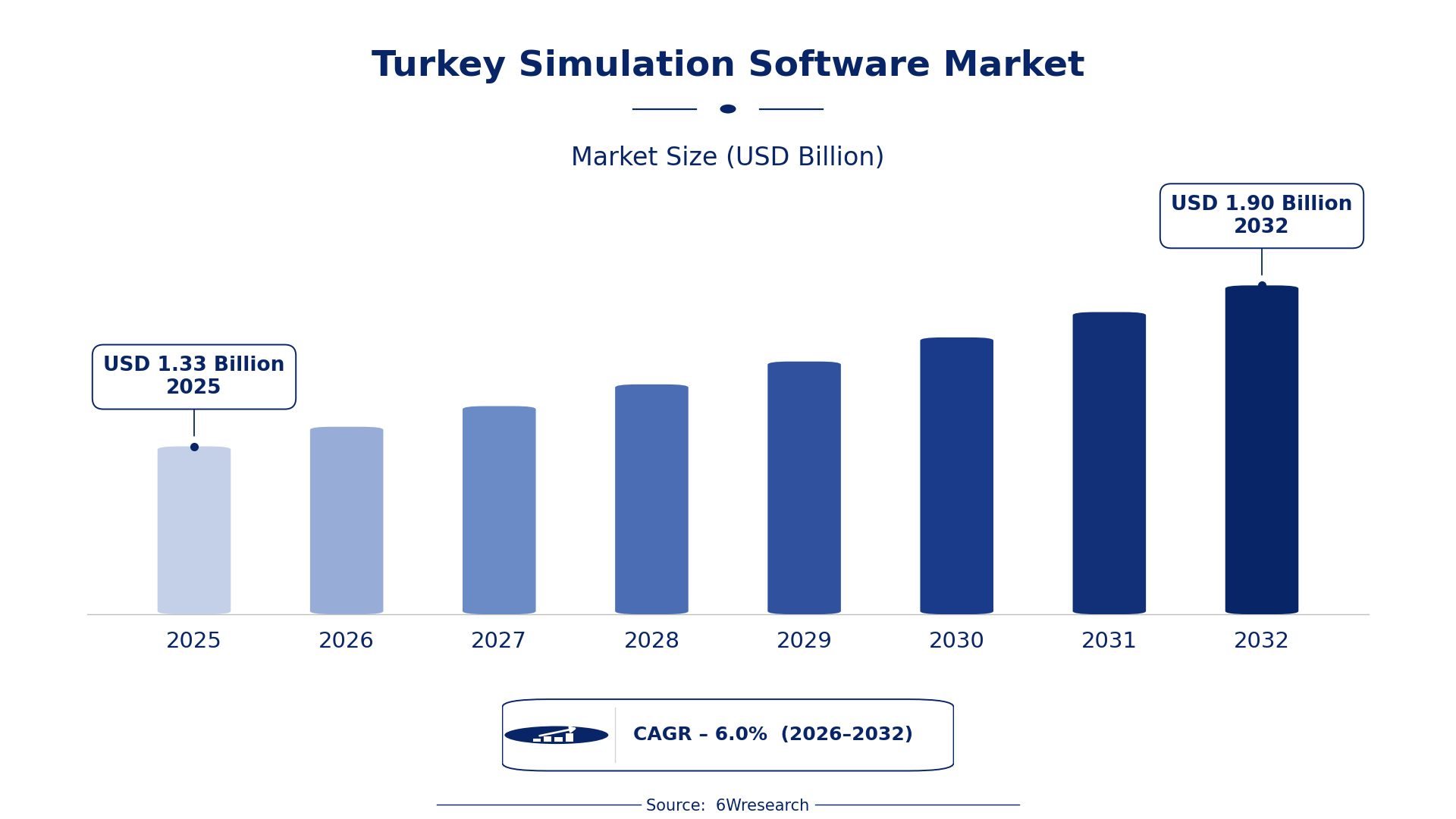
The Turkey Simulation Software Market was estimated at USD 1328 Million in 2025 and is projected to reach USD 1901 Million by 2032, growing at a CAGR of 6.0% from 2026 to 2032.
Turkey Simulation Software Market Synopsis
The most significant force currently shaping the Turkey Simulation Software Market is the increasing demand for advanced simulation technologies across key sectors such as defense, aerospace, and healthcare. This demand is driven by the need for enhanced operational efficiency and innovative product development processes, pushing companies to adopt more sophisticated simulation solutions.
As organizations across Turkey embrace digital transformation, the adoption of simulation software is on the rise. Notably, sectors like automotive and healthcare are investing in training and testing applications, further propelling market growth. The integration of technologies such as virtual reality (VR) and augmented reality (AR) into simulation practices is also contributing to this momentum.
Turkey Simulation Software Market Year-wise Growth Rate and Key Drivers
This graph illustrates the annual growth rates of the Turkey Simulation Software Market from 2021 to 2032, highlighting a steady upward trajectory and projected expansion over the forecast period.
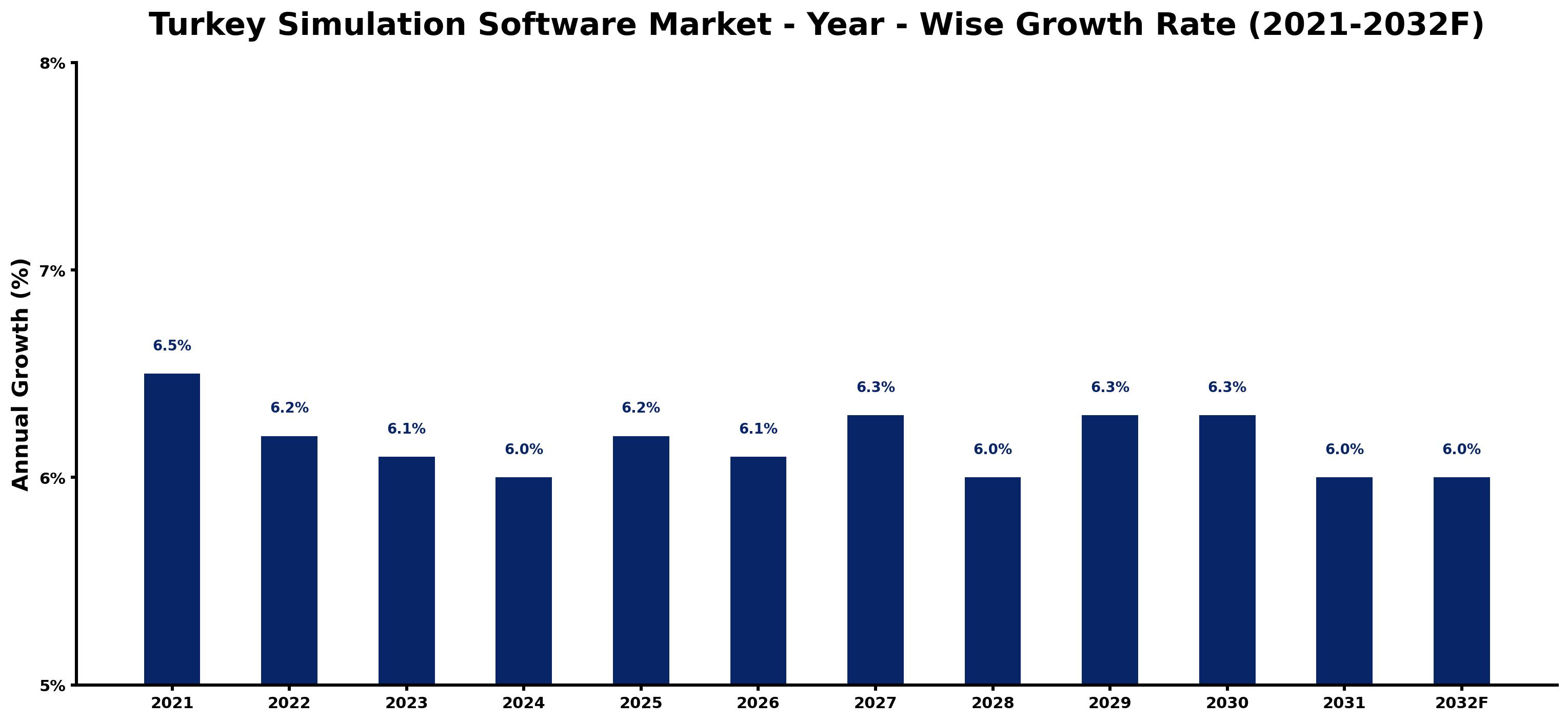
The table below presents the year‑wise growth rates along with the key drivers influencing the market
| Year | Growth Rate | Major Drivers |
| 2021 | 6.5% | Increased R&D spending by Turkish aerospace and defense firms. |
| 2022 | 6.2% | Government incentives for local firms adopting simulation tools. |
| 2023 | 6.1% | Surge in virtual prototyping for automotive industry projects. |
| 2024 | 6.0% | Turkish construction sector's shift to digital project management. |
| 2025 | 6.2% | Demand for simulation in disaster management training initiatives. |
| 2026 | 6.1% | Boost from local gaming industry adopting advanced simulation. |
| 2027 | 6.3% | Growth in e-learning platforms integrating simulation software. |
| 2028 | 6.0% | Initiatives to enhance smart manufacturing using simulation applications. |
| 2029 | 6.3% | Collaboration between research institutions on simulation standards. |
| 2030 | 6.3% | Increased investments in defense training simulations by government. |
| 2031 | 6.0% | Significant adoption of simulation in healthcare training programs. |
| 2032 | 6.0% | Rising need for urban planning simulations amidst population growth. |
Note: Market size estimations and growth projections presented in this report are based on 6Wresearch's proprietary forecasting methodology, utilizing the latest available industry data, government publications, and primary research inputs.
Turkey Simulation Software Market Key Takeaways
Below are some of the specific key takeaways from the market, including:
- The market is driven by technological advancements in simulation tools and methodologies.
- Key industries, including automotive and defense, are leading the demand for simulation software solutions.
- Government initiatives are fostering digital transformation and investment in the technology sector.
- Virtual reality and augmented reality are becoming critical components in simulation applications.
- Investment opportunities exist in industry-specific simulation solutions catering to unique sector needs.
Evaluation of Restraints in Turkey Simulation Software Market
Despite its growth potential, the Turkey Simulation Software Market faces certain constraints. Competition from global software providers poses a challenge for local firms, necessitating differentiation through innovation. Additionally, the need for organizations to adapt to rapid technological changes, particularly with artificial intelligence and VR, can be overwhelming. Concerns regarding data privacy and security remain significant, as they directly impact customer trust. on top of that, a lack of awareness about the advantages of simulation software among potential users can limit market penetration, especially in sectors with less IT infrastructure.
Turkey Simulation Software Market Trends
Several trends are currently shaping the Turkey Simulation Software Market. The integration of artificial intelligence and machine learning into simulation tools is becoming increasingly prevalent, enhancing their capabilities. Additionally, a shift towards cloud-based simulation platforms is observed, offering greater accessibility and scalability for users. There’s also a growing emphasis on industry-specific solutions, as organizations seek tailored software that meets their unique operational challenges. Notably, the use of VR and AR technologies is expanding, providing immersive experiences that improve training and testing outcomes.
Turkey Simulation Software Market Opportunities
The Turkey Simulation Software Market is ripe with investment opportunities. The increasing reliance on simulation technologies across various sectors presents a favorable environment for software development companies. Opportunities also lie within consulting firms that offer simulation services to help businesses implement these technologies effectively. on top of that, the growth of VR and AR simulation software indicates potential for innovative applications, particularly in training and product design, which are expected to attract considerable investment in the coming years.
Government Initiatives in the Turkey Simulation Software Market
The Turkish government is actively promoting the growth of the simulation software market through various initiatives. By implementing investment incentives, such as tax breaks for tech companies, the government is creating a more favorable environment for innovation. Additionally, initiatives aimed at advancing digital transformation across industries are opening doors for the adoption of simulation software solutions. Collaborative efforts with universities are enhancing R&D capabilities, further stimulating the sector.
- A national initiative launched to provide tax incentives for technology startups, enhancing growth opportunities for simulation software developers.
- Ongoing digital transformation programs aimed at modernizing industries, encouraging the integration of simulation solutions.
- A planned public-private partnership expected to enhance research and development resources for simulation technologies by 2027.
- Recent investments in educational programs focused on increasing awareness and understanding of simulation software benefits among potential users.
Future Insights of the Turkey Simulation Software Market
Looking ahead to the period from 2026 to 2032, the Turkey Simulation Software Market is set for substantial growth. The increasing adoption of AI and machine learning will continue to enhance the capabilities of simulation software, making it indispensable across various industries. Businesses will increasingly prioritize cost-effective and efficient training solutions, driving further demand. As organizations continue their digital transformation journeys, the emphasis on innovative and sophisticated simulation tools will only intensify, positioning the market for significant expansion.
Turkey Simulation Software Market Latest Developments
Recent activity in the Turkey Simulation Software Market indicates a dynamic phase of development. Companies are increasingly focused on enhancing their offerings through technology upgrades and strategic partnerships. As industries seek to modernize their operations, several noteworthy initiatives have emerged in the past year.
- A major technology vendor announced a significant upgrade to its simulation platform, launched in Q2 2025, enhancing features for VR and AR applications.
- A collaboration between a simulation software company and a leading university, initiated in early 2025, aims to develop advanced training modules for the healthcare sector.
- Ongoing research efforts are underway to integrate AI capabilities into simulation software, with pilot projects expected to conclude by mid-2026.
- A startup recently secured funding in late 2025 to develop niche simulation solutions tailored to the automotive sector, expected to launch in 2026.
Turkey Simulation Software Market - Key Attractiveness of the Report
- 10 Years of Market Numbers
- Historical Data Starting from 2022 to 2025
- Base Year: 2025
- Forecast Data until 2032
- Key Performance Indicators Impacting the Market
- Major Upcoming Developments and Projects
Key Highlights of the Report:
- Turkey Simulation Software Market Outlook
- Market Size of Turkey Simulation Software Market, 2025
- Forecast of Turkey Simulation Software Market, 2032
- Historical Data and Forecast of Turkey Simulation Software Revenues & Volume for the Period 2022-2032F
- Turkey Simulation Software Market Trend Evolution
- Turkey Simulation Software Market Drivers and Challenges
- Turkey Simulation Software Price Trends
- Turkey Simulation Software Porter's Five Forces
- Turkey Simulation Software Industry Life Cycle
- Historical Data and Forecast of Turkey Simulation Software Market Revenues & Volume By Component for the Period 2022-2032F
- Historical Data and Forecast of Turkey Simulation Software Market Revenues & Volume By Software for the Period 2022-2032F
- Historical Data and Forecast of Turkey Simulation Software Market Revenues & Volume By Professional Services for the Period 2022-2032F
- Historical Data and Forecast of Turkey Simulation Software Market Revenues & Volume By Deployment for the Period 2022-2032F
- Historical Data and Forecast of Turkey Simulation Software Market Revenues & Volume By Cloud for the Period 2022-2032F
- Historical Data and Forecast of Turkey Simulation Software Market Revenues & Volume By On-premises for the Period 2022-2032F
- Historical Data and Forecast of Turkey Simulation Software Market Revenues & Volume By Application for the Period 2022-2032F
- Historical Data and Forecast of Turkey Simulation Software Market Revenues & Volume By Product Engineering for the Period 2022-2032F
- Historical Data and Forecast of Turkey Simulation Software Market Revenues & Volume By Research and Development for the Period 2022-2032F
- Historical Data and Forecast of Turkey Simulation Software Market Revenues & Volume By Gamification for the Period 2022-2032F
- Historical Data and Forecast of Turkey Simulation Software Market Revenues & Volume By Vertical Automobile for the Period 2022-2032F
- Historical Data and Forecast of Turkey Simulation Software Market Revenues & Volume By Automobile for the Period 2022-2032F
- Historical Data and Forecast of Turkey Simulation Software Market Revenues & Volume By Aerospace and Defense for the Period 2022-2032F
- Historical Data and Forecast of Turkey Simulation Software Market Revenues & Volume By Electrical and Electronics for the Period 2022-2032F
- Historical Data and Forecast of Turkey Simulation Software Market Revenues & Volume By Healthcare and Pharmaceuticals for the Period 2022-2032F
- Historical Data and Forecast of Turkey Simulation Software Market Revenues & Volume By Oil and Gas and Mining for the Period 2022-2032F
- Historical Data and Forecast of Turkey Simulation Software Market Revenues & Volume By Construction for the Period 2022-2032F
- Historical Data and Forecast of Turkey Simulation Software Market Revenues & Volume By Ship Buildings and Marine for the Period 2022-2032F
- Historical Data and Forecast of Turkey Simulation Software Market Revenues & Volume By Chemicals for the Period 2022-2032F
- Turkey Simulation Software Import Export Trade Statistics
- Market Opportunity Assessment By Component
- Market Opportunity Assessment By Deployment
- Market Opportunity Assessment By Application
- Market Opportunity Assessment By Vertical Automobile
- Turkey Simulation Software Top Companies Market Share
- Turkey Simulation Software Competitive Benchmarking By Technical and Operational Parameters
- Turkey Simulation Software Company Profiles
- Turkey Simulation Software Key Strategic Recommendations






































