Turkey Web Application Firewall Market Size & Growth Rate (2026-2032)
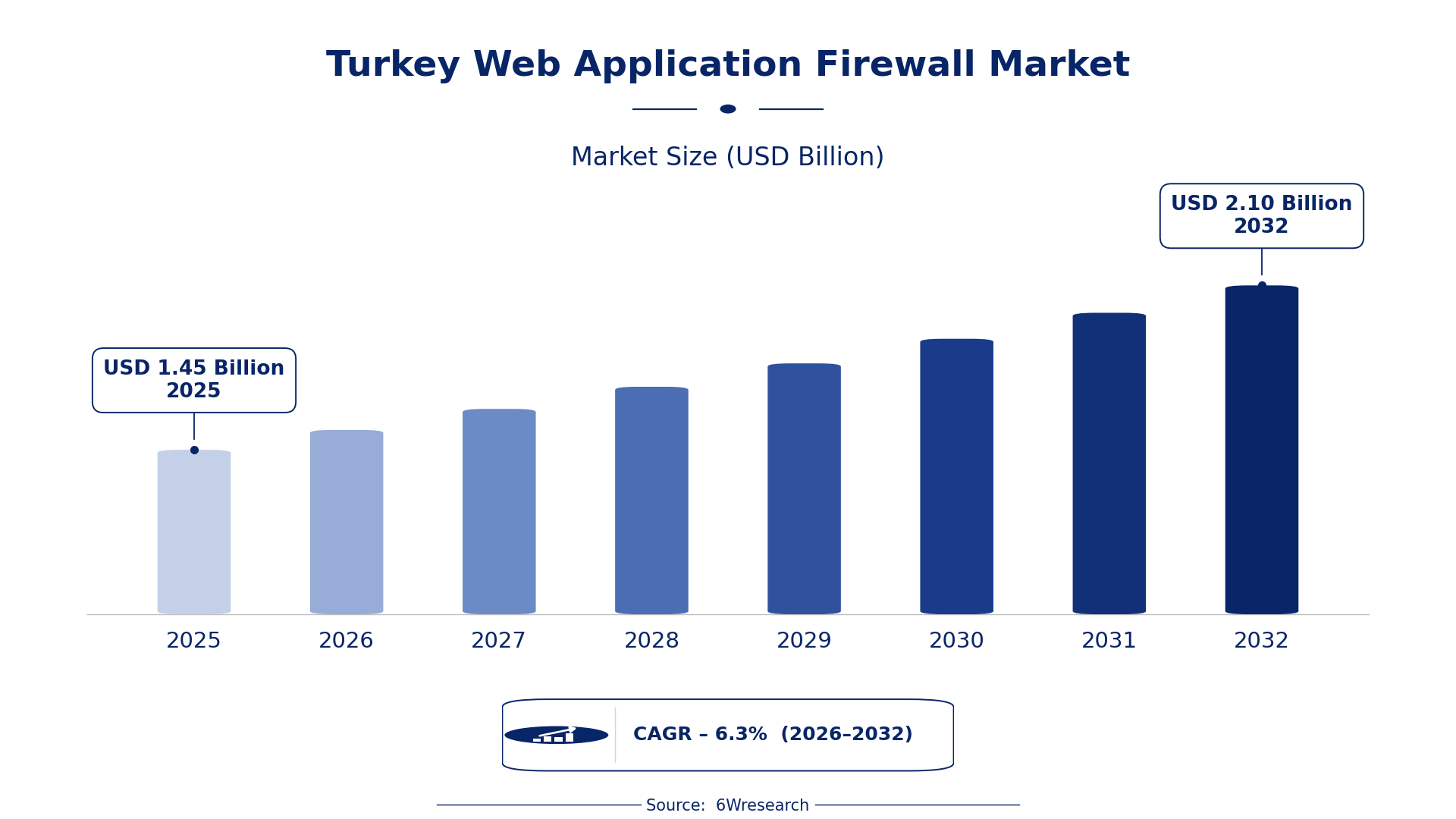
The Turkey Web Application Firewall Market was estimated at USD 1447 Million in 2025 and is projected to reach USD 2098 Million by 2032, growing at a CAGR of 6.3% from 2026 to 2032.
Turkey Web Application Firewall Market Synopsis
The rise in cyber threats has significantly influenced the Turkey Web Application Firewall Market, compelling organizations across sectors to seek advanced protection solutions. As the frequency of attacks like SQL injection and cross-site scripting escalates, businesses recognize the necessity of implementing WAF technologies to fortify their digital assets.
In Turkey, the demand for web application firewalls is not just a trend; it reflects a critical strategic shift toward cybersecurity resilience. Organizations are increasingly integrating threat intelligence and AI-driven capabilities into their WAF solutions to enhance their defenses and ensure compliance with international standards.
Turkey Web Application Firewall Market Year-wise Growth Rate and Key Drivers
This graph illustrates the annual growth rates of the Turkey Web Application Firewall Market from 2021 to 2032, highlighting a steady upward trajectory and projected expansion over the forecast period.
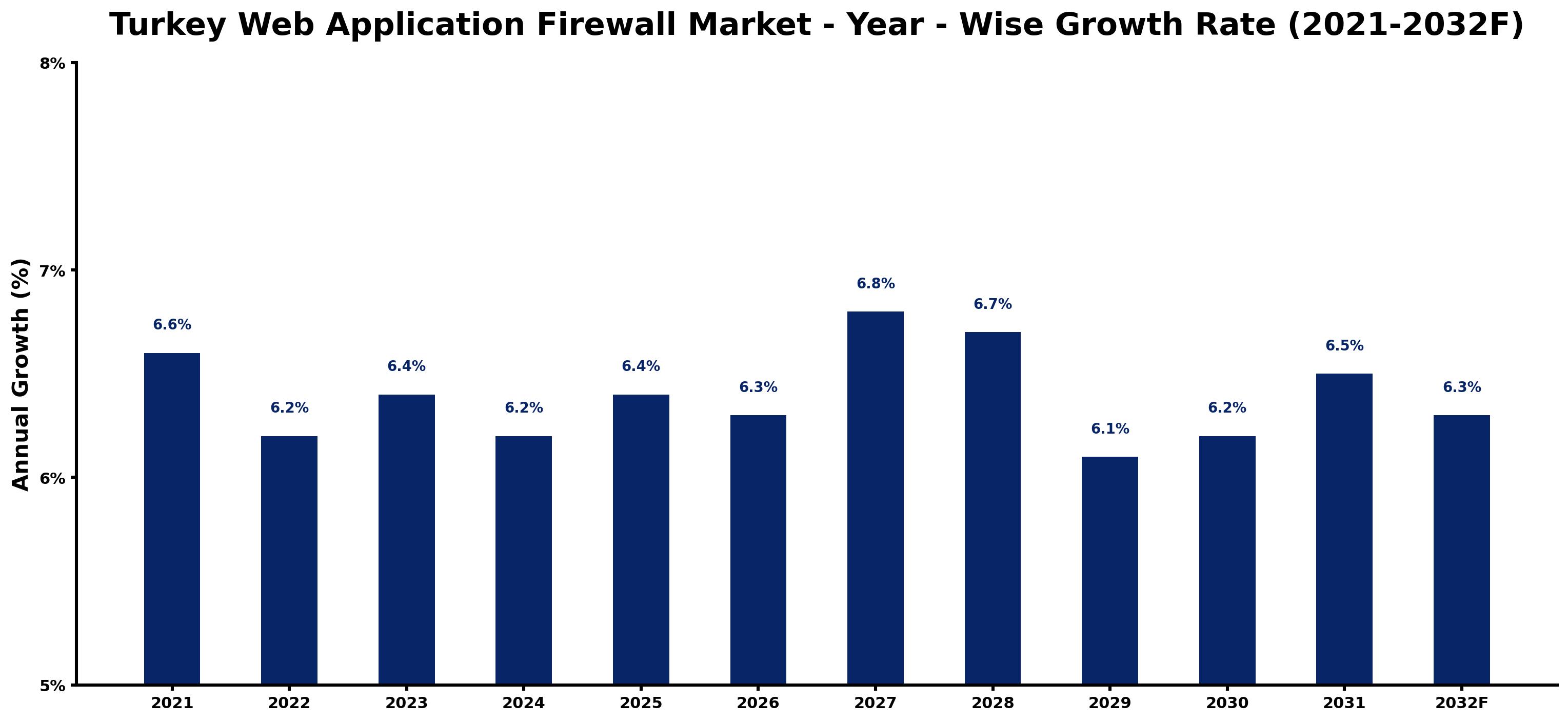
The table below presents the year‑wise growth rates along with the key drivers influencing the market
| Year | Growth Rate | Major Drivers |
| 2021 | 6.6% | Increased cyber threats prompting demand for security solutions. |
| 2022 | 6.2% | Regulatory compliance for data protection drives market growth. |
| 2023 | 6.4% | Government push for digitalization enhances cybersecurity investments. |
| 2024 | 6.2% | Local tech startups boost web security service offerings. |
| 2025 | 6.4% | Growing e-commerce sector needs enhanced cybersecurity measures. |
| 2026 | 6.3% | Rising adoption of cloud services fuels firewall requirements. |
| 2027 | 6.8% | Cybersecurity awareness campaigns increase demand for firewalls. |
| 2028 | 6.7% | Financial institutions require stronger protection against cyberattacks. |
| 2029 | 6.1% | Telecommunications growth necessitates robust web application security. |
| 2030 | 6.2% | Digital identity initiatives drive demand for firewall solutions. |
| 2031 | 6.5% | Enhanced security protocols mandated by Turkish government regulations. |
| 2032 | 6.3% | Shift towards remote work highlights need for web firewalls. |
Note: Market size estimations and growth projections presented in this report are based on 6Wresearch's proprietary forecasting methodology, utilizing the latest available industry data, government publications, and primary research inputs.
Turkey Web Application Firewall Market Key Takeaways
Below are some of the specific key takeaways from the market, including:
- The market is seeing increased investment in AI-driven WAF technologies to combat sophisticated cyber threats.
- Growing regulatory requirements are pushing organizations to adopt advanced firewall solutions.
- Cloud services proliferation drives the demand for WAFs tailored to cloud environments.
- Integration of threat intelligence is becoming a key differentiator for WAF solutions.
Evaluation of Restraints in Turkey Web Application Firewall Market
Complex network environments pose a real challenge to the effective deployment of WAF technologies. Organizations struggle to implement comprehensive security measures without affecting performance. Furthermore, the constant evolution of cyber threats complicates the landscape, requiring continuous updates and adaptation of WAF systems. Regulatory compliance can also burden organizations, making it difficult for them to balance security needs with operational efficiency.
Turkey Web Application Firewall Market Trends
The integration of artificial intelligence into web application firewalls is reshaping the market. Organizations are seeking solutions that not only detect threats but also predict and mitigate them proactively. Another trend is the move towards more user-friendly interfaces, allowing IT departments to manage security protocols efficiently without extensive training. Additionally, as businesses migrate to cloud environments, WAFs designed for cloud-native architectures are becoming increasingly essential.
Turkey Web Application Firewall Market Opportunities
The shift to cloud computing offers a fertile ground for WAF providers to innovate and capture market share. Companies are eager to explore solutions that address both on-premises and cloud security needs. Partnerships between technology vendors and organizations to create tailored WAF solutions represent another significant opportunity. As awareness of cybersecurity threats increases, so too does the potential for education and training initiatives around WAF technologies.
Government Initiatives in the Turkey Web Application Firewall Market
Government policies in Turkey are emphasizing cybersecurity as a critical area of focus. The current regulatory environment is designed to enhance the country’s overall cybersecurity posture, which directly impacts the adoption of web application firewalls. By promoting advanced firewall technologies and ensuring compliance with international standards, the government is steering organizations toward stronger protective measures against cyber threats.
- A national cybersecurity strategy launched recently aims to improve digital infrastructure and promote advanced firewall adoption.
- Current initiatives are underway to enhance compliance frameworks for organizations, focusing on ensuring continuous monitoring and incident response capabilities.
- Planned regulatory guidelines expected to roll out by late 2026 will introduce mandates for integrated cybersecurity measures across all sectors.
Future Insights of the Turkey Web Application Firewall Market
Looking ahead to 2026-2032, the Turkey Web Application Firewall Market is expected to witness substantial growth. The escalation of cyber threats combined with a growing dependency on digital services is likely to keep demand for WAF solutions high. Organizations will increasingly prioritize comprehensive security strategies that encompass both traditional and cloud environments. As technology advances, we can anticipate significant innovations in threat detection and response capabilities, making WAF solutions smarter and more efficient.
Turkey Web Application Firewall Market Latest Developments
Recent activity in the Turkey Web Application Firewall Market indicates a strong push towards innovative solutions and collaborative efforts. Companies are ramping up development activities, recognizing the urgent need to address rising cybersecurity threats. The focus on AI integration and user-friendly interfaces is becoming more pronounced, reflecting market demands.
- A major technology vendor launched a new WAF solution in early 2025 that emphasizes AI-driven threat detection capabilities, significantly enhancing user security.
- An ongoing partnership between cybersecurity firms and local businesses began in mid-2025 to develop tailored WAF solutions for specific industry needs.
- Plans for a public-private initiative to create a national cybersecurity training program are set to begin in Q3 2026, aiming to upskill IT professionals across Turkey.
Turkey Web Application Firewall Market - Key Attractiveness of the Report
- 10 Years of Market Numbers
- Historical Data Starting from 2022 to 2025
- Base Year: 2025
- Forecast Data until 2032
- Key Performance Indicators Impacting the Market
- Major Upcoming Developments and Projects
Key Highlights of the Report:
- Turkey Web Application Firewall Market Outlook
- Market Size of Turkey Web Application Firewall Market, 2025
- Forecast of Turkey Web Application Firewall Market, 2032
- Historical Data and Forecast of Turkey Web Application Firewall Revenues & Volume for the Period 2022-2032F
- Turkey Web Application Firewall Market Trend Evolution
- Turkey Web Application Firewall Market Drivers and Challenges
- Turkey Web Application Firewall Price Trends
- Turkey Web Application Firewall Porter's Five Forces
- Turkey Web Application Firewall Industry Life Cycle
- Historical Data and Forecast of Turkey Web Application Firewall Market Revenues & Volume By Component for the Period 2022-2032F
- Historical Data and Forecast of Turkey Web Application Firewall Market Revenues & Volume By Solutions (Hardware Appliances, Virtual Appliances, Cloud-Based) for the Period 2022-2032F
- Historical Data and Forecast of Turkey Web Application Firewall Market Revenues & Volume By Services (Professional and Managed) for the Period 2022-2032F
- Historical Data and Forecast of Turkey Web Application Firewall Market Revenues & Volume By Organization Size for the Period 2022-2032F
- Historical Data and Forecast of Turkey Web Application Firewall Market Revenues & Volume By SMEs for the Period 2022-2032F
- Historical Data and Forecast of Turkey Web Application Firewall Market Revenues & Volume By Large Enterprises for the Period 2022-2032F
- Historical Data and Forecast of Turkey Web Application Firewall Market Revenues & Volume By Vertical for the Period 2022-2032F
- Historical Data and Forecast of Turkey Web Application Firewall Market Revenues & Volume By Banking, Financial Services & Insurance for the Period 2022-2032F
- Historical Data and Forecast of Turkey Web Application Firewall Market Revenues & Volume By Retail for the Period 2022-2032F
- Historical Data and Forecast of Turkey Web Application Firewall Market Revenues & Volume By IT & Telecommunications for the Period 2022-2032F
- Historical Data and Forecast of Turkey Web Application Firewall Market Revenues & Volume By Government & Defense for the Period 2022-2032F
- Historical Data and Forecast of Turkey Web Application Firewall Market Revenues & Volume By Healthcare for the Period 2022-2032F
- Historical Data and Forecast of Turkey Web Application Firewall Market Revenues & Volume By Energy & Utilities for the Period 2022-2032F
- Historical Data and Forecast of Turkey Web Application Firewall Market Revenues & Volume By Education for the Period 2022-2032F
- Historical Data and Forecast of Turkey Web Application Firewall Market Revenues & Volume By Other Verticals for the Period 2022-2032F
- Turkey Web Application Firewall Import Export Trade Statistics
- Market Opportunity Assessment By Component
- Market Opportunity Assessment By Organization Size
- Market Opportunity Assessment By Vertical
- Turkey Web Application Firewall Top Companies Market Share
- Turkey Web Application Firewall Competitive Benchmarking By Technical and Operational Parameters
- Turkey Web Application Firewall Company Profiles
- Turkey Web Application Firewall Key Strategic Recommendations






































