Ukraine Commercial vehicles Market Summary
The ukraine commercial vehicles market was estimated at USD 1462 Million in 2025 and is projected to reach USD 2092 Million by 2032, growing at a CAGR of 4.8% from 2026 to 2032.
Ukraine Commercial vehicles Market Year-wise Growth Rate and Key Drivers
This graph highlights how the Ukraine Commercial vehicles Market has steadily grown over the past five years, supported by major growth factors.
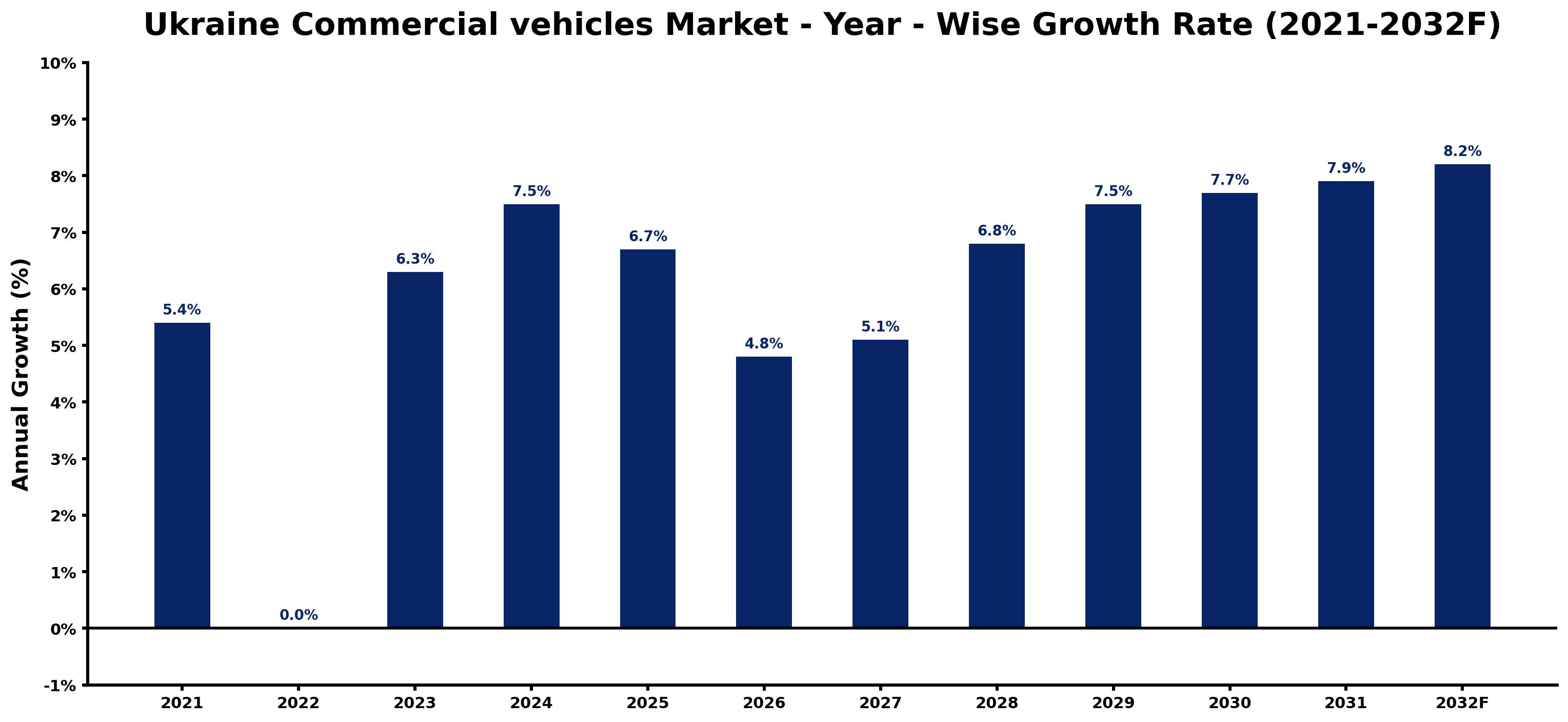
The table below presents the year wise growth rates along with the key drivers influencing the market
| Year | Growth Rate | Major Drivers |
| 2021 | 5.4% | Recovery from political instability allows businesses to rethink fleet investments. |
| 2022 | 0.0% | Increased infrastructure projects boost the need for reliable commercial transportation solutions. |
| 2023 | 6.3% | Rising urbanization and logistics demands create new opportunities for delivery services. |
| 2024 | 7.5% | Investment in road networks encourages higher commercial vehicle registrations and usage. |
| 2025 | 6.7% | Local manufacturers adapt to global supply chain shifts, enhancing production capabilities. |
| 2026 | 4.8% | Technological upgrades in vehicle telematics improve operational efficiencies for fleet managers. |
| 2027 | 5.1% | Environmental concerns prompt interest in sustainable commercial vehicle options among companies. |
| 2028 | 6.8% | Increased e-commerce activity significantly drives the demand for light commercial vehicles. |
| 2029 | 7.5% | Foreign investments in Ukraine's transportation sector lead to modernization and expansion. |
| 2030 | 7.7% | Growing interest in electric vehicles reshapes commercial fleet strategies and procurement. |
| 2031 | 7.9% | Partnerships between logistics firms and tech companies drive innovation in transportation. |
| 2032 | 8.2% | Enhanced trade relations with neighboring countries expand market access for Ukrainian vehicles. |
Note - Market size estimations and growth projections presented in this report are based on 6Wresearch's advanced forecasting approach, validated with industry datasets as of June 2026.
Ukraine Commercial vehicles Market Synopsis
The Ukraine Commercial vehicles Market is projected to reach 4.8% and witness significant growth during the forecast period (2026-2032). The landscape of this market is shaped by diverse factors, including the increasing demand for efficient transportation solutions across various sectors such as logistics, agriculture, and construction. The ongoing development of critical infrastructure and government initiatives further add to the positive outlook for the market, indicating robust opportunities for businesses and stakeholders.
Ukraine Commercial vehicles Market Growth Drivers
Several factors are driving the expansion of the Ukraine Commercial vehicles Market. Firstly, the growth in the logistics sector is a primary catalyst, as businesses seek to enhance their operational efficiency through reliable transportation solutions. Secondly, increased government investment in transportation infrastructure aims to modernize roads and facilities, thereby supporting a thriving commercial vehicle sector. Thirdly, the rise of e-commerce has amplified demands for delivery vehicles, giving a further boost to the commercial vehicles market.
- Infrastructure projects are expected to create a more conducive environment for commercial vehicle operations.
- Government policies geared towards economic recovery are anticipated to stimulate demand for transportation services.
- The growing focus on agricultural modernization is increasing the need for specialized commercial vehicles.
- Technological advancements in vehicle design are driving the adoption of next-generation commercial vehicles.
- Increasing urbanization is resulting in higher demand for public and private transportation options.
Ukraine Commercial vehicles Market Trends and Opportunities
In recent years, the Ukraine Commercial vehicles Market has observed significant trends that suggest a transition towards sustainability and innovation. One prominent trend is the shift towards electric and hybrid vehicles, influenced by rising environmental concerns and supportive government incentives aimed at reducing emissions. Additionally, fleet operators are increasingly prioritizing advanced safety features and connectivity solutions, which enhance operational efficiency and driver security.
- The demand for medium and heavy-duty trucks is on the rise, particularly within logistics and construction sectors.
- Leasing and rental services for commercial vehicles are becoming more attractive due to their flexibility and economic benefits.
- Technological integration, such as telematics and vehicle tracking, is gaining traction among fleet operators.
- Growing consumer preferences for environmentally friendly transportation options are reshaping purchasing decisions.
- Partnerships between local and international stakeholders are fostering innovation in vehicle design and functionality.
Ukraine Commercial vehicles Market Challenges and Restraints
Despite the optimistic prospects, the Ukraine Commercial vehicles Market faces notable challenges that may hinder growth. Political instability continues to create an unpredictable business landscape, impacting investment decisions and consumer confidence. Economic fluctuations, particularly inflation rates and exchange rate volatility, pose substantial risks for market stakeholders. Furthermore, evolving regulatory requirements and shifts in customer preferences necessitate agile responses from businesses.
- Political turbulence in Eastern Ukraine has created uncertainties affecting market operations.
- High inflation rates are reducing purchasing power among both businesses and consumers.
- Regulatory changes aimed at emissions control may increase operational costs for manufacturers.
- Fluctuations in the exchange rate of the Ukrainian hryvnia affect the profitability of import and export activities.
- Market players must adapt to changing consumer preferences, which can be unpredictable.
Ukraine Commercial vehicles Market Investment Opportunities
The Ukraine Commercial vehicles Market presents a variety of investment opportunities, driven by key factors such as increased industrialization and infrastructural developments. The rising demand for transportation services, spurred by e-commerce growth, further enhances the appeal of this sector. Investors can explore avenues in manufacturing as well as in the distribution of trucks, buses, and vans.
- Investments in electric and hybrid commercial vehicles are poised to yield substantial returns as demand increases.
- Government initiatives aimed at fleet modernization create favorable conditions for public-private partnerships.
- The growing logistics sector presents opportunities in last-mile delivery and vehicle service enhancements.
- Infrastructure upgrades, including roads and transport facilities, drive demand for new commercial vehicles.
- Strategic alliances with local firms can enhance market entry and operational effectiveness.
Ukraine Commercial vehicles Market Government Investment and Initiatives
Government policies play a crucial role in shaping the Ukraine Commercial vehicles Market. The Ukrainian government has emphasized the importance of upgrading vehicle safety standards and emissions control. Investments in infrastructure development are prioritized in national budgets, which support the transportation sector. Furthermore, incentives such as subsidies for environmentally friendly vehicles encourage the adoption of electric and hybrid technologies. These policies aim to create a balanced market environment that fosters industry growth while promoting sustainability.
Ukraine Commercial vehicles Market Latest Developments (May 2025 - June 2026)
Between May 2025 and June 2026, the Ukraine Commercial vehicles Market has seen significant movements reflecting ongoing trends and challenges. The market has increasingly leaned towards adopting electric vehicles, spurred by government initiatives aiming to reduce carbon footprints. Additionally, the rise in demand for logistics and delivery solutions has been evident, driven by e-commerce growth. However, ongoing political and economic challenges have continued to create a complex landscape for market participants, necessitating adaptive strategies. Companies are focusing on maximizing efficiency and safety in their vehicle offerings to align with emerging consumer preferences.
Ukraine Commercial vehicles Market - Key Attractiveness of the Report
- 10 Years of Market Numbers
- Historical Data Starting from 2022 to 2025
- Base Year: 2025
- Forecast Data until 2032
- Key Performance Indicators Impacting the Market
- Major Upcoming Developments and Projects
Key Highlights of the Report:
- Ukraine Commercial vehicles Market Outlook
- Market Size of Ukraine Commercial vehicles Market, 2025
- Forecast of Ukraine Commercial vehicles Market, 2032F
- Historical Data and Forecast of Ukraine Commercial vehicles Revenues & Volume for the Period 2022-2032F
- Ukraine Commercial vehicles Market Trend Evolution
- Ukraine Commercial vehicles Market Drivers and Challenges
- Ukraine Commercial vehicles Price Trends
- Ukraine Commercial vehicles Porter's Five Forces
- Ukraine Commercial vehicles Industry Life Cycle
- Historical Data and Forecast of Ukraine Commercial vehicles Market Revenues & Volume By Product for the Period 2022-2032F
- Historical Data and Forecast of Ukraine Commercial vehicles Market Revenues & Volume By Light Commercial Vehicles (LCVs) for the Period 2022-2032F
- Historical Data and Forecast of Ukraine Commercial vehicles Market Revenues & Volume By Heavy Trucks for the Period 2022-2032F
- Historical Data and Forecast of Ukraine Commercial vehicles Market Revenues & Volume By Buses & Coaches for the Period 2022-2032F
- Historical Data and Forecast of Ukraine Commercial vehicles Market Revenues & Volume By End-Users for the Period 2022-2032F
- Historical Data and Forecast of Ukraine Commercial vehicles Market Revenues & Volume By Industrial for the Period 2022-2032F
- Historical Data and Forecast of Ukraine Commercial vehicles Market Revenues & Volume By Mining & Construction for the Period 2022-2032F
- Historical Data and Forecast of Ukraine Commercial vehicles Market Revenues & Volume By Logistics for the Period 2022-2032F
- Historical Data and Forecast of Ukraine Commercial vehicles Market Revenues & Volume By Passenger Transportation for the Period 2022-2032F
- Historical Data and Forecast of Ukraine Commercial vehicles Market Revenues & Volume By Others for the Period 2022-2032F
- Ukraine Commercial vehicles Import Export Trade Statistics
- Market Opportunity Assessment By Product
- Market Opportunity Assessment By End-Users
- Ukraine Commercial vehicles Top Companies Market Share
- Ukraine Commercial vehicles Competitive Benchmarking By Technical and Operational Parameters
- Ukraine Commercial vehicles Company Profiles
- Ukraine Commercial vehicles Key Strategic Recommendations






































