Ukraine Web Application Firewall Market Size & Growth Rate (2026-2032)
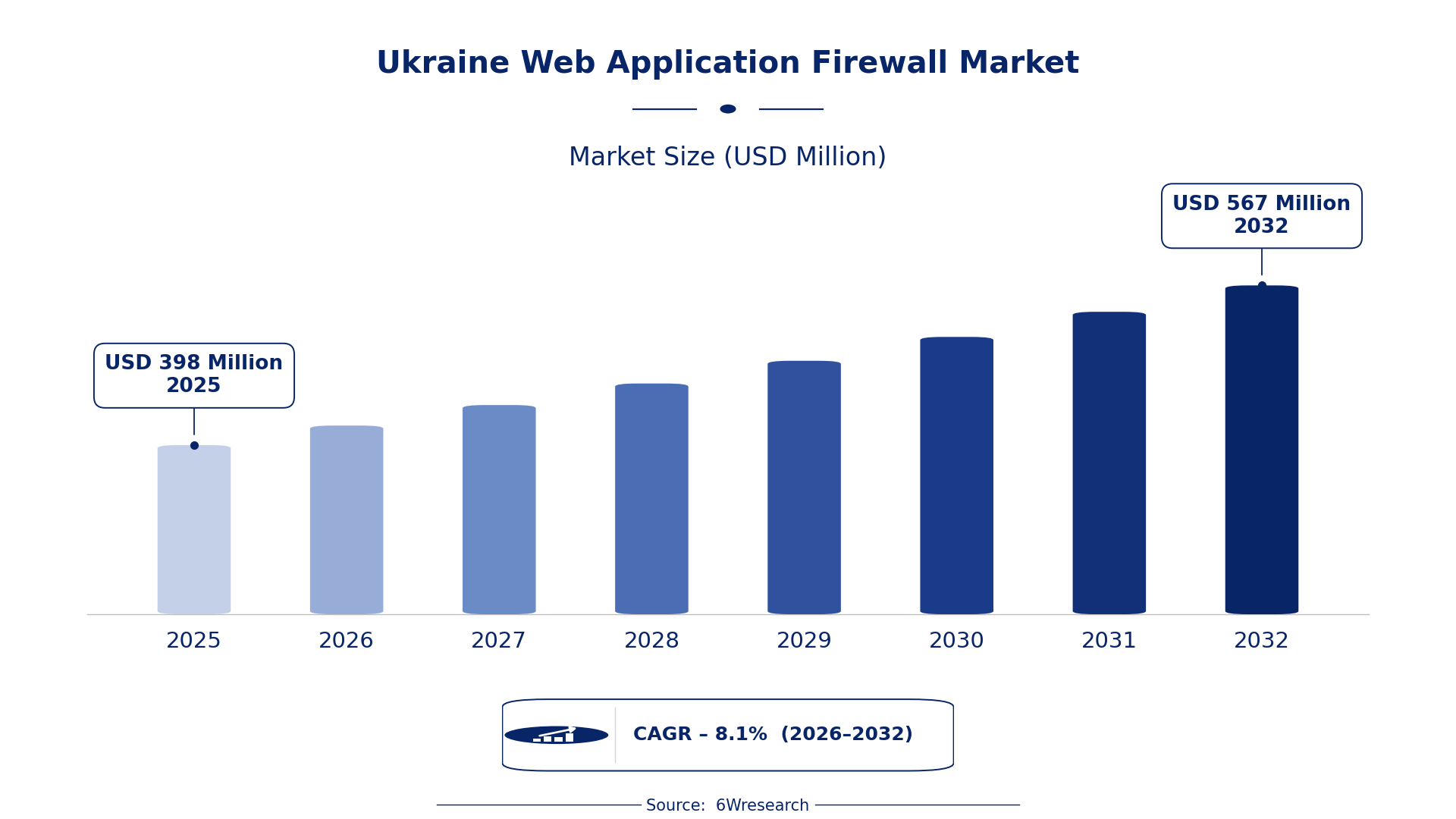
The Ukraine Web Application Firewall Market was estimated at USD 398 Million in 2025 and is projected to reach USD 567 Million by 2032, growing at a CAGR of 8.1% from 2026 to 2032.
Ukraine Web Application Firewall Market Synopsis
The Ukraine Web Application Firewall (WAF) market is currently witnessing a surge, propelled by an uptick in cyber threats targeting organizations across various sectors. As businesses increasingly prioritize cybersecurity, the demand for advanced WAF solutions has intensified, shaping the market's immediate trajectory.
In the coming years, the landscape will likely shift with greater emphasis on innovative technologies like artificial intelligence and machine learning, which will enhance threat detection capabilities. The growth momentum, however, must overcome several hurdles such as awareness deficits and legacy systems hampering effective WAF implementation.
Ukraine Web Application Firewall Market Year-wise Growth Rate and Key Drivers
This graph illustrates the annual growth rates of the Ukraine Web Application Firewall Market from 2021 to 2032, highlighting a steady upward trajectory and projected expansion over the forecast period.
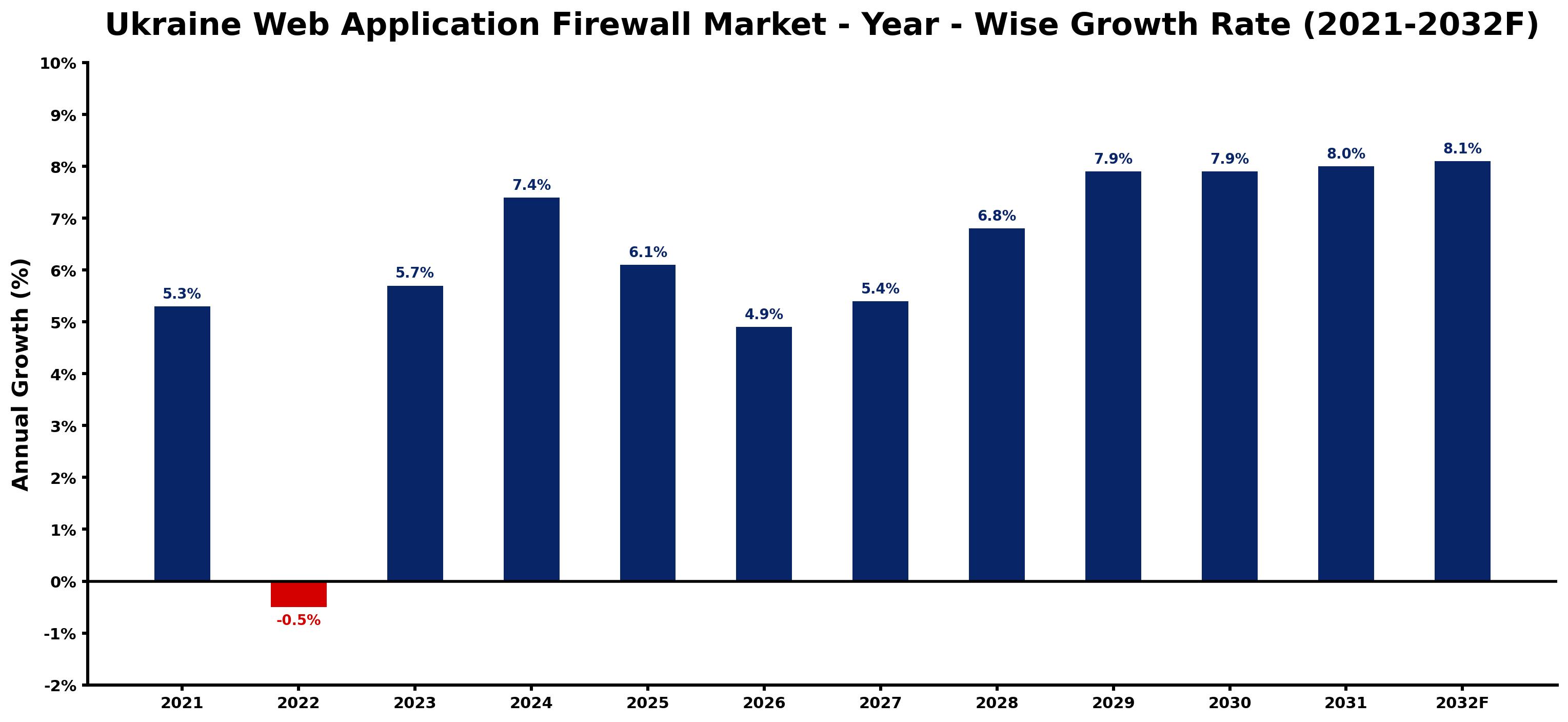
The table below presents the year‑wise growth rates along with the key drivers influencing the market
| Year | Growth Rate | Major Drivers |
| 2021 | 5.3% | Increased cyber threats prompted regulatory focus on data security. |
| 2022 | -0.5% | Ongoing conflict disrupting internet infrastructure development. |
| 2023 | 5.7% | Government initiatives to strengthen IT infrastructure against cyberattacks. |
| 2024 | 7.4% | Growing investment in digital transformation across Ukrainian enterprises. |
| 2025 | 6.1% | Adoption of e-governance spurred WAF demand from public sector. |
| 2026 | 4.9% | Heightened awareness of cybersecurity through national campaigns. |
| 2027 | 5.4% | Digital banking growth necessitated advanced protective measures. |
| 2028 | 6.8% | Expanded remote work culture raised cybersecurity requirements for firms. |
| 2029 | 7.9% | Increased interest in compliance with GDPR among Ukrainian companies. |
| 2030 | 7.9% | Rising foreign investments driving demand for robust web security. |
| 2031 | 8.0% | Local tech startups emphasize data protection in services offered. |
| 2032 | 8.1% | Mature cybersecurity ecosystem fostering competition in WAF solutions. |
Note: Market size estimations and growth projections presented in this report are based on 6Wresearch's proprietary forecasting methodology, utilizing the latest available industry data, government publications, and primary research inputs.
Ukraine Web Application Firewall Market Key Takeaways
Below are some of the specific key takeaways from the market, including:
- The market is gaining traction as organizations face an increasing number of cyber threats.
- Investment in cloud-based WAF solutions is rapidly expanding, with a focus on scalability.
- Innovations integrating AI and machine learning are on the rise, enhancing security measures.
- Compliance with data protection regulations is becoming a key driver for WAF adoption.
- Partnerships between local cybersecurity firms and technology providers are likely to accelerate growth.
Evaluation of Restraints in Ukraine Web Application Firewall Market
Despite the promising prospects for the Ukraine Web Application Firewall market, significant challenges hinder its growth. A primary issue is the widespread lack of awareness surrounding the critical importance of web application security among businesses, resulting in suboptimal adoption rates. Furthermore, many organizations continue to rely on outdated legacy systems that complicate the integration of modern WAF solutions.
The rapidly evolving nature of cyber threats necessitates constant updates and customization of WAF technologies, which can be resource-intensive. Additionally, the scarcity of skilled cybersecurity professionals in Ukraine hampers the effective deployment and management of WAF solutions, restricting overall market potential.
Ukraine Web Application Firewall Market Trends
The trends shaping the Ukraine Web Application Firewall market are compelling. A notable rise in the adoption of cloud-based services is steering organizations to seek WAF solutions that can seamlessly integrate with their existing systems. Companies are increasingly looking for WAFs that not only offer real-time threat analytics but also facilitate compliance with stringent regulations such as GDPR.
Additionally, there is a marked shift toward WAFs that provide flexibility and scalability to meet ever-changing business security needs. As businesses invest more in digital transformation, these trends will continue to define the market and push innovations in WAF technology.
Ukraine Web Application Firewall Market Opportunities
The Ukraine Web Application Firewall market presents noteworthy investment opportunities, particularly as businesses become increasingly aware of cybersecurity risks. The growing frequency of cyberattacks targeting web applications creates a heightened need for effective WAF solutions. Investments directed towards companies developing tailored WAF technologies could yield substantial returns.
Collaborating with local technology providers to offer customizable WAF solutions will also likely prove beneficial, especially in a market that is rapidly maturing. As Ukrainian businesses prioritize cybersecurity, those ready to adapt will find ample opportunities for growth and innovation.
Government Initiatives in the Ukraine Web Application Firewall Market
Government policies in Ukraine play a crucial role in shaping the Web Application Firewall market. The National Security and Defense Council of Ukraine is actively implementing strategies aimed at bolstering the country's cybersecurity framework. This involves promoting the adoption of advanced WAF technologies to mitigate risks and safeguard vital digital assets.
- A national digital infrastructure upgrade programme launched in 2023 focuses on improving cybersecurity across public and private sectors.
- A regulatory framework initiated in 2024 emphasizes the need for businesses to adopt modern WAF solutions to protect against evolving cyber threats.
- Current efforts include a collaborative initiative between government and tech firms aimed at increasing information sharing during cyber incidents.
- Plans for 2025 include the establishment of cybersecurity training programs to develop a skilled workforce in web application security.
- Ongoing public-private partnerships are designed to enhance the overall cybersecurity posture of Ukraine through shared resources and expertise.
Future Insights of the Ukraine Web Application Firewall Market
Looking ahead to 2026-2032, the Ukraine Web Application Firewall market is expected to experience substantial growth driven by continued technological advancements and heightened cybersecurity awareness among organizations. As businesses increasingly recognize the importance of safeguarding sensitive data, the demand for advanced WAF solutions will likely rise.
Stricter data protection regulations will also drive the adoption of WAF technologies, necessitating businesses to stay compliant while protecting their assets. Companies that can offer innovative, adaptable solutions will thrive in this evolving market landscape.
Ukraine Web Application Firewall Market Latest Developments
Recent months have seen a flurry of activity in the Ukraine Web Application Firewall market, with a focus on enhancing security measures amidst rising cyber threats. As organizations prioritize their cybersecurity postures, new initiatives and product offerings have begun to emerge across the sector.
- A major technology vendor introduced a new WAF solution in early 2025, designed to integrate AI for enhanced threat detection capabilities.
- Ongoing partnerships between local cybersecurity firms are expected to lead to innovative WAF offerings that cater to the unique needs of Ukrainian businesses.
- A rollout of a comprehensive training program for cybersecurity professionals is underway, aiming to address the skills gap in the industry by mid-2025.
- Upcoming initiatives include the launch of a public awareness campaign slated for late 2026, focusing on the importance of web application security.
- A regional operator has plans to upgrade existing WAF technologies with advanced analytics features expected to be implemented by early 2026.
Ukraine Web Application Firewall Market - Key Attractiveness of the Report
- 10 Years of Market Numbers
- Historical Data Starting from 2022 to 2025
- Base Year: 2025
- Forecast Data until 2032
- Key Performance Indicators Impacting the Market
- Major Upcoming Developments and Projects
Key Highlights of the Report:
- Ukraine Web Application Firewall Market Outlook
- Market Size of Ukraine Web Application Firewall Market, 2025
- Forecast of Ukraine Web Application Firewall Market, 2032
- Historical Data and Forecast of Ukraine Web Application Firewall Revenues & Volume for the Period 2022-2032F
- Ukraine Web Application Firewall Market Trend Evolution
- Ukraine Web Application Firewall Market Drivers and Challenges
- Ukraine Web Application Firewall Price Trends
- Ukraine Web Application Firewall Porter's Five Forces
- Ukraine Web Application Firewall Industry Life Cycle
- Historical Data and Forecast of Ukraine Web Application Firewall Market Revenues & Volume By Component for the Period 2022-2032F
- Historical Data and Forecast of Ukraine Web Application Firewall Market Revenues & Volume By Solutions (Hardware Appliances, Virtual Appliances, Cloud-Based) for the Period 2022-2032F
- Historical Data and Forecast of Ukraine Web Application Firewall Market Revenues & Volume By Services (Professional and Managed) for the Period 2022-2032F
- Historical Data and Forecast of Ukraine Web Application Firewall Market Revenues & Volume By Organization Size for the Period 2022-2032F
- Historical Data and Forecast of Ukraine Web Application Firewall Market Revenues & Volume By SMEs for the Period 2022-2032F
- Historical Data and Forecast of Ukraine Web Application Firewall Market Revenues & Volume By Large Enterprises for the Period 2022-2032F
- Historical Data and Forecast of Ukraine Web Application Firewall Market Revenues & Volume By Vertical for the Period 2022-2032F
- Historical Data and Forecast of Ukraine Web Application Firewall Market Revenues & Volume By Banking, Financial Services & Insurance for the Period 2022-2032F
- Historical Data and Forecast of Ukraine Web Application Firewall Market Revenues & Volume By Retail for the Period 2022-2032F
- Historical Data and Forecast of Ukraine Web Application Firewall Market Revenues & Volume By IT & Telecommunications for the Period 2022-2032F
- Historical Data and Forecast of Ukraine Web Application Firewall Market Revenues & Volume By Government & Defense for the Period 2022-2032F
- Historical Data and Forecast of Ukraine Web Application Firewall Market Revenues & Volume By Healthcare for the Period 2022-2032F
- Historical Data and Forecast of Ukraine Web Application Firewall Market Revenues & Volume By Energy & Utilities for the Period 2022-2032F
- Historical Data and Forecast of Ukraine Web Application Firewall Market Revenues & Volume By Education for the Period 2022-2032F
- Historical Data and Forecast of Ukraine Web Application Firewall Market Revenues & Volume By Other Verticals for the Period 2022-2032F
- Ukraine Web Application Firewall Import Export Trade Statistics
- Market Opportunity Assessment By Component
- Market Opportunity Assessment By Organization Size
- Market Opportunity Assessment By Vertical
- Ukraine Web Application Firewall Top Companies Market Share
- Ukraine Web Application Firewall Competitive Benchmarking By Technical and Operational Parameters
- Ukraine Web Application Firewall Company Profiles
- Ukraine Web Application Firewall Key Strategic Recommendations






































