United Arab Emirates (UAE) Air Traffic Control Market Size, Share & Growth Rate
The United Arab Emirates (UAE) Air Traffic Control Market was estimated at USD 1240 Million in 2025 and is projected to reach USD 2344 Million by 2032, growing at a CAGR of 9.5% from 2026 to 2032. This robust growth trajectory is propelled by the accelerated expansion of the UAE's aviation sector, where air travel demand is soaring, spurred by tourism and business activities. The ongoing investment in advanced air traffic management systems further underscores the urgency for modernized infrastructure to enhance operational efficiency and safety.
United Arab Emirates (UAE) Air Traffic Control Market Year-wise Growth Rate and Key Drivers
This graph highlights how the United Arab Emirates (UAE) Air Traffic Control Market has steadily grown over the years, supported by major growth factors.
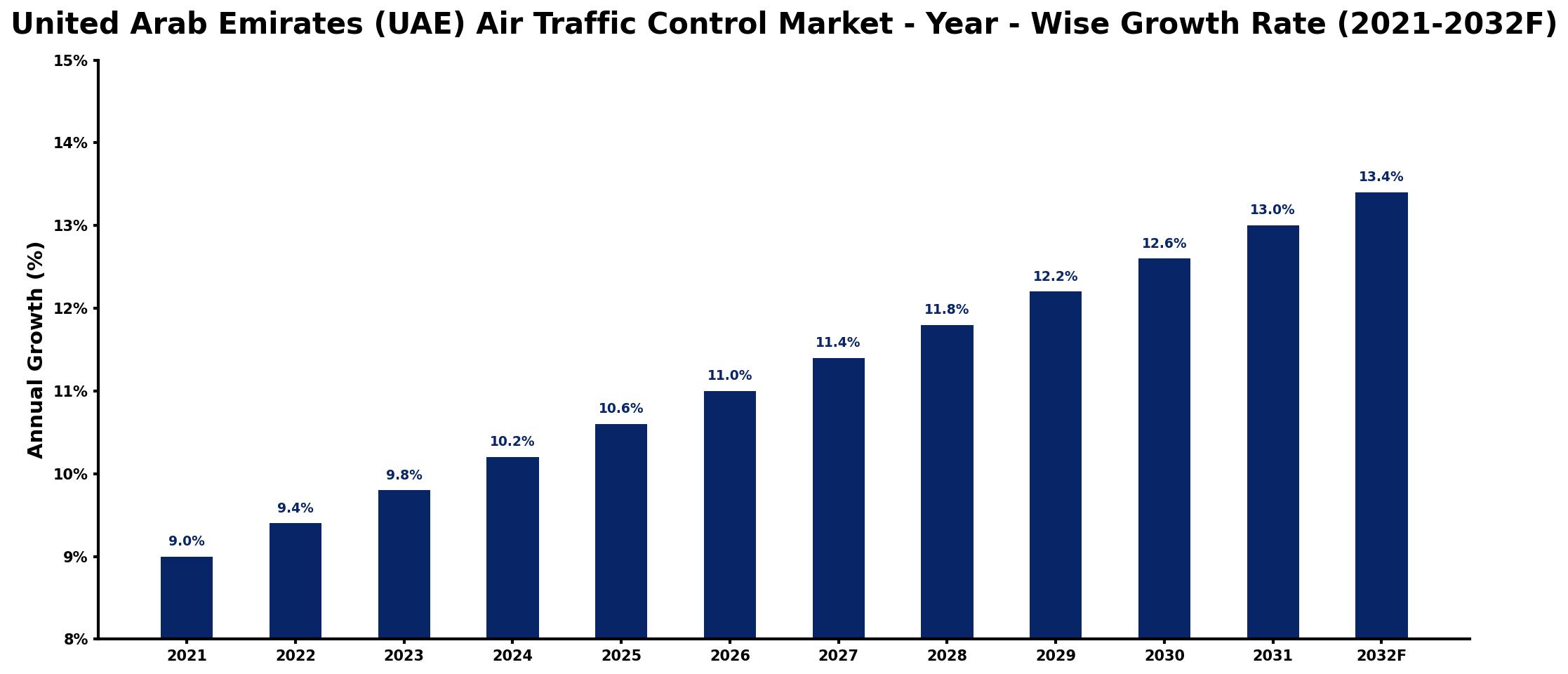
The table below presents the year‑wise growth rates along with the key drivers influencing the market
| Year | Growth Rate | Major Drivers |
| 2021 | 9.0% | Rising international travel demand |
| 2022 | 9.4% | enhanced product quality standards |
| 2023 | 9.8% | Expansion of tourism sector |
| 2024 | 10.2% | Growth in logistics industry |
| 2025 | 10.6% | Technological advancements in aviation |
| 2026 | 11.0% | strengthening underlying market demand |
| 2027 | 11.4% | growing commercial sector adoption |
| 2028 | 11.8% | Surge in cargo volumes |
| 2029 | 12.2% | Emergence of new routes |
| 2030 | 12.6% | Increased public safety regulations |
| 2031 | 13.0% | Higher passenger capacity planning |
| 2032 | 13.4% | Enhanced digital transformation initiatives |
Note: Market size estimations and growth projections presented in this report are based on 6Wresearch's proprietary forecasting methodology, utilizing the latest available industry data, government publications, and primary research inputs.
United Arab Emirates (UAE) Air Traffic Control Market Synopsis
The strongest force shaping the United Arab Emirates (UAE) Air Traffic Control Market is the relentless growth of air traffic, driven by both regional tourism and the UAE's strategic geographical position as a global aviation hub. To support this unprecedented surge, a significant overhaul and enhancement of air traffic management systems are imperative, promoting safety and efficiency in air travel.
Additionally, as the UAE continues to develop new airports and expand existing facilities, the demand for state-of-the-art air traffic control solutions becomes increasingly critical. Addressing the complex challenges posed by environmental factors, such as the harsh desert climate, is essential to ensure sustainable market growth and operational reliability.
United Arab Emirates (UAE) Air Traffic Control Market Key Takeaways
- The market is poised for significant growth, driven by rising air traffic and infrastructure modernization.
- Advanced air traffic management solutions are essential for maintaining safety and efficiency in operations.
- Geopolitical dynamics in the region are influencing air traffic control strategies and investments.
- Environmental factors present ongoing challenges that necessitate innovative solutions in system design and maintenance.
- The impact of COVID-19 has been substantial but has also spurred investment in technology and infrastructure upgrades.
Evaluation of Restraints in United Arab Emirates (UAE) Air Traffic Control Market
Several restraints continue to challenge the United Arab Emirates (UAE) Air Traffic Control Market, particularly as air traffic volume escalates. Increasing congestion in airspace necessitates comprehensive upgrades and the adoption of cutting-edge technologies to mitigate potential safety risks. Furthermore, the region's harsh desert climate requires ongoing maintenance and protective measures, significantly raising operational costs. Lastly, geopolitical tensions have introduced layers of complexity that must be navigated to maintain the reliability of air traffic control systems, which is critical for fostering ongoing growth in the aviation sector.
United Arab Emirates (UAE) Air Traffic Control Market Trends
Emerging trends in the United Arab Emirates (UAE) Air Traffic Control Market include the increased adoption of automated systems designed to improve air traffic management efficiency. These advanced technologies not only streamline operations but also enhance safety protocols, addressing growing airspace congestion. Furthermore, the integration of data analytics and artificial intelligence is revolutionizing decision-making processes, providing insights for predictive maintenance and operational excellence.
Moreover, sustainability is becoming a focal point, with an emphasis on developing environmentally-friendly air traffic control systems that align with global sustainability goals. These trends signal a shift toward a more efficient and responsive air traffic management framework capable of supporting the future demands of the aviation industry.
United Arab Emirates (UAE) Air Traffic Control Market Opportunities
The United Arab Emirates (UAE) Air Traffic Control Market presents considerable growth and investment opportunities, particularly in technological innovations and system enhancements. The ongoing infrastructure development projects provide a fertile ground for new entrants and established players alike to collaborate on cutting-edge solutions tailored to the unique demands of the UAE's aviation landscape. With a focus on safety and efficiency, there is ample scope for investments in automation and real-time data analytics to optimize air traffic operations.
Additionally, as the UAE positions itself as a global aviation hub, partnerships with international stakeholders can facilitate knowledge transfer and access to state-of-the-art technologies, further enhancing the region's air traffic control capabilities.
Government Initiatives in the United Arab Emirates (UAE) Air Traffic Control Market
The UAE government plays a vital role in shaping the air traffic control landscape through strategic policies and initiatives aimed at modernizing aviation infrastructure. Substantial public spending is directed toward enhancing airport facilities and air traffic management systems, ensuring that they meet the growing demands of the aviation sector. Programs designed to promote technological advancements in air traffic control are being prioritized, alongside incentives for companies investing in innovative solutions. This commitment to modernization reinforces the UAEs position as a leading player in global aviation.
Future Insights of the United Arab Emirates (UAE) Air Traffic Control Market
Looking ahead to 2026-2032, the United Arab Emirates (UAE) Air Traffic Control Market is expected to continue its robust growth trajectory, supported by ongoing investments in advanced technologies and infrastructure. As air traffic volumes rise, the emphasis will be on developing sophisticated, integrated systems that enhance safety and operational efficiency. Additionally, the market will likely see a greater push towards sustainability, as stakeholders increasingly seek environmentally friendly practices within air traffic management.
The combination of technological advancements and a proactive government approach is anticipated to ensure that the UAE remains at the forefront of global aviation, solidifying its status as a premier air travel destination.
United Arab Emirates (UAE) Air Traffic Control Market Latest Developments (2025 - 2026)
In recent months, the United Arab Emirates (UAE) Air Traffic Control Market has witnessed a notable shift toward enhancing digital infrastructure. This includes initiatives focused on the integration of artificial intelligence to improve real-time data processing capabilities and overall system responsiveness. Additionally, there is a concerted effort to upgrade existing air traffic control systems to address increasing air traffic demands and ensure operational resilience. The industry is also aligning with global best practices, fostering collaborations to boost the adoption of innovative technologies.
United Arab Emirates (UAE) Air Traffic Control Market - Key Attractiveness of the Report
- 10 Years of Market Numbers
- Historical Data Starting from 2022 to 2025
- Base Year: 2025
- Forecast Data until 2032
- Key Performance Indicators Impacting the Market
- Major Upcoming Developments and Projects
Key Highlights of the Report:
- United Arab Emirates (UAE) Air Traffic Control Market Outlook
- Market Size of United Arab Emirates (UAE) Air Traffic Control Market, 2025
- Forecast of United Arab Emirates (UAE) Air Traffic Control Market, 2032
- Historical Data and Forecast of United Arab Emirates (UAE) Air Traffic Control Revenues & Volume for the Period 2022-2032F
- United Arab Emirates (UAE) Air Traffic Control Market Trend Evolution
- United Arab Emirates (UAE) Air Traffic Control Market Drivers and Challenges
- United Arab Emirates (UAE) Air Traffic Control Price Trends
- United Arab Emirates (UAE) Air Traffic Control Porter's Five Forces
- United Arab Emirates (UAE) Air Traffic Control Industry Life Cycle
- Historical Data and Forecast of United Arab Emirates (UAE) Air Traffic Control Market Revenues & Volume By Airspace for the Period 2022-2032F
- Historical Data and Forecast of United Arab Emirates (UAE) Air Traffic Control Market Revenues & Volume By Air Route Traffic Control Centers for the Period 2022-2032F
- Historical Data and Forecast of United Arab Emirates (UAE) Air Traffic Control Market Revenues & Volume By Terminal Radar Approach Control for the Period 2022-2032F
- Historical Data and Forecast of United Arab Emirates (UAE) Air Traffic Control Market Revenues & Volume By Air Traffic Control Tower for the Period 2022-2032F
- Historical Data and Forecast of United Arab Emirates (UAE) Air Traffic Control Market Revenues & Volume By Remote Tower for the Period 2022-2032F
- Historical Data and Forecast of United Arab Emirates (UAE) Air Traffic Control Market Revenues & Volume By Application for the Period 2022-2032F
- Historical Data and Forecast of United Arab Emirates (UAE) Air Traffic Control Market Revenues & Volume By Communication for the Period 2022-2032F
- Historical Data and Forecast of United Arab Emirates (UAE) Air Traffic Control Market Revenues & Volume By Navigation for the Period 2022-2032F
- Historical Data and Forecast of United Arab Emirates (UAE) Air Traffic Control Market Revenues & Volume By Surveillance for the Period 2022-2032F
- Historical Data and Forecast of United Arab Emirates (UAE) Air Traffic Control Market Revenues & Volume By Automation for the Period 2022-2032F
- Historical Data and Forecast of United Arab Emirates (UAE) Air Traffic Control Market Revenues & Volume By Offerings for the Period 2022-2032F
- Historical Data and Forecast of United Arab Emirates (UAE) Air Traffic Control Market Revenues & Volume By Hardware for the Period 2022-2032F
- Historical Data and Forecast of United Arab Emirates (UAE) Air Traffic Control Market Revenues & Volume By Software & Solutions for the Period 2022-2032F
- Historical Data and Forecast of United Arab Emirates (UAE) Air Traffic Control Market Revenues & Volume By Services for the Period 2022-2032F
- Historical Data and Forecast of United Arab Emirates (UAE) Air Traffic Control Market Revenues & Volume By Airport Size for the Period 2022-2032F
- Historical Data and Forecast of United Arab Emirates (UAE) Air Traffic Control Market Revenues & Volume By Large for the Period 2022-2032F
- Historical Data and Forecast of United Arab Emirates (UAE) Air Traffic Control Market Revenues & Volume By Medium for the Period 2022-2032F
- Historical Data and Forecast of United Arab Emirates (UAE) Air Traffic Control Market Revenues & Volume By Small for the Period 2022-2032F
- Historical Data and Forecast of United Arab Emirates (UAE) Air Traffic Control Market Revenues & Volume By Sector for the Period 2022-2032F
- Historical Data and Forecast of United Arab Emirates (UAE) Air Traffic Control Market Revenues & Volume By Commercial for the Period 2022-2032F
- Historical Data and Forecast of United Arab Emirates (UAE) Air Traffic Control Market Revenues & Volume By Military & Defense for the Period 2022-2032F
- United Arab Emirates (UAE) Air Traffic Control Import Export Trade Statistics
- Market Opportunity Assessment By Airspace
- Market Opportunity Assessment By Application
- Market Opportunity Assessment By Offerings
- Market Opportunity Assessment By Airport Size
- Market Opportunity Assessment By Sector
- United Arab Emirates (UAE) Air Traffic Control Top Companies Market Share
- United Arab Emirates (UAE) Air Traffic Control Competitive Benchmarking By Technical and Operational Parameters
- United Arab Emirates (UAE) Air Traffic Control Company Profiles
- United Arab Emirates (UAE) Air Traffic Control Key Strategic Recommendations






































